Family and Friends
War Is Not Theoretical
A foreigner living in Ukraine reflects on daily life amid conflict.
August 8, 2026
Try 3 months of unlimited access. Start your FREE TRIAL today. Cancel anytime.
START FREE TRIAL NOWWar Is Not Theoretical
A foreigner living in Ukraine reflects on daily life amid conflict.
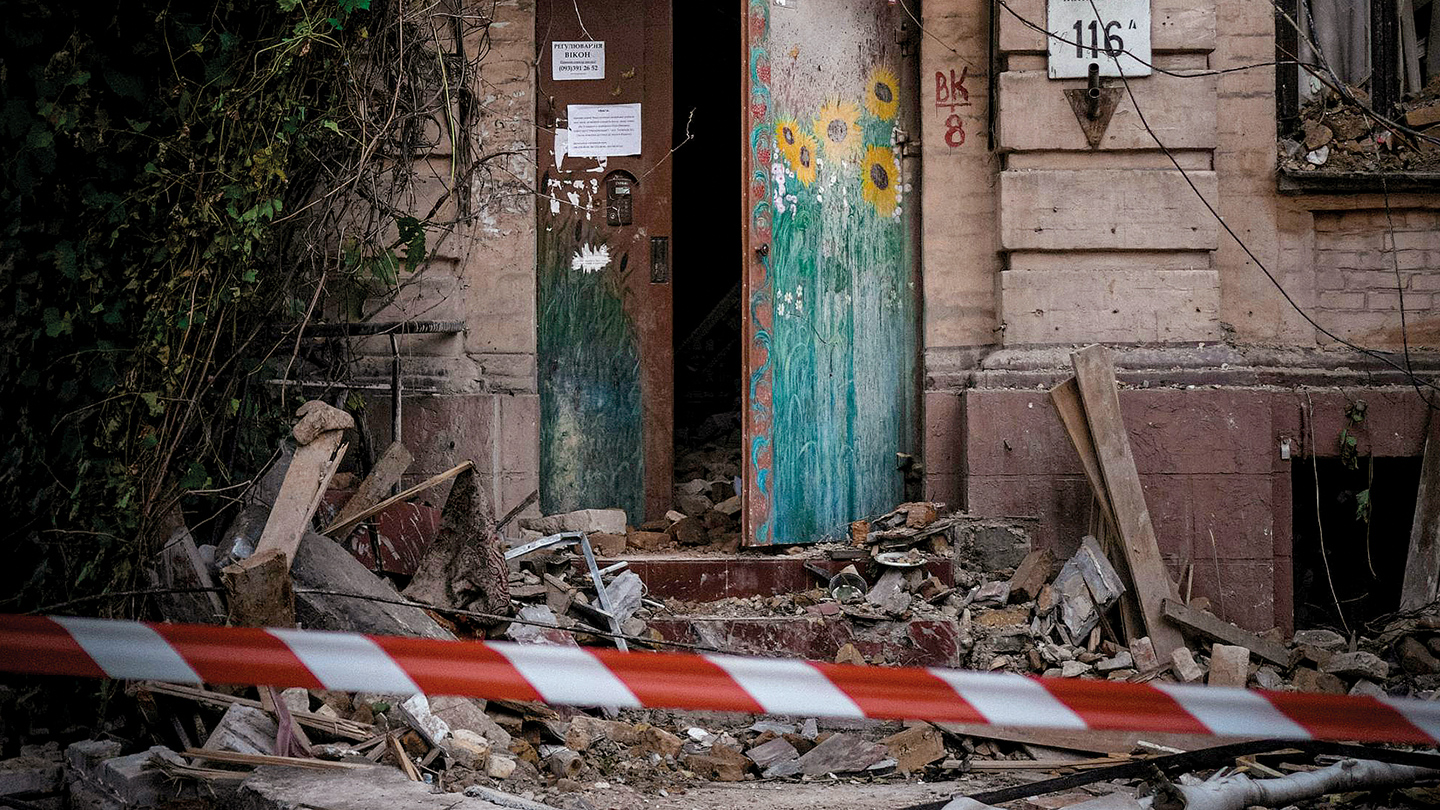
A building damaged by an explosion in Kyiv, Ukraine. [.smalltext]Photograph by Ales Ustinau / Pexels. Used by permission.[.smalltext]
[.small-caps]2:37 a.m.: A loud explosion[.small-caps] somewhere to the north yanked me out of sleep. I lay still and listened. There is this math you run in the middle of the night in Kyiv: distance, direction, what kind of weapon. Then you decide if you have to move. I didn’t. My village is relatively safe.
I fell back asleep. By morning, the whole sky was covered in smoke. Kyiv was burning.
The news told the story: Russia had launched 703 missiles and drones at sleeping Ukrainian cities, killing at least sixteen civilians across the country and injuring ninety-eight. Four of those dead were in Kyiv, including a twelve-year-old boy, and more than sixty people were injured in the capital alone.
By 7:00 a.m. I was getting ready to head into the city center. I had an appointment at the German consulate to renew my passport, which I had accidentally let expire.
If you want to understand Ukraine and Ukrainians, ride the metro the morning after a large attack. It was packed. Everyone headed somewhere to carry on like nothing had happened, except of course, something had happened. I couldn’t stop noticing people’s faces. They looked tired. Not merely “the explosions last night kept me awake” tired, but more “this has been going on for four years; when will it end?” tired.
One babushka sat, hands folded over her handbag, head nodding, as she tried to stay awake. A man in construction gear stood near the doors looking blankly across the carriage as if it had taken everything he had just to get up for another day. Kids on their way to school scrolled their phones, thumbs moving, eyes heavy. There was no complaining.
I got off at my stop and walked to the consulate through streets that were busy and perfectly ordinary, except for the smoke still hanging in the air.
I am a foreigner here, which means part of my life in Ukraine is still made up of very foreigner things: passports, residency paperwork, embassies, stamps, translations, and the constant need to explain to people why I am here. I came in January 2024 to work with the Novi Community, a humanitarian organization focused on restoring childhoods disrupted by war. I have lived on the outskirts of Kyiv since then.
This work has taken me across Ukraine: to Kherson, building playgrounds under direct fire from Russian forces; to Kharkiv, running programs for children carrying stress no child should have to carry, among entire city blocks that had been destroyed; to Druzhkivka, Donetsk Oblast, teaching English at a children’s summer camp about nine miles from the fighting and where we sometimes had to drop everything and run inside because FPV drones were nearby. It has also taken me to the Carpathian Mountains, to Lviv, to small villages, schools, churches, and shelters most people will never hear about.
All this does not make me Ukrainian. It does not make their grief and suffering mine. But it does make the war less theoretical and a lot more personal. It turns headlines and numbers into people, villages, classrooms, playgrounds, roads, and names.
After my appointment, I returned to Khotiv, the village where I live. It’s a small village, suburban and green, bordering Kyiv, so it provides convenient access to the city without the hustle and rush of city life. I was walking to Fora, the local grocery store, when I heard police sirens and noticed people around me stopping.
A funeral procession was moving down the main street toward the cemetery. It was a local man, killed in action at the front. I did not know him or his name. The procession was made up of family, friends, and fellow service members. As it approached, every person on the street stopped what he or she was doing. Shoppers, workers, the mother with a baby in the stroller, the old man who sweeps the sidewalk clear. Then, one by one, they dropped to one knee. I did the same.
This gesture never gets easier to witness. It happens across the country, in cities and villages, whenever a father, brother, son, or sometimes daughter is brought home to lay to rest. It happens without discussion, unorganized, unenforced. The sirens come, the cars approach, and the streets understand what to do.
This man’s death did not belong only to his family. It belonged to his village. It belonged to his country. And in a smaller, borrowed way, because I have chosen to stay and live and serve among the people carrying this war, it belonged to me too.
The procession passed, and people stood back up. The mother adjusted her stroller. The old man started sweeping again. I carried on toward the grocery store.
You can tell how much a Ukrainian village has suffered by driving down the main road. In almost every village, portraits of the local fallen line the road. Photographs. Real faces. Looking out at the village they called home. Here in Khotiv, there are about twenty lining the highway by the school. It’s a lot for a village this size. I walk past them nearly every day, and I always look. Brave, happy, smiling –faces from before the war. Many are family men in their thirties or forties. Some are younger, in their late teens and twenties. All of them have people here who miss them and loved them – who still love them. This is what staying shows you.
I headed home. Tomorrow will have its own alerts.