The Doers
A Car Is Not a Home
Christians are finding creative ways to serve their unhoused neighbors. Does the biblical vision of home and hospitality demand more of us?
July 27, 2026
Try 3 months of unlimited access. Start your FREE TRIAL today. Cancel anytime.
START FREE TRIAL NOWA Car Is Not a Home
Christians are finding creative ways to serve their unhoused neighbors. Does the biblical vision of home and hospitality demand more of us?
All photographs by Dennis Radermacher. Used by permission.
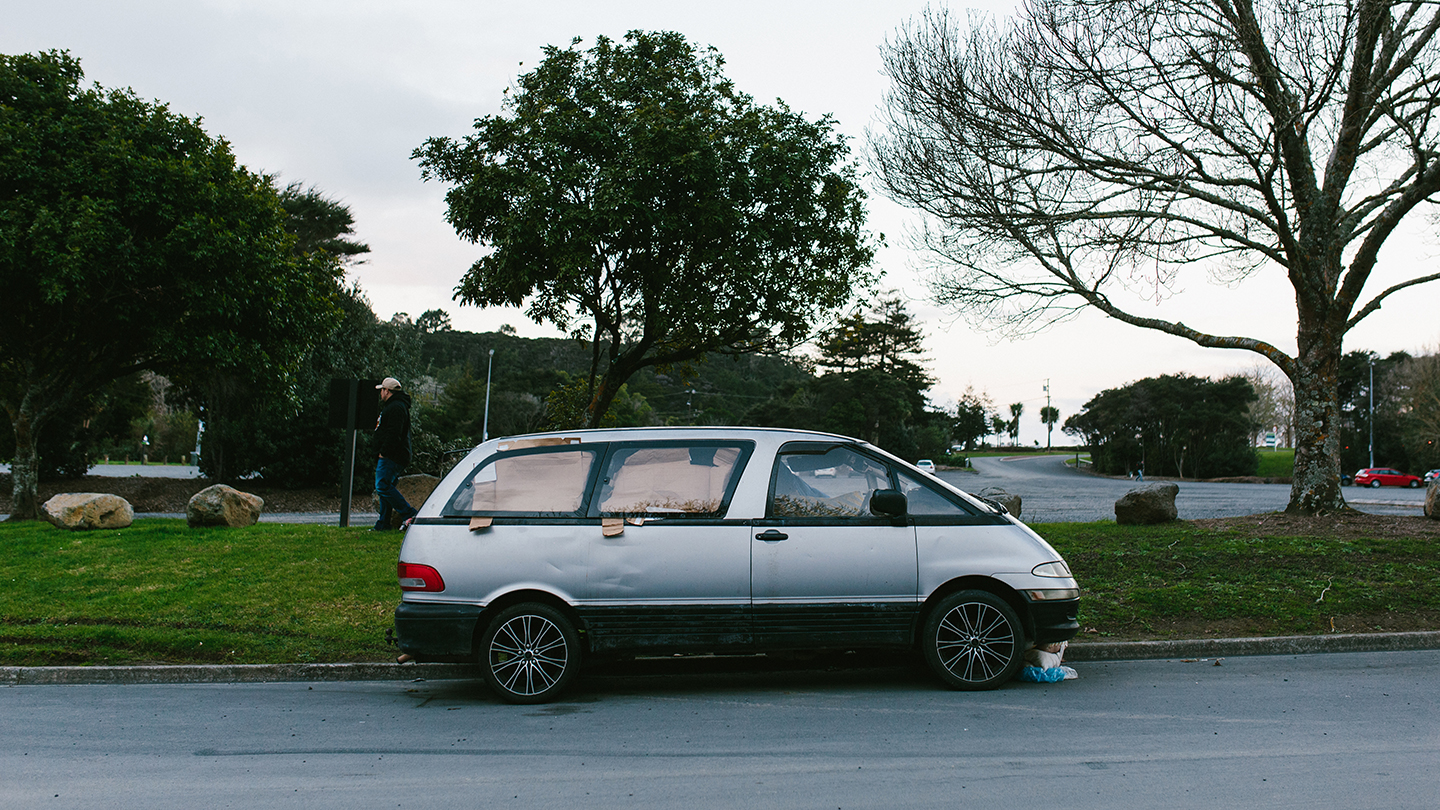
[.article__paragraph--cap][.small-caps]Wayne parks his car[.small-caps] outside a community church in Wellington, New Zealand’s capital city. It’s his usual nightly practice. He has been living in his car for months now. He has a job. He’s paid his taxes. He’s done everything we tell people to do. He simply cannot find anywhere to live that he can afford.[.article__paragraph--cap]
My friend Nick sat with Wayne, both listening to the cold southerly wind slam into the waves and rattling the windows of the car. Wayne did not ask about housing policy or which political party was responsible for his situation. Instead, as he looked at the line of cars, each one holding a person trying to sleep, he asked a more profound question: “If God sees all of this, is he actually good?”
I have been building houses and communities for nearly two decades. Together with my wife, Jessica, I cofounded the Home Foundation Group, which partners with communities, churches, and the government to design and build affordable housing, undertake research, and advocate for systemic change. The housing crisis is not unique to New Zealand, but I can tell you it is real here, and it is not going away.

[.article__paragraph--cap][.small-caps]The longer I do[.small-caps] this work, however, the more convinced I become that the crisis we are not talking about is the one inside the institutional church itself. Christians do not have an adequate theology of housing. We have charity and compassion. We have food banks and homeless shelters and occasionally a church that converts a parish hall into temporary housing. All of these are good, but none of them is sufficient, because without a theological vision for housing, the church cannot explain why housing matters. And if we cannot explain that, we will keep treating our unhoused neighbors as someone else’s problem that we feel moved to help with occasionally.[.article__paragraph--cap]
As a consequence, we make two mistakes. The first treats housing as a precondition for the real spiritual work: Get people sheltered, then evangelize them. Roof first, “kingdom” second. Housing becomes a steppingstone to those things we think actually matter to God.
The second mistake is subtler: we spiritualize the language of home until material conditions become of no importance. Christ is our dwelling, we say, and Scripture points toward the day when God will make his home among us for good. Beautiful and true, yet apparently useless to the man sleeping in his car in the church parking lot.
Both errors share the same root. They divide our humanity in two, assigning the body to the state or market and the soul to the church. But the God who took on our full humanity will not allow it, and neither should we.
God took on flesh, not as a metaphor for solidarity, but as an act of love. God the Son entered into creaturely life in all its fullness: born in a particular place, sheltered under a particular roof, formed by the rhythms of a particular household. Therefore, where people live and whether they can dwell in safety and dignity is not a question adjacent to the gospel.

The early church understood this. At Chalcedon in AD 451, the church confessed that Christ’s divine and human natures exist “without confusion . . ., without separation.” That confession is not merely convenient doctrinal grammar to be filed away as theological housekeeping. It gives us a way of understanding how our creaturely work relates to God’s ultimate purpose without confusing our work with God’s. By building and dwelling together, we can genuinely participate in the redemption Christ has brought about, without ever confusing our work with salvation itself. We cannot build the kingdom out of plywood and concrete. But neither are we merely marking time until it arrives.
This means housing belongs to what Dietrich Bonhoeffer, called “the penultimate.” Neither ultimate, nor irrelevant, the penultimate creates a space where the church’s confession is either embodied or shown to be empty.
[.article__paragraph--cap][.small-caps]If housing sits inside[.small-caps] the gospel rather than alongside it, a number of things should follow that we often conveniently avoid thinking about or addressing. It means we have to speak truthfully about land. “The earth is the Lord’s, and the fulness thereof.” the psalmist insists (Ps. 24), while Leviticus is more blunt: “The land shall not be sold in perpetuity, for the land is mine” (25:23). Land is a gift, not a commodity for our willful use. But truthful speech demands more than quoting Scripture: it demands that we name current reality and act accordingly. In my own country, Māori communities were stripped of their land through confiscation and legislative theft – sometimes by churches – and the effects continue to show up in every housing statistic we produce. The Baptist theologian Willie James Jennings warns that Christianity has too often imagined itself “floating above land,” relegating material place to the logic of capital markets. A theology of housing that does not acknowledge the dispossession of people from place in our colonial history or through contemporary systemic injustice is not yet truthful. And an untruthful theology cannot intentionally build anything worth living in.[.article__paragraph--cap]
And I need to be honest about something closer to home. Even among well-meaning organizations, the logic of extracting “market-rate” returns on capital deployed into housing is common. This practice is justified, proponents argue, because those returns often fund church activities, missions, or charitable work elsewhere. But every dollar of market-rate return is another dollar paid by the tenant whose precarity prompted the project in the first place, as though the kingdom of God can be built on the backs of the vulnerable, as though you can separate the ends from the means and still call the result Christian. Christ himself refuses this logic in the wilderness. When the devil offers him all the kingdoms of the world through a single act of worship, a shortcut to every good outcome imaginable, Jesus responds with an emphatic no. In our work, the ends cannot justify the means, because the means inevitably shape what the ends become.

All this means that what we build and how we build it actually matters – not just structurally, but theologically. How we approach land, what designs we use to create neighborhoods, and how we treat the workers who build them can cultivate community or fracture it. Every shared green space, every threshold, every kitchen large enough for the neighbor’s children to sit around the table shapes the kind of life possible within those walls.
Every time a Christian community opens a dwelling to someone who has been excluded from dwelling, they both participate in the radical divine pattern. Not simply as charity, but as divine recognition. The person who cannot find shelter is not a problem to be managed, but a neighbor God has acknowledged and invites us to know. The act of opening a door, of saying “there is room,” is not peripheral to the Christian confession, but is the confession made visible.
The welcoming threshold of a dwelling is where theology becomes concrete. It is the place where strangers become neighbors, exclusion gives way to belonging, and the gospel is shown to be true. A home that cannot welcome is not properly a home, regardless of its design, or its affordability, or its energy efficiency. And a church that preaches the God who dwells with humanity while doing nothing about the humans who cannot dwell, has ceased to perform the very confession it speaks.
This is what distinguishes a Christian vision of housing from market logic or mere social provision. We do not simply build for people: we build with them, to live with them. Some communities of faith have known this for generations, choosing shared life and dwelling as a form of witness. When we build and open what has been built so that it creates community, we participate in that good news.
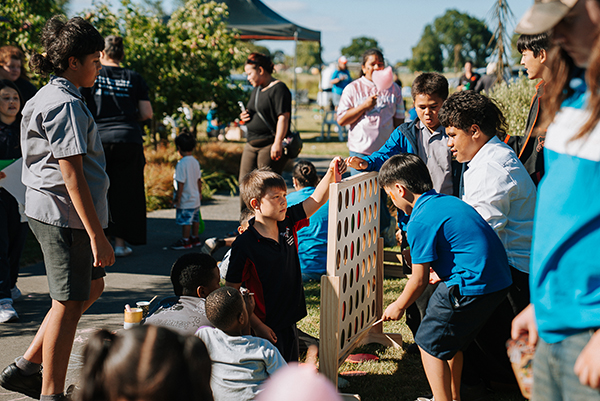
[.article__paragraph--cap][.small-caps]I often think about[.small-caps] Wayne in the church car park in Wellington. I think about his question. I also think about a family who recently moved into one of our developments after years of homelessness. The mother stood in her new kitchen, ran her hand along the counter, and said something that has stayed with me: “This is the first time my children have had a place to invite their friends.”[.article__paragraph--cap]
She was not only talking about square footage or storage or lighting features. She was talking about a door that could finally open outward. A place where her children could be known, where her child could say to a friend, for the first time: “Come in.”
That is not just good social policy. It is a foretaste of the city of God. Partial, provisional, and penultimate, but real and significant in all its materiality. The New Jerusalem descends from heaven as a gift, Scripture tells us. We cannot build that city ourselves, but we can stop pretending it has nothing to do with the neighborhoods and cities we are building today.
Does God care about where people dwell? I have sat with Wayne’s question for a long time. The answer, I have come to believe, is that God cares about this far more than we do.