Podcast
Why Baseball Is the Most Sublime of Sports
On the latest episode of Another Life podcast, David Bentley Hart convinces Joy of the transcendent beauty of baseball.
August 11, 2026
Try 3 months of unlimited access. Start your FREE TRIAL today. Cancel anytime.
START FREE TRIAL NOWWhy Baseball Is the Most Sublime of Sports
On the latest episode of Another Life podcast, David Bentley Hart convinces Joy of the transcendent beauty of baseball.
[You can listen to this episode of Another Life on Apple, Spotify, Amazon Music, or wherever you get your podcasts.]
Joy Marie Clarkson: Welcome to Another Life, a podcast of Plough Quarterly. I’m your host, Joy Clarkson, and this is an episode in our series, Searching for the Soul of America. In this series, we embark on a hopeful search for what is good, admirable, and even providential in the American project.
On this episode, I speak with David Bentley Hart. David Bentley Hart is many things: a scholar of religion, a cultural critic, an essayist, a novelist, a provocateur, but perhaps most fundamentally of all, a lover of America’s favorite pastime, baseball. In this episode, we talk about baseball as a spiritual practice capable of bearing the full weight of America’s need for the sacred integration of personal, historical, mythic, and timeless memory. This episode is for lovers of that esteemed American pastime, but also for those interested in the question of being; Heidegger and thrownness; the Pythagorean mysteries; and which teams, home runs, and players are most poetic and their Homeric glory. From Homer to home runs, our conversation covered all the bases. I hope that you will enjoy this episode of Another Life.
Well, thank you so much for joining us today, David. It’s wonderful to have you on Another Life, a podcast of Plough Quarterly.
David Bentley Hart: Well, thanks for having me.
Joy Marie Clarkson: So I always begin by asking people where they are in the world physically, since my guests tend to be from all over. I am in my flat in East London. It is an oppressively humid day, but we count our blessings because we don’t get that much summer, so we might as well enjoy it while we can. Where are you?
David Bentley Hart: Well I’m in South Bend, Indiana, where I’ve been for about a decade now, and the weather here was oppressively hot until yesterday. I of course lived for many years in England and I still can’t get used to hot summers in England when I encounter them.
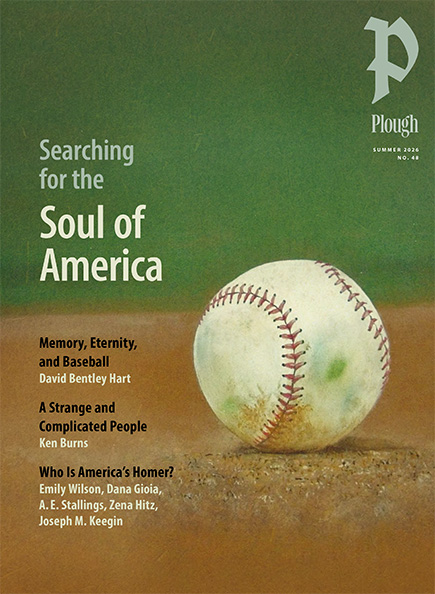
Joy Marie Clarkson: Yes, well I’m glad to hear that you have some sympathy in that regard. Today we are going to have the pleasure of talking about a rather fun topic, I think, but also a profound one, which you addressed in the pages of our recent issue Searching for the Soul of America. And that is America’s favorite pastime – at least so we’re told – which is baseball. And I thought I would also tell you that interestingly, the interview that will come just before this one was with Ken Burns, the filmmaker. And sort of out of nowhere, he burst forth with this monologue about how baseball was both indicative of America’s spirit, but also the greatest sport in the world. So unintentionally, baseball has become a recurring theme throughout this issue, and your piece tied together those themes rather well. But could you begin by telling us a bit about where your love for baseball began?
David Bentley Hart: Well, you know, now that’s stroking the mystic chords of memory. I was the youngest child in the family, so I can’t remember a period before I was introduced to the game. Also – my family’s from Maryland – that was a great era to be an Orioles fan. I mean there were twenty years in which the Orioles were sort of the gold standard franchise in the game, in which they won more games than any other team. They won more gold gloves, lots of Cy Young winners – you know, it was wonderful.
So I grew up under the impression that the Orioles had been touched by God and could never, never know a losing season. But you know, baseball has an interesting history in Maryland, because the old National League Orioles that came into being in the 1880s are by common consent the first, well, what is now called a dynasty, but with the exception of the live ball era emphasis on the home run, they did much to create the modern game. And so there was always a sort of a local mythology associated with baseball going way back to the days of Wee Willy Keeler, one of the great hitters in the history of the game. The Orioles in those days were, most would say, especially from 1969 to ’71, one of the most impressive teams ever assembled – top twelve or fifteen in the history of the game. So it was a joyous time. The period of tribulation came later, but by then I was hooked.
Joy Marie Clarkson: Hmm. I think it’s interesting to ask about when one’s origin of interest for baseball begins, that being something that’s not easily remembered; because of course your piece is very much about memory. And I will confess I was a little nervous about this interview, because my affection for baseball is there, but my knowledge is not very great. And yet it’s always been a part of the imaginative memory of my childhood, because I grew up partially in Texas, a many-generation Texan family. So some of my earliest memories were of my brothers being excited to go to Texas Rangers games. And for some Christmas they were given Texas Rangers outfits, of which we have pictures somewhere in the depths of family photo albums. I also remember growing up with things like the great collection of American poetry that I was invited to read as a child. It had “Casey at the Bat.” Did you ever read that poem?
David Bentley Hart: No, never heard of it. Yes. And I’m old enough that it was actually still standard reading for children when I was in school. But we understand, of course, that it is the American Iliad. Some people will say that that Melville was our Homer: but no, Moby Dick, for all its greatness, I think takes second place to “Casey at the Bat.” It captures – you do know that “Casey at the Bat” actually was written about the nineteenth-century iteration of the Orioles. Or are you not aware of that? Mudville is actually a name for Baltimore.
Joy Marie Clarkson: I did not know that. There you go.
David Bentley Hart: Yes. So the mighty Casey is the hometown hero where I’m from.
Joy Marie Clarkson: Amazing. I grew up with that, and I was just rereading it before we had our conversation today. And it is just an excellently written sucker punch of a poem, which I enjoyed very much as a child. And I also remember growing up reading The Chosen by Chaim Potok, which is I know about other things, and it is about religion; but in my mind it was principally about baseball.
David Bentley Hart: Yeah, I’m not getting the distinction you’re drawing there; religion and baseball.
Joy Marie Clarkson: Well, that leads to my next question. In this article you write about the human need for the ability to integrate our personal memory with cosmic memory. I’m probably putting this poorly, but you have this wonderful claim near the beginning where you say that baseball is capable of bearing the full weight of a people’s need for the sacred integration of the personal, historical, mythic, and timeless memory. And you say this is specifically for America, which has its propensity to cannibalize religious traditions. So can you tell us what about baseball makes it able to bear this burden?
David Bentley Hart: Now you don’t think I overstated things in the article, do you?
Joy Marie Clarkson: No, I thought it was completely sincere and very levelheaded the whole time.
David Bentley Hart: It was completely sincere. I don’t know if it was levelheaded. I mean, you know, sacred ecstasy is also part of religious experience. Getting past the facetious aspects of the article, you know, it’s written in a high oration style right up to the last paragraph. But it is, of course, the oldest of our native organized sports. And that in itself it is something that carries with it a weight of historical memory that the other games don’t. I think I mentioned in the article that racial divisions in society were progressively eroded but not yet fully overcome. Even before the integration of the major leagues there’s the whole rich history of Negro League Baseball which is as much part of the spiritual as material history of the country, you know – at once a reproach against the injustices of our society, but also a festive reminder of what a community of festive sharing and joy could look like.
It’s a pastoral sport. It’s grounded in something very different from the sort of martial and oddly urban – I don’t know how else to put it – nature of American football, which I will watch out of out of loyalty to blood and soil when you know the Ravens are on, but compared to baseball, it’s like bad pop music compared to Bach, or checkers compared to chess. But more than that, I mean for me, part of the special power of baseball at the mythic level is twofold. One is that it really is not a team sport in the sense of massed fields of force colliding and trying to get past one another, as many of the games that are played on an oblong are – what I call the oblong game – especially American football. But it always in any given moment has this sort of heroic dimension. It’s the lone batter facing the lone pitcher, the fielder on his own going for the ball. But then, more than that, it has a timelessness to it, not just in the emotional sense that it has not, for all the changes in the game and the technology now used, conspicuously altered in its logic and its more conspicuous beauty since the nineteenth century. But it also literally is timeless. It is not played on the clock.
As much as I love Japanese baseball culture, I don’t approve of the willingness to settle for a tie. I think that baseball of its nature bears the eternal, even though it can’t really embody it. It has a sacramental openness that that isn’t bound to the clock. And so both the long memory it cultivates and the openness to the possibility, the conceptual possibility of an eternal game, is part of its strange mystery. You really don’t know if it’s gonna be two and a half hours at the park or two and a half days. And also one last thing – the mythic forces, the spatial configurations of the game. It’s not between two fields of force each trying to penetrate the other’s territory. We’re all trying to take command of the same infinite openness – not to take command of it but to flourish. So I think it just has poetic and mythic dimensions that the more martial and geometrically monotonous sports don’t.
Joy Marie Clarkson: Hm. Yes. something that Ken Burns told me, which I have not verified, is that also every field is slightly different. So no field is exactly the same as another. And there’s something I think interesting about that as well.
David Bentley Hart: Yeah, I mean, there are other games of which that’s true, like cricket, although the pitch is uniform just as the diamond is uniform in baseball. I actually quite like cricket, although the lack of the board game at the middle of the field, you know, advancing the runners, trying to thwart their advance, to me makes it ultimately a less interesting game tactically. And athletically it’s not as beautiful, but it has been for several decades getting more graceful and athletic. But yeah, every baseball field has different outfield dimensions, and there are other, subtler differences, like the height of the grass and things like that, or the surface. Playing the game in Fenway is very different from playing it anywhere else. That’s an obvious example, or Yankees Stadium, to talk about one of the corners of hell, has that ridiculous right field porch, you know, and that’s just vulgar and meretricious, but that’s the way the Yankees are. But for the most part it’s a beautiful diversity.
Joy Marie Clarkson: Mm. Yes. And I think that the game is both in principle timeless, but can also be timeless in the experience of going to a game. Because I did go to a few games as a child, and I remember the marathon sense that one had, and one thought about when one was going to get a hot dog and when one was going to get ice cream because you didn’t know how long it was going to last, you know.
David Bentley Hart: Well, I would say going to get a crab cake, but you know, it’s different in different regions.
Joy Marie Clarkson: Yeah. Different regions, yes. I have very vivid memory of getting Dots, which were the flash frozen ice cream, in a baseball hat bowl, and that being very exciting for me as a nine-year old, though I don’t particularly like Dots. But there’s something about that as well that just invites you out of, to put it in terms that are perhaps overused, the mechanistic secular time into this potential for eternity. And it just enters you into a different space than some of the other sports do, I think.
David Bentley Hart: I’ll also point out, since we’re talking about time, that there’s a plasticity to time in baseball, not just in the sense that you really don’t have a fixed limit on the clock. People who don’t understand the game speak as if there were longer periods in it in which nothing is happening. This isn’t true, because at any moment, if you know the game, you see the positioning of the fielders from pitch to pitch. I mean, every pitch is a very particular decision, how you’re trying to defend against it, what the situation on the bases are. But you’ll notice that American football is a game, unless it goes into overtime, which can only be ten minutes now, is simply an hour on the clock that takes three and a half hours to play.
So, I mean, there’s more dead time if you watch a football game. If you were new to the sport, you might get the impression that most of the action consists in throwing penalty flags, and that this constant flow of fluttering yellow bits of rag is only occasionally interrupted by episodes of blunt force trauma. You know it in terms of the content of time.
So every minute in baseball is so much richer, even if it requires a certain subtlety of discernment to recognize it, so much richer than an entire football game which manages to extend what is really a very limited scope of action over an enormous period of dead time. But I don’t mean to be invidious. Let’s just stick with baseball.
Joy Marie Clarkson: I know. I was going to say I was wondering whether (as we record this the World Cup is ongoing) and I was wondering whether you follow it at all, or if it follows too much your distaste for the oblong game, which you describe with some disgust as “the squalid struggle for territory.” That’s one of the descriptions of the oblong game. It tells only the tale of invasion and conquest, nothing more than a mobile allegory of human history in a fallen world.
David Bentley Hart: I think I’m very restrained in my rhetoric in the piece. Well, I mean at least football, I mean soccer football, has a constant flow to it. There isn’t the constant stopping for penalty flags, and you know, the action doesn’t stop if someone puts a toe outside the lines and so on.
In that sense, it’s clearly superior and more choreographic, let’s say, than American football. I mean, I understand the appeal of American football in terms of the extraordinary physical skills. It’s just that I think it’s a pity to see young men in such excellent condition storing up years of pain and disability and probably brain damage for the years to come. I mean, there is a certain gladiatorial cruelty in the game in what we’re willing to accept as entertainment. A few years ago I happened to be – I don’t know why – the Ravens weren’t involved – watching a game in which (I don’t even remember who it was) [Damar Hamlin] was struck. The young man – I think he was a running back, or maybe he was a wide receiver – was struck in the chest by a helmet, and his heart stopped on the field in the game. You know, there has been one death in the history of Major League Baseball as a result of a fastball hitting someone in the head in the days before helmets. So any game, any physical motion, has its dangers. But to me there is something not only morally but aesthetically inferior to a game in which violence is so preponderantly a part of the appeal. Also this attempt to conquer one another’s territory is a fairly tedious oscillation. That is nothing like the weird synchrony of baseball, where one team occupies the field and the other team doesn’t, except on the bases, if the people can reach base. And you know, the inning has a top and a bottom half in baseball that oscillates in a very different way, like a choral ballet in the background.
I don’t know, I find that this openness both in time and space means that notionally the field of play is infinite in baseball. Once you get it, you know, you’re at the right angle. But the outfield wall is a convention. As you say, the dimensions are different from park to park because the wall is not a fixed boundary within the dimensions of the game. The game opens out into the infinite.
And the wall is a barrier that you try to get past as well as you can. A great outfielder reaching over the wall to make an impossible catch is still getting an out. You can’t do that in cricket, for instance. There, if you’re going out over the boundary, you have to try to loft the ball back into play and then come back in and make the catch. So even cricket has inviolable circumscriptions in a way that baseball doesn’t.
Joy Marie Clarkson: Hmm. This reminds me of something else I was thinking about when I read your article, which is the apparent inability of Europeans to appreciate the sublimity of baseball. I was wondering if you had any thoughts on that.
David Bentley Hart: Like any supreme spiritual achievement, it takes formation, cultivation of the spiritual disciplines, cultivation of the spiritual senses. It’s like, why can’t a person achieve mystic union with God after two days of trying out this religion thing? It’s because he or she yet lacks the spiritual formation necessary, and the higher the good that the discipline embodies, the more difficult it is to complete. I think the NFL has more followers now in Europe for the simple reason that it’s a banal extension of a banal logic, whereas baseball is like being able to understand a Zen Koan, being able to hear a prophetic utterance and translate it into an actual style of spiritual life. It requires so much more. And I think we have to hold America culpable for the absence of its mission efforts in this regard. We should have been sending out missionaries. I mean, look, Japan has one of the great baseball cultures in the world. Latin America has many. They differ very much in certain aspects of atmosphere, like any creed. They adjust themselves to the cultural environment, to the milieu. We think of the post-war period when the Japanese leagues were really starting, but it was actually before that: it was being played back at the turn of the twentieth century.
The person who made it part of the special curriculum of the schools and then ushered in the new age of baseball as a national pastime in Japan (where it really is the national pastime still in a way that it isn’t, sadly here, since we’ve become such a degenerate country), was the father of Akira Kurosawa, the great filmmaker. He saw it as having an actual moral and spiritual meaning. He thought it was a game that taught a sense of harmony and proportion, of honor and justice. You know, if you see what he thought about it. And the greatest, the most legendary figure of Japanese baseball is Sadaharu Oh. it’s fascinating, if you ever read his autobiography, telling the story of how he studied Aikido in order to make himself the baseball player he was. He had this very strange way of standing at the plate on one foot. He had a bat fashioned from a tree with which he thought he had a spiritual tie, as identified with the help of a spiritual guide. So there you had a mission field that not only took the word to another land, but brought back a new perspective on it to us. We have so much to learn from Japanese baseball. This thing about ties though. I don’t like that. Maybe I’m too American to understand the beauty of an honorable tie.
Joy Marie Clarkson: It does seem that a tie curtails the possibility of the endlessness, the time aspect of it. So I can see that.
David Bentley Hart: Right. And that’s my problem with it. Now obviously in the postseason that’s not true in Japan. That’s a convention of the […], and you can see why, if you’re trying. We’ve made efforts now with the shadow runner after the ninth inning, which again you don’t have in the postseason, but there it is in the regular season in the hope of sparing the bullpen. So there are practical considerations. But even then, even with the shadow runner, I’ve seen games go thirteen, fourteen innings at times.
Joy Marie Clarkson: Mm. So when I first moved to the United Kingdom, one of the things people would joke about was the fact that in baseball you call the World Series the World Series.
David Bentley Hart: Well, yes, nineteenth century. I mean, it was sort of like a Carney show in those days, the first you know, 1901, right? You know, the American League came into being with the Baltimore Orioles, or the first version of the American League Orioles. Who, alas under the managership of the great John McGraw, who had played for the National League Baltimore Orioles, went to New York and became the New York Knickerbockers, which later became some ... I can’t remember the name of the franchise. Starts with a Y. But obviously in the World Series, you know, you’re just in the sort of fairground atmosphere of a different time. It was the World Series because it was also Canadian, so it’s international. But the truth is now, in a sense, it is the World Series, isn’t it? Because the American major leagues are where everyone who plays the game in the world comes. You know, in a sense, British football, British soccer, is an international sport in its own right. I mean, you know, every South Korean kid who’s good at soccer dreams of playing for Manchester United. So I actually like the world baseball classic quite a lot, because there you see these national teams, and they all embody the specific ethos and joy of the game in their own terms. I also love the fact that in world baseball the Dominican Republic is a superpower. You know, you have to love that, that everyone dreads the Dominican Republic because of the bizarre regularity with which it produces not just good players, but great, astoundingly great players. And when you see the Japanese team and the Dominican Republic team playing one another, and you see the different ways in which the dugouts acknowledge a great play or celebrate it. Huge cultural difference, and yet united in the beauty of this game. You know, you have to love that. But yeah, when you now watch the World Series, you are seeing Shohei Ohtani standing in against a pitcher or pitching to a batter. He’s rather unique in this regard at the moment. Players can come from East Asia ... there are actually Australian players who’ve made it to the major leagues – and from all over Central and South America and the Caribbean. So, you know, in that sense, it’s a World Series now. The world comes to us.
Joy Marie Clarkson: The Catholicity it proclaimed over a hundred years ago is coming to pass in a prophetic manner.
David Bentley Hart: Right. I mean the Roman Catholic Church is genuinely Catholic, even though it’s in Rome. If you think about it, Roman Catholic should be a contradiction in terms. But is it? No, no. It’s the statement of a paradox, but not a contradiction.
Joy Marie Clarkson: So this too can apply to American baseball. Another question I had for you, I was thinking about how there’s a certain universality, a breaking forth of a sense of eternity, one can even say a lost to history, pastoral sense, a sort of almost pre-modern feeling about baseball. But there’s also in baseball this great obsession with statistics. And so I was curious about how you think those things fit in together. Does it jeopardize its sense of openness and eternity, or is there something fitting about the love of statistics and baseball?
David Bentley Hart: Well, most people don’t know this, but baseball is actually rooted in the Pythagorean mysteries, which were very much mysteries of the countryside and the heath and natural places, and the thin places between this world and eternity. No, I mean statistics are oddly unrelated to anything of much practical value. One of the obscenities of sabermetrics is that they’ve devised statistical models that are actually predictive. I don’t like that. I take a more Mayan mathematical approach to it. The statistics in baseball are like the Mayan cyclic notion of time. They keep us fixed within patterns of recurrence within diversity, the gyre rather than the closed circle, both linearity and circularity in a spiral, you know, getting very Yatesian here. Yates would have loved baseball if he’d understood it, because he would have recognized the esoteric, the benignly occult, the spiritual nature of the game, but alas he never really got introduced to the game when he was still seeking entry into the mysteries.
But you know, the statistics are a way of marking that incredible regularity to what is possible and what’s impossible in the game. What the statistics aren’t meant to be – I hate sabermetrics because first of all, they’re predictive in a banal way that actually doesn’t work toward strategic advantage. Yes, on-base percentage is the most important thing in some of the three true outcomes, but those are generalizations over a 162-game season that extracts results, but gives you nothing, I think, in the way of actually how you play the game on the field because the difference is, you may have a statistical aversion to stealing in certain situations, but what if the guy you’ve got on base is Ricky Henderson? OK. At that moment, a prediction becomes just a prosaic refusal of the poetry of the game. Right, you have to know that there is free variation, that it’s Baroque music, it’s jazz, it’s not a totally through-composed late Romantic score. And the statistics tell us things. With the exception of Joe DiMaggio’s fifty-six-game hitting streak, there is no other statistical anomaly in the history of the game that exceeds the probabilities; but that does exceed the probabilities, and in that one moment you have a messianic revelation of a power deeper than mere material determination.
My favorite baseball player (because we all have one whether or not we’re aware of it) was Frank Robinson. I’m from Baltimore, and he was the greatest player who ever wore a Baltimore Orioles uniform. And he got to Baltimore after ten years as a Cincinnati Red. When you look at his numbers, they have a meaning because they tell the story of his career of two decades in relation to the history of the game, decade upon decade. And all games use statistics now, but in baseball they are obsessed over, as you as you say, they’re loved. They’re an object of absolute fascination because they’re part of a deeper story. You know, they tell a longer tale, they relate to a longer history. There’s that Homeric dimension because baseball is not the most physically demanding game in the sense that it won’t leave you half crippled the way football will, and it’s not just constant stamina the way basketball requires, but nonetheless, it requires a diversity of skills that have nothing to do with one another. So it’s already the most improbable sport at which anyone can excel. And when you see all the statistics together, a much richer story is being told about these players than you can tell by the statistics of other games, with both offensive and defensive sides. I look at Frank Robinson’s numbers, and I see them in relation to other hitters, other power hitters, other right fielders, other base dealers, other clutch hitters. One of the most miraculous moments in my memory of him when I was a very small fellow – I think it was 1971, it was the night he hit two grand slams in successive innings. And for some reason the Orioles have more players who’ve hit two grand slams in a game than anyone, Jim Gentile and Chris Hoiles. Or they did at one time. But with Frank Robinson, what was interesting happened in Washington. One of the things I have against the Rangers is I liked them better when they were the Senators, and I could just drive down the road to see them get trounced by the Orioles, because they were a horrible team in those days and the Orioles were a great team, so there was never any mystery, you know. Frank Howard would hit a home run, but otherwise Washington would do nothing, and the Orioles would score six runs. But the night before they’d been playing in Boston, I think the game went sixteen innings, and on a catch that saved the game for Baltimore at the right field wall, Frank had injured his rib – actually cracked it. He could not swing the bat coming up in the next inning, all right? Because he was in so much pain. But he didn’t let anyone know this. But there was a runner, a Baltimore runner on third, and he got a signal to him that he was going to lay down a squeeze, and he did. You know, it was shocking. It brought in the winning run of the game. We remember him winning so many games with home runs, but he would win them with bunts, shortening up the swing and going the other way, sacrifice flies.
The next night after that, you know, you know how much a rib injury hurts, perhaps? It’s agonizing. And then the next night he hit two grand slams, and in the next game. Moments like that, you know, nothing else compares to that. There’s a kind of insanity to someone being like that. I think the statistics encourage people to that degree of perfection, in part because they are chronicles of failure. Always remember this. In every other sport, the statistics are statistics about how often a player succeeds, right? In baseball, the statistics for a hitter – what’s a great hitter? Someone who fails slightly less spectacularly than most others would. Who gets three hits out of every ten times at the plate. So it has a morally chastening effect, but it also creates a desire to do everything perfectly because the margins are so very unforgiving.
Joy Marie Clarkson: And that’s maybe a more interesting perspective on human nature. A sense of the player being someone who succeeds every once in a while out of a continual failure. That feels more appropriate to human nature to me.
David Bentley Hart: The last man to hit .400, .406. Ted Williams, .406. So that means he succeeded in getting a hit in at bats, just slightly over 40 percent of the time. And now of course I have to say that in those days a sacrifice fly was counted against your average, so it was actually a much more impressive record than people quite realize. But even so, no one’s ever gonna hit five hundred. Well, maybe Shohei Ohtani – well, who knows? There doesn’t seem to be any limit to what he can do, but we don’t have a higher league for him to play in!
Joy Marie Clarkson: I was also going to say it’s interesting that you’ve mentioned Homer so many times because one of the articles in the issue was “Who is America’s Homer?” And this has generated a lot of discussion, and perhaps I’ll have to try to intrigue you to make your case for a baseball player.
David Bentley Hart: Well with me, yeah, it really would be Melville. I think Moby Dick (if we have to have a Homer) is one great epic of America that is both a strange and compelling and magnificent work in its own right, but that also captured something that is unique to whatever the madness or beauty or horror that America is, would be – It’s Moby Dick. And Billy Budd could be his Odyssey, you know. Maybe that and the Piazza Tales.
Joy Marie Clarkson: We don’t have too much time left, but I wanted to ask you one personal question, and then I will ask you the question that I ask all of our guests. It seems to me that you and John Milbank agree on many of the most important things. One could even say most of the important things, but he does seem to stick to his love of cricket over baseball.
David Bentley Hart: Well, as I say, spiritual formation is very important. Cricket’s a wonderful game. And you know, the old rule of the faith is pray as you can, not as you should. Or rather, pray as you can, not as you cannot. And John, angelic little imp that he is, simply was not given the necessary spiritual formation to understand baseball. It’s a higher mystery; but he does appreciate it from afar. He recognizes that there’s something going on there. He can see analogies to cricket. So you know, he makes an effort.
Joy Marie Clarkson: Do you think it’s too late now or do you think we can still pray for his conversion?
David Bentley Hart: Yeah, no, I mean he’s so long in the tooth. I mean, you know, he’s already a fossil.
Joy Marie Clarkson: No hope for him converting to be an acolyte of baseball.
David Bentley Hart: Yeah, I think it’s too late, you know. The spiritual senses take time to form.
Joy Marie Clarkson: It’s true. That’s why you have to start children before they can even remember when they began to love baseball. That’s true.
David Bentley Hart: That’s right. Yeah, they have to find themselves already thrown. There’s a Geworfenheit, as Heidegger would say, thrown into baseball, but it’s a paradisal Geworfenheit. It doesn’t have that sad being-unto-death-ish. Actually its horizons are beyond death. It’s potentially eternal, potentially infinite. And so yes, that’s another thing about baseball. It’s the correct phenomenological starting point for an understanding of being, and should be: if you know baseball you don’t need to read Being and Time, because you recognize the latter has an error regarding method.
Joy Marie Clarkson: So I said I only had one more question, but I feel I would be remiss if I didn’t ask you what was one of your most memorable, most transcendent experiences of a baseball game.
David Bentley Hart: Well, I did mention being a small child seeing, (although it was on television in that case, we didn’t drive down to Washington) those two grand slams hit by Frank Robinson. But curiously enough, it tended to be defensive plays that had perhaps the greatest effect on me because again, this is specific to being raised an Orioles fan. One of the things that made that team of my youth so strangely compelling was that it was, as most aficionados of the game say without any question, the greatest defensive team ever, especially from about 1969 through ’73. And one of the most transcendent experiences I remember is Brooks Robinson getting to a ball. This was in 1972 and it was just an around the horn double play, not specific, but it was the sheer grace and speed with which he got it to Mark Belanger, who was also one of the greatest shortstops of all time. And then getting it to Boog Powell at first – I don’t know why, but that one just lingers in memory because I was small, and I did not think it was physically possible; and there I was in person to see it.
On a larger scale though, it wasn’t even an Orioles game. I was watching a broadcast of the time when Frank Robinson left the Orioles. He became the player manager of Cleveland. He became the first black manager in the history of the game. And he understood the importance of this, so he took it, though he was still in playing form and could have been in more games. You know, he fell just short of five hundred and eighty-six home runs, for instance. If he’d put himself in more, he would have gone over the six hundred mark. And he had had a terrible injury in 1967 that had already reduced some of his extraordinary talents. But it was the bottom of the ninth in Cleveland. He put himself in as a pinch hitter, hit a home run, won the game for Cleveland, and from that moment on, I think, the fans in Cleveland understood what was so extraordinary about this man, and why his absolute attention to doing everything perfectly had a sublime perfection to it that issued in moments like that.
Joy Marie Clarkson: Beautiful. Well, I will end by asking you a question that I ask all our guests, which is: What is one thing that reminds you that another life is possible? Which of course comes from our tagline, thinking about other lives being possible and not being stuck in the fixed ways of doing things. I suppose you have an easy answer: baseball, but I’ll let you choose whatever you’d like to choose.
David Bentley Hart: Well, because that answer is easy, I’ll avoid it. Let’s take that as a given. The second unaccompanied violin partita of Bach, which always has the same effect on me, I cannot listen to it to the end, especially through the chaconne at the end, without knowing that we choose to live insanely, we choose to live in illusion, and there’s another reality that transcends and promises far more and something far more beautiful than we usually allow.
Joy Marie Clarkson: Well, thank you for that. Perhaps we’ll have to include it in the outro to this episode to encourage people to listen to it. But thank you so much both for your article and for joining us today on this conversation about baseball and the many important and transcendent things that connect to it.
David Bentley Hart: Well, thank you very much for having me on.