Essay
Acquire a Friend
We seem to lack a cultural script for how to make and cultivate friendships – and why.
October 7, 2026
Try 3 months of unlimited access. Start your FREE TRIAL today. Cancel anytime.
START FREE TRIAL NOWAcquire a Friend
We seem to lack a cultural script for how to make and cultivate friendships – and why.

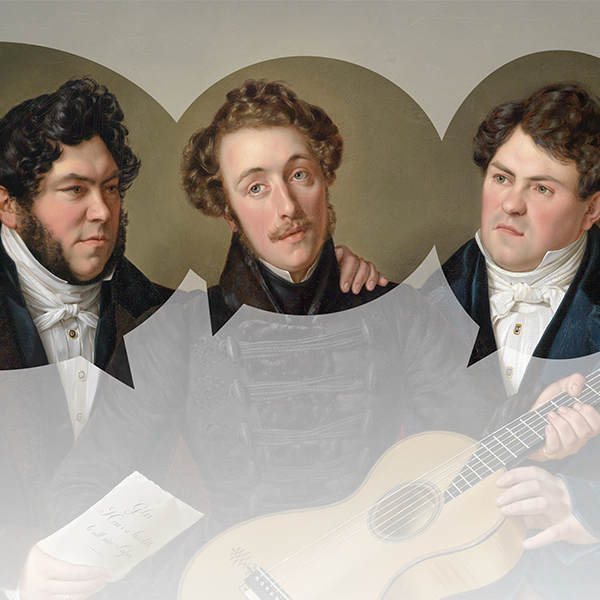
Douglas Gray, Autumn Evening Drinks, Paris, oil on panel, 2017. [.smalltext]Used by permission.[.smalltext]
[.article__paragraph--cap][.small-caps]There is a famous[.small-caps] passage in the Mishnah, that body of Jewish oral traditions, that offers several pieces of advice, one of which is to acquire for oneself a friend. This advice is striking for two reasons. First, because the Hebrew Bible features a world of things but rarely portrays friendships (David and Jonathan being a famous exception).[.article__paragraph--cap]
And second, because this counsel is also out of step with the incentives of contemporary life.
We are awash in advice when it comes to health, longevity, self-care, career advancement, creating generational wealth, child-rearing, you name it. But we seem to lack a cultural script for how to make and cultivate friendships – and why.
In Wesley Yang’s superlative 2008 essay “The Face of Seung-Hui Cho,” he defines love as the thing that “that no person can flourish without,” and also describes memorably the terrible effects of going without it. And indeed there has been a tremendous upwelling of concern in recent years about the deficit of love, of family, of communal ties.
There is, then, a widespread recognition both that friendship is in decline and that this is somehow an undesirable development. But the difficulty comes in saying exactly why it is unfortunate. Consequently, such articles tend to fall back on various utilitarian arguments to the effect that the lack of friendship has negative impacts on our health, or perhaps broader claims about the death of community such as Robert Putnam put forth in Bowling Alone.
All this may be true, but it is not sufficient to describe the phenomena of having or losing friendships. In an uncharacteristically strong statement, Aristotle claims that “without friends, no one would choose to live, even if he possessed all other goods.” In his celebrated essay on the subject, Montaigne writes, “So many coincidences are needed to build up such a friendship that it is a lot if fortune can do it once in three centuries.”
I myself have never made friends easily. And while I have only rarely outright lost friendships, I have misplaced a number over the years; casualties of a peripatetic life. I have probably never stated, much less mentioned that it might cause me grief. The truth is, it’s not an easy thing to admit, but it is also just a hard thing to know how to talk about.
Even artistic depictions of lost friendships are generally less common than romantic versions, or secondary to the main action. Though it is understood that the loss of his friendship with Hal grieves Falstaff unto death, it is a death that takes place wholly offstage. And these kinds of aesthetic models matter, for they function as guides, educating our tastes and tempering our emotions. Someone suffering a bad romantic breakup might watch Annie Hall or listen to Blood on the Tracks for consolation, but one finds fewer works of equivalent stature for the dissolution of adult friendships.
Indeed, this is more true when it comes to cultural representations of adult friendship (while books and films featuring children’s friendships are legion). And to the extent that they exist, they tend to be subsumed by the larger action of the plot. There is, for example, an entire genre of film known as the “buddy cop” movie – an undeniably entertaining category but not perhaps one with wide applicability to most people’s lives.
In general, literature offers greater examples than other art forms. One thinks of Jack Aubrey and Stephen Maturin in Patrick O’Brian’s eponymous series of novels, or Ishmael and Queequeg in Moby Dick (curiously, another maritime example). Or more prosaically, Lenù and Lila in Elena Ferrante’s Neapolitan Quartet.
I have long thought that the most potent and widely recognized example of friendship remains the Beatles, camaraderie being an underrated aspect of their entire appeal. From A Hard Day’s Night on, their associated imagery consistently made them seem like the world’s best, most exclusive club, and decades later we still pick over the causes that led to the breaking of that happy band of brothers. Everyone loved the documentary Get Back for its real-time documenting of how a classic song gets written and recorded, but the emotional heart of the film is the phone call between John and Paul when they attest to the depth of their friendship with surprising frankness.
Just compare them with the Rolling Stones, who – as Keith Richards’s autobiography confirms – barely seemed to even like each other, despite seasons of temporary comradery. (Perhaps ironically, the Rolling Stones nonetheless produced maybe the greatest rock song about friendship, “Waiting on a Friend,” though it must be said that much of its warmth derives from Sonny Rollins’s gorgeous sax solo.)
Otherwise, cultural models for adult friendship remain less prominent than those for romantic and familial love. And those that exist, like Sam and Frodo in Lord of the Rings, or Keanu Reeves and Patrick Swayze in Point Break, are themselves frequently interpreted as being homoerotic. John Knowles, incidentally, swore up and down that there was no homoerotic subtext in his classic novel of prep school friendship, A Separate Peace. This sort of tendency has led Very Online right-wing types to decry the way that the normalization of homosexuality in modern culture has undermined the idea of non-romantic friendships, by finding innuendo in the strength of the connection.
But realistically, the erosion of modern friendship is much more thanks to the pressures of ordinary bourgeois life, with most adult attention consumed by work and family. Between the bills to pay, deadlines to meet, and carousel of kids’ activities to get to, it’s hard to even make space for the thought of doing some activity for its own sake, and doing it with friends. Those bygone days of you and your buddy biking to the store when you were nine years old to buy sodas and junk food with your allowances – who has time for that now?
[.article__paragraph--cap][.small-caps]The reality is[.small-caps] that friendship has always enjoyed an odd relationship with other forms of human association: to be a friend is like but not like being a fellow citizen, community member, colleague, soldier, or spouse. In each case, the bonds of association share some element of what it means to be a friend while departing from it in some essential respect.[.article__paragraph--cap]
That is to say, a colleague or a neighbor may be a friend, but only by chance. Another way of putting this would be to say that real friendship is almost wholly non-instrumental. It does not exist to reinforce communal bonds or inculcate civic-mindedness or stimulate economic productivity (though it may do all those things). It exists for itself.
The point is not to exhort all friendships to become “true” friendships. Friendship need not be all or nothing, and it is normal to have a variety of acquaintances that might be called “friendships,” which nonetheless would be unlikely to withstand strong tests of loyalty.
The point is rather that the concept of friendship has been pruned down to its most functional definitions. And it is difficult to avoid the sense that the comparative absence of friendship in its “thick” versions has something to do with the deep, gnawing loneliness that besets so many of us today. A recovery of that way of understanding friendship will not necessarily restore our community or our democracy, but it may serve as a vital consolation in a life that has need of such things.
The TED-talk version of this argument would probably have a title like “The Necessity of Friendship,” but the reality is almost the opposite. Friendship is superfluous in ways that few other enterprises are. As Montaigne points out, we are biologically impelled to seek sex and romance (not least for the very continuation of the species). We are materially impelled to need work so that we can live. Participation in the governance of our political communities is no longer a prerequisite for citizenship, but we are still obliged to pay taxes and observe the basic rules of commerce and society.
Friendship is distinctive in existing purely for itself. It is true that erotic and romantic love can exist purely for itself as well. But affairs of the heart must inevitably expire or be transformed. Either they implode or cool over time, or they give way to something more lasting, which inevitably becomes entangled with the ordinary business of life. This is not at all to denigrate marriage or suggest that it cannot contain lasting passions, but to acknowledge that it cannot avoid dealing with the practical realities of house-management and child-rearing, and all the rest of it.
Not so with friendship, which can in principle last a lifetime. It is easier to maintain in theory but lacks the practical support of other types of associations. This is not to say that we are not ultimately responsible for our choices to initiate or continue friendships with others. But these choices benefit (or don’t) from social mores. A utilitarian society like our own is deficient in language to justify our claim on this time spent for no other reason than – to paraphrase Montaigne – because I am me, and they are them.
[.article__paragraph--cap][.small-caps]This all sounds[.small-caps] very edifying, to be sure, but I am as much in need of this counsel as anyone. Seeking professional advice, I recently called up an old friend with whom I hadn’t actually spoken in years. We immediately fell back into our old rapport, and it was only after it ended that I realized how much more I valued the conversation itself than the pretext for it. And yet – and this shames me to admit – it wouldn’t have occurred to me to call him for no reason whatsoever. Surely we were both too busy? I only realized afterward that what I was gratified to recover was a part of myself as well.[.article__paragraph--cap]
In his book The Four Loves, C. S. Lewis writes of the passing of his fellow Inkling, the poet and editor Charles Williams, that there is something in us that only a particular friend can bring out. And thus, his death also meant a kind of death of those parts of himself and of J. R. R. Tolkien and other friends that were uniquely enlivened by Williams.
I think this is true. And even in a less dramatic vein, I can recognize how there are parts of myself that are effectively dormant in those periods during which I don’t see certain friends of mine: there are jokes I make, memories I recall, ideas I have only because they arise out of the conversations I have with specific friends.
This then is an instrumental pitch for friendship in our practical age: that it allows us to become more fully ourselves. The lack of social scaffolding or aesthetic examples for these kinds of relationships (not that romance and eros are doing so great these days) is a hindrance, but perhaps this only makes it more imperative that we attempt to do for ourselves what institutions no longer do for us. What is most essential about friendship – people and the conversations they have with one another – remains reproducible almost anywhere. And there is in the end little that actually prevents us from putting aside our awkwardness and self-consciousness and seeking them out or renewing friendships while we can. That time we could have spent in friendship is one thing we can’t get back.