Essay
The Art of Friendship
Whether it’s reading plays or visiting museums, good friends seek out beauty together.
September 2, 2026
Try 3 months of unlimited access. Start your FREE TRIAL today. Cancel anytime.
START FREE TRIAL NOWThe Art of Friendship
Whether it’s reading plays or visiting museums, good friends seek out beauty together.
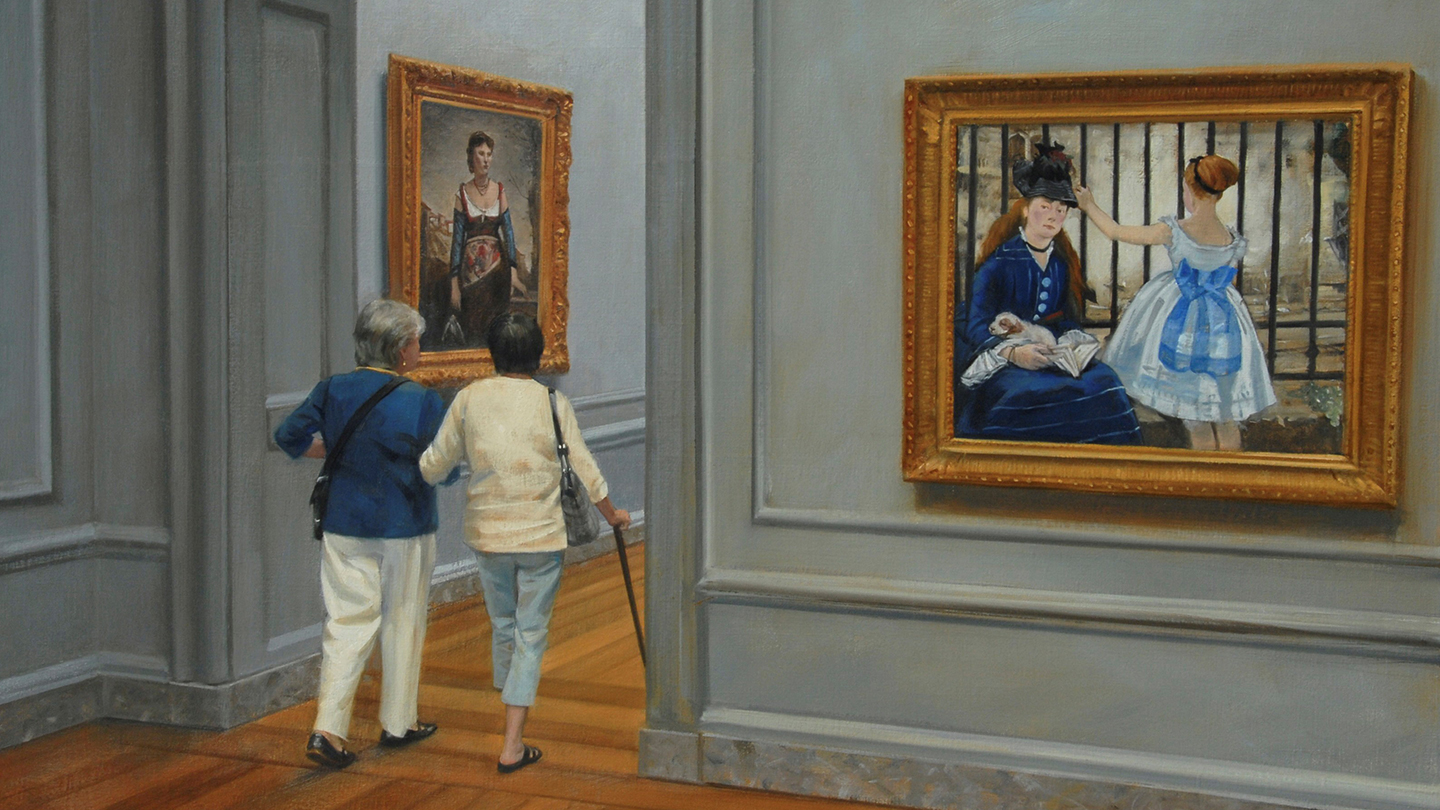
Bradley Stevens, Among Friends, 2012, Oil on linen.[.smalltext]Used by permission.[.smalltext]
[.article__paragraph--cap][.small-caps]A few months ago,[.small-caps] in Venice, two friends and I read The Bacchae out loud on the marble floor of a barely decorated AirBnB, a few steps from the obscure waters of the winterlogged lagoon. I was Dionysius. It was one of the best nights of my life.[.article__paragraph--cap]
We had not seen one another in several months. In New York we’d been part of a close-knit friend group, predicated on regular riotousness. One of them had moved to Dublin for a yearlong master’s program; another had decamped for Paris, indefinitely, for a new life as an au pair. Losing them both from my daily life in the span of a month had cleaved me in a way it had taken months for me to understand. I too was starting my life over, in New York: shoring what fragments I could from the collapse of a marriage, and of one sense of vocation. It felt particularly galling that, at the moment I wanted constancy most, so many of the people I loved were seeking out their own next stages without me.
And then we started reading plays.
This had not been my idea. It had, rather, spun off from a series of Zoom meetings (ostensibly weekly; in practice bimonthly) we’d planned to discuss a vaguely spiritual creativity self-help book called The Artist’s Way: a twelve-week program of journaling, solo-planned Artist’s Dates, and discussion activities designed to bring each of us in touch with our Inner Artist and, in author Julia Cameron’s distinctly Nineties Christian-meets-New-Age inflected language, into better relationship with our Creator. The three of us – along with another recently-retired printmaker friend in New York – had committed to using the group to keep in touch throughout our year of relative separation: what we called, with varying degrees of irony, our annus monasticus. A few more friends, geographically dispersed, joined our calls more stochastically.
We all, I think, found the book relatively useful; its more basic dictates – write three pages longhand in a diary daily; get used to creative projects in solitude; think critically about all the ways you might be sabotaging your life and artistic practice out of fear of failure – incontrovertibly true. We all bristled, for different reasons, at some of the author’s more mystical language about synchronicity and divine abundance. I was drawn to the conversations, too, by academic curiosity: I was trying to reawaken my ability to conceive of fiction while working on a research project about beauty and spiritual yearning. Conversations about creativity, and our pursuit of it, were themselves material.
And yet the heart of our Zoom conversations, for me, was less the book itself than the opportunity it presented to speak more seriously, and intimately, to my friends about my pursuit of my art, and to hear in turn how they pursued their own. I’d been friends with these women for years; we had seen one another through upheavals, catastrophes, fallings-in-love, divorce. But in the absence of the ability to simply go to the bar for a drink, to catch up, to rant or vent or gossip, our Zoom meetings became a prism through which we learned to carefully understand each other. When we understood ourselves as artists, our conversations as geared to our parallel discovery of who we were as artists, our quotidian worries (money, retirement, dating misadventures) as fundamentally downstream of the major question of what am I called to do; what am I called to make; how do I manifest who I am and what I love materially in the world around me, our friendships deepened. We had been close before these conversations; afterwards, I do not know that anyone else understood me better.
About four months into our separation we started planning more concrete, artistically rooted, outings for those rare times that allowed some or most of us together in one room. A visit here, a trip home there, a work trip that took one of us to Paris or Dublin or New York – these occasions were too infrequent to be squandered. They merited Projects. Our Dublin-dweller, in particular, had become the de facto group leader; her ideas were the most ambitious; and, inspired, we all made them happen.
And so, in Paris, we spent three parallel hours in the Louvre, trading thereafter what we’d seen. In New York, at Christmastime, we held a “Classical Winter School,” reading selections from Cicero and Plato out loud at a midtown Irish pub, Zooming in our Paris-dweller on an iPad. A few months later, when I was in Venice for work, they visited me there for “Tragedy in Venice” a weekend of reading classical plays out loud. My friend came from Dublin with a Ryanair carryon full of loose-leaf pages of translation. We had The Bacchae on the first night, Iphigenia at Aulis on the second. We saw each other anew. The shyest of us I saw as Clytemnestra, to my Agammemnon; as Pentheus to my Dionysius. Our leader was Cadmus, and the Chorus, and a steely Iphigenia herself. Afterwards we drank wine at a modern aperitivo bar – somehow old wood and low lighting felt too discomfitingly chthonic, after declaiming the power of Greek gods – and got stuck all together untangling one of the play’s last lines, which it took a ninety-minute reading for me to really understand. We think Dionysius has triumphed – he has killed and cursed all who doubted him – except that Cadmus, condemned to be turned into a snake, has one final rejoinder. Humans have the right, he says (or, rather, I hear my friend say), to expect better from our gods. We sat – together and unresolved – with whatever that was supposed to mean. I spent the next few weeks thinking and writing and wondering about what eros was, and what it meant to evoke a Dionysian part of one’s self through theater, and during each of our subsequent Artist’s Way conversations I felt, for the first time, like I had a vocabulary with which to talk about both my personal and intellectual life, with friends who could understand the gravity of both. I like to think that our readings, and our conversations, have done the same for them.
Our outings have continued since then. In April we read Racine’s Phaedra in New York. In July, with the aid of low-cost European airfare, I managed to spend a Dublin morning with one friend and a Parisian evening with another. We have somehow only made it through week eight of the Artist’s Way and are in no hurry to finish. We have an A Streetcar Named Desire reading planned for the fall. We all go to more museums, separately and together. We are, I think, better friends than we have ever been.
It is not simply that reading plays out loud is good for fostering friendship. I do think this and have found this to be the case both in our small-group readings, and in wider gatherings centered around the same thing. Nor is it even, I think, that friendship is bolstered by talking explicitly about art, or by having a Cicero reading group, or by prioritizing museums over pubs – though all those things may be individually true. Rather, I think that it was precisely in our shared commitment to artistic creation – to making something happen, together – that we were all best able to sustain a friendship in the absence of geographic togetherness.
Our time together was not merely about catching up, reporting back to each other about the arcs of our separate lives. Rather, our time together, creating even this informal moment of art, allowed us to process, to interpret, and to integrate our separate questions and curiosities and (in my case, at least) neuroses in tandem. We brought the people we had been this year, separately, into a site of both creation and play.
And, in so doing, we allowed ourselves to be changed by one another. Playing the romantic, self-indulgent Phaedra opposite my far more sensible friend as her deadpan advisor-enabler Oenone, I learned to laugh more robustly at my own romantic misadventures – and to appreciate, with a new fullness, my friend’s ability to pierce through anyone’s dramatic self-conception.
To make art, I have come to learn – as much through these conversations as through the chapters of the Artist’s Way – is not merely about technique or time. It is about the giving over of one’s entire self – one’s best, one’s worst, one’s foolishness, one’s insight – into a presence over which we have far less active control than we think we do. We learn to hold less tightly to our self-conceptions; we learn to be receptive to what actually obsesses us, rather than what we think we should write, or what the kind of people who think like us ought to paint, or sculpt, or sketch.
So too, I have learned, with friendship. The best of my friendships, time has taught me, are those in which creation, openness, play, are active forces, in which our friendship itself is a stage. They are friendships in which we do not simply recount to one another life happening, but in which life actually happens.
It would be a mistake to think of friendship as a merely aesthetic phenomenon – or to think of friendship as a “stage” in the sense of mere performance. But I think it is no discredit to friendship, or to artistic creation, to see one as a form of the other: the willingness to use our capacity for presence, for attention, and for love to reshape our imaginations, and our relationships with each other. If that is theater, so be it. I don’t think it makes it any less real.