Published
March 31, 2020
ISBN:
9780874863185
Length:
168
“By turns whimsical, chilling, and profound, Peters has created a wonderful anthology of classic poems new and old." — Gareth Hinds (The Iliad)
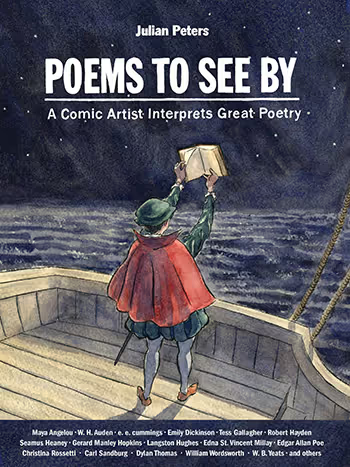
This stunning anthology of favorite poems visually interpreted by comic artist Julian Peters breathes new life into some of the greatest English-language poets of the nineteenth and twentieth centuries.
These are poems that can change the way we see the world, and encountering them in graphic form promises to change the way we read the poems. In an age of increasingly visual communication, this format helps unlock the world of poetry and literature for a new generation of reluctant readers and visual learners.
Grouping unexpected pairings of poems around themes such as family, identity, creativity, time, mortality, and nature, Poems to See By will also help young readers see themselves differently. A valuable teaching aid appropriate for middle school, high school, and college use, the collection includes favorites from the Western canon already taught in countless English classes.
Includes poems by Emily Dickinson, Langston Hughes, Carl Sandburg, Maya Angelou, Seamus Heaney, e. e. cummings, Robert Frost, Dylan Thomas, Christina Rossetti, William Wordsworth, William Ernest Henley, Robert Hayden, Edgar Allan Poe, W. H. Auden, Thomas Hardy, Percy Bysshe Shelley, John Philip Johnson, W. B. Yeats, Gerard Manley Hopkins, Edna St. Vincent Millay, Tess Gallagher, Ezra Pound, and Siegfried Sassoon.
Peters particularly excels at adapting weighty subjects, using his art to allude to historical events and styles, such as African textiles and folk art in “Caged Bird,” or propaganda films, posters, and black & white photojournalism in “Conscientious Objector.” But he also nods to classic American comic strips, film noir, manga, and more.
Gareth Hinds (The Iliad)
The selections . . . encompass a range of moods and media, from a twinkly black-and-white manga version of W.B. Yeats’ “When You Are Old” to poignant watercolor scenes illustrating Robert Hayden’s “Those Winter Sundays.” . . . Fresh angles aplenty for poetic encounters.
Kirkus Review
Julian Peters sees with his heart, and it’s clear in these loving, deliberate works. “The truth is, I did it all for love of beauty,” he says in his preface, and it is this love of beauty, this curiosity of spirit, and appreciation for the work he covers, that makes Poems to See By both moving and meditative.
Montreal Review of Books
The Canadian comics artist Julian Peters performs a sleight-of-paintbrush, as it were, with an array of powerful verses in Poems to See By, a collection for readers ages 10 to adult. It is a wide and varied collection, both in visuals and text. . . . In a preface, Mr. Peters writes that his motivation for translating great poetry into the visual language of comics was “for love of beauty.” In this he has undoubtedly succeeded; reading Poems to See By is a stirring experience.
The Wall Street Journal
By creating interesting juxtapositions of text, imagery, and illustration style, cartoonist Peters elevates each of the 24 visualizations of classic poems here into something much more interesting than mere translation. . . . Peters’s virtuosity as an illustrator and keen understanding of the texts included here results in a beautiful, memorable volume.
Thomas L. Batten, Library Journal
Peters has provided a startling visual feast for those already acquainted with the poems he has chosen – and a superb aid for those grappling with poetry for the first time, who are seeking an interpretative key to those mysterious words and stanzas.… One has to admire the chutzpah behind this splendid variety of different styles that convey his responses to the poems, all arresting, quirky, and revelatory.
Francis Phillips, Catholic Herald
Poems to See By is a perfect fit not only for die-hard poetry fans and curious new readers – it’s also a fantastic teaching tool that any educator trying to get their students excited by poetry should pick up for their classroom.…[It]harnesses the power of lush visuals, timeless poetry, and the magical alchemy that arises when words and pictures come together to create a reading experience that’s truly unique – one which might even change the way you see poetry for good.
Alex Yarde, The Good Men Project
Peters adopts a distinct visual style for each poem, then imagines a complex narrative to accompany it. For William Ernest Henley’s “Invictus,” he creates a blocky, black-and-white sequence about a dramatic prison break. For Langston Hughes’s “Juke Box Love Song,” tender watercolor portraits illuminate glowing city lights. Some of the black-and-white action of Wordsworth’s “The World Is Too Much With Us” unfolds on a smartphone screen, while Tess Gallagher’s “Choices” evokes nature’s green in scribbly landscapes.
Publishers Weekly
Fascinating.
School Library Journal