Published
November 1, 2017
ISBN:
9780874861280
Length:
179
David Kline (Foreword), Jennifer Harries (Editor)
“One of the most powerful books I’ve ever read.” – Joel Salatin
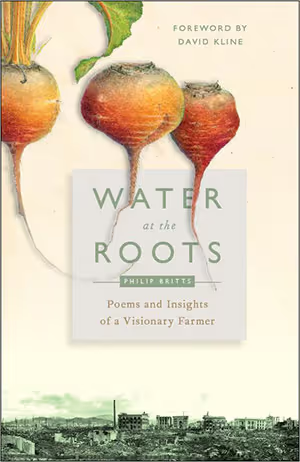
In a society uprooted by war, industrialization, hate-filled ideology, and dehumanizing technology, Philip Britts sought a way of life where people could work together in harmony with the land and one another.
A farmer, poet, activist, pastor, and mystic, Britts (1917–1949) has been called a British Wendell Berry. His story is no romantic agrarian elegy, but a life lived in the thick of history. As his country plunged headlong into World War II, he joined an international pacifist community, the Bruderhof, and was soon forced to leave Europe for South America.
Amidst these great upheavals, his response – to root himself in faith, to dedicate himself to building community, to restore the land he farmed, and to use his gift with words to turn people from their madness – speaks forcefully into our time. In an age still wracked by racism, nationalism, materialism, and ecological devastation, the life he chose and the poetry he composed remain a prophetic challenge.
Jennifer Harries, a member of the Bruderhof, was born in Llansamlet, Wales, and now lives in New York.
Watch the trailer:
Britts’s unpretentious style brings immediacy to his subjects, and Water at the Roots provides enough context about his life, and the challenges of building a community in an environmentally difficult region, to underscore what the author was up against…. It’s a thorough book that illuminates an important but little-known writer.
Foreword Reviews
One of the most powerful books I’ve ever read. Alive with profound spiritual and practical insights, Britts’s words are timeless. You will be deeply moved by his humble conviction expressed in thoughtful action.
Joel Salatin, author, Folks, This Ain’t Normal and You Can Farm
There is a deep sense of reality – true, eternal, and human reality – in Britts’ work… Here was a man who clearly articulated and lived out his beliefs. When one considers the back-breaking, dawn-to-dusk labor that was farming the Paraguayan Primavera for ten months a year with animal-drawn or human-powered tools, it seems amazing that he had time to produce such thoughtful and polished work. Yet, always is the sense of a man who may have been quietly composing while hoeing, whose spirit ever sat at the feet of his Master while his body was at work.
Remembered Arts Journal
There is much beauty in Britts’s thoughts, and a quiet radicalism too.…He warns that the worst possibility of progress would be to lose the organic connection with and intimate, tactile knowledge of the land: unlike “that indescribable sensation that comes, perhaps rarely, when one walks through a field of alfalfa in the morning sun, when one smells earth after rain, or when one watches the ripples on a field of wheat.” That is the agrarian spirit, the spirit of Wendell Berry and so many localists everywhere.
Russell Arben Fox, Front Porch Republic
Britts’s poems and musings offer a window into a life defined by clear Christian values of radical pacifism, love of neighbor, and care for the Earth. Britts provides a gentle corrective to modern impulses of acquisition and aggression, his ebullient verses always returning to wonder and awe at the natural world…. An inspiration for Christians and humanists seeking peace and purpose in a tumultuous world.
Publisher’s Weekly
What to do with one’s life? Britts answered this question as one who loved the land, its creatures, and its people. For those seeking a healthy and peaceful world, this book will be a provocation to a better way of living.
Norman Wirzba, author, Making Peace with the Land and Food and Faith
To read the poetry and prose of Britts today is an experience akin to reading Wendell Berry or Joel Salatin.… What emerges is the story of a man who lived his faith and lived his beliefs in community and farming. One gets the impression of a quiet, gentle man, but also a man of inner strength. More than 70 years after his death, the Bruderhof community he helped to create still flourishes. Water at the Roots is perhaps a good explanation of how that’s happened.
Tweetspeak Poetry
Philip Britts died at thirty-one, but this collection of poems and insights shows the depth and richness of his wisdom during those shortened years. His writings are reminiscent of Wendell Berry’s: they touch on the same themes of earth and faith, community and presence. It’s a short but lovely read.
Gracy Olmstead, The American Conservative
Water at the Roots is not only a stunning example of poetry and prose informed by agricultural work, faith, and war, but also a rare voice we’ve not heard before. With unique qualifications as a pacifist, a member and pastor of an intentional community, and a farmer in Paraguay during World War II, Britts has the authority to not only call for the restoration of land but also to call for the restoration of our humanity. This is a deeply important book for our times.
Lori Horbas, Boswell Book Company, Milwaukee, Wisconsin
The British farmer we meet in Water at the Roots is many things, but indecisive is not one of them. He would counsel us to lay down our arms (which means more than just actual weapons, though not less), to embrace the poor, and to turn our backs on a world that has turned its back on the crying baby that we meet in the Christmas story. If the church will have a future in the West … it will be because we see the little way of Philip Britts and find it beautiful. It will be because we heard a baby crying and we came to worship.
Jake Meador, The University Bookman
Epilogue