Essay
What Comes After America First?
Borders can protect a nation’s body, but hoarding its gifts will ultimately destroy its soul.
July 10, 2026
Try 3 months of unlimited access. Start your FREE TRIAL today. Cancel anytime.
START FREE TRIAL NOWWhat Comes After America First?
Borders can protect a nation’s body, but hoarding its gifts will ultimately destroy its soul.
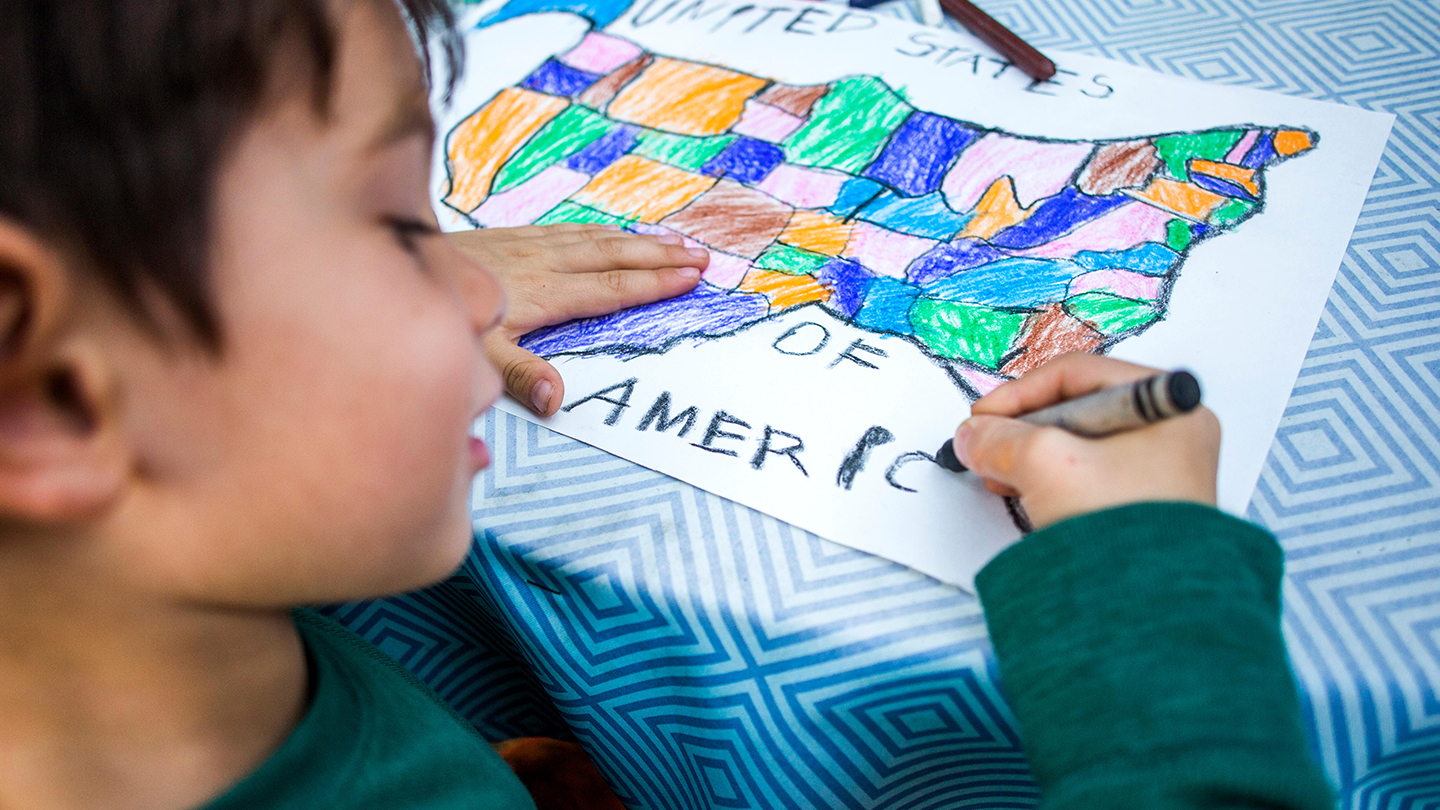
Photograph by Tetra Images, LLC / Alamy Stock.
[.article__paragraph--cap][.small-caps]“America First” has gone[.small-caps] from a pithy campaign slogan to a settled instinct. After more than a decade in American politics, it is less a provocation than a premise – an attempt to reorder public life around national advantage, border security, and the felt injuries of those who understand themselves as “ordinary citizens,” who suspect that those they regard as elites prefer the world to their concrete neighbors at home. The demand is not merely for policy adjustments but for a reordering of priorities: the nation first, without apology.[.article__paragraph--cap]
Many Christians sympathize. Others recoil. The church, like the country, is divided: some see in this posture a recovery of sanity and responsibility; others see suspicion, cruelty, and national self-regard.
The dispute is usually framed as a clash between nationalism and cosmopolitanism. But the deeper problem is that – in important respects – these two positions are not genuine alternatives so much as mirror-image disorders. Both distort the moral reality of nations and our duties toward them.
Elite cosmopolitanism treats national particularity as morally suspect. Borders appear as accidents of birth, and our obligations are imagined to run primarily toward all humanity. Accordingly, nations are often perceived as meaningless entities composed of accidental conglomerations of largely interchangeable economic units – portable “Anywheres” who have no duties to place or people. Interest-based nationalism begins with a defensible claim – that a nation’s primary political obligations are to its own citizens – but quietly transforms that claim into something else: namely, that those obligations are exclusive. Other nations become competitors, threats, or resources (and noncitizens are largely disregarded, if not viewed with suspicion). For such nationalists, duties beyond the national border are rendered meaningless and the nation’s interests are elevated above all else, while cosmopolitans diffuse obligation across an abstract humanity to which no one is concretely bound. The latter jeopardizes a nation’s body while the former threatens its soul.
A nation, we can say, has a body and a soul. Its body – its people and their land, its inherited traditions and institutions, its cultural memory and accumulated capacities – is real and worth preserving. But a body can survive while the soul withers. To keep its soul, the nation must hold these goods rightly: to receive them as gifts held under God rather than possessions self-generated and owed to no one, and to exercise stewardship over them with the awareness that other peoples exist within the same moral order.
When self-preservation becomes the only horizon – when the circle of obligation shrinks to “our own” alone – a nation may appear strong while it is becoming spiritually hollow. Such a nation preserves its body at the expense of its soul.
To see why cosmopolitanism and interest-based nationalism so often mirror one another, we must notice that they share a genealogy. Both positions emerge from assumptions embedded within the modern liberal tradition.
By liberalism I do not mean the contemporary political left, but the broader philosophical framework shaped especially by thinkers such as Thomas Hobbes and John Locke. Within this tradition the individual is typically imagined as existing prior to society, entering relationships through consent and constructed will rather than inherited obligation. Here, the gift of existence through birth bears little significance for public life, and the relationships between parents and children has little to do with political life.
No thinker did more to lay the groundwork for this framework than Hobbes. He gave the tradition its foundational architecture: prior to political order, individuals exist in a condition of rivalry and insecurity, and society emerges only when they consent to a sovereign capable of restraining their mutual hostility. Anthropological individualism, the state of nature, sovereignty as coercive power – these are distinctively Hobbesian formulations that subsequent liberal theory inherited even where it softened or complicated them. The idea of political consent itself predates Hobbes – one finds it in earlier thinkers who grounded consent in classical natural law (such as Richard Hooker and Johannes Althusius) – but Hobbes stripped that tradition of its realist foundations, wedding consent to a voluntarist account of obligation in which no moral order precedes the will. It is this Hobbesian inheritance, rather than consent theory as such, that generates the grammar both disorders share. Locke’s individual is more reasonable and his state of nature less savage, but the underlying structure remains: the self precedes society, and obligations arise from the will rather than from any prior moral order.
Within such a framework, duty becomes difficult to explain. Liberal thought has a rich vocabulary for rights, interests, and consent, but it struggles to account for obligations that bind us prior to choice, responsibilities we inherit simply by virtue of our place in the world: where, and to whom, we are born.
Seen in this light, the apparent opposition between cosmopolitanism and nationalism begins to dissolve. Both operate with the same underlying grammar. The cosmopolitan assumes that the self arrives in the world unencumbered by given obligations, free to extend its concern outward to humanity as it chooses. The interest-based nationalist applies the same logic at the level of nations: the state appears as a self-contained actor, its people figuratively born from the soil and unrelated to others by common human nature or friendship, pursuing its advantage among rivals in an international arena. Both the Davos cosmopolitan and the America First nationalist agree that obligation requires consent; they disagree only about the scope of the community that consented. This is not a genuine opposition. It is a family quarrel within a shared framework – the same grammar, merely applied at different scales.
The Catholic philosopher David L. Schindler names the theological root of this vision: “ontological Pelagianism,” or the assumption that the self enters the world owing nothing to anyone, that relations are not first given to the creature but chosen by it. Nothing in being itself is received as gift. This is not merely an abstract metaphysical error. It is a posture toward reality – one that shapes how we perceive obligation before we have consciously reasoned about it. A self that arrives unencumbered cannot, in principle, owe anything it did not consent to owe. That is why both the cosmopolitan’s selective generosity and the nationalist’s hard borders feel, to those who hold them, like freedom: they are freedom, on this account – the freedom of a will that constructs its own attachments rather than receiving them.
But this premise contradicts the most obvious fact about human existence. Every person begins as a child – radically dependent, constituted by relationships he did not choose, sustained by care he did not earn. We enter life not as self-originating individuals but as creatures already embedded in webs of belonging we did not construct and cannot casually discard.
We need a recovery of duty toward neighbors we did not choose, but which we were given – including the nations in which we reside and those nations which constitute the global community.
To recover the category of duty, we need to recover the nature of nations themselves. Political societies are not merely collections of individuals living under the same legal regime. They are communities capable of acting together – peoples who share practices, institutions, and memories that allow them to pursue common goods. Political authority does not create such a people from scratch. It governs a people that already exists: a community that speaks a common language, inhabits a land, remembers a shared past, and recognizes certain forms of life as its own.
The political theologian Oliver O’Donovan describes this reality as a form of coordinated agency: a society capable of acting as a “we.” To see oneself as part of such a people is therefore not merely a sociological observation but a moral insight – an act of political imagination that recognizes what has been given.
That “we,” however, is not constituted primarily by blood or descent. The classical tradition recognized this clearly. Cicero defined a people not as a gathering united by kinship but as a community bound by agreement about justice and partnership in the common good. Augustine took this civic definition as his starting point even while revising it: his own account of a people as those united by shared loves is, if anything, more open, since loves can be redirected and reformed. What makes a people is not simply shared ancestry but participation – sharing in the practices, institutions, and memory that constitute a common life. A nation’s heritage is genuinely inheritable by those who were not born into it. The newcomer who does come to receive that heritage – who learns the language, enters the memory, and takes up the obligations of the people – does not dilute the national body. He extends it, adding to the ongoing story of a living inheritance.
Consider what America’s constitutional order actually represents: rule of law, limited offices, procedures that allow citizens to appeal beyond the will of the strong to a public norm, all wrapped up in a political vision of ordered liberty. None of this arrived from nowhere. It was received – shaped by centuries of English common law, Protestant resistance theory, and republican experiment, formed by failures as much as successes. Americans did not invent it from scratch; they inherited it, and now hold it in trust. That is what a national body is: not a set of preferences a people has chosen, but a set of goods a people has been given and charged to pass on.
Nations are contingent and historical – neither divine nor eternal – but their customs and institutions incarnate particular forms of universal goods necessary to human flourishing. That is why nations can wield moral authority and warrant our love: not because they are sacred, but because they embody genuine goods. And precisely because those goods are received from the past and held in trust for those who come after, they cannot be treated as private possessions. What is received as gift cannot be hoarded without distortion. The nation that understands itself as steward rather than self-generated owner finds that its autonomy carries obligations as well as rights.
Augustine is particularly helpful in offering a starting point for identifying our concrete duties. Human beings are finite creatures whose loves must take practical form. Finitude necessarily means that we cannot serve everyone equally in action. Love must begin somewhere – not according to preference or worth, but according to the neighbors God has placed within our reach. Proximity is not an accident of geography but a feature of providence: the order of our loves reflects the order in which God has given us to one another. Augustine can therefore say, without embarrassment, that one’s first care will be for one’s own people, because one has a readier and more immediate opportunity to care for them. Love of nation, at its best, is not the pride of self-made, choosing selves but the gratitude of creatures who recognize their place within a providential order they did not construct.
The nationalist reaction, for all its distortions, often carries a legitimate grievance here. For decades, many elites systematically privileged abstract commitments and global interests over the concrete good of proximate neighbors – workers displaced by deindustrialization, communities hollowed out by policy decisions made far away, citizens pressured to treat their cultural inheritance as embarrassment rather than gift. Augustine’s ordered love allows us to take that grievance seriously: to love distant humanity while neglecting the neighbor at hand is not higher charity. It is a failure of love’s order.
Yet Augustine refuses to let ordered love become a nationalist weapon. Figures as disparate as as Herman Bavinck, Fyodor Dostoyevsky, Jacques Ellul, C. S. Lewis, and Eric Hoffer observed that the temptation to love “humanity” in the abstract is often the temptation to evade the concrete neighbors one has actually been given. But the reverse distortion is equally real: because ordered love begins with the proximate, it can end there – the priority of the near neighbor quietly hardening into indifference to the distant one. To love one’s parents, children, neighbors: this is a good in itself, but it is also meant to be training in love of people who are unlike oneself. Ordered love gives priority to the proximate, but it does not authorize contempt for the distant. The same providence that gives me my own people also gives others their own peoples.They, too, bear goods, traditions, and responsibilities. The world, on this account, is not a competitive arena of self-interested powers but a community of nations – each given to itself by providence, and each given as neighbor to the others. Love of nation can therefore never be absolute. It remains one expression of charity within a larger community of peoples – and when the priority of the near neighbor hardens into permanent indifference toward others, ordered love collapses into its caricature, the beginning of charity being mistaken for its end.
To ask what ordered love requires in practice, then, is first to ask what has actually been given – what goods a people holds in trust and is rightly charged with preserving.
Every nation carries particular goods in its traditions worth preserving – goods that belong to the nation’s body, but whose right ordering belongs to its soul. The case for national particularity is not, at its best, a case for superiority. It is a case for stewardship, and stewardship is only intelligible if the goods in question were received rather than self-generated. A nation defends inherited goods which have been entrusted to it.
America’s inheritance includes goods that deserve that kind of care: constitutional rule of law, the limitation of governmental power, a tradition – however inconsistently applied – of religious liberty that protects conscience without requiring uniformity, and civic institutions of self-governance that have embodied genuine political goods. These are not merely “American preferences.” They are forms of human flourishing that took centuries to develop, that can be lost more quickly than they were built, and that, when faithfully pursued, can bless those within the nation as well as offer something to the world beyond it.
If a nation has customs and institutions that embody genuine goods, it is right that it should defend them, along with the cultural hinterland that makes them intelligible. Political authority does not merely manage present interests; it stewards an inheritance for those who come after. This is also why borders are morally serious – they define the territory within which a people is free to cultivate and transmit a way of life. Border control need not be a posture of fear. It can be an act of fidelity: the protection of a space within which particular goods, received from the past, can be handed on.
Yet the border that protects a people’s inheritance does not exhaust their obligations toward those who cross it. Not every stranger who dwells among a people will embrace its heritage, but even those who do not still remain within the community’s moral order and are owed its hospitality – the ancient duty of guest-friendship, which the classical and Christian traditions alike extended to the resident alien. Guest-friendship, however, is a relationship with obligations running in both directions. The guest owes the host respect, deference to the customs of the household, and conduct befitting one who has been welcomed in rather than one who already belongs. Host obligations are real, but they are not unconditional, and a people retains the authority to define the terms of welcome and to respond when those terms are persistently refused.
But a body becomes diseased when it makes itself an end – when stewardship curdles into self-centered possession and defense becomes domination. The biblical story of Babel presents linguistic and cultural diversity as a safeguard against imperial pretension: God’s world order is plurally constituted, and world-empire is its deformation. Augustine’s judgment is bracing: an empire animated by the lust to dominate becomes armed robbery on a grand scale. The drive to expand beyond proper limits corrupts the very goods a nation claims to defend and, in so doing, reveals that it has already ceased to understand them as gifts.
The line between faithful stewardship and soul-loss is not always easy to see from the inside. A nation can believe it is defending its inheritance while it is actually hoarding it, when it thinks it exists merely to enlarge its goods regardless of the needs of neighbors. A nation loses its soul not by maintaining borders or defending its inheritance, but when its moral imagination shrinks until it can no longer perceive any obligation beyond its own advantage. A nation that stops giving finds it has also stopped seeing: neighbors, near and far, cease to appear as neighbors at all and become only threats, burdens, or instruments.
The legitimacy of national autonomy does not justify isolationism. As Nigel Biggar writes, “the autonomy a nation enjoys within its borders is not absolute. It does not have the right simply to do with its resources whatever it pleases, but only to manage them responsibly; and where it has resources surplus to its own needs, it has a duty to devote them to the good of others.”
This is not liberal guilt but Christian stewardship. A nation’s goods are not self-originating, nor is its prosperity a private entitlement: in surplus, a nation must always recall that its resources are held under God. And the existence of surplus creates obligations: not infinite obligations, not obligations that erase national responsibility to one’s own, but real duties that cannot be reduced to optional charity.
What might this look like in practice? Consider refugees. The soul-preserving logic is neither open borders nor closed hearts. A nation with surplus capacity – in housing, in labor markets, in civic institutions – and facing people fleeing genuine persecution has a duty that cannot be reduced to preference or political mood. That duty has limits: it must be exercised with prudence about absorptive capacity, with attention to the cultural conditions that make integration possible, without the fantasy that borders are morally arbitrary. But those limits do not dissolve the duty; rather, they shape its exercise. Welcoming the refugee, within the limits that prudence and absorptive capacity define, is not supererogation. It is the neighbor-logic of ordered love applied to dislocated peoples – a duty real enough to demand serious discernment, not dismissal.
The same grammar extends across the range of a nation’s dealings with others: in foreign aid, in the terms it sets for trade with poorer nations, in whether its military power treats foreign lives as expendable. Surplus creates obligation. Strength does not license exploitation. To refuse this grammar entirely – to treat the nation’s goods as generating no obligations beyond its own – is soul-loss: the failure to steward goods given with reference to the needs of given neighbors.
When interest replaces duty entirely, two structural failure modes follow. The first is exploitative imperialism: the lust to dominate. Within such a mode, other nations are merely threats to subdue or resources to plunder. Borders become staging grounds for expansion. The second mode is miserly isolationism, in which the nation turns inward, insulating itself from the claims of the international community, treating surplus resources as private property. One withers the soul by aggression, the other by indifference. One is pride; the other is refusal.
But there is a third failure: that of internal scapegoating. The corruption of national love does not only appear at the border or in foreign policy. It appears just as readily within – when loyalty to an imagined nation displaces care for the actual, complicated neighbors who constitute it. O’Donovan’s warning about the “demon” inhabiting collective self-esteem is instructive here. The demon works by turning a real people into an imagined ideal, then demanding loyalty to the ideal rather than care for the nation as it actually is. Once that gap opens between the ideal nation of imagination and the real nation of complicated human beings, those who complicate the picture stop being neighbors and instead become problems to be solved. We are living with this dynamic now: when political rhetoric requires a class of internal enemies – the disloyal, the unpatriotic, the not-quite-American – to explain why the national ideal remains unrealized, the demon has done its work. The logic follows predictably: the “real Americans,” perhaps the “heritage Americans,” awakened to their political selfhood, identify the newcomer and the “insufficiently loyal” as the culprits. Scapegoats are named, and national mythology becomes sacred and immune to criticism, demanding loyalty rather than honest stewardship. The defense of tradition becomes a thin guise for the defense of privilege.
Augustine’s exchange with the pagan official Nectarius offers a model of what lies between all three failures. Nectarius invokes patriotism as the highest love – surpassing even love for parents. Augustine does not dismiss this. He affirms it: for good people, he says, there is no limit to caring for the fatherland. But the affirmation is immediately set within a larger horizon. The earthly homeland is real, its claims are genuine, its love is not embarrassing – but it is not ultimate. And that “not ultimate” is not a diminishment. It is what saves patriotic love from becoming idolatry, keeping such patriotic love oriented toward genuine goods rather than the nation’s self-image. A love that cannot be criticized cannot be trusted; a love ordered beneath a higher loyalty can be honest about failure, capable of reform, and capable of genuinely serving the neighbors it claims to cherish.
Here, the logic cuts directly into foreign policy. The same providential order that gives me my own nation as something received – neither self-made nor self-justifying – gives me other nations as neighbors. They, too, are given by God’s providence to their people. They too bear goods, traditions, and responsibilities that are not mine to dismiss or absorb. A foreign policy that treats other peoples purely as threats or competitors is not merely strategically brittle; even more fatally, it is theologically malformed. It refuses to see the neighbor. And a nation that has ceased to see its neighbors honestly tends, with time, to lose the capacity for honest self-knowledge as well.
Civil authorities have special duties to their own citizens and national traditions. These duties are real and morally serious, but such duties do not exhaust a nation’s moral obligations. Stewardship has a direction. It moves both inward – toward the citizens and traditions entrusted to a nation’s care – and outward, toward the neighbors that same providence has placed alongside it. “America First” may name the beginning of political responsibility – a real beginning, with genuine duties attached – but it cannot become its end.
This is not merely a theoretical danger. It is the recurring failure of patriotic Christianity across history. For that reason, the church is not a pious add-on to the argument but a structural necessity. The ancient image from the Epistle to Diognetus captures this well: as the soul is to the body, so Christians are to the world – present within every part of it, yet not identical with any of it. Henri de Lubac retrieved this image deliberately, identifying the church as the conscience of the human race which animates the world’s moral life from within, preventing any people from mistaking its own story for the whole story. Concretely, this means that the church prevents ordered love from hardening into its counterfeit not by abolishing national particularity but by relativizing it: insisting that the person is never merely a citizen, that the neighbor-nation is never merely a rival, and that no people’s self-understanding exhausts the moral universe.
Christians know this, not as an abstraction but as a lived fact. By virtue of baptism, they are united with brothers and sisters across every national boundary – the Haitian congregation that shares the Creed under a fragile state, the Ukrainian church whose men have been buried and whose children have fled, the Mexican community that sings the same Psalms, the churches in Israel and Palestine that preach the same gospel, the Christians in Iran who confess the same Lord under threat. And each Lord’s Day, the Supper enacts what baptism has already declared: a common fellowship in the Lord, manifesting a unity that no foreign policy can create and no border can finally sever. To relegate this unity to a “spiritual” plane that has no practical import is to make nonsense of an enormous quantity of the New Testament, including a large portion of Saint Paul’s epistles; it is to assert that the real, concrete body of Christ is irrelevant to living as Christians. These others who share the Supper are not abstractions called “foreigners.” They are family, and their existence makes the neighbor-nation impossible to unsee.
And the church, by its very existence as a transnational communion, will not let the collapse from “America First” to “America Only” go unremarked. Where the nation sees rivals, the church sees neighbors – common humanity, those descended from Adam and Eve whom we are commanded to love: brothers and sisters in the faith, and those who may yet be welcomed into the family. Where the nation calculates interests, the church insists upon duties. And where the nation draws borders around obligation, the church – by its catholic communion – crosses them, not to abolish the nation, but to prevent it from becoming an idol.
The nation that receives its inheritance as gift rather than possession, and its neighbors as neighbors rather than rivals, is not thereby weakened. It is freed from the particular anxieties that drive both disorders – the cosmopolitan’s embarrassment at particularity and the nationalist’s fear of loss. To steward rather than hoard, to see the neighbor-nation as given rather than threatening, to allow the church to keep calling the nation beyond itself – none of this requires a nation to surrender what it has been given. It requires only that it hold those gifts rightly: openly enough to be honest about failure, and capaciously enough to recognize that the moral order it inhabits is larger than its own story.
There is room in the city of God for all nations, since that city does not erase creaturely particularity; it redeems it. De Lubac described the church – that anticipation of the city of God on earth – as an ark giving shelter to all varieties of humanity, and a banqueting hall whose dishes are the product of the whole of creation: nothing authentically human can be alien to her. The goods each people has stewarded – its laws and languages, its forms of justice and memory – are not dissolved but received, honored, and gathered into something greater.
In view of that final horizon, nations need not harden themselves against one another in order to survive, nor do they have to abandon their particular inheritances in pursuit of an abstract humanity. The false alternatives dissolve. What remains is stewardship: a patient care for gifts we did not originate, entrusted to us for the good of neighbors we did not choose.
Those neighbors are not abstractions. They are the peoples God has placed around us, near and far. And a nation that remembers this may preserve its body without losing its soul.