Essay
The Novel That Started a Civil War
Who was Harriet Beecher Stowe, author of Uncle Tom’s Cabin?
July 8, 2026
Try 3 months of unlimited access. Start your FREE TRIAL today. Cancel anytime.
START FREE TRIAL NOWThe Novel That Started a Civil War
Who was Harriet Beecher Stowe, author of Uncle Tom’s Cabin?
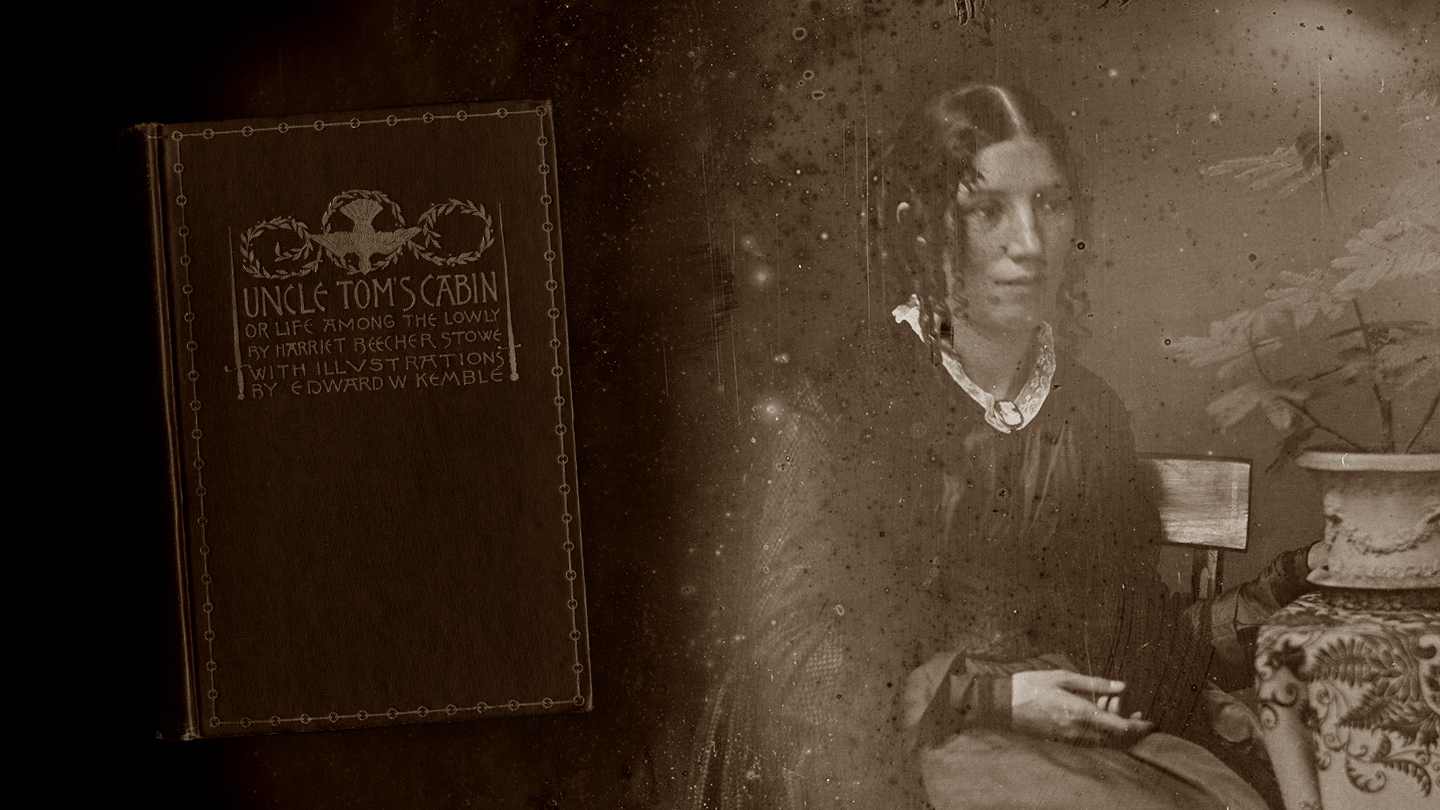
Daguerreotype of Harriet Beecher Stowe, circa 1850, The Metropolitian Museum of Art. [.smalltext]Wikimedia Commons, public domain.[.smalltext]
[.article__paragraph--cap][.small-caps]Harriet Beecher Stowe[.small-caps] was already stewing with anger when news arrived of the dramatic arrest and daring escape of Shadrach Minkins on February 15, 1851. Minkins, a fugitive from slavery in Norfolk, Virginia, was leaving his job as a waiter in a Boston coffee shop when he was swarmed by a posse of marshals, directed by a notorious Southern slave catcher. In broad daylight, the marshals dragged the struggling man to the nearby courthouse. Antislavery attorneys from the Boston Vigilance Committee rushed to courthouse, while outside an angry crowd gathered.[.article__paragraph--cap]
Suddenly, a scrum of black men crashed into the courtroom, overwhelming the marshals and hustling Minkins out onto the street and into a nearby hiding place. Within a week of this miraculous escape, Minkins crossed the border into the free country of Canada, via the Underground Railroad. Shadrach Minkins was the first New Englander to be arrested under the new Fugitive Slave Law. But he would not be the last.
No one would have marked Harriet Beecher Stowe for greatness in that dark winter of 1851. Harriet was “a little bit of a woman – somewhat more than forty, about as thin and dry as a pinch of snuff,” as she described herself around that time. Hardscrabble housekeeping occupied most her hours. She had a newborn baby and a half-dozen children whom she was homeschooling, while keeping house on a professor’s salary. Her husband, Calvin Stowe, was a professor of biblical studies.
But Harriet Beecher Stowe had higher aspirations. She was the middle daughter in a family of prominent Yankee ministers and reformers. Her father, the Reverend Lyman Beecher, was renowned as “the great gun of Calvinism.” All seven of her brothers, including Henry Ward Beecher, who would become a popular New York society preacher, entered the ministry, and her sister Catharine enjoyed a national reputation as an educator. As a woman, Harriet could not follow her father into the pulpit, but like all the Beechers, she was a preacher at heart. Instead, she channeled her ambitions into her pen, occasionally writing short stories and essays to supplement her husband’s meager salary.
Harriet was hardly a radical abolitionist. Like her conservative father, she generally shied away from the topic of slavery as too divisive and depressing. “In fact,” remembered her friend, the writer Charles Dudley Warner, Harriet felt like “many humane people in those days, that the subject was so dark and painful a one, so involved in difficulty and obscurity, so utterly beyond human hope or help that it was no use to read, or think, or distress one’s self about it.” But that winter, she underwent a conversion of sorts.
“Up to this year I have always felt that I had no particular call to meddle with this subject,” Stowe wrote to her editor in March of 1851. “But I feel now that the time has come when even a woman or a child who can speak a word for freedom and humanity is bound to speak.”
Slavery had bedeviled the country since its founding. But lately the rising rancor between the slave-owning South and the free states of the North seemed like it might split the United States asunder. From the distance of 175 years, it is difficult to understand how Americans could have tolerated slavery for so long. Thousands of books have explored the complex social factors which kept the “peculiar institution” alive. But in essence, for those who decried the evils of slavery, there were two primary obstacles to emancipation: The first was the Constitution. The second was the Bible.
Neither the Constitution nor the Bible required slavery to exist, and neither explicitly endorsed slavery as a social good. But both documents enshrined slavery as a normal, legal, even godly, fact of life. At its ratification in 1787, the Constitution explicitly recognized the legal status of slaves as “three fifths of all other Persons.” Although this measure was intended to limit the votes that the slaveholding states could command in the House of Representatives, it nevertheless embedded the institution of slavery in the nation’s highest law. Individual states could abolish slavery if they chose, but the federal government could do nothing without amending the Constitution by national consensus.
Slavery figures far more prominently – and ambiguously – in the Bible. It first appears in the book of Genesis and recurs regularly throughout the Old and New Testaments. At no point does the Bible explicitly call for the abolition of slavery or for the exclusion of slaveholders from grace. At best, the Bible describes how to make bondage more consistent with God’s laws. At worst, the words of Leviticus 25:44–45 seem like a solid endorsement of enslavement:
Both thy bondmen, and thy bondmaids, which thou shalt have, shall be of the heathen that are round about you; of them shall ye buy bondmen and bondmaids. Moreover of the children of the strangers that do sojourn among you, of them shall ye buy, and of their families that are with you, which thy begat in your land; and they shall be your possession.
Conversely, antislavery Christians cited verses like Deuteronomy 23:15, God’s injunction to Moses: “Thou shalt not deliver to his master the servant which is escaped from his master to thee.” Or from the eminently egalitarian teachings of Paul, like Galatians, 3:28: “Here there is no Greek or Jew, circumcised or uncircumcised, barbarian, Scythian, slave or free, but Christ is all and is in all.” Unfortunately, Christ gave no direction on slavery specifically, leaving entirely too much room for interpretation.
The political divide over slavery remained stable as long as it was under the jurisdiction of individual states. But the extraordinary growth of the territories in the West upset the fragile political equilibrium. The discovery of gold in California in 1848 gave the question new urgency: Would slavery be allowed to spread to these future states?
To be frank, most Northerners didn’t care much about slavery as long as it stayed in the South. Even many antislavery sympathizers considered it a hornets’ nest that was best avoided. But they had no desire to see the slave economy extended to these new states. The more the North grew united against the spread of slavery, the more infuriated Southerners became in self-defense. From Virginia to Texas, rage, defiance, and talk of secession exploded.
Out of this chaos emerged the Compromise of 1850, proposed by Kentucky senator Henry Clay. To the North, Clay offered the prohibition of the slave trade in Washington, DC, and the immediate admission of California with a constitution prohibiting slavery.
To the South he offered iron-clad guarantees of their existing rights. Congress would have no power to interfere with the slave trade between states. Human bondage could be abolished in Washington, DC. only with the consent of the citizens of Maryland, and with financial compensation to the owners. There would be no congressional restrictions on slavery in the territories acquired from Mexico. Most notably, the federal government would strengthen what became known as the Fugitive Slave Laws, requiring all Northern citizens to actively capture and return runaway slaves in free states.
The response to Clay’s proposal was volcanic. For seven bitter months Congress debated the compromise measures. Washington became a literal armed camp of enemies as congressmen began carrying pistols onto the floor of the House. When one legislator unintentionally fired his gun while fussing with some papers, thirty or forty pistols instantly appeared in congressional hands. The uproar from Capitol Hill echoed in the streets, barrooms, churches, and newspapers. Finally, in September of 1850, Clay’s compromise was reluctantly ratified. But any hopes for a lasting peace were soon dashed.
Of all the measures in Clay’s bill, the Fugitive Slave Law was the most inflammatory. It stripped away all rights to due process. Suspected fugitives could be arrested without a warrant, based only on the say-so of their alleged owner, and were denied the right to a juried trial. Instead, they were turned over to a special commissioner, who received a bounty of ten dollars for each such person captured. Alleged runaways could not testify on their own behalf, so they could be convicted on nothing more than a white man’s claim to ownership. Because the evidentiary requirements were so flimsy, free blacks were as likely to be seized as actual runaways, with little legal recourse.
Compounding the outrage, the measures compelled the North to enforce the obnoxious law. The number of federal marshals would dramatically increase, and any marshal who did not cooperate would be fined $1,000. If called upon, ordinary citizens of free states were required to join posses to help trap suspected fugitives. Anyone aiding a runaway with shelter, food, or assistance could be sentenced to six months in prison and a ruinous $1,000 fine (approximately $40,000 in today’s dollars).
New England was already in a furor when the news of Shadrach Minkins’s capture and escape swept through the region. Every newspaper and every postal delivery brought more reports of kidnappings and bounty hunters, of panic and despair in the black communities. Stowe followed the news with horror. But she was perhaps most shocked at the apathy of many otherwise good Christians in the North. Surely, if only they could see the depravity of the slave system, they would unite against this injustice.
Her plan came to her in a vision that February, while sitting in church one Sunday. She would create an emotional and spiritual portrait of slavery that would transcend fruitless constitutional and biblical bickering. “My vocation is simply that of a painter, and my object will be to hold up in the most lifelike and graphic manner possible slavery, its reverses, changes, and the negro character,” Stowe told her editor. “There is no arguing with pictures, and everybody is impressed by them, whether they mean to be or not.”
She entitled her manuscript Uncle Tom’s Cabin, or The Man That Was a Thing. The book is a 600-page emotional rollercoaster, brimming with colorful characters who embody all aspects of the slavery debate. It climaxes with the murder of the enslaved hero, Uncle Tom, who, like Christ, sacrifices his life when he is whipped to death for refusing to betray two fugitives; and the flight of the beautiful Eliza, who escapes the slave catchers by bounding from ice floe to ice floe across the Ohio River with her baby in her arms. Through the power of imagination alone, Stowe enticed readers into putting themselves in the shoes of the slave.
With her unconventional cast of heroes, hypocrites, villains, and ordinary Americans, Stowe dramatized the cruel and corrosive effects of slavery not only on black people – both free and enslaved – but on white folks and the nation as a whole. She offered an almost subversive interpretation of Christianity: any reading of scripture that licenses kidnapping, bondage, rape, and killing cannot possibly be called Christianity. She insisted that Christians should not be measured by blind obedience to scripture or to the pronouncements of the clergy; the mark of true Christian is how closely one imitates Jesus Christ himself, with his boundless empathy, humility, and self-sacrifice.
Stowe closed the story with a challenge: What can readers do about this terrible national sin? “There is one thing that every individual can do,” she replies, “they can see to it that they feel right.” Without a national change of heart, she warned, God will wreak vengeance on our unrepentant country.
The first chapters of Uncle Tom’s Cabin appeared in June 1851, serialized in the National Era, an antislavery newspaper. It was meant to run for only a few weeks but quickly took on a life of its own. By the third installment of this odd and fascinating tale, readers were writing to the surprised editor saying they’d never read anything so provocative and thrilling. When she missed an installment several weeks later, protests streamed into the National Era office. But that was nothing compared to the cry that arose when Stowe killed off the character of little Eva, a slave owner’s saintly daughter, in the December issue. People who scoffed at novels couldn’t put the story down. People who believed it vulgar or dangerous to speak of slavery praised it from the rooftops.
The book appeared in hardcover on March 20, 1852, selling 3,000 copies on the first day. Within a year, the book had sold over a million copies. The country was gripped by “Tom Mania,” producing hundreds of “Uncle Tom” spin-offs: sheet music, plays, minstrel shows, parodies, knick-knacks, handkerchiefs, toys, and lithographs illustrated with scenes from the book. Uncle Tom’s Cabin would go on to become one of the best-selling books in the world, translated into around fifty-eight languages. The minister’s wife remained suitably modest. “I did not write it,” she insisted. “God wrote it. I merely did his dictation.”
Backlash followed quickly. The novel was unofficially banned throughout the South, hate mail streamed in (one envelope brought a bloody brown human ear), and the hostile press excoriated her as a foulmouthed liar, a polluted woman, and “an obscure Yankee school mistress, eaten up with fanaticism.” “Mrs. Stowe betrays a malignity so remarkable that the petticoat lifts of itself, and we see the hoof of the beast under the table,” wrote the Southern author William Gilmore Simms.
Uncle Tom’s Cabin swept a tidal wave of public opinion into the antislavery camp. “The value of Uncle Tom’s Cabin to the cause of Abolition can never be justly estimated,” Booker T. Washington observed in 1907. The book “so stirred the hearts of the northern people that a large part of them were ready either to vote, or in the last extremity, to fight for the suppression of slavery.”
Of course, Stowe did not solve the impasse over slavery. If anything, she heaped fuel on the growing conflagration. Or as Abraham Lincoln is said to have exclaimed, upon meeting Stowe for the first time, “So you’re the little woman who wrote the book that made this great war!”
Instead, Stowe set out to recast human bondage as a moral issue, a spiritual sin, that transcended political and legal wrangling. In that, she succeeded beyond all expectation. In the twentieth and twenty-first centuries many critics belittled Stowe’s book as sentimental, unrealistic, and pandering to white prejudices. Stowe’s demand that Americans “feel right,” came to be seen as a spurious substitute for the hard work of right action. After all, as James Baldwin scoffed, “we receive a very definite thrill of virtue from the fact that we are reading such a book at all.”
Most notably, the name “Uncle Tom” was recast as an insult, evoking subservience rather than Christ-like self-sacrifice. As the book was adapted into plays, musicals, and other spinoffs, racist white entrepreneurs jettisoned the depiction of Uncle Tom as charismatic martyr and heroic model of Christianity, replacing him with a shuffling, submissive old man, a caricature of the “happy slave” that came to dominate popular culture. By the late twentieth century, the very idea of principled but passive martyrdom as a vehicle for radical social change had passed out of fashion.
Nonetheless, it was a radical thing, indeed, to persuade free whites to feel a kinship with enslaved blacks, and to measure the demands of Christianity against the inner logic of the gospel and the law of love. As even the most cynical politicians conceded, without a change of heart there could have been no change in the law.