Review
The Limits of Independence
What does a good life look like when independence is permanently out of reach?
August 18, 2026
Try 3 months of unlimited access. Start your FREE TRIAL today. Cancel anytime.
START FREE TRIAL NOWThe Limits of Independence
What does a good life look like when independence is permanently out of reach?
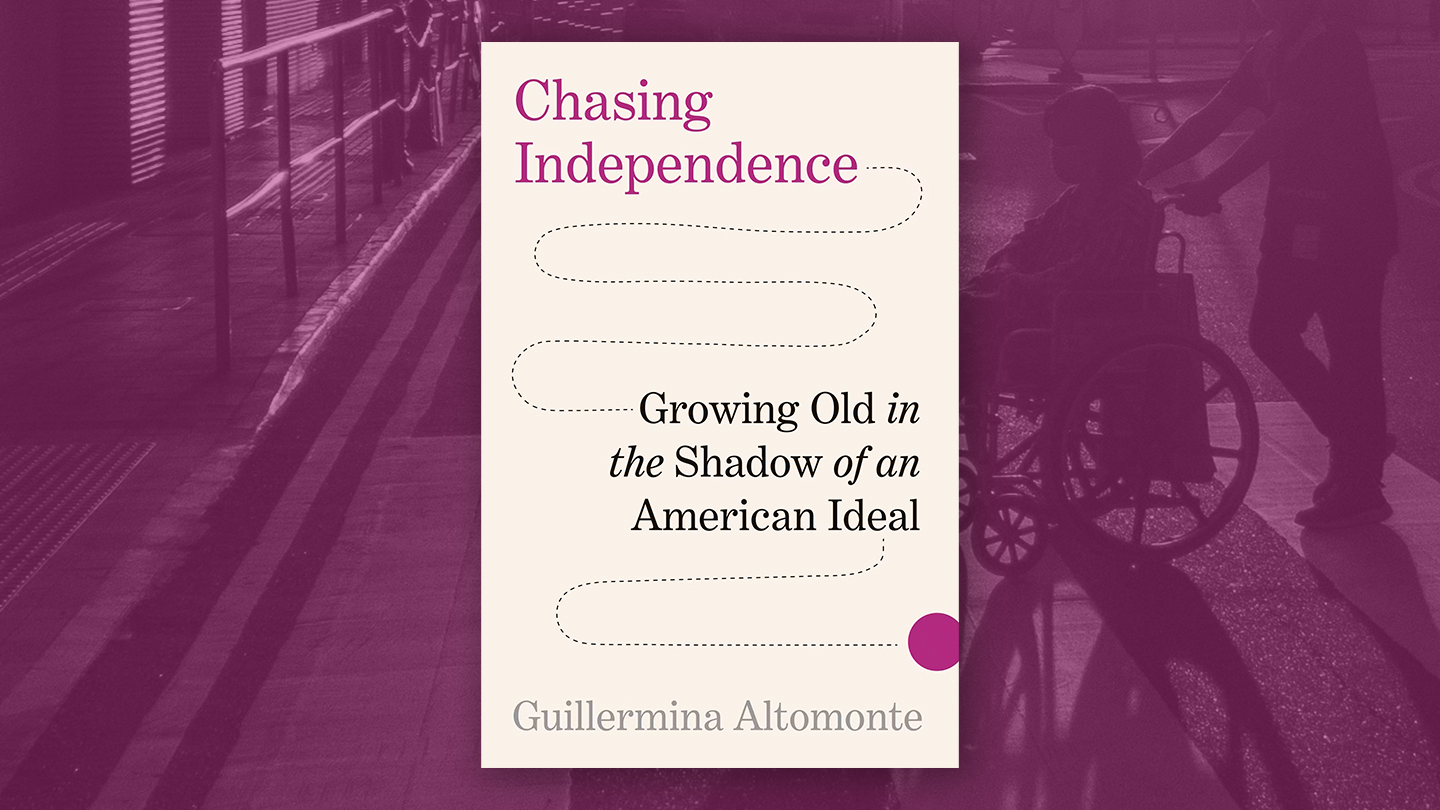
[.article__paragraph--cap][.small-caps]In ideal circumstances,[.small-caps] a doctor works to restore a patient to her former status quo. The broken arm is set, the cancer is cut out, the hormones are titrated back into balance. But, as Guillermina Altomonte chronicles in Chasing Independence: Growing Old in the Shadow of an American Ideal, healing looks different for elderly patients. The men and women who come to Oakville, a skilled nursing facility in New York City, have suffered serious setbacks, and their former lives may be permanently out of reach. Still, their caregivers aim to get them over the threshold of “independence,” which will allow them to be (at least on paper) safely discharged.[.article__paragraph--cap]
To be able to leave Oakville, patients must accept new forms of support: walkers, home health aides, and a much deeper entanglement with their families. All of this help is, as Altomonte observes, framed as a way for vulnerable patients to live “alone” – that is, not in the care of doctors. “It is a place designed to receive old people after an event that has rendered them dependent,” Altomonte writes, “and where old people must work their way out by becoming reclassified as independent.”
Altomonte contrasts the implicit philosophy of the skilled nursing facility with older ways of aging and dying well. She writes:
While medieval writers had approached aging as a mystery, a stage of life imbued with meanings related to God, nature, and spiritual transcendence, modern medicine redefined aging as a process of decline – a decline that could be studied and managed through expert intervention.
For the workers at Oakville and their patients, everything is about preservation, not transformation. How much of a patient’s old life can be salvaged?
If America is the land where the poor are temporarily embarrassed millionaires, it is also the land where the old and dying are temporarily embarrassed autonomous adults. Altomonte sees this play out at the institutional and the individual levels. Karen, a woman whose ulcerous legs limit her mobility, tells Altomonte stories of her life that are all oriented toward the past: her travels, her athletic feats, the male attention she drew. Altomonte feels that Karen tells these stories to convince Altomonte and herself that “her current immobility and chronic pain were not ‘really’ part of who she was. … Her own wounds seemed alien in contrast with a body that had ‘always’ been healthy, active, and beautiful.” She might be reliant on others now (for years on end), but this dependence is a temporary occlusion of her real, independent self.
In this, Karen mirrors the institutional attitude of Oakville. The caregivers at Oakville are working with patients in pain, patients who may be facing a period of unsteady decline, and who have to decide what will motivate them to spend their limited energy on hard physical rehabilitation. For Zach, a physical therapist, this shapes how he talks to reluctant patients, especially those with cancer: “I try to encourage them, because – do you like to be dependent on people to take care of you?” He exhorts them “to take care of yourself, so you don’t need anybody to help you.” It is the obvious indignity of dependence that Zach relies on to justify the present suffering.
Caregivers have to strike a difficult balance. Rehabilitation means asking fragile patients to do things that are very hard for them. I remember how much my father did not want to do physical therapy for his lungs after a bypass, and how my brother stepped in as coach, trying to push him without being cruel. The doctors could repair his failing heart (for a time), but he couldn’t get the full benefit of the surgery without his own work to heal and strengthen his body. No pill or surgery could do what walking did. But where was the ceiling on how much he could do? Who would he be if he never returned to full strength?
Like many vulnerable groups, the elderly and the dying try to escape the stigma associated with their weakness by changing the language that applies to them. Altomonte notes that the American Geriatrics Society and the American Medical Association now specifically discourage the use of the terms “the aged,” “the elderly,” and “senior citizens” to refer to people who are, well, old. Instead, these advocacy groups recommend “older adults” or “older people.”
But the discomfort with their being follows and eventually shades whatever new language is chosen. Steven Pinker called this pattern the “euphemism treadmill.” The word “retarded,” which is pejorative today, was initially intended as a neutral, clinical word that could replace “moron” and “imbecile,” which themselves began as descriptive and became derogatory. What specific stigma are the elderly trying to outrun? As Altomonte reads it, this “vagueness (older than whom?) is fitting for an era in which older people are intent to prove that they are not a distinct social group with distinct needs, but really just like other citizens.”
In this, they are perhaps more correct than they know. The elderly are, indeed, substantially like other citizens in the fact of their dependence. The old differ from the “normal” in that, unlike younger, stronger people, they cannot pass, even for short periods, as that mythical creature, the autonomous human person. Unlike the young, they are becoming aware that their strength, their beauty, their intelligence are things they temporarily steward, not possessions they hold by right. Soon, they will be recipients of the final, unrecompensable mercy: care for their bodies after death.
Altomonte’s book can be read as a story of scarcity. Insurance will only pay for so many days of skilled nursing care, creating incentives to just barely clear the bar for independent living, to turn out old patients and take in new ones. Newly discharged patients struggle to retain the progress they’ve made once they’ve returned home, where they have only partial supports or limited hours of home health. Some of these gaps can and should be filled by more generous benefits and lower administrative burdens.
Better-structured benefits would relieve some of the pressure, but they could not resolve the existential problem at the heart of the book: What does a good life look like when independence is permanently out of reach? When Altomonte arranged her observations at Oakville, her goal was to see how paid and unpaid caregivers shared the load of caring for the elderly. As she watched sessions in the physical therapy room and sat in on “safe discharge” evaluations, the focus of her research shifted. For Altomonte, there was a contradiction at the heart of Oakville’s model: “Old people were pushed into independence even as they evidently needed a lot of assistance.”
Her humane, closely observed book ends with questions, not a list of policy prescriptions. What would a facility like Oakville look like if it acknowledged that some of its patients could not return to their former lives? What models of institutional life would we build if it wasn’t regarded as a temporary, embarrassing waystation on the way back to “real” life? What would form elderly patients to live comfortably with caregivers, instead of prioritizing the appearance of autonomy over the risk of repeat, debilitating falls?
After the book has formally come to a close, the methodological appendix is unexpectedly tender. Altomonte goes over the basic details of her research, then discusses how two of her subjects,“Martha” and “Eva,” slipped into confusion over the course of her observations. In the language of Oakville, they were no longer “fully capacitated.” Each woman had given consent to be interviewed and included in the book, but they were no longer capable of understanding the project or withdrawing consent. Altomonte chose to stop recording her conversations with these women, but she kept in touch, and continued to see Martha, who remained at Oakville. “Martha had grown fond of me,” Altomonte writes, “and sought out my company, as I did hers.” Here perhaps, is the final conclusion of the book: that Martha can be loved when she is no longer “of use.”