Forum
Readers Respond to After Religion
June 15, 2026
Try 3 months of unlimited access. Start your FREE TRIAL today. Cancel anytime.
START FREE TRIAL NOWReaders Respond to After Religion
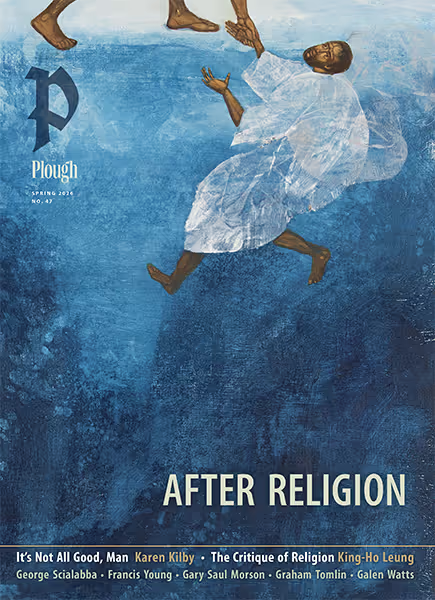
[.smalltext]Readers respond to our Spring 2026 issue, After Religion. [.smalltext]
I can’t recall how my husband and I encountered our first issue of Plough in 2016, but since that time it has become a beloved source of beauty, challenge, learning, and hope. I can’t imagine who I would be now if I hadn’t been molded and shaped by the writings and art that I have encountered in Plough. Rarely have I encountered an issue that didn’t at some point bring me to tears.
My husband and I have been interested in intentional communities (we married while living in one) and we have been so thankful for the example of the Bruderhof, much of which is shared through Plough. I believe that this foundational formation through Plough was part of what made it possible for my husband and I and our four kids to sell our home and most of our possessions this past year to move across the ocean to join in with a prayer community living intentionally in Rotterdam, Netherlands.
Jodi Winger, Rotterdam, Netherlands
On Karen Kilby’s “It’s Not All Good, Man”: This was the article I wrestled most with in this issue, as I tend to celebrate the end of cultural Christianity as a purification. I appreciated the metaphor of physical death, particularly in its uncontrollability. As statistics show the trends, we cannot rely on technique to save us.
However, I also realize that suffering is not automatically redemptive – we must receive the invitation to more deeply trust the Lord. For those who have faith in the Trinitarian God, the real question is not an anxious, “Will the church fail?” but a hopeful, “How will we become more Christlike through this?”
Alan Kreider’s The Patient Ferment of the Early Church makes an argument that we are not called to “change the world” but to first be “transformed” into the mind of Christ.
A further question is, “How will we be the church to our neighbors?” As Amar Peterman asks in Becoming Neighbors, “What will we be to each other if the world doesn’t end [yet]?” Indeed, “conviviality” is figuring out a way to live together across difference.
Pete Ford, Grand Rapids, Michigan
On Galen Watts’s “The Gods of Modernity”: The author states, “There have been murmurings about a Christian revival, about youth flocking back to the churches. What should we make of these claims?” I would urge everyone to go forth and seek the answer! My own experience quite surprised me.
In early 2024 a friend and I began meeting once every other week or so, our children tagging along, seeking to extend on-the-go hospitality to members of our community and perhaps find opportunities to share the good news or encourage other believers. We would find some corner of a busy plaza or park to tuck ourselves into with a little table (beautifully decorated by my friend) with free literature and a sign reading “Free Hot Chocolate, Free Prayer.” (As the weather warmed up, we switched to lemonade.)
When we first spoke to a teenager, I was surprised at the level of openness he expressed. Lovely conversations took place, with the chance to bear the burdens of other believers through prayer. Each journey forth brought us in touch with a new believer or two! The assistant pastor at our small church began to get involved, and was soon invited to the local high school to disciple believers. A youth discipleship group has started at our church and is going strong. And every week, our prayer chain rejoices over new family members in Christ – at first a few, but within months, over one hundred! Praise God!
Megan, California
On Ryan Burge and Lyman Stone’s “Secrets of the Vanishing Church”: This is an interesting article! But it avoids the million-dollar question: the institutional church has a remnant in it – that remnant is the church Jesus meant! The church was never meant to be institutionalized. The word “church” is better translated “congregation.” The villain is King James, who specifically authorized the King James Translation by insisting that έκκλησία (ekklēsia) be translated “church,” or else he would not authorize it, and translators would be branded as heretics and traitors to be executed. He did this to preserve his political hold on the “church.” The remnant is found everywhere, in and out of the institutions, and is independent of the institutions. On the metric, the church has never been stronger!
Anton Hoffmann, Santa Barbara, California
On Jason G. Edwards’s “The Weight of a Tender Conscience”: Thank you for writing this article. This is an issue that I have struggled with for years, mostly due to my natural disposition and tendencies, but at times, aggravated by the church even when a gospel of grace is clearly taught. I have in mind those times when I was a young Christian in college and books like Don’t Waste Your Life (Piper) or Radical (Platt) were making the rounds, or those books on personal holiness like Not Even a Hint (Harris) that contributed to a hyper-scrupulosity. I don’t blame those books – much good came about from them – and admittedly, my disposition could skew their impact on me, and I imagine for others too. It has been helpful in the last few years to see more writing like this article that helps highlight something I suspect many suffer with and helps cast a clearer vision for what ordinary, faithful Christianity looks like.
Jeffrey Moore, Boise, Idaho
On Randi Kelder’s “Forgiving Myself”: Thank you for sharing your story. That you took all that pain and turned it into something positive to help another struggling with addiction is a testament to your heart. It’s sad how the stigma of asking for help takes such a toll on so many lives. Many will never get the opportunity to live a better life in recovery unless they challenge those assumptions. But recovery is possible. I speak from personal experience.
My heart gets heavy when I think of all the people I knew who were lost to addiction. Good people caught in the snare of a powerful negative force. I’m thankful to be living a clean and sober life today. It has not always been easy but it’s so very worth it, and I never could have done it alone. It has been the help of others, others who ignored the stigma and gave of themselves in any way possible to help others struggling with addiction, that has helped me.
Scott Tammaro, New Castle, Pennsylvania
[.smalltext]Send letters to letters@plough.com.[.smalltext]