Essay
No Longer a Slave
Paul’s letter to Philemon about his former slave Onesimus shows how the Gospel transfigures relationships.
November 9, 2026
Try 3 months of unlimited access. Start your FREE TRIAL today. Cancel anytime.
START FREE TRIAL NOWNo Longer a Slave
Paul’s letter to Philemon about his former slave Onesimus shows how the Gospel transfigures relationships.
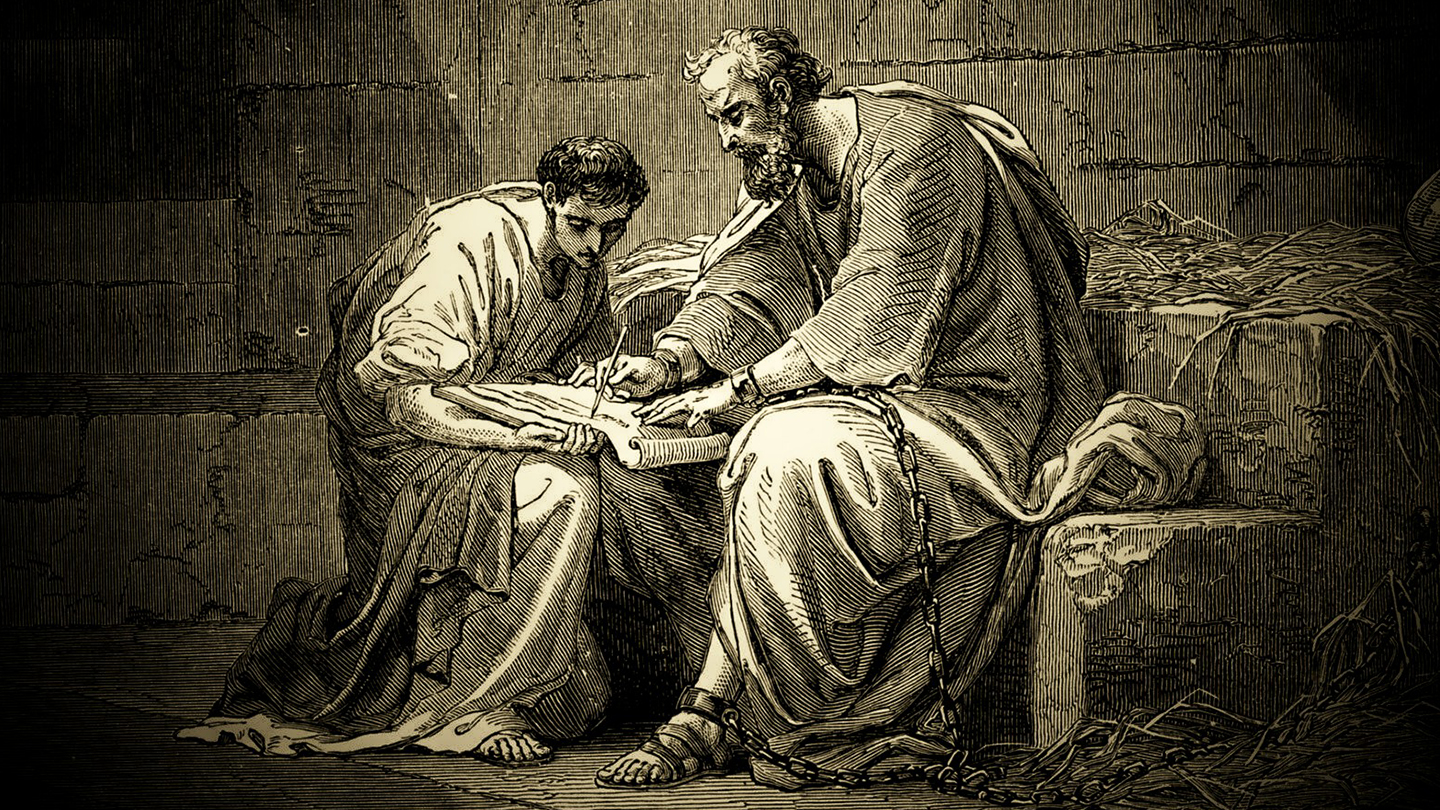
Gustave Doré, Saint Paul in Prison, 1886. [.smalltext]Wikimedia Commons (public domain).[.smalltext]
[.article__paragraph--cap][.small-caps]Of the many privileges[.small-caps] of pastoral ministry, one of the most precious is the moment that comes just before the call to worship. Just after I climb the steps to the lectern, in the seconds before I address the gathered community, there’s the briefest of spaces when I can look out and behold within the congregation the faces of the men and women who I have come to know and love. In that moment I glimpse those faces, I am reminded of stories that accompany each visage. Souls struggling with quiet dignity in impossible situations. Saints living hidden lives of love. Women and men facing sickness and death with resilient hope. It’s quite a thing to behold.[.article__paragraph--cap]
What I see in that half-moment of time before I speak words of welcome and invocation is God’s people on pilgrimage. On Sunday mornings our respective paths convene as we gather together for a moment of refreshment and fortification. Judged by exterior appearance, our paths might appear different, each of us making our way through different realities, each of us giving different answers to the question of what love demands. But those appearances belie the more fundamental thing that unites us as pilgrims. We’re all traveling together to the New Jerusalem. And as we go, we are being changed, transformed more and more into the persons we were made to be.
Personhood is both gift and responsibility. It is gift in that each of us is named an image bearer, a title that comes to us irrespective of ability or accomplishment. Disabled, clinically depressed, defeated by addiction or tragedy: nothing can rob us of our dignity as persons. But personhood is also responsibility in that we are summoned to live in to that dignity as we face and move into life’s demands. Will we, more and more, become persons who reflect the dignity of the One whose image we bear?
That is not a summons we can answer alone. We gather as fellow pilgrims on Sunday mornings not only because we need to hear the summons again and be reminded of the call, but also because we need one another as fellow travelers who strengthen, encourage, and refresh us. We need a company of friends if we are ever going to arrive finally at home.
This insight does not belong exclusively to Christians; many others have also understood that friendship was essential to flourishing personhood. Perhaps the greatest of these classical reflections comes to us from Cicero in his famous text, On Friendship. There is a long and noble tradition of plundering pagan wisdom for the sake of serving God’s people. Does Cicero give them what it is they need to forge the friendships they need? One does not have to read far in this book before discovering that there is much that recommends itself. Cicero speaks of the goodness of friendship with an enthusiasm that is in our own time reserved for romantic love: “What is sweeter than to have someone with whom you may dare discuss anything as if you were communing with yourself? How could your enjoyment in times of prosperity be so great if you did not have someone whose joy in them would be equal to your own?”[.footnote-link]1[.footnote-link] The insights of his times speak to the deficits of ours; we all too often ask our romantic partners to bear the full weight of our pilgrim journey when others were meant to walk beside us. Cicero invites us to find that same kind of companionship in friends.
Cicero also speaks to the prejudices we bring to friendship. We wish we were self-reliant and strong; friendship seems like an acknowledgement of some defect or weakness. But Cicero tells us that we were made for friendship – it is in our nature. “The greatest advantages will be realized from friendship, and its origin, being derived from nature rather than from weakness, will be more dignified and more consonant with truth. For on the assumption that advantage is the cement of friendships, if advantage were removed friendships would fall apart; but since nature is unchangeable, therefore real friendships are eternal.”[.footnote-link]2[.footnote-link] Our need for friends reveals not our weakness, but something deep in our being as persons.
There is much to praise in Cicero’s full-throated endorsement of friendship. But there is also a fragility to it that leads me to doubt its usefulness for the pilgrim journey of the saints. Cicero is anxious about unequally yoked friendships: what do you do when it becomes clear that both parties are not equally virtuous? “There are often in friends outbursts of vice which affect sometimes their actual friends, sometimes strangers, yet so that the infamy of the evil flows over on to the friends.” His answer is that you must tactfully unwind friendship: “Therefore the ties of such friendships should be sundered by a gradual relaxation of intimacy.”[.footnote-link]3[.footnote-link] Perhaps this counsel made sense in the waning days of the Roman Republic; it’s less helpful for those looking for faithful companions in the transience of modernity.
There’s also a frankly elitist tenor to Cicero’s understanding of friendship. Friendship as a good can be pursued by a certain kind of man (the exclusiveness of the noun is deployed intentionally) who has a certain kind of means. Friendship is “cultivated by those who are most abundantly blessed with wealth and power and especially virtue, which is man’s best defense; by those least in need of another’s help; and by those most generous and most given to acts of kindness.”[.footnote-link]4[.footnote-link] These are undoubtedly the ideal conditions for friendship, but the traveling conditions of God’s people are rarely so accommodating.
There is much to glean from Cicero. But as wise as his insights are, and as profitably as they might be applied, they are too often too lofty, floating above the grittier realities of our journey to the New Jerusalem. The people I look out upon on a Sunday morning come from differing vocations, different socioeconomic profiles, and live in the cross-pressures of diverse conflicts. They need a vision for friendship that lives closer to the ground, that can be lived out in the tensions and ambiguities and pressures that unyieldingly push us away from one another. They need sturdier footing than Cicero gives them, a Good that will give them more profound resources so that they might endure. Where can they, and we, find a vision for friendship that will sustain them on their way to the New Jerusalem?
A surprisingly relevant description of friendship can be found tucked away on a single page in the Bible, just after Paul’s pastoral instruction to his friend Titus and just before the Letter to the Hebrews. On that single page we see a whole theology of friendship in nuce, seen as a pastor, pondering the complex relational dynamics of two people in his congregation, gives counsel to two men on how they must live together as friends and fellow travelers in spite of all the various reasons they might choose otherwise.
Philemon holds a unique place in the Bible: a letter from Paul, written to his friend Philemon of the church in Colossae, likely carried by the individual that it is ostensively about, Onesimus. Onesimus was once a slave, having become for some unknown reason an indentured servant in Philemon’s household. For reasons that are similarly unknown, he fled Philemon and his labor in Philemon’s household, eventually encountered the imprisoned Paul, and then, through their relationship, encountered and gave his life to the risen Christ. And now Onesimus returns to Philemon, a former runaway and thus offender of Roman law, bearing a letter from Paul about what will become of their now fraught relationship.
The word “friendship” does not appear in Philemon. Relationships are described in many other ways: brother, worker, soldier, father, debtor. But friendship is nonetheless silently present, a single question, posed in multiple ways, that must be answered by Paul and Onesimus and Philemon. How will these three be friends? What sustains the vision of friendship in the letter to Philemon? What does love require of us as we make our pilgrim way? The answer is found in Paul’s letter.
Friendship requires trust. Onesimus bears this epistle back to his former master, Philemon. The letter he carries argues that “master and slave” can no longer describe the relationship that now exists between the carrier and the recipient. The gospel, a message of liberty to captives set within a story of slaves set free from bondage, has transfigured this relationship and made the old categories obsolescent. Onesimus no doubt knows that is what this letter argues; what he does not know is how this declaration will be received. Will Philemon agree with Paul, or will he insist upon his material rights and attempt to reenlist his erstwhile servant under the former terms, or even to punish him through Roman law? Onesimus does not know, but he nonetheless delivers the letter, trusting that a new beginning is possible in this friendship.
Friendship requires grace. Philemon has, within his culture’s frame, the right to believe that he has been wronged. When Onesimus fled, he lost a valuable “commodity” in his household. And now Onesimus has returned. Paul is attempting persuade Philemon to give up his rights and to absorb this loss. Forgiveness is no theoretical category here: it will seem absurd to the watching world and it will prove costly to Philemon, both financially and in terms of honor. There is no room here for a Ciceronian analysis of the cost-versus-benefit value of Onesimus’s friendship. There is only the call to forgive and accept his former slave as Christ has accepted him: as a friend. Aristotle would hold that the two men are now friends in a truer way, because they are friends in the Good, who, shockingly, has turned out to be a person.
Paul’s letter to Philemon possessed in acorn form an insight that would later become a mighty oak: the relationship between master and slave was not something that should exist among God’s pilgrim people. How could God’s people journey together on the way to becoming persons if this institution was allowed to keep men and women in its shackles? Indeed, how could those who kept others in bondage themselves become persons of love if they continued on in this practice? Paul’s acorn insight would rightly come to disrupt and displace slavery’s evils in his and our time.
And friendship requires courage and conviction. Paul writes this audacious letter, advocating on behalf of a new friend, to an old friend, a friend wealthy enough to have bondservants in his household, and a prominent friend in a fledgling church. We could excuse Paul if he had decided that now was not the time to bring up this issue. But Paul does not duck the moment that has come to him. He stakes his argument on the conviction that the gospel has made a claim on Philemon’s life, just as it has made a claim on his own. Something new is at work in the world, and so Paul submits himself to the story of the gospel and follows the implications where they take him: Onesimus is no longer a slave, but now a brother.
And so the letter ends, leaving us to imagine how it was received and what happened next. History has given us no record of what happened to Onesimus and Philemon, nor detailed Paul’s further relationship with them. But what we have been given in the letter to Philemon is a vision for friendship and the resources that the Christian faith has to sustain this much needed institution in the conflicts and complexities of life.
I look out on the congregation on Sunday morning. God’s pilgrim people are gathered once more, weary and worn from answering the summons of love this past week. God, in his wisdom, has providentially placed them in places where their answer is the means by which they will become the persons they are called to be. But now they are hungry, eager for the refreshment that pilgrims need in order to begin again in the week to come. And so together we hear the words that Paul himself wrote as he began his little letter, the words that bound him and Philemon and Onesimus together in friendship then and that bind us together today: “Grace to you and peace from God our Father and the Lord Jesus Christ.”