Essay
How Should We Read the Bible?
The Bible records God’s work in history, work that continues today.
August 26, 2026
Try 3 months of unlimited access. Start your FREE TRIAL today. Cancel anytime.
START FREE TRIAL NOWHow Should We Read the Bible?
The Bible records God’s work in history, work that continues today.

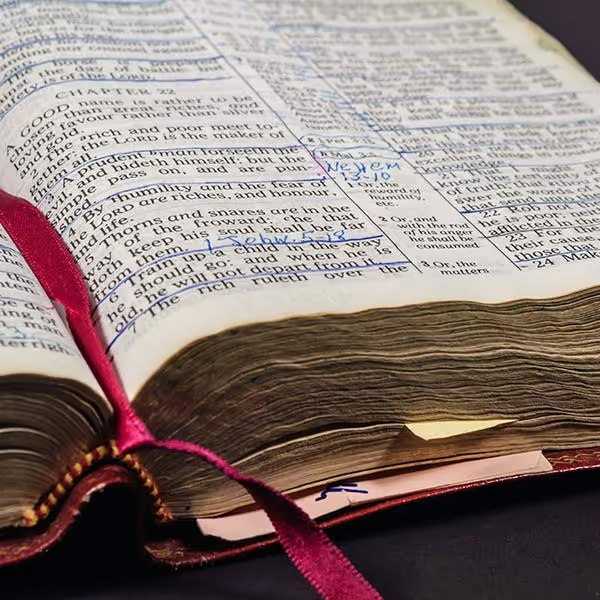
[.smalltext]Photograph by Jacob Bentzinger / Unsplash.[.smalltext]
[.article__paragraph--cap][.small-caps]This is a problem[.small-caps] that has occupied me for some time. I took my first college-level Bible class thirteen years ago, and in the years since, I’ve had the chance to study the Bible at the undergraduate and graduate level with some of the best-known scholars in biblical studies.[.article__paragraph--cap]
Yet I’ve also spent several of those years living and working alongside faithful Christians who have no academic training in biblical interpretation. And I’ve had to see, again and again, that often my untrained brothers and sisters in the faith are better readers than I am. They’re better attuned to some nuances of the text that I sometimes overlook, and the life of faith through which they read leads them to often ask better questions of the text than those I find myself asking.
All this leads me back, based on my own background as a student and Christian, to the problem of reading the Bible. When we open that book, what is it we should be doing? How should we be doing it? There are, depending on your faith tradition, all kinds of theories about this. But the theories are confusing. What is the difference between inerrant and infallible? What is “perspicacity,” anyway? These are all important concepts, but what do they mean?
Many of the theories of scripture that my brothers and sisters in other faith traditions hold share a common characteristic: they treat scripture as an end to itself. What we believe about scripture matters, then, because the Bible is an article of faith on the same level as belief in the virgin birth and resurrection of the Messiah. Or, in the Western tradition, beliefs about scripture might be placed on the same level as certain beliefs about the relationship between the Father and the Son, setting the West apart from its Orthodox comrades.
It would be fair to say, I think, that in some corners of Christendom what you believe about the Bible is part of what makes you a Christian. This is especially true in American evangelicalism. Since the days of Carl Henry, Norman Geisler, and others in the 1980s and ’90s, a torrent of literature has emerged to defend or dispute the doctrine of inerrancy. And when scholars within the same confessional boundaries offer critiques of the inerrantist view, they risk both reputation and job. I myself witnessed it from a distance. A former professor of mine was dismissed after publishing an academic work that, in passing, called normative evangelical beliefs about Scripture into question. And the doctrine of inerrancy is just one example of the ways in which our belief about the Bible can divide us.
What if there was a different way to approach this whole question? What if – for lack of a better phrase – there was a “more excellent way”? I think there is. I do not pretend to think that this will take away the problem. Nor do I set myself up as an authority on scripture or on anything else. But I have seen from experience over these years of immersion in the Bible that there is a way to resolve many of these questions of what it is, what it does, and how we should read it.
The easiest way to describe this would be to say that we should treat the Bible not as an end unto itself, but as a means to an end. To formulate it a different way: the Bible is not the Word of God. The Bible contains the Word of God, but it is not the Word of God. Jesus is the Word of God – that is something we can all agree on. So what is the Bible, then?
There is one thing we can say for sure about the Bible: it is an authoritative witness to the Word of God. Whether through direct access or indirectly through others, the Bible is essential to getting to know the Word of God. But it is not the Word of God. The Bible does in fact contain words that God spoke to Moses, to the judges and kings, to the prophets. When we read these words, we are reading the words of God. Yet the Bible does something else, something bigger, which I think can help us solve the endless disputes about scripture: it records God’s work in history.
That might seem like a truism. Of course the Bible records God’s work in history. But if we make that our working definition of the Bible, it accomplishes three important things for us: it situates the Bible appropriately, it gives God the glory, and it allows us to be more sensitive to God’s continuing work in history.
Let’s talk about each of those things. First, saying that the Bible is a witness to God’s work in history allows us to situate the Bible appropriately. It means that we can acknowledge as fellow-believers that conflicting beliefs about the nature of scripture do not need to divide us. We can have honest disagreements about the nature of the Bible, but these disagreements need not stand in the way of our fellowship in Jesus. Because, after all, the Bible is not the point. The point is that God spoke and worked in history, and that this speaking and working culminated in the life, death, and resurrection of Jesus Christ.
Second, agreeing that the Bible is primarily a witness to God’s work in history gives God the glory, because instead of focusing on the words that tell about God’s work, we keep our eyes on the work itself. We don’t, for instance, worry about the hundreds of differences between the gospels. Instead we marvel at the deeds of Jesus and the way God used his Son to accomplish great things and set something in motion that is still at work today. We don’t, let’s say, obsess over whether there are three different Isaiahs within one biblical book – we rather pay close attention to the love of a God who called his people, over and over again, to come back to him in repentance.
Finally, if we say that the Bible is a witness to God’s work in history, it allows us to see the book for what it is (a collection of ancient documents far removed from our time and culture and language). This in turn makes room for us to see that God has kept working. I, for one, believe that in spite of the messiness of the process by which it was collected and redacted, we have the Bible God wanted us to have. So if God could work in that complex, messy process, how much more can he work with us! We know the process by which the Bible was formed is full of people just like us, who believed in God as we do, but who also made mistakes as we do. Seeing them as people just like us allows us in turn to open our hearts to the possibility that God can work with us like he worked with them. If God could guide the rabbis at Yavneh and the early Jesus movement communities around the Mediterranean to agree on the books that would be right for us to have, then surely he can keep working in our day, too.
If all this is true – if we are supposed to leave the Bible as just a witness to God’s work, then what about all those other things? What about “all scripture is God-breathed”? (2 Tim. 3:16) All Scripture is God-breathed! It is an even greater miracle than the Protestant doctrine of inspiration that God can use these ancient stories, poems, songs, and prayers passed down to us over thousands of years and still can speak to us through them. Every one of us who has opened the pages of the gospels and encountered Jesus there knows that this is possible. And it is in those moments – those encounters with the real person behind the text – that we know that the text itself is not the point.
But here’s the best part: treating the Bible this way allows us to focus on one of the best things it can do for us: teach us. If we believe that the Bible is a witness to real events that happened to real people, and if we focus on those people and what they heard and what God did with them, then we can learn from the Bible. That is what the author of 2 Timothy was driving at: not that the words themselves are endowed with a special holiness, but rather that they are “useful for teaching, for reproof, for correction, and for training in righteousness.”