Bonhoeffer’s Lifelong Search for Christ
From boyhood to his last letters, Dietrich Bonhoeffer grappled with how to live a life for Christ.
August 28, 2026
Try 3 months of unlimited access. Start your FREE TRIAL today. Cancel anytime.
START FREE TRIAL NOWBonhoeffer’s Lifelong Search for Christ
From boyhood to his last letters, Dietrich Bonhoeffer grappled with how to live a life for Christ.
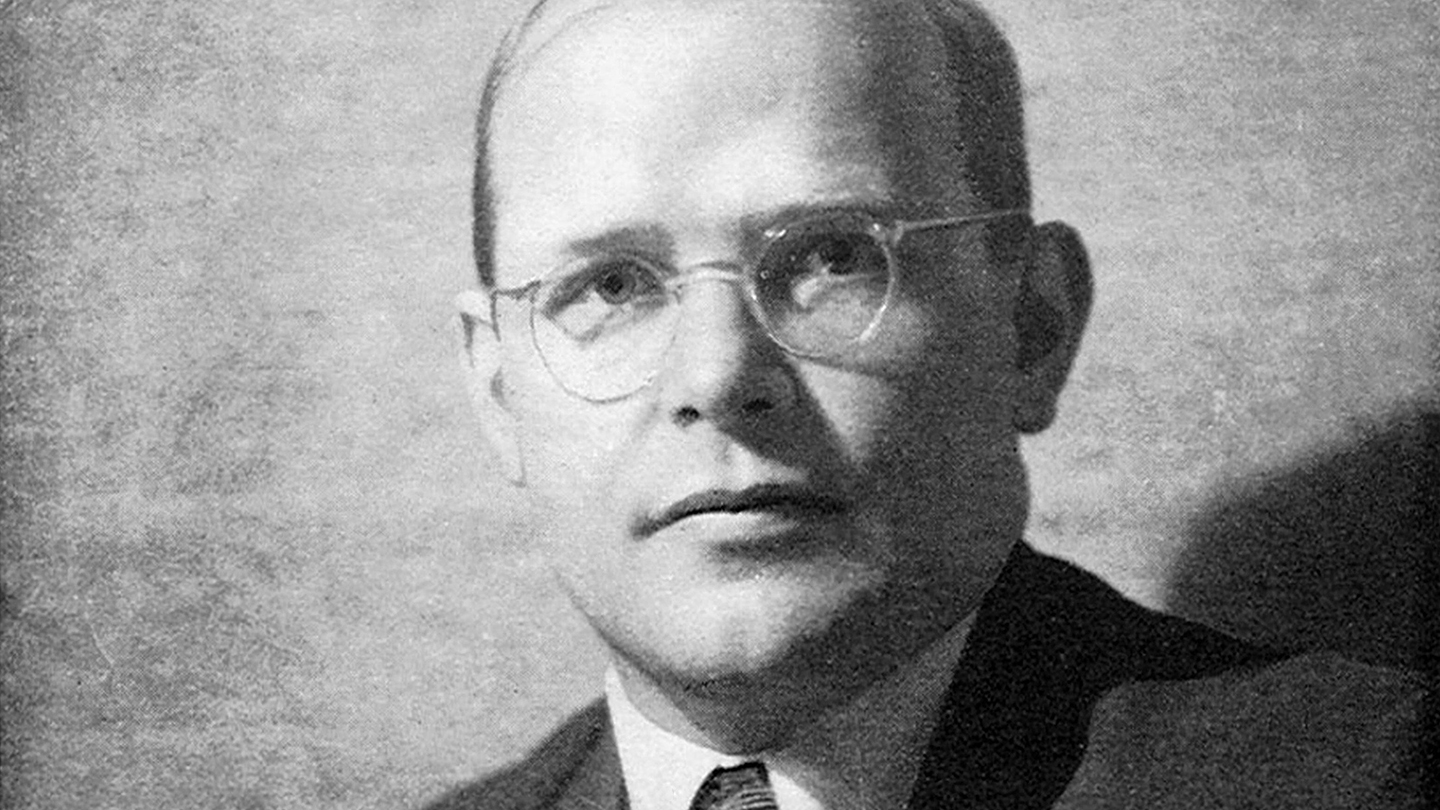
[.smalltext]World History Archive / Alamy Stock.[.smalltext]
[.article__paragraph--cap][.small-caps]The German theologian[.small-caps] Dietrich Bonhoeffer was born into a nominal Protestant family. His mother set a moderate tone of piety within the home: grace was said at mealtimes; evening prayers were routine. Practically, from day to day, a tolerant empiricism – consistent with the father’s atheism – provided the atmosphere of the family.[.article__paragraph--cap]
In the summer of 1919, at the age of thirteen, young Dietrich joined the Boy Scouts. On Sunday mornings they conducted mock drills and battles, which he enjoyed. He seemed unaware that some Germans attended church services on Sunday mornings. That same year, for reasons unknown, he announced he was going to be a theologian. Though there were theologians and clergy in the lineage of his mother and father, Dietrich’s declaration that he would give his life in service to the church was met with questions. His father feared that his quite gifted son would be consigned to “a quiet, uneventful minister’s life.” Several in his family were confused. Why would he devote himself to “a poor, feeble, boring, petty, and bourgeois institution” such as the church? Young Dietrich did not dispute their characterization. He simply replied with confidence: “In that case, I shall reform it.” No one could have known how prophetic Dietrich’s words would prove – or how untrue his father’s.
In April 1924, eighteen-year-old Dietrich traveled with his brother Klaus to Italy, to see “European culture in its purest form” – St. Peter’s Basilica, the Sistine Chapel, the Colosseum, the Pantheon, and the great works of Michelangelo and Bernini. As recorded in his diary and letters, this trip would prove to have a formative impact on his theology. Arriving with Karl Baedeker’s Central Italy and Rome guidebook known “by heart,” Dietrich was overwhelmed by the extraordinary sights of Rome, with some disappointments from his high expectations. But as he engaged with expressions of Catholic faith more deeply, he was moved. The beauty of the art and music ignited his senses – conveying a sense of the glory of God. During a Palm Sunday vespers service at the Trinità dei Monti, Dietrich was struck when forty young girls, dressed in nuns’ habits, led the Easter evensong. “The impression left by these novices was even greater than would have been left by real nuns, because every trace of routine was missing. The ritual was truly no longer merely ritual. Instead, it was worship in the true sense. The whole thing gave one an unparalleled impression of profound, guileless piety.” Through these experiences he sensed that he had glimpsed something of “the reality of Catholicism.” In fact, he commented that he was quite simply “beginning to understand the concept of ‘church.’” This included seeing the “universality of the church” in ways he had never seen before, including members of religious orders of various races and nationalities all “united under the church.”
Later in this trip he observed a baptism, accompanied by good choral music, at the Baptist Church of Roma Trastevere, which he described as a “sect” – an early twentieth-century sociological designation for smaller religious groups that operated counter to “the church” – that is, the large, often state-led institutional religions. His encounter at Trastevere caused him to reflect critically on established (territorial or state) churches and, especially, the Protestant Church in Germany. “Maybe Protestantism should not have tried to become an established church; perhaps it should have remained a large sect,” he wrote, for “when the official ties of state and church have been severed, the church is confronted with the truth.” Released from this distorting marriage, the church, he thought, might then “represent an unusual phenomenon of religious life and serious thoughtful piety. It would therefore be the ideal form of religion, which is sought after in so many ways today. It is not the content of the gospel of the Reformation that repels people so much as the form of the gospel, which one still tries to tie to the state. If it had remained a sect, it would have become the church the Reformers intended.” He seemed to be pondering whether it might be possible to combine the best of Catholicism with the polity of “sectarian” Protestantism.
Having spent the Holy Week in Rome, Dietrich and Klaus continued south to Sicily, and then decided to board a ship to Libya, where Dietrich experienced the “tremendous contrast” between Italy and Africa. In a letter to his parents, he offered reflections on the Muslims he observed in Tripoli. Their way of life and piety, he said, reminded him “in an astonishing way of Old Testament scenes and atmosphere.”
In Islam, everyday life and religion are not separated at all. Even in the Catholic Church they are separated, for the most part. At home [in the Protestant world he observed] one just goes to church. When one returns a completely different life begins. It is thoroughly different for the Muslims.
These experiences – and their theological ramifications – would stay with Bonhoeffer for the rest of his life.
[.article__paragraph--cap][.small-caps]Of equal or even more[.small-caps] significance was Bonhoeffer’s introduction to the writings of the theologian Karl Barth that winter. New Testament scholar C. Kavin Rowe has succinctly captured the theological contributions of Barth that would revolutionize Bonhoeffer’s own understanding of the Christian faith: “God is the measure of all things. To speak properly of God in Barth’s sense is not to speak of the grandest object within our horizon but of the reality that constitutes the total horizon of all human life.” He continues, “the hermeneutical corollary of Barth’s insight is of momentous consequence and can be simply stated: what we think about God will determine what we think about everything else.” In other words, theology is never merely about ideas. “It is always and inherently a total way of life.”[.article__paragraph--cap]
This approach to theology would decisively inform Bonhoeffer’s doctoral thesis, Sanctorum Communio, “The Communion of the Saints,” written in 1927. As the subtitle, “A Dogmatic Inquiry into the Sociology of the Church,” indicates, this work is an ambitious, multilayered study, borrowing extensively from sociology to understand the Christian church as a community made up of humans that are inherently social in nature. Within the church, Bonhoeffer claims, “the concepts of person, community, and God are inseparably and essentially interrelated.” When one enters the body of Christ, one exits the world of “Adam” – of sin – and through faith enters the transforming world of the living, what Bonhoeffer describes as “Christ existing as church community.” He writes, “Faith acknowledges God’s rule and embraces it; love actualizes the realm of God.” Bonhoeffer argues that we only truly know what love is through Christ. We come to know that such love is possible only through faith in Christ and the power of the Holy Spirit: that it is volitional and purposeful; that it loves real neighbors; that it knows no limits.
Following the completion of his thesis, Bonhoeffer spent a year in Barcelona, where he worked as an assistant pastor in a German-speaking congregation, before returning to Germany in February 1929. Within a few months, he would begin work on a second thesis, Act and Being, which would qualify him to teach in German universities. His thesis was submitted in March 1930; his first formal lectures at the University of Berlin were given in July. By early September, Sanctorum Communio would be published, and Bonhoeffer would be on board a ship bound for New York City.
Bonhoeffer’s primary purpose in going to New York was to study at Union Theological Seminary, and though his time there was a mixed experience, he would learn much. More important to his future were several friendships and his experiences with the large African American congregation at Abyssinian Baptist Church in Harlem, pastored by the dynamic Adam Clayton Powell Sr. Before visiting Abyssinian, Bonhoeffer had visited both fundamentalist and liberal white Protestant churches. The contrast he saw was stark. In Abyssinian, wrote Bonhoeffer, “one really could still hear someone talk in a Christian sense about sin and grace and the love of God and ultimate hope, albeit in a form different from that to which we are accustomed. In contrast to the often lecture-like character of the ‘white’ sermon, the ‘black Christ’ is preached with captivating passion and vividness.” And this vividness elicited passionate responses from the congregation. In addition, worship was not divorced from service to the community that surrounded the church building, nor from challenging racism.
For six months, Bonhoeffer was actively involved in the life of Abyssinian Baptist Church. He taught Sunday school, helped in weekday classes once a week, led a Bible study for women, worked in a boys’ club, and spent time visiting and helping in a number of congregants’ homes. Additionally, through reading and his friendship with Union student Albert Frank Fisher, who had introduced him to Abyssinian, Bonhoeffer attempted to learn more about racism in the United States.
In addition to Fisher, Bonhoeffer became friends with several other fellow students, including Jean Lasserre, a French Reformed pastor, who was the first pacifist Bonhoeffer had met of his own generation. In a letter written in 1936, Bonhoeffer refers to how his time in New York City was transformative. When he had arrived, he “was not yet a Christian,” but while there, he experienced a “great liberation.” He became convinced that “the life of a servant of Jesus Christ must belong to the church.” He gained a clarity about his own vocation as a theologian in service to the church. And he came to see “pacifism as utterly self-evident.”
[.article__paragraph--cap][.small-caps]Toward the end[.small-caps] of June 1931, after brief visits to southern portions of the United States, Cuba, and Mexico, Bonhoeffer returned to Germany. In August, Bonhoeffer would, for the first time, become formally involved in the ecumenical movement. As his biographer, Eberhard Bethge, says, “The emerging world of the Protestant ecumenical movement became a vital part of his theology, his role in the church struggle, and ultimately his political commitment.” Over the next few years, Bonhoeffer would present several talks to these gatherings, arguing that Christians should not participate in war. In fact, it was his commitment to peace that kept him connected to the movement, despite, as he saw it, its inadequate theology.[.article__paragraph--cap]
Simultaneous with Bonhoeffer’s entry into the Protestant ecumenical movement was Adolf Hitler’s rise to power. On January 30, 1933, Hitler was appointed Reich Chancellor. In April, responding to the first major anti-Semitic legislation passed by the Nazi regime, Bonhoeffer would write his essay, “The Church and the Jewish Question,” which he published in two journals. In the essay, Bonhoeffer calls for four actions on the part of Christians. First, individual Christians, as individuals and as members of “humanitarian associations,” should accuse the state of “inhumanity” when it is called for. The other three are actions of the church as a whole. The church should question the state if it is not doing what it should be doing, that is, it should promote law and order, not disorder or the removal of rights. Second, “the church has an unconditional obligation toward the victims of any social order, even if they do not belong to the Christian community.” And third, the church should “not just bind up the wounds of the victim beneath the wheel,” but should know that it may need “to fall into the spokes of the wheel itself” in order to stop such violent, unjust acts of the state. Bonhoeffer also repeatedly charged church leaders with heresy when they excluded Jewish Christians from church membership or from being members of the clergy on behalf of the church.
For much of 1933, Bonhoeffer would be actively involved in working with other like-minded church leaders to try to keep the Protestant Church from being co-opted by Nazism. This culminated in his being asked to co-author a potential confession for what was emerging as “The Confessing Church.” On August 20, in the midst of working on the confession, Bonhoeffer sent a letter to his grandmother:
It is becoming increasingly clear to me that what we are going to get is a big völkisch national church that in its essence can no longer be reconciled with Christianity, and that we must make up our minds to take entirely new paths and follow where they lead. The issue is really Germanism or Christianity, and the sooner the conflict comes out in the open, the better. The greatest danger of all would be in trying to conceal this.
Amid the discouragement expressed in this letter, Bonhoeffer, along with his close friend, Franz Hildebrandt (a Jewish Christian), considered abandoning the Protestant Church and starting some sort of free church. That did not happen. But in October, he left Germany to pastor two small German-speaking congregations in London. In a letter to Karl Barth, Bonhoeffer noted that he had left Germany for serious discernment. Why did he disagree with most of his friends on so many matters? Was he being dogmatic? Was he wrong?
After he had been in England for almost a year, he was asked to consider returning to Germany to direct a seminary for the Confessing Church. As he weighed this possibility, he wrote to his Swiss friend, Erwin Sutz: “The next generation of pastors, these days, ought to be trained entirely in church-monastic schools, where pure doctrine, the Sermon on the Mount, and worship are taken seriously.” When he expressed these ideas to his agnostic brother, Karl-Friedrich, he was told that he sounded like a fanatic. “I myself am sometimes afraid of that,” Dietrich responded, “but I know that the day I became more ‘reasonable,’ to be honest, I should have to chuck my entire theology.” He added, “Things do exist that are worth standing up for without compromise. To me it seems that peace and social justice are such things, as is Christ himself.”
[.article__paragraph--cap][.small-caps]In the spring of[.small-caps] 1935, Bonhoeffer would be back in Germany, launching the Finkenwalde seminary to train pastors for the Confessing Church. For the next two years, Bonhoeffer sought to create a formative seminary experience that embodied this “new kind of monasticism.” His lectures on discipleship would provide the theological and spiritual anchor for this training. In 1938 he would attempt to capture their “life together” in a book by that title. In September of 1937 the Gestapo forcefully closed the seminary at Finkenwalde, though before the year was out, Bonhoeffer had managed to find a way to continue training in remote places, and would continue thus until the spring of 1940.[.article__paragraph--cap]
Bonhoeffer’s book Discipleship was originally presented as lectures to his students. Amid discussion of the Sermon on the Mount, he offered reflections on “the visible church community.” Followers of Jesus, he says, “are the visible community of faith, their discipleship is a visible act which separates them from the world – or it is not discipleship. And discipleship is as visible as light in the night, as a mountain in the flatland.” In the second half of the book, he developed this thought into a whole chapter. At the seminary, he was seeking to create a community in Christ that would be a visible light for the world, a new kind of monasticism. However, as he put it in Life Together, “the goal is not monastic isolation but rather the most intensive concentration for ministry to the world.” He hoped that such a community would plant “the Word of God so soberly and deeply in their heart that it holds and strengthens them all day long, leading them to active love, to obedience, to good works.”
In the spring of 1940, the Gestapo closed Bonhoeffer’s seminary for good. His brother-in-law, Hans von Dohnanyi, worked for the Abwehr, a military intelligence agency, and it appears that Bonhoeffer met with Dohnanyi and his boss, Hans Oster, both prominent figures in the anti-Nazi German resistance, in order to become a civilian “intelligence agent.” Oster could make the case to the relevant authorities that Bonhoeffer’s work as an agent was “necessary for the welfare of Germany,” which would make him ineligible for military conscription. Dietrich had been making arguments since 1932 that Christians should be conscientious objectors to war; since 1939 this had become a pressing personal issue. Working for the Abwehr would both allow him to avoid conscription and continue working for the Confessing Church, including writing on a book on ethics.
Ethics, like Discipleship, is fundamentally shaped around the centrality of Jesus Christ. It is a complicated, unfinished set of manuscripts. But we do see a reiteration of themes that had been of central importance to Bonhoeffer since the early 1930s. One of these is the visibility of the church community. “The church of Jesus Christ is the place – that is, the space – in the world where the reign of Jesus Christ over the whole world is to be demonstrated and proclaimed.” Rather than imagining that discipleship is simply obeying some teachings of Jesus, formation could occur “only by being drawn into the form of Jesus Christ.”
[.article__paragraph--cap][.small-caps]Bonhoeffer was still[.small-caps] at work on Ethics almost up to the time he was arrested on April 5, 1943, for his involvement in helping fourteen Jews escape from Germany. Over the next two years he would be a prisoner of the Third Reich.[.article__paragraph--cap]
Among his writings later gathered in Letters and Papers from Prison were reflections, especially in the spring and summer of 1944, on the failure of the Protestant Church of Germany. But his driving question is the same as ten years earlier: “Who is Christ actually for us today?” And what does Christ existing as the Christian community look like? “Our church,” he says, “has been fighting during these years only for its self-preservation, as if that were an end in itself. It has become incapable of bringing the word of reconciliation and redemption to humankind and to the world.” Christ works in the world, transforming the world, not by exerting his power but by suffering for the sake of the world. It should be the same for the body of Christ. But given the German church’s failure, it seems not to have realized that “the church is church only when it is there for others. … In particular, our church will have to confront the vices of hubris, the worship of power, envy, and illusionism as the roots of all evil.”
In some ways, Bonhoeffer’s final letters return to lessons learned in Tripoli. We have focused too much on “religion,” says Bonhoeffer; instead, we need faith. As he notes, “the ‘religious act’ is always something partial; ‘faith’ … is involving the whole of one’s life.” None of this means that matters like prayer were unimportant to Bonhoeffer. In fact, one of his fellow prisoners in the last few days of his life testified: “He was one of the very few men I have ever met to whom his God was real and ever close to him.” In May of 1944, in a letter to his close friend Eberhard Bethge, Bonhoeffer encouraged him to retain a sense of “the polyphony of life. What I mean is that God, the Eternal, wants to be loved with our whole heart, not to the detriment of earthly love or to diminish it, but as a sort of cantus firmus (fixed melody) to which the other voices of life resound in counterpoint. … Where the cantus firmus is clear and distinct, a counterpoint can develop as mightily as it wants.” A creative, succinct summary from a gifted theologian.