Essay
Bonhoeffer’s Message to America
Bonhoeffer determined that America did not know what true freedom was.
August 5, 2026
Try 3 months of unlimited access. Start your FREE TRIAL today. Cancel anytime.
START FREE TRIAL NOWBonhoeffer’s Message to America
Bonhoeffer determined that America did not know what true freedom was.
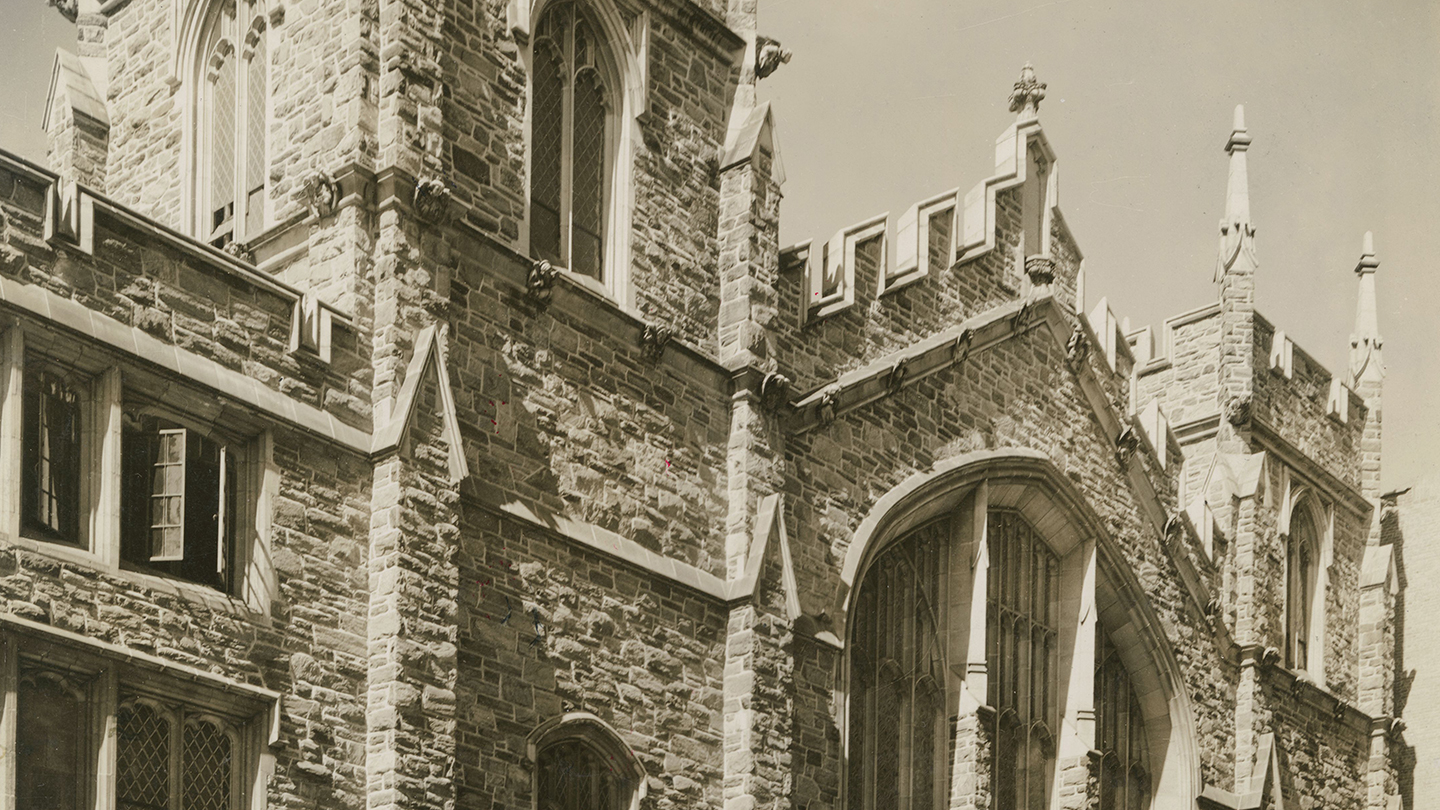
Abyssinian Baptist Church, in Harlem, New York City, 1936. [.smalltext]Digital Collections, The New York Public Library.[.smalltext]
[.article__paragraph--cap][.small-caps]On a hot night[.small-caps] in early July 1939, Dietrich Bonhoeffer sat gazing out the window of his student dormitory at Union Theological Seminary, an endless stream of automobiles moving up and down Broadway, their din the music that now accompanied his existence. It was a far cry from his parent’s house in Berlin’s posh Charlottenburg suburb or the idyllic summers he had spent in the Harz Mountains, but that world was now tainted by a darkness of historic proportion. Straining against the ungodly humidity, he attempted to recollect the events of the past few weeks. He had come to the city in a state of supreme unease, having endured a six-year-long struggle for the soul of Germany’s church – a battle that was now lost.[.article__paragraph--cap]
The Confessing Church was never a perfect institution: it had stood up for its own rights and not much else. But it was the vessel into which Bonhoeffer had poured himself as the only means of resistance against a Nazi regime hellbent on perverting the church to its own ends. Now the Confessing pastors had been rounded up, Bonhoeffer’s communal experiment at Finkenwalde had been shut down, and he had accepted an invitation from Reinhold Niebuhr to lecture in New York.
Any peace Bonhoeffer had hoped to find there was fleeting. While his first sojourn to New York in 1930 had opened his eyes to the witness of the black church, in the summer of 1939, Bonhoeffer was far too occupied with events in Germany to be fully present in his American experience. Within weeks of his arrival, he was determined to return to the land of his birth. “I have come to the conclusion,” he wrote, “that I made a mistake in coming to America. I shall have no right to take part in the restoration of Christian life in Germany after the war unless I share the trials of this time with my people.” In the sizzle of a Manhattan summer, he had found his ultimate calling.
So, he wrote in his diary on that July night, “Perhaps I have learnt more in this month than in a whole year nine years ago; at least I have acquired some important insight for all future decisions. Probably this visit will have a great effect on me.”
Before boarding the ship that would carry him home, Bonhoeffer recorded some final thoughts on the American church, which he had come to know through his experiences at Union Seminary and in visits to churches of various confessions throughout the city. Despite the multitudinous Christian factions in the United States – Catholic and Protestant, progressive and fundamentalist, orthodox and heretical – Bonhoeffer tended to focus on the similarities, with the notable exception of the black church. He saw that tendencies of expressive individualism, consumerism, and triumphalism had taken hold from the Episcopal palaces of Manhattan to the big tent revivals of the nation’s frontiers.
As early as June 24, 1939, he had written in his diary, “I now often wonder whether it is true that America is the country without a Reformation. If Reformation means the God-given knowledge of the failure of all ways of building up a kingdom of God on earth, then it is probably true.” Now, he set to work on an essay titled “Protestantism without Reformation,” in which he would diagnose the chief spiritual deficiencies of a country he was convinced would soon be forced to take its place in the global conflict.
The difficulties of international travel and the urgency of the German situation seem to have prevented Bonhoeffer from finishing and publishing his analysis of the American church. However, the fragments that remain, when connected with his previous books, sermons, and letters, allow us to piece together the mosaic.
In America, Bonhoeffer found a people that treasured freedom above all else and mentioned it as often as possible. The tragedy of the American church, Bonhoeffer determined, was that it did not know what true freedom was.
[.small-caps]“Protestantism without Reformation”[.small-caps] begins with Bonhoeffer’s observation that America was settled by Europeans fleeing religious persecution. The full story of American history is, of course, more complicated, but this was the narrative upon which Bonhoeffer seized.
What was for their parents a right of their Christian faith, won at the risk of their lives, becomes for the children a general Christian rule. The struggle over the creed, because of which the parents took flight, has become for the children something which is in itself unchristian. Absence of struggle becomes for them the normal and ideal state of Christianity. The descendants of the fugitives grow up into a peace which is not won, but inherited.
Absence of struggle and a deceptive peace: this was the American way. He had already mused about this idea in a diary entry on June 27. “I wonder if the Americans do not understand us at all because they are people who left Europe so as to be able to live out their faith for themselves in freedom? i.e., because they did not stand fast by the last decision in the question of belief?” They had separated themselves from churches in the Old World that he too saw as impure, but they chose to flee rather than staying to face the inevitable consequences of that separation, in which they might have been prophetic witnesses: either literal or figurative martyrs.
He concluded that Americans “would understand the fugitive better than the one who stays.” The key phrase here was perhaps Bonhoeffer’s comment that Americans wished “to live out their faith for themselves in freedom.” (emphasis added) Americans seemed to portray faith and freedom as things for themselves as individuals: the right to be left alone, to live in comfort, to have every possibility left open, to earn their way and receive their just desserts, to be thoroughly affirmed.
Now, in his essay, Bonhoeffer wrote that “praise of this freedom may be heard from pulpits everywhere, coupled with the sharpest condemnation of any limitation of such freedom which has taken place anywhere.” But crucially, freedom for the American church meant “the possibility of unhindered activity given by the world to the church.” This was a freedom guaranteed by the state: a right to non-interference and non-struggle. Bonhoeffer saw the true freedom of the church quite differently.
The freedom of the church is not where it has possibilities, but only where the Gospel really and in its own power makes room for itself on earth, even and precisely when no such possibilities are offered to it. The essential freedom of the church is not a gift of the world to the church, but the freedom of the Word of God itself to gain a hearing.
Bonhoeffer was not opposing peace and tranquility, but rather the false appearance thereof. The purpose of the church was not simply to survive in and of the world, but to transform the world through the proclamation of the gospel. The real possibility that mattered was not that of earthly strength and comfort, but the possibility for the Word of God to “gain a hearing.” This was the freedom in line with truth, which comes from God alone and makes its own way in the world, irrespective of the actions of thrones and powers.
As Bonhoeffer had written in his work Creation and Fall, “one is free only through God’s creation, by means of the Word of God; one is free for the worship of the Creator.” Freedom is therefore received as a gracious gift from the Creator for the purpose of worshiping that same Creator. The Word of God creates the world and then enters it through the Incarnation, becoming the Word made flesh. “Here created freedom means … that God enters into God’s creation. Now God not only commands and God’s word becomes deed, but God enters into creation and thus creates freedom.”
This means that true freedom exists in relationship with others. As Bonhoeffer wrote in Act and Being, “God is free not from human beings but for them.” This distinction was critical for the theologian who spent much of his too short career focusing on Christian community. In Creation and Fall, he extended this notion of “freedom for” to relationships between humans.
Being free means “being free for the other,” because the other has bound me to himself or herself. Only in relationship with the other am I free. No substantial or individualistic concept of freedom has the ability to encompass freedom. Freedom is something over which I have no control as a possession. It is simply the event, the experience, that happens to me through the other.
Bonhoeffer’s focus on a spiritual event or experience is perhaps indicative of Karl Barth’s influence. Barth had written of man’s relationship with God in terms of the revelatory encounter: the urgent here and now in which God meets man. For his part, Bonhoeffer spoke of the moment of encounter as the place where true Christian community happens – a community in which humans who are free for one another live for one another by loving one another.
The German Christian movement which had wedded itself to the Nazis believed God’s purposes were being revealed in the unfolding story of the German people. Revelation for Bonhoeffer was something very different: God making himself known to man by his own power, for his own purposes through the witness of the church he has called into being.
“Revelation should be thought of only in reference to the concept of church, where the church is understood to be constituted by the present proclamation of Christ’s death and resurrection – within, on the part of and for the community,” Bonhoeffer wrote in Act and Being. “The community of faith is God’s final revelation as ‘Christ existing as community’ ordained for the endtime of the world until the return of Christ.”
The true church exists in conflict with the world because it proclaims God’s revelation: a freedom which binds us to our Creator and fellow creatures. This is why the church cannot hope to receive its freedom from the world, for the world will never give the church permission to oppose it, and oppose it the church must by proclaiming God’s Word, the gospel of salvation.
Because to be free does not mean to be great in the world, to be free against our brothers and sisters, to be free against God; but it means to be free from ourselves, from our untruth, in which it seems as if I alone were there, as if I were the center of the world; to be free from the hatred with which I destroy God’s creation; to be free from myself in order to be free for others.
Americans chase after self-improvement, self-reliance, and self-care. We turn inward to find meaning and purpose. But true freedom is always oriented toward the other: the one whom we encounter in relationship.
[.article__paragraph--cap][.small-caps]Though the United States[.small-caps] possessed an abundance of resources, Bonhoeffer detected a profound scarcity of the Word of God that had left the American church spiritually impoverished. Attending a service on June 18 at the famed Riverside Church – that bastion of progressive Christianity constructed by John D. Rockefeller beside the Union campus – his encounter was not with the living God nor even with his fellow man, but “a respectable, self-indulgent, self-satisfied religious celebration.” In his diary, Bonhoeffer complained, “Such sermons make for libertinism, egotism, indifference. Do people not know that one can get on as well, even better, without ‘religion’ – if only there were not God and God’s Word?”[.article__paragraph--cap]
But the problem was not restricted to progressive churches. After a discussion with David Roberts on June 20, Bonhoeffer noted his criticism of the fundamentalists: “he does not think that they are any more reliable than the Riverside Church people.” He had nothing better to say about the respectable Presbyterians, nor a word to spare in favor of the Southern Baptists. Whether loudly or quietly, nearly the entirety of the white American church (which he saw as relatively synonymous with the “American church”) had refused to publicly defend the freedoms of their black brothers and sisters, leaving the black church to provide the only witness of suffering in a culture addicted to comfort. Bonhoeffer’s final verdict on July 2 was grim. “Freedom for the church comes from the necessity of the Word of God. Otherwise it becomes arbitrariness and ends in a great many new ties. Whether the church in America is really ‘free’ I doubt. They are lonely Sundays over here. Only the Word makes a true community.”
Bonhoeffer’s American experiences were limited by the bounds of his travel. A sampling of Manhattan’s denominational redoubts is not a proper cross section of the American religious landscape, and even then he does not seem to have interacted with the New York-based Catholic Worker edited by Dorothy Day during this same decade, which might have provided a different understanding of American social activism. His perspective was always a German one, and though he saw the reality of the black American experience, he was slower to grasp the full extent of the persecution of Germany’s Jews. He was an exceptional human with an exceptional mind, but it was a human mind nonetheless and subject to all the flaws of his kind. Yet, in his longing for a community like the one he had managed to create at Finkenwalde, he was in genuine disagreement with the individualist tendencies that predominated not only in America, but in much of his native Europe.
Bonhoeffer believed the church was not created to be one source of fulfillment and wholeness among many, nor a self-help program, nor even a do-good organization. As he had written in Act and Being several years earlier, the church is “the community brought into being by God in which Christ is revealed as the deuteros anthropos, as the new human, or rather, as the new humanity itself.”
There was therefore a necessity of freedom for the church on account of the righteous reign of its head, Jesus Christ. For he was already sitting on the throne, his Word had already triumphed, and the future of his church was assured. It was time for the Word to go forth and conquer by its own power. In “Protestantism without Reformation,” Bonhoeffer concluded that this essential freedom of the Word was being mistaken in America for the institutional freedom of the church apparatus.
Freedom as an institutional possession is not an essential mark of the church. It can be a gracious gift given to the church by the providence of God; but it can also be the great temptation to which the church succumbs in sacrificing its essential freedom to institutional freedom. Whether the churches of God are really free can only be decided by the actual preaching of the Word of God. Only where this word can be preached concretely, in the midst of historical reality, in judgment, command, forgiveness of sinners and liberation from all human institutions is there freedom of the church. But where thanks for institutional freedom must be rendered by the sacrifice of freedom of preaching, the church is in chains even if it believes itself to be free.
Bonhoeffer did not see the American church as uniquely iniquitous. After all, he had fled Germany because of the horrific state of its church, and he noted in a diary entry on July 20, 1939, that Europe was in some ways ahead of the United States in the slide toward unfaithfulness. “America forty years behind Germany. Twenty years behind Scotland. It seems that Germany is still the land of spiritual discoveries,” he wrote sarcastically. But he did see that the American tendency toward individualism could make it particularly likely to value “freedom from” rather than “freedom for,” and he perceived that America’s rise to global power could present unique temptations in the future.
Bonhoeffer’s warning echoes down the years, for the church has often been asked to sacrifice its essential freedom – the undiluted preaching of God’s Word – in exchange for institutional freedom. While some governments have outlawed Christianity outright, others have permitted the existence of an officially sanctioned church while persecuting the true church that insists on its right of proclamation: the maintenance of a prophetic witness in which the Word of God is given free rein.
There are few voices preaching against the besetting sins that Bonhoeffer identified: the false comforts of consumerism, the obsession with the self, the dismantling of community, the neglect of virtue, the desire for heaven without death or resurrection. Even now, a Religious Liberty Commission pursues institutional freedom while standing beside leaders who exemplify vice. We have believed the lie that vicious leaders can promote societal virtue, that we should protect our livelihoods rather than our prophetic witness: the essential freedom of God’s Word to call us to repentance. We have forgotten that the freedom which truly matters is the breaking of sin’s bonds, the forgiveness that comes from Christ alone. We have not trusted the church’s head to preserve his bride and save his inheritance.
As the United States of America celebrates its 250th anniversary, the air is thick with talk of freedom, that thing which separates us from the petty tyrannies of the world, defines us as Americans, and is our sacred birthright. But what kind of freedom are we talking about when we say these things? Is it freedom for ourselves as individuals, freedom from obligations to others, freedom to engage in vice, and the supposed freedom of unlimited choice? Or is it a freedom to serve, to make good, and to grow in virtue? Again, is it the institutional freedom of the church or the essential freedom of gospel preaching which convicts the world even as it announces salvation?
In a diary entry dated June 18, 1939, Bonhoeffer concluded mournfully, “I have no doubt at all that one day the storm will blow with full force on this religious handout, if God is still anywhere on the scene. … The tasks for a real theologian over here are immeasurable. But only Americans themselves can shift all this rubbish, and up till now there do not seem to be any about.” America has experienced a dizzying degree of change since he wrote those words, yet the diagnosis still holds, for our fundamental beliefs remain in place. Our understanding of freedom is as flawed as ever, and now the storm is blowing with full force, endangering the foundation laid by centuries of Americans. In clinging to institutional freedom, we may well lose it. We would have been better off coming before God with hands open and empty, ready to receive the freedom he alone provides.
The path to which Bonhoeffer called the American church was that of Christian discipleship: the Sermon on the Mount, the bearing of a cross, the union with Christ in his sufferings. “When Christ calls a man, he bids him come and die,” Bonhoeffer wrote, and the same call is given to the church. To trust the freedom granted by God over that granted by the world has always been the narrow path on which few dare to tread. Bonhoeffer could not convince the German church to take that narrow path, nor has the American church been keen to take it. But for those with ears to hear and open hearts to receive, the call of Christ makes its own way through the world, undeterred by the forces of evil.
On the night of July 7, 1939, Dietrich Bonhoeffer boarded the White Star Line vessel RMS Queen Mary, docked at Pier 90 at the foot of 50th Street on the Hudson. Just after midnight, the ship motored out past the Statue of Liberty and set a course for Europe. Like so many before him, he had traveled to America in the hope of greater freedom. Now, he was moving in the opposite direction, to where he would be literally and metaphorically chained.
In an effort to avoid being conscripted into the Reichswehr, he joined the German intelligence service, the Abwehr. However, at the same time, he aided the resistance movement of his brother-in-law Hans von Dohnanyi, using his role in the Abwehr to gather information. It was in this capacity that he became involved in an attempt to assassinate Adolf Hitler, though as an associate rather than a leader. The German government was unaware of this when they arrested Bonhoeffer in 1943, but once his connection to the plot was discovered, his fate was certain.
He was transferred between prisons until finally being executed at Flossenbürg prison camp on April 9, 1945, just before it was liberated by the Allies. But though Bonhoeffer would become best known for his aid of the resistance movement, he never considered this to be a heroic action, but one that was fraught with ethical problems. His chief concern, in the end, was not for his own freedom, nor even the institutional freedom of the church, but for the essential freedom of God’s Word, which he supported as he could under impossible circumstances, relying ultimately not on the righteousness of his actions but the mercy of God.
Like so many saints before him, Bonhoeffer understood that freedom of movement could not compare with spiritual freedom. He used the freedom he still possessed to aid the resistance against a false Christianity being promoted by a tyrannical government. More than that, he used his freedom for the sake of the least of these. He surrendered it to his neighbors. Until the very end, he served in a pastoral role toward those around him, even leading communion service for his fellow prisoners on the day of his death. This was his final attempt to use his “freedom for.”
Likewise, the healing of America must begin with the healing of its church in which we embrace the “freedom for” rather than the “freedom from.” For freedom is a gift like any other, to be surrendered to the will of God or hoarded for our own pleasure and comfort. As Saint Paul wrote to the churches in Galatia, “You were called to freedom, brethren; only do not turn your freedom into an opportunity for the flesh, but through love serve one another.” The final test of our greatness will be not our “freedom from” but our “freedom for.”