Review
Andrey Kurkov’s Kyiv Mysteries
The Ukrainian literary sensation does far more than entertain.
August 4, 2026
Try 3 months of unlimited access. Start your FREE TRIAL today. Cancel anytime.
START FREE TRIAL NOWAndrey Kurkov’s Kyiv Mysteries
The Ukrainian literary sensation does far more than entertain.
[.article__paragraph--cap][.small-caps]The year: 1919.[.small-caps] The month: May. The place: Kyiv. Reverberations from the Russian Revolution still continue to roil the city and the region. In the meanwhile, though, ordinary people must live ordinary lives – and die ordinary deaths. But while an ordinary life in the new normal is increasingly within many people’s grasp, an ordinary death may be harder to come by.[.article__paragraph--cap]
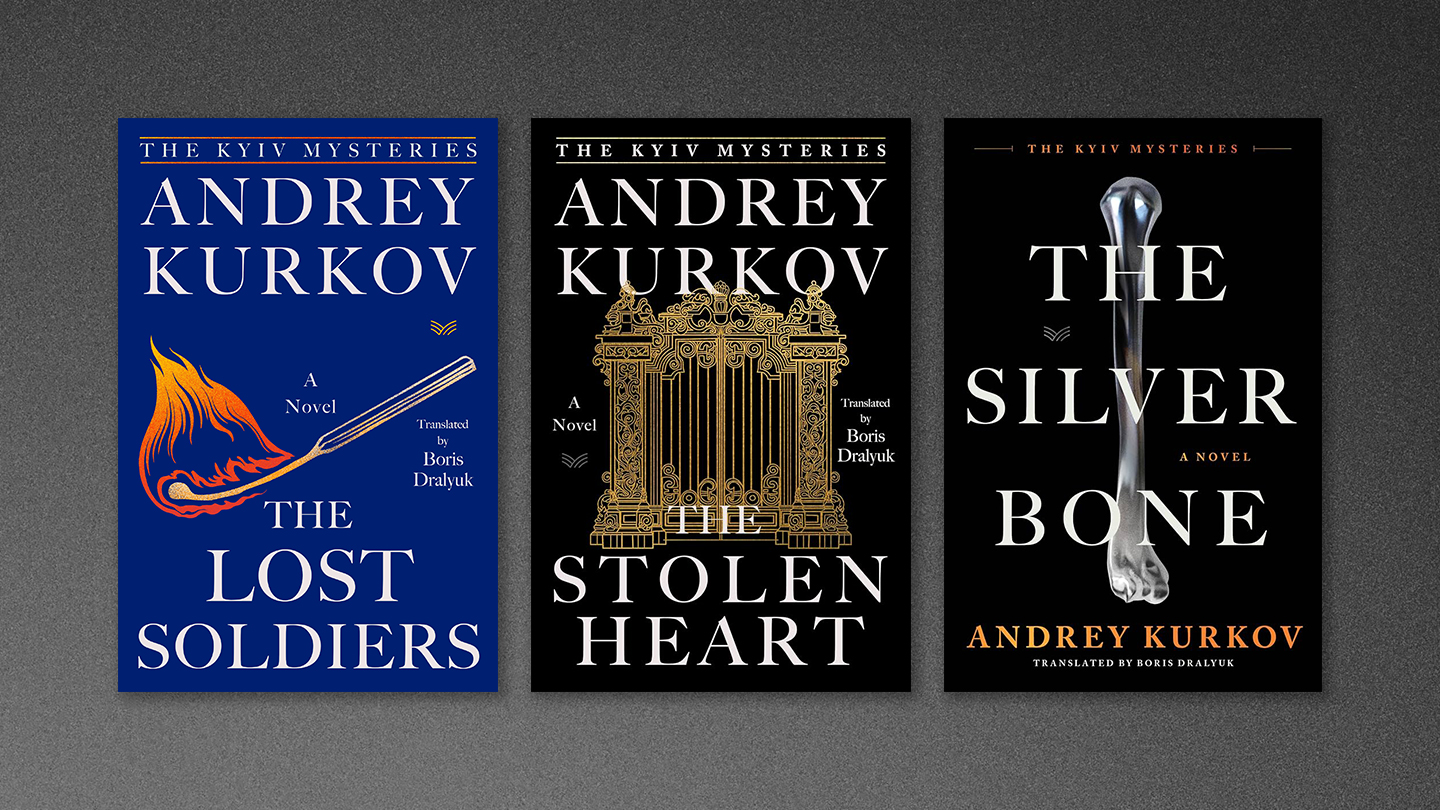
Murder mysteries typically begin with a body. A stranger’s body mysteriously materializes in the bathtub of a perfectly ordinary family’s bathroom. A body in a private compartment of a train, the door locked from the inside. A body on a luxury cruise. A body on the beach. Really, a body can be found anywhere – but there must be a body to get an investigation going. But Andrey Kurkov’s The Lost Soldiers, the third installment of the internationally acclaimed Kyiv mysteries by one of the leading Ukrainian novelists today, begins with an absence. Twenty-eight Red Army soldiers walked into a bathhouse. None ever walked out. Leaving their clothes and all personal effects behind, they disappeared without a trace. The unusual premise of this mystery, as with Kurkov’s previous ones, challenges readers to consider: What is the genre of the murder mystery for? What can reading mystery novels do for readers? Perhaps, Kurkov gently suggests, this reading can be an exercise in transformation. One cannot approach these novels and remain unchanged; they demand something from the reader instead of merely offering delight. Solving the mystery fulfills a similar role for the fictional detective.
Readers familiar with the first two books in the series will not be surprised at the unusual premise behind this mystery – or, rather, while surprised perhaps over the setup for it, they would not be surprised that Kurkov pushes the genre of the murder mystery past its regular clichés and predictabilities. The second installment in the series, for instance, opened with blood seeping grotesquely from under the door of a shed – except the blood turned out to be porcine, not human. Such twists that push the readers to question appearances are characteristic of Kurkov. In the process, instead of merely challenging the readers to see if they can guess who committed a crime, these mysteries aim to get at much larger and more timeless questions than merely the mystery on hand – which remains unclear for much of this novel. Kurkov encourages us to reflect: What is it like to live and die in an unstable world in flames? Is it possible to flourish in a world like this – and if so, what might this flourishing look like? Could blessings be found even here, in a new, godless world Communism has wrought – or wherever may be the “here” in which we dwell ourselves?
These questions certainly occupy the young detective, Samson Kolechko, who must investigate the case of the lost soldiers. An ordinary university student before the revolution, he became overnight a police detective in a new country that has much crime and no trained police force. But he has a supernatural gift that has allowed him to crack multiple difficult cases already: his ear, brutally chopped off his head in the same attack that killed his father in the first book of the series, The Silver Bone, has special powers. Separated from his body, the ear can still hear – allowing Kolechko to eavesdrop on conversations far removed from where the rest of him is physically. He keeps the ear in a little box, sometimes bringing it along in a jacket pocket, and other times stashing it in his office in the police station, yet other times sneaking it as his spy into places connected with crimes he is investigating.
Early in this novel, Kolechko stops to consider the miracle he has been given, which turns out to be key to his new and unexpected career as detective:
How can an ear sliced off by a Cossack saber in March still be living, warm, and quivering in May? Was it in fact some sort of miracle, some divine gift? Maybe this was how God protected pure souls from Cossack pogromists and Red Army raiders? Or perhaps time itself had simply stopped, abolishing its own laws of decay in light of the general savagery of recent years? After all, why should it enforce its laws? Now, no one could expect to live to a calm, well-fed old age and to die quietly among loved ones. Death was no longer in the hands of God, but in those of the Antichrists.
Perhaps, it seems, Kolechko’s special gift is redemption. After all, it is relics of saints that have historically been associated with miracles like that of Kolechko’s ear. But does this make Kolechko himself a saint? Kolechko doesn’t seem to think so, but he is grateful to be alive. His world is uncertain and disordered – that he is surrounded by sinners is clear. Yet his work of investigating crimes gives him a sense of purpose: he is restoring justice and order in a world, doing good for his society, even as he is no fan of the new regime. Besides, he is a newly married man, having just celebrated his wedding to Nadezhda in the previous novel. Her name, which means hope, is no accident: Kolechko has increased hope in his life now, and he really is much more hopeful for a future he could build in this new world. This does not mean he doesn’t miss the old world, in which he and his family were so happy – before his mother and sister died and his father was brutally killed.
A key character in Kurkov’s mysteries is his own home city of Kyiv, where he still lives and writes in the present. His deep love for Kyiv shows through Samson Kolechko’s own reflections about the city and its landmarks, such as in this remarkable moment:
Walking through Nikolaevsky Park, Samson stopped in front of the monument to Nicholas I and gazed up at the slender figure atop its mighty pedestal. For some reason, the clouds had parted directly above the tsar’s bronze head, but this could not be any sort of sign. It would soon be a year since the entire royal family had been shot, putting a definite end to monarchy in the Russian lands. Who would rule over this spot tomorrow?
The past and the present coexist in Kurkov’s Kyiv, a city at war a century ago, and again now. It is in this context that Kurkov has been writing his mysteries, even as the war that began with Russia’s invasion is still ongoing. Civilians in Kyiv and all over Ukraine are still dying, as nighttime missiles rain on apartment buildings where ordinary people are trying to sleep. Kolechko’s quest to build an ordinary life in a city filled with too many extraordinary deaths, then, reflects Kurkov’s own plight. Even in a city at war, where death could arrive any night, people continue to live, work, marry, have children, and hope for a better future. To hope, after all, is human, natural even in times of war or revolution.
But hope is not merely a feeling. It is one of the heavenly virtues, right alongside faith and love. And so we find Kolechko’s quests to solve mysteries evolve into pilgrimages of sorts in each of Kurkov’s books. In the process, he repeatedly finds himself in the holy places of Kyiv – sometimes walking or riding past its old chapels and churches and monasteries, and other times walking into them to stand, look, reflect, almost pray. Holiness is within reach, even in a world that has been declared secular by a new regime’s fiat.
Murder mysteries entertain readers – this much has been the purpose of the genre from its inception. But Kurkov’s masterful mysteries echo G. K. Chesterton’s and Dorothy L. Sayers’s experimentations with the genre, as they aim beyond mere entertainment, pointing us to contemplate mysteries not only of life and death, but also of our very purpose – the telos of human existence. Perhaps, Kurkov suggests, no regime has the power to dictate or change this purpose, try as the self-proclaimed earthly rulers might. Deep down, we know the truth, and it isn’t a mystery after all. As a monk sums it up to Kolechko at one point in his investigation, “Does every sinner not dream of becoming a saint?”