Podcast
A Path Forward for Palestinians and Israelis
Palestinian Aziz Abu Sarah and Israeli Maya Savir chart a hopeful course for their country, and celebrate Maya’s new book On Reconciliation.
October 6, 2026
Try 3 months of unlimited access. Start your FREE TRIAL today. Cancel anytime.
START FREE TRIAL NOWA Path Forward for Palestinians and Israelis
Palestinian Aziz Abu Sarah and Israeli Maya Savir chart a hopeful course for their country, and celebrate Maya’s new book On Reconciliation.
[You can listen to this episode of Another Life on Apple, Spotify, Amazon Music, or wherever you get your podcasts.]
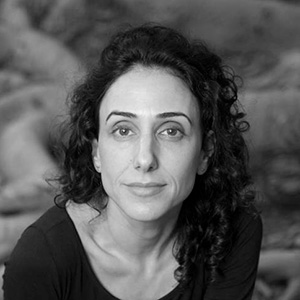
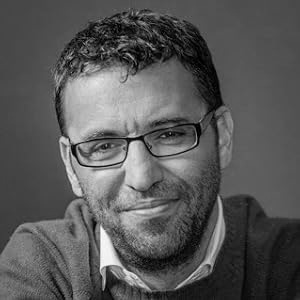
Joy Marie Clarkson: Welcome back to Another Life, a podcast of Plough Quarterly. Today I am delighted to be joined by Aziz Abu Sarah and Maya Savir. This will be a part of our series on Friendship, but it’s also an introduction to the book [On Reconciliation] that Plough is publishing – that Maya has just written, that Plough is publishing the translation of, and we’re really excited about. But welcome to the show, both of you.
Maya Savir: Thank you. Thank you for having us.
Aziz Abu Sarah: Thank you.
Joy Marie Clarkson: So, I always like to begin these conversations with a simple question, because these conversations usually happen with people all over the world on different continents. But today is even more exciting because there’s two of you to talk to. So my question is: Where are you speaking to us from today? And how do you spend your days these days?
Maya Savir: Aziz, you go.
Aziz Abu Sarah: I’m in Africa and I just got here from Europe where I was at a peace festival and before that was on a book tour for my book, The Future is Peace, and that’s what I’ve been doing in the last few months, pretty much, traveling all over, working on talking about the book with Maoz Inon, another one of my dear friends and brothers and partners, Israeli partners.
Joy Marie Clarkson: How about you, Maya?
Maya Savir: I’m in Tel Aviv, in my home, next to my desk. This is where I do most of my work from and most of my writing. Most of my energy is dedicated to saving this place, making sure that Palestinians and Israelis can share it and that our children, all of our children, have a chance for a different future.
Joy Marie Clarkson: So, both of you are at work in various ways surrounding peace in Israel and Palestine. Could you tell us a little bit about your background and how you came to do this work? Aziz, do you want to start?
Aziz Abu Sarah: OK. I grew up in Jerusalem, in the time of the First Intifada. My brother was killed when I was ten years old due to torture in Israeli prison, and so I was very anti-peace for the eight years after that. I was ten years old when Tayseer was killed and until eighteen I was very anti-peace, until I went to study Hebrew, not so much by choice, but by necessity in ulpan, which is where Jewish immigrants go to learn Hebrew. And that was the first time I met Israelis who were not soldiers, settlers, and, in some ways, the first time I met an Israeli who treated me like a human being, like an equal, and that’s what set me on this on this journey of peacemaking.
Joy Marie Clarkson: How about you, Maya?
Maya Savir: I grew up in Jerusalem, as well, and a little bit in other places in Canada and in the United States. My father was a diplomat. Both of my parents were always peace activists, so I grew up in a home in which the language was a language of peace and equality and solidarity, always. My father was also the chief negotiator of the Oslo Accords, so I knew everyone from the onset. And you mentioned that the title of this series is friendship, and so I also want to say something about that, if it’s OK.
Joy Marie Clarkson: Mm hmm, of course.
Maya Savir: Because I was a witness to the Oslo Accords, which was the last serious attempt at solving this conflict. And of course, there are many things we can learn, many things we can do differently. But there is – the essence of it, or the starting point was, acknowledgement, mutual acknowledgement – the acknowledgement of the other – which is something that we will have to start with in any peace process, in any attempt to end this conflict. And I was witness to a very special friendship between my father, Uri Savir, the late Uri Savir, and the late Abu Ala, who was the chief negotiator for Palestine. And their friendship, their … it was … they were brothers. And it was at the core of the negotiations that were many times difficult, obviously. These are very sensitive issues, but the friendship and the respect and the empathy and the solidarity was at the core of it.
Joy Marie Clarkson: Hm. That’s beautiful.
Maya Savir: And maybe I’ll just add that I, so I was a human rights and peace activist all my life, I’m a writer, I’ve published eight books, and in my previous position before – today I’m the country director, Israel country director, at Search for Common Ground, which is an international peace-building organization, working in over twenty-five contexts – and in my previous position, and I’m mentioning this also because, Aziz, you mentioned that you are in Africa now, so before that I was executive director of an Israeli NGO focused on malnutrition. So I worked in various contexts, South Africa, Rwanda, the Democratic Republic of Congo, Ethiopia, Uganda, Kenya.
Joy Marie Clarkson: Before we even started this conversation, I was getting myself settled with my computer and you were both easily having a conversation and making plans on various things you wanted to partner on, and it felt like I was witnessing something of a friendship already. So I wanted to know how did you all come to know each other? And what role – you’ve already answered this a little bit, Maya – but what role, if any, do you think friendship plays in this work of peace-building together?
Maya Savir: Our first encounter was through our mutual friend and partner and brother-in-peace, Maoz Inon. Aziz and Maoz partnered shortly after October Seventh. Maoz’s parents were both killed on October Seventh in the Hamas attack. And Aziz was one of the first people who contacted Maoz and said, I’m sorry, brother, I’m sorry for your loss. And they embarked on this journey, which is making quite some noise in a very positive manner in Palestine and Israel because both of them have been very personally affected by this conflict. And here they are coming and saying, “We don’t have to continue.” Maoz and I met again shortly after October Seventh. And Maoz read On Reconciliation in Hebrew, and for a very long time he was the absolute best salesperson of this book, which had been, by the way, had been out there for quite some time. But after October Seventh there was a newfound interest in it. Maybe we’ll get to that later because I do think it says something about the mindset of Israelis. In any case he used to, everywhere he went he had a pile of books, of my books, in his bag and he gave them away, telling people “you have to read this.” And one of these people was Aziz, and Maoz kept saying, “you really have to get this translated so that Aziz can read it, I mean he has to” – and so that, and so then we met and we share the same circles, I feel very lucky in my line of work … it is challenging because you know we deal with the most delicate issues and with people who are heavily traumatized on both sides. But, I feel very fortunate because all of my partners in Palestine and in Israel have not given up. We haven’t given up. Peace is possible and we will never give up. And I think this is a part of the work that Aziz and Maoz and I try to do also with our friends abroad. We haven’t given up. Don’t give up on us. We need your help.
Aziz Abu Sarah: Yep. I’ll just add, I think what kind of brings us together, maybe different that many Israeli and Palestinian peace activists, is that the two of us have done peace work in international settings. And that’s not necessarily true, I would say, for the vast majority of Israeli and Palestinian peace activists – they’ve traveled to other places, have engaged with people in other countries, but their work usually is to go and talk about Israel and Palestine in other countries, while both Maya and I have engaged in those countries to work with the conflicts in those countries, and to learn about what’s happening there, whether it’s in Africa, whether it’s, in my case, in Afghanistan and in Syria and in Colombia and other parts of the world, and Northern Ireland. And in some ways, there is such a new perspective that you get when you get out of your own bubble, your own issue, and learn to see a bigger world, and realize what do we have in common with other places, and what’s unique about each place that you visit and their conflicts and, therefore, our conflicts. And so we have something that, kind of, we can talk about that not necessarily everyone in this movement can talk about.
Joy Marie Clarkson: Hmm. Yeah, that must be – being able to see a perspective on how each conflict is individual and has its own intractable natures, but there are things that are also shared between these conflicts, between these different regions, and you both have that different perspective. Aziz, have you now read Maya’s book, now that it’s been translated? I assume you have, at least part of it. You wrote a beautiful and really thoughtful foreword.
Aziz Abu Sarah: Yes, yeah, I did, I wrote the foreword, I had to – no, I enjoyed reading it. And I kept, and I think I told you, maybe, Maya this – I kept being like, oh I know this, I was there, I did this, and I mentioned that in the foreword a few times – was reading something I’m familiar with, and it was beautiful seeing the way Maya understood these places and was able to relate to them for us Israelis and Palestinians. And I think the whole concept of also rethinking the different logic of how you make peace, and the logic of war is different than the logic of peace. To me that was the thing that spoke to me the most because so often, after October Seventh, people will tell me all the time, “but if you were the head of Israel on October eighth, what would you have done?” And that’s the logic of war, is people want to put you in this frame that the only answer you’re supposed to give is we have to go to war, we have to go and kill somebody, and we have to revenge, and we have to, so on, and therefore it’s all justified. And in reading On Reconciliation, I like that you really focused quite a bit on this logic and saying we have to reject this way of thinking. You cannot you bring peace with the logic of war. It just never happens. And so much of what’s going on today, especially in the diplomatic world, is using the logic of war as they talk about peace. And that just doesn’t work.
Joy Marie Clarkson: Hm, yeah. That’s really helpful I think. And that’s what I also found helpful about your book, Maya, is reframing how we have these conversations. And I think often there’s an assumption, as you said, Aziz, that one thing cascades into a logic of justification, which is something you touched on a lot, Maya, and I found that really, really helpful.
Aziz, if there was one thing – well, I suppose you might have already said it – but if there was one thing that you wish people would remember or take away from the book, what would it be?
Aziz Abu Sarah: So what I said is important, but I would say one thing we strongly, Maya, me, and Maoz talk about it quite often, and this is why the three of us have this connection, and Maoz was giving the book – literally, I used to be going to talks with him and he’ll open his bag and be handing over books or selling books. In the beginning, he was giving it for free and then eventually he realized he wants to give a lot more, so he started selling them. But I would say the one powerful thing from working again in all these conflict zones and seeing it written in the text is that peace is possible even in the worst moments. And, when you are entangled in these situations, when you are in Rwanda and you see a million people massacred, killed in within a few months, it’s the norm for people in that moment, I guess, to say, How do you expect us to have peace?
And so when I look at Israel and Palestine, and I hear I can talk as a Palestinian, I can hear from Palestinians says, How can you expect us to have peace when people are killed on a daily basis in Gaza in the West Bank, the settlers, violence, all of that? I get it. But the thing is you always, when you’re in conflict, gonna feel that. You always, when there is violence, you’re gonna feel like that. And what’s powerful about the book is it shows that it is possible. And having been to Rwanda, having been to South Africa, having been to a lot of these conflict zones, it’s possible and the future is much, much brighter than what we have today, and the book makes that clear: that we can get there. That there’s this … something I heard in Northern Ireland that really stuck with me and Maya, you bring it very powerfully in the book, is basically you cannot bring into existence what you cannot imagine. And if you cannot imagine what peace will look like, then you cannot work for it, you cannot bring it because you can’t create something you don’t know. And so by looking at other places and learning from other places, we bring that political imagination that is significantly lacking right now in both Israel and Palestine. And that’s the one thing I want people to take, is that political imagination is that belief that it’s possible, it’s knowing that we can get there at the end of the day.
Joy Marie Clarkson: That is very much in keeping with this podcast titled Another Life is Possible, right? I do think that just the beginning of believing that there are different possibilities than the ones that we’ve been presented is, is very important. Do you want to say something?
Maya Savir: Yes, I do, I want to add something that is remarkable about Maoz and Aziz’s book, because it also, I think it’s, it’s related to what we’re speaking about. For people who live in conflict, one of the biggest shackles, is that people are sure that people don’t change. Which means that, for instance, in our setting, Palestinians, the majority of mainstream Palestinians, believe that Israelis will always be occupiers that don’t care about the lives of Palestinians. And for many Israelis, Palestinians will always want to eliminate them. And what we need to demonstrate is that – and we know this from history – people change. People change as individuals and they change as societies. And I think what, Aziz, what your book, you and Maoz both demonstrate is how people transform. I mean, you speak about it so beautifully, about where you were after you lost your brother, and how you transformed and, and you take the reader through it, and I think it’s so important because it reminds us that it’s possible. We don’t always have to be stuck in this vicious circle of revenge, we can change. And so this is something that I really want to highlight, and I think your book is so, it portrays it so beautifully.
Aziz Abu Sarah: I was saying people need to get both books, so they go very well together.
Joy Marie Clarkson: I will put them as friends in the show notes.
Maya Savir: Oh, that’s perfect.
Aziz Abu Sarah: That’s perfect.
Joy Marie Clarkson: Well, Aziz, thank you so much for joining us.
Aziz Abu Sarah: Pleasure, pleasure. Thank you for having me, and I look forward to hearing the rest of the conversation.
Joy Marie Clarkson: Great, thank you.
Maya Savir: Thank you, we’ll see you soon.
Joy Marie Clarkson: So Maya, I’m so excited to talk about your book, On Reconciliation, which to, to provide some clarity, has actually been out in the world, telling its story, for almost a decade now, so you published it in Hebrew in 2017, is that right?
Maya Savir: The end of – like at the end of December, 2017, yeah.
Joy Marie Clarkson: Yes. So I want to start with a simple but broad sweeping question, which is: What do you mean by the word “reconciliation” in the book? What does that word encompass?
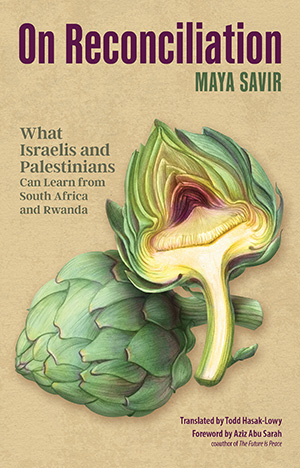
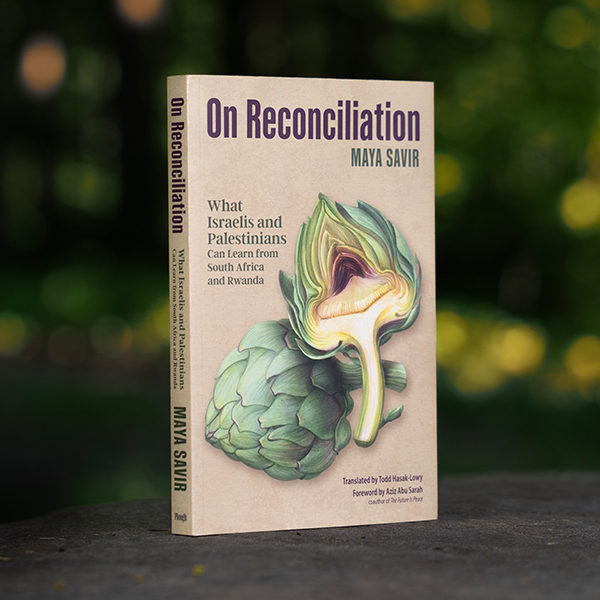
Maya Savir: Very simple question. It is actually on the one hand simple, on the other hand it entails everything. And I think people, human beings, respond to stories and to metaphors, which is why, throughout the book, I was searching for a way to convey what it is. And this is why on the cover of the book there’s an artichoke, which is, for me, was the most effective metaphor. Maybe I’ll just start by saying that when I write, in all of my books, I write when I try to understand something. And this is true for my works of fiction, for my children’s books, and also for narrative nonfiction, like On Reconciliation. Writing is the way I understand reality. And my work, my previous work, in malnutrition, was more humanitarian, development work, brought me to various places in Africa, and the first two places I arrived at were South Africa and Rwanda. And although I had been by then a human rights and peace activist all of my life, it was the first time I found myself actually living and working with people who were living reconciliation, and it was a chance for me to ask questions and to really try to understand what reconciliation is.
And the question I asked myself throughout writing the book was whether reconciliation is an onion or, or an artichoke. And the difference, besides the taste, obviously, is that onions are just layers, layers and layers and layers, and there’s nothing in the middle besides more layers. And an artichoke has layers and more layers and more layers and in the middle there’s a heart of the artichoke, and this was my question: Does reconciliation have a heart? Is there a principle without which there will not be reconciliation? And, in all honesty, I can share that some of my findings surprised me, because some of the layers, I was sure that they were the heart, but they are not. Maybe we can get to them later on, but one of them, for instance, is forgiveness. Very interesting. But there is a heart to reconciliation, and it is that both sides need to acknowledge and accept that neither is going anywhere, both sides to the conflict, that both sides will forever share the space, that the rights of both sides to this space, or to this coveted something that both sides want, are equal, and that because of this, the future of this shared space need to be decided upon together in equality and sensitivity and respect to one another’s needs and to the narrative of one another. That is the heart of reconciliation.
Joy Marie Clarkson: One of the things that you write about throughout the book is that people can have a resistance to reconciliation, I think, for various reasons, and for various good reasons, right? I was thinking as I was reading through the book of the passage from the prophet Jeremiah where he says, You treat my wounds lightly, you say peace, peace, but there is no peace. And so I think that’s sometimes what people have is this resistance to or reaction to or almost offense at the idea of reconciliation. And you write about this really well. I especially enjoyed your reflections on this in the final chapter about thinking about this book in its life after October Seventh. But how would you respond to people who have this resistance to reconciliation?
Maya Savir: I would say, first of all, that I understand it, it’s natural and it’s natural especially for people who live in conflict because, and this is something that is common to all conflicts, especially ones that are so bloody and long and demanding. People who live in conflict are essentially drowning in it, like we are, can’t see any other possibility, and it’s normal and this is the logic of my book, this is why I want to bring another perspective because when you look at another conflict you cannot continue to say that our conflict is unique, I mean, of course it’s unique because every conflict has its own uniqueness and conflicts differ in their content and certainly in their intensity. But all conflicts share the same structure. And a part of it is the belief that ours is the most difficult that there ever was. And this is why in my book I devote much attention to providing the context, the historical context, the facts. And I think for readers after hearing, after reading about, the nature of the conflict in South Africa, and the nature of the conflict in Rwanda, it’s quite difficult to maintain the stance that the Palestinian-Israeli conflict is the most difficult that there ever was. Sure, it’s very difficult. But there have been other conflicts, just as difficult, and they also seemed intractable. In fact, many times, just before the dynamics begin to change, they are the worst. For instance, in South Africa, the last decade of the apartheid regime were the worst, the bloodiest. I mean, there was no hope in sight. And we tend to think that history progresses in a linear fashion, but it doesn’t. So many times, you know, we push and we push and well, it looks like nothing is moving, until it does. And I think this is where we’re at also in Palestine and in Israel. Sometimes it looks, really we are at the lowest and bleakest point of this century-old conflict, but it doesn’t mean that another way is not right behind the corner.
Joy Marie Clarkson: Mm. So I want to dive into the book, but I also want to ask you about – we were referencing the fact that it’s had this journey over the last ten years. Tell us a little bit about that. How was it initially received? I know I was reading, I think it was in your preface, where you said that when you first wrote it, people read it as a sort of intellectual thing that yes, at some point in the distant future, this is something we really ought to consider. But then that over the last few years, since October Seventh and the war, there’s been this return to it in a new way, as though it is urgent, as though it needs, has a different relationship. So could you tell us a bit about the journey the book has been through and how it’s been received?
Maya Savir: Sure. So as I mentioned, I wrote it because I wanted to understand. I was like – I wanna understand what these people get, and we Palestinians and Israelis aren’t even close to getting. And many of my conversations in the book circle around this. I actually, I’m sort of very persistent in asking people, “But is your reconciliation real? Do you trust your former enemy? I was really, I wanted to understand this, and many of the conversations are like that. And the book came out, say in the beginning of 2018, and until 2023 – so that’s about five years – there were quite a few readers, and I was invited to speak once in a while, and these conversations were always very interesting.
And now I’m focusing on the Israeli-Jewish readers because the book is in Hebrew. And for Israeli-Jewish mainstream, until October Seventh, the conflict was in many ways distant and ostensibly controllable. This is what many, this is how many Israeli Jews perceived the conflict. So when I spoke about reconciliation, the ideas I shared were very positively accepted, and not because they were easy to swallow, but because they seemed theoretical in nature, just like you said. It was like, we have so many moral pressing matters to deal with, so yep, share them, and stories about Africa are always very, I think, intriguing. So, you know, share them with us. And then sometime in the very distant future, we’ll get to that and then it’ll be useful. And then October Seventh happened, and not at the very beginning because for a few months everything was frozen. I know that in light of everything that has happened after that, especially in Gaza, it’s sometimes hard to remember. But October Seventh really the – it, it was unbelievable in its magnitude and, and cruelty. And people were really in a state of shock. So it took some time.
But about probably two months after that, suddenly I began to get more and more invitations to speak about reconciliation. The book went into new to print, new editions. And suddenly the people who were inviting me to speak about reconciliation were not necessarily in the peace camp. That was interesting. And I think what changed is the echo chamber in which the book was echoing, because people could no longer suppress that there is a conflict and the conversation was not always easy, but it was about the conflict. Before October Seventh, many Israeli Jews didn’t want to talk about the conflict, and it was quite difficult because it’s really hard to talk to – well, it’s impossible to talk to someone about what lies beyond their blind spot. And the conflict was behind their blind spot. So that changed. And although, admittedly, too many Israeli Jews are entertaining horrible ideas about how to solve this conflict, they are nevertheless accepting that there is a conflict, and engaging in conversation, and for me this is a step forward because we need to talk about it and we need to look at it. So that’s a little bit about the journey. And I also want to say that in these conversations, and when people read the book, I think something happens that changes the mindset because we live in a space in Palestine and in Israel where it’s very common to say that there is no solution.
And that there is no partner. Like, it’s a void, right? There’s nothing. There’s no partner and no solution. It’s a, it’s like, and it’s difficult to maneuver in here. And then by introducing other models of conflict that have been resolved, even if they are not exactly the same, and they are never exactly the same, – but just by demonstrating this and bringing another perspective, and showing examples of what it means to reconcile, it introduces new energy, and new ideas, and Aziz earlier mentioned political imagination – it expands the political imagination because we can see OK, this is what the South Africans did, this is what the Rwandans did. And even if it’s not a, like a copy-paste solution to our setting, there are some interesting ideas there, for us as well.
Joy Marie Clarkson: So let’s dive in a little bit to the examples that you explore in the book. So you look primarily at your work in these two places, South Africa and Rwanda. Tell us a bit about these two regions and what they did specifically that made reconciliation possible.
Maya Savir: So, they are very, very different. I mean they’re similar in the sense that they are both on the same continent, but other than that the conflicts are different, and the reconciliation processes are different. Perhaps let’s look at the reconciliation processes, and maybe we can focus on a theme or two.
In South Africa, what’s interesting – well maybe in both cases. The reconciliation process began after the conflict ended, or was on the way to ending, and that’s really, really important because maybe we need to mark the difference between signing an agreement, ending the conflict, a peace agreement, and reconciliation, which is really the higher process, right? It, it means, OK, we either settled the conflict, or are on our way to settling it. We acknowledge that there are two of two sides here. The major injustice – we are tending to it, we are addressing it, and now we want to reach the higher goal, which is reconciliation, for us to be able to see one another, acknowledge one another, and live together. And in both places, this is what happened. The reconciliation process in South Africa began after the apartheid regime fell. Nelson Mandela had become the president of the new South Africa. In a sense, he won, right? He won. The moral victory was remarkable, but he didn’t stop there. And that’s, for me that’s amazing, because for him the higher goal was reconciliation, not winning, right?
And then South Africa embarked on this journey which manifested in the Truth and Reconciliation Committee, whose work was led by Desmond Tutu, was the highest spiritual leader, religious leader in South Africa. And the work of the committee was led by the notions, the ideas of Christianity, specifically of forgiveness, and the ideas of ubuntu, which is, in Zulu it means “humanity,” it means – the essence of it is that our humanity is attached. And if I do anything to harm, to take away, your humanity, I am also taking away my own humanity. And if I ask for your forgiveness and you forgive me, then we are restoring one another’s, each other’s, humanity. An essential part of it is – of the work of the Truth and Reconciliation Committee – is truth, establishing the truth. And again, I cannot stress this enough, it goes to acknowledgement. And in a conflict setting, acknowledging the wrongs that have been done is like antibiotics when a person is ill. It’s medicine.
And in Rwanda, the mechanism was a little bit different – these are both, we’re talking about mechanisms of what we know as transitional justice, it’s a very interesting idea. In essence, what it means is it’s a set of procedures and mechanisms that take a society to the direction of more democracy and more peace. And in every setting it’s a little bit different, and we will have to find our own mechanisms, but there’s so much to learn from these. So if in South Africa it was the truth and reconciliation process committee, in Rwanda, it was the Gacaca hearings – gacaca in Kinyarwanda, which is the language that is spoken in Rwanda, means “grass.” Because this is where the hearings took place. And what is very interesting about this process is that the Rwandan government tapped into Rwandan tradition. Gacaca is a tradition that dates back to precolonial days when Rwanda was a kingdom. And it was a method of solving disagreements within the community. Community members would come together on the grass, this is where it took place, right? This is where their name comes from. And the whole community was there, and the sides that had a disagreement shared their views, and the community helped them solve it. And, in essence, this is what they did: each community after the genocide, you know, I just want to remind our listeners that a million people were martyred in a hundred days. I mean we can get into many more specifics and numbers, but I think that gives us a sense of it. And it took them ten years to begin this process, to understand that it’s not enough to stop the bloodshed, to stop the conflict, a healing process is needed for the country to recover. And each community chose its own representatives from within that community. They were to become judges. And each community heard in these hearings from the people who were perpetrators. And in a way, again, it established an acknowledgement of the crimes that were committed. Many people asked for forgiveness, many people were forgiven, it was a part of the process.
And interestingly, you know, we mentioned this at the beginning of our conversation, on how our thinking is so influenced by conflict. In essence, it is shaped like a conflict, and we need to reconsider how we think of things, how we view reality. And one of it is trying to sever links that we make we mistakenly make between things. For instance, one of them is forgiveness and reconciliation. Because, of course, forgiveness is a part of reconciliation, of the process. And it is of course a part of a culture of reconciliation. Of course it’s a very high goal, it’s a very noble goal. But, one of the things that I found, and I was quite surprised to learn, that it’s not essential. Certainly it is not essential at the beginning of the process. And the reason I sort of wanna emphasize this is because I think it is one of the things that causes us to be stuck here in any conflict setting. Because many in Palestine and in Israel have been very personally affected by this conflict and very painfully so. And many feel that they cannot forgive for what had been done to them. And then their next, like logical, they think it’s logical, their next assumption is that if they can’t forgive, then they there will never be reconciliation, and this is a mistake. Because a society that is not yet reconciling is a very weak society. It takes a lot of courage, it takes a lot of strength. And a society that is strong enough, and brave enough, to choose the path of reconciliation, is also strong enough to contain those individuals within it that feel that they can’t forgive. It’s OK. They don’t have to. They can still reconcile. Because we don’t have to agree about everything, really. And this is another thing that we really, I think it’s a different kind of logic, it’s different than the logic of war, yeah, of conflict. The logic of reconciliation is different. We don’t have to agree about the narrative of the past, and we probably won’t. And it’s fine, it’s OK. We don’t even have to agree on the narrative regarding the present. It’s OK. The only thing we need to agree about is the narrative of the future. And I think this is, it takes, there’s a leap of faith that is required of both sides. But when you take this leap, then you see that actually it’s OK, you know, my, you know, Aziz and I don’t have to agree about the past. It’s OK. On many things we agree. We don’t have to agree about everything. We do have to agree on what the future of this place will look like, and we have to engage in this conversation in good faith, in friendship, with a lot of creativity.
Joy Marie Clarkson: It makes me think about the different ways that we use the word reconciliation, because one of the ways we might use it is by saying, this is a weird way of putting it, but it’s been very hot for London – London’s usually not this hot in the summer – and it’s been like forty degrees for weeks on end. And so I might say that I’m reconciling myself to a new pattern of weather. Right? And when I say that, that doesn’t mean that I like the weather, that that I’m not going to find ways to be cooler, but it’s the sense of recognizing what has happened, and finding a way to accept it and orient myself towards it. And I think that’s a part of what you’re describing is reconciliation not as a feel-good-everyone-comes-to-agreement, but a sense of acceptance and new orientation towards what has happened. Because, and this is something that both you and Aziz, Aziz says in his foreword and you say throughout the book, is that conflicts will come to an end. The question is how much blood will we shed? How much damage will we do to each other, in the meantime? And so that was just something that I was thinking as you were saying that, is the sense of reconciliation, having a kind of ambivalence to it, right? That we reconcile ourselves to the world that we live in that is not perfect, where we cannot perfectly understand each other, but that that is a part of the work.
Maya Savir: It is, and interestingly, in South Africa and in Rwanda I spoke, to anyone who was willing to speak to it with me, and from both sides of the conflict, and again and again I challenged them, and I asked, Is your reconciliation real? Are you really friends? Do you trust one another? Isn’t it hard? I kept asking,” but isn’t it hard?” I mean, in Rwanda you see people who were victimizers and victims who live in the same community, and they know one another. It’s very, very personal. And again and again, in South Africa and in Rwanda, I heard variations of the same answer. Yes, it is very, very, very hard. We’re doing it – for the next generation. And this is something that I really want to stress because I think it’s missing in our conversation, in Palestine and Israel. There are so many differences between a society that has chosen reconciliation and a society, like ours, which is, let’s face it, essentially, we’re living on our swords, this is what we’re doing. In a society like ours, those who make the sacrifice are, most of the time, are the young generation, right? They go to war, and sometimes the sacrifice they make is giving their own lives. And, in a society that chooses a different path, something happens in the mindset of the older generation, right? The parents and the grandparents, and they’re like, “What? We’re asking our children to sacrifice, to make the sacrifice? It’s on us.” We are the ones who need to make the sacrifice, and the sacrifice is learning to live together, because it is – it’s hard, and many times it’s not very romantic. It’s hard work, and it is a labor of love, and it’s a choice we need to make every day. And sometimes reality forces us, you know, puts us to tests, and we need to continue to choose this because we’re doing it for our kids, so that they have a better future. And this is something that I wish we can introduce into the conversation. Yes, of course it’s hard, but we’re not in it for us. We’re in it for the kids.
Joy Marie Clarkson: So, something I ask every guest who’s on the show at the end of our conversation, which is to say – PS I’m going to ask you at the end, is “what is one thing that reminds you that another life is possible?” And I would say that over fifty percent of the time when I ask people that, they say their children. That there’s something about looking at their children, both in the way that they experience the world, that offers a kind of beauty and a grace, but also in the sense that there must be another life to be possible because they want it to be possible for their children. So there’s something about that next generation that gives us this gift of a new way to see. And, I hope you don’t mind if I riff off of what you said for a little bit, and then I have another question for you. So at the moment I’m speaking to you from King’s College London, where I work in the theology and religious studies department, where I think actually Desmond Tutu did his doctoral studies way back in the day. But there’s this – when you were speaking about the logic of peace and the logic of warfare – one of the things that one theologian talks about is the ontologies of peace versus ontologies of violence – so how we think about being itself, and the mythologies that we tell about how being comes to exist, and how so many of the kind of stories and mythoses and descriptions of how the world came to be from all over are stories of violence, right? It’s the, you know, one god raped another god and then out of its womb came you know the physical world. Whereas something that I think is actually shared in Abrahamic faith is this idea of a creation that is created out of love, or out of abundance. And that when you have that difference of perspective on being. It shapes your whole – everything that comes out of that is different if your understanding of the material world that we live in is one that’s a product of violence versus being a product of something that didn’t need to be, but does.
And something else that I was thinking about recently, we just had a – in the summer you get all of these kind of traveling, usually Americans who come and do seminars – and recently, someone at one of the theology seminars said something that struck me, and it related to your book, I thought. It goes back to the heart of the artichoke, I think. And this person giving the seminar said that it’s important that we don’t begin to think that there are two types of people in the world. And, she meant this very generally, but I think that it’s a habit of thought, it’s a way of imagining the world, that is so ingrained, I think, in human nature that it’s hard to get ourselves out of, right? So – you can think of it in a very simple way. You can say that there are Israelis and there are Palestinians. That’s one way of thinking about it. It’s also thinking that there are villains and there are good guys. It’s that there are victims and there are victimizers. And I think that we have this great resistance to this, to actually rejecting that, because we have an impulse towards justice, right? We don’t want to say that there’s no such thing as victims and victimizers, because when someone experiences victimization, they really experience an injustice. And so we are afraid that by saying that there’s really only one kind of human, right? There are there’s one kind of human, we all share in that humanity, and we violate each other in various ways, but that logic of trying to separate groups out into different kinds of human beings is at the core of most of our conflicts. And that strikes me as kind of the heart of your artichoke, I think, of the recognition of – that we’re all, we are all one kind of human being, we have experienced – that doesn’t mean we’ve all experienced the same amount of trauma, that we’re all equally guilty, that we’re all whatever, but there is this sense that to begin any something like reconciliation, you have to begin with the sense that we share in humanity, no matter what we have done to each other, and that’s the start. Could you speak to us a little bit about that?
Maya Savir: Sure. You said it so beautifully. I think it goes to empathy. And empathy is at the core of our humanity and one of the things that we so easily sacrifice in conflict. And one of the things I think we don’t fully comprehend is that it’s impossible to compromise your empathy towards the other without compromising the empathy you have to yourself and to your side of the conflict. Empathy is just like that. It does not accept like a selective … selectivity. It has to be given … you practice empathy just for the sake of practicing empathy – and to all human beings. And what’s very, very, to me, interesting about reconciliation processes is that it is a means of practicing empathy. I think I also write this in my book. In my conversations in South Africa and Rwanda, many times I felt that the people I was speaking to were inviting me into their very intimate spaces. Like, come with me to, to my session with my psychologist, with my therapist. Like it’s so, there’s such a reflective essence in this process, because you have to look at yourself to understand where and what you did and what you believe, and you also have to look at the other. And it’s so different from the way we live here in Israel and Palestine, where much of our energy is devoted to talking about what the other side is doing and how wrong they are, instead of looking at ourselves. …
Maybe I can just give a small example of a conversation I had with a colleague in in Rwanda, Mukugali. He’s a science teacher. And we were talking about the local tradition of remembering the genocide. Every April, the whole month is dedicated to ceremonies. And I asked him, you know, I was very intrigued, it’s very interesting, and I asked them if it’s not too difficult for the victims – like really the whole of existence is all about that. And he looked at me and he said, Yes, but we’re not doing it, it’s not a psychological question, it’s an educational question. We’re doing it because it’s the right thing to do. Remember and to think about it. So, you know, and I continued and I asked him, OK, so you’ve been doing this for twenty years, reflecting. It’s a time to reflect. What did you learn? And then he thought, you know, he was quiet for a moment and then he said, during these moments that are dedicated to personal and collective reflection, I learned that in everyone we’re all built the same. There is also a little monster. And I understood he was from the side of the victim in this conflict. And he said, and I learned that me too, I also have that in me. And if my mind had been, if I had been brainwashed, like the Hutus, like the victimizers were, maybe a monster would come out of me as well. And I found that, you know, a very high form of empathy, the victim being able to look at the victimizer and see we are the same. There are circumstances and in which we might have been on the opposite side, found ourselves on opposite sides. And another colleague in South Africa told me, he’s a black school principal, and he said to me, you really need to understand that apartheid also harmed the white people in South Africa. We are all victims of this moral, this injustice. So yes, to answer your question, humanity and the understanding that we are all connected, and the same, we are all the same, is at the core of a, of acknowledging one another, acknowledging the humanity of one another. The narrative, the sensitivities, the traumas and the dreams of one another, I mean, we all have the same dreams, right?
Joy Marie Clarkson: Yeah. Yes, it’s interesting because I think that we have this impulse just in naturally in the way that we speak, that when we speak about conflicts or atrocities that are perpetuated, we want to say that that certain acts of violence or cruelty are inhuman. And in a sense, there’s something that’s true about that, right? That it’s unbefitting of how humans ought to act. But it’s also something that humans do. Recurrently. And you have to reconcile yourself to that being a part of what is human nature, I think, and I think that’s the beginning of recognition.
Maya Savir: Everything is part of human nature. And I think you’re so right that it’s so natural to say, no, this in human, and I think everything we’ve been going through here in Palestine and Israel and for many years, but certainly since October Seventh. Yes, we even use that language very easily. “It’s inhuman.” But it’s true. On the other hand, we are all humans and we are the ones engaging in all this inhuman behavior. And again, just to say, maybe to connect again to what I was saying earlier about why we are here, why we are doing this, it’s you know, for the next generation, I can’t not think about all these young Palestinians and Israelis and the fact that they are surrounded by so much cruelty, and what this does to their souls, and how it’s on us to present them with an alternative. And so, some of what I do is to present an alternative by looking, you know, fixing our gaze at places that are a little bit more distant. And one of the reasons that I use this strategy is that everyone here is understandably so touchy, right? It’s almost impossible to say anything. And I think also, maybe you and your listeners know this also, when trying to engage in conversation about Palestine and Israel in the States or in Europe, in the UK, everybody feels this impulse to choose, right? You’re either pro-Palestine or pro-Israel, which is so unhelpful, right? It’s like, well Aziz was with us earlier, does anyone really need to choose between Aziz and me? We’re on the same side. But you need to choose the side or Aziz and me because we are partners, right? We are partners in peace. And this way of thinking is, again, it’s the logic of conflict, it’s not the logic of reconciliation. The logic of reconciliation means: choose us both. We are on the same side. Choose humanity.
Joy Marie Clarkson: That was something that really struck me in the way you wrote as well, about how – I think that even that very language of describing access and human, kind of allows one to justify one side or the other. So when you look at the truly horrendous things that happened on October Seventh, that becomes this way to justify the starvation of children. And I found it really helpful in the concluding chapter when you wrote about the fact that, to the question what can justify rape, the answer has to be, nothing. But to the question of what can justify the starvation of children, the answer should also be nothing. And something that has disturbed me watching the last few years is how people talk themselves into being able to justify one or other of those things, because on some level they want to be on the right side. And it is a much more difficult and less glamorous and more complicated thing, but there is the sense that we need to not allow ourselves into that that kind of logic of warfare.
Maya Savir: And to keep reminding ourselves in our context, nothing, not even the occupation, can justify October Seventh. And nothing, not even October Seventh, can justify Israel’s actions in Gaza. And instead of trying to find justifications for actions that in any other case would not be permissible, we need to focus our attention on how to stop doing them, right? And if you need to be the first person who says, OK, – just like, by the way, Aziz and Maoz, right? Maoz, who was Aziz’s partner in in his book, the following day after October Seventh or two days after, the children of these two parents who were murdered got together, issued a statement, we do not revenge. We want to stop them, right. So sometimes, you know, it doesn’t matter what the other side is saying. There are things that we need to do simply because they are the right thing to do. To want to stop bloodshed and to do justice, to do what is right, to seek equality and solidarity, is the right thing to do, and this is why we need to do it, because it’s the right thing to do, not because we’re getting anything from it.
Joy Marie Clarkson: So as we draw to a close, I want to ask you a little bit of a personal question as a writer. I really appreciated reading you as a writer – just so you know, this is vain – but I liked your use of metaphors, partially because I wrote a whole book, published a book a few years ago, devoted to metaphors and of how they actually help us have new ways of imagining, right? We can kind of get stuck on some metaphors and sometimes finding new words or new metaphors opens up new things for us. And it seems like you, as you said, you write as a way of understanding, and of discovering, and knowing. But you also wrote in the final chapter about how for a while you almost felt like you lost the ability to write or the ability to find words because of this horror that was unfolding. So I was just wondering, have you begun to recover your words and your ability to write?
Maya Savir: As I said earlier, I mean the weeks following October Seventh were – yeah, I could hardly talk and words seemed to lose their meaning. Much like by the way I felt during the years when I worked in Africa and I encountered such immense and shameful poverty, and I felt I didn’t have the words to describe them, and when I came back and I shared what I saw, what I encountered, with my loved ones, I felt that, you know, these words – they weren’t enough. Right? Like how can there even be a starving child? What, what kind of a world is this? And it took – it was actually a dream that brought me back to writing and, you know, a few weeks into the war, I understood that, you know, it’s what would, it’s what saves me. And again, connecting to what you said about your book, which I saw online and I found before our interview and it looks so interesting, so I can’t wait. Because I work in in in peace building, but I’m a writer and so I’m also probably biased, but this is also what my life experience shows me.
People respond to stories, to personal stories, and to metaphors. I mean, not to models, not … this what they remember. And you know I sometimes have people quoting back to me a story that they read in my book, like a one person that you know, the conversation with him I describe in the book. A few months into the war, a very old friend of mine contacted me and said we really need to meet. And this is a person I love dearly. But our lives are, you know, we’re busy, and we don’t live close, and we don’t see each other often. And then she said to me – and it’s a few months into the war – she said, “Everyone around me has lost hope. Everyone says that there will never be peace. And I know that they’re wrong, but I don’t have the words. I don’t know how to explain this. Can you give me words?” And I found this so touching. And I think many times we have an instinct about something, we have an intuition about something, but we don’t have the words, and I think that’s part of our journey: to try and find the words, the metaphors, the stories, that will help us carry this intuition, this – I mean for me it’s so, I just know it. I know that peace is possible, and I know we can do better for our kids. And what I try to do is to find a way to convey it.
Joy Marie Clarkson: And you’ve done that really beautifully. And I hope many people will pick up a copy of the book On Reconciliation with its beautiful artichoke on the cover. I want to end today by asking you a question that I ask all of my guests, which I mentioned earlier, which is the question: What is one thing, at the moment, and it could be something profound or something simple, it can be a person or an image or a practice that you have that reminds you that another life is possible?
Maya Savir: I think well, first of all I want to say that the reason that I’m in this is my kids, and all of our kids. This is why we need to continue to do what we do. And the reason I know it’s possible is because I try to be a friend of history, and to learn from history. And this is what history teaches us: all conflicts end. It’s in their nature. This is how they are built, right? They end. And the only question is how long it will take, and our mission should be to make it as fast as possible. And also we know from history that horrible, horrible situations also present an opportunity, because so many people look around and say, this can’t be it, we are better than this, and we can do better. So really this is the darkest time in the history of our conflict, there is an alternative, and it’s there.
Joy Marie Clarkson: Thank you so much, Maya. I hope everyone will pick up a copy of your book. Thank you for this conversation.
Maya Savir: Thank you. It was a pleasure.