La historia de Steven McDonald
Limitado a una silla de ruedas y un ventilador, este detective policial perdonó a su asaltante adolescente.
March 22, 2023
Disfruta 3 meses de prueba de acceso completo. Inicia hoy tu PRUEBA GRATUITA. Cancela en cualquier momento.
INICIA PRUEBA GRATUITA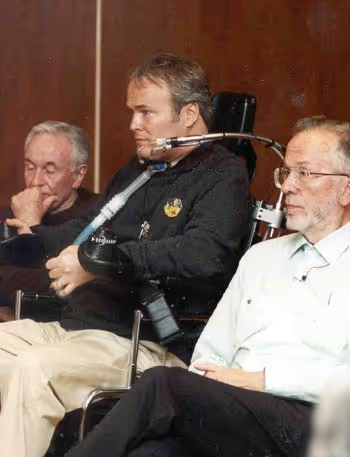
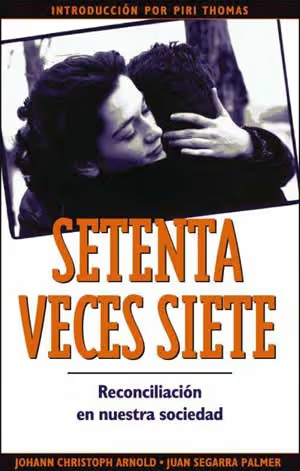
[.article__paragraph--leading] El detective Steven McDonald de la policía de Nueva York, quedó paralizado del cuello hacia abajo por disparos. Limitado a una silla de ruedas y un ventilador, perdonó a su adolescente asaltante. Presentamos aquí la historia tal como aparece en el libro Setenta veces siete de Johann Christoph Arnold, escrito después del primer encuentro de Arnold con McDonald. Durante 20 años con el programa Breaking the Cycle , McDonald y Arnold hablaron juntos sobre la resolución no-violenta de conflictos en asambleas escolares de la zona de la ciudad de Nueva York. Además, hicieron tres viajes a Irlanda del Norte para hablar sobre perdón y reconciliación, acompañados del Padre Mychal Judge, quien se murió en los Torres Gemelos el 11 de septiembre del 2001. Tanto Arnold como McDonald fallecieron en 2017. [.article__paragraph--leading]
[.article__paragraph--cap] La historia de Steven McDonald ha tocado a muchos estadounidenses, pero parece que no son muchos los que ven en su acto de perdonar algo más que un acto de voluntad sobrenatural. Steven, un policía y detective de la ciudad de nueva york, fue baleado en 1986 mientras interrogaba a tres jóvenes en el Parque central, y quedó paralizado del cuello hacia abajo. Llevaba menos de un año de casado, y su esposa tenía dos meses de embarazo.[.article__paragraph--cap]
Shavod Jones, su asaltante, provenía de un complejo de viviendas públicas en Harlem, Nueva York; Steven vivía en un barrio de gente blanca adinerada. Su breve encontronazo podría haber terminado con prisión para uno, y toda una vida de amargura para el otro. Pero aún antes de que soltaran a Shavod de la cárcel, comenzó a cartearse con él en un esfuerzo de traer “paz y propósito” a la vida de ese joven. Steven escribe:
[.blockquote] Preguntarme por qué me había disparado el muchacho era algo que estaba completamente fuera de mi pensamiento mientras miraba el cielo raso desde mi cama en el hospital. Estaba perplejo, pero descubrí que no podía odiarlo a él sino a las circunstancias que esa tarde lo habían llevado al Parque Central con una pistola escondida en el pantalón. [.blockquote]
[.blockquote] Para ese muchacho yo era una chapa, un uniforme que representaba al gobierno. Yo era el sistema que les permitía a los dueños de casas cobrar alquiler por apartamentos escuálidos en edificios deteriorados; yo era la agencia municipal que reconstruía barrios pobres y echaba a los residentes, mediante el «aburguesamiento», sin tener en cuenta si eran buenos ciudadanos que respetaban la ley, o criminales y traficantes en drogas; yo era el policía irlandés que se presentaba en una disputa doméstica y se iba sin hacer nada porque no había ninguna violación de la ley. [.blockquote]
[.blockquote] Para Shavod Jones, yo era el chivo expiatorio, el enemigo. No me veía como una persona con seres queridos, como hombre casado y futuro padre. Él estaba infectado con los mitos que circulan entre su gente: los policías son racistas, se vuelven violentos, así que ármate contra ellos. No, yo no podía echar la culpa a Jones. La sociedad, la familia, las agencias sociales responsables por él, los que hicieron que fuera imposible que sus padres se quedaran juntos – todos le habían fallado mucho antes de que Shavod Jones se encontrara con Steven McDonald en el Parque Central. [.blockquote]
[.blockquote] A veces, cuando no me siento bien, puede que me enoje. Pero me doy cuenta de que el enojo es una emoción derrochada…a veces estoy enojado con el adolescente que me pegó el balazo; pero más a menudo le tengo lástima. Sólo espero que él pueda cambiar su vida y ayudar a la gente en vez de hacerles daño. Yo le perdono y espero que pueda encontrar paz y propósito en su vida. [.blockquote]
[.blockquote] Al principio Shavod no contestó las cartas de Steven; más tarde, cuando lo hizo, el intercambio fracasó, porque Steven rehusó acceder a su pedido de ayudarle a obtener la libertad condicional. A fines de 1995, sólo tres días después de salir de la prisión, Shavod perdió la vida en un accidente de motocicleta. Steven continúa predicando su mensaje de amor y perdón desde su silla de ruedas. [.blockquote]
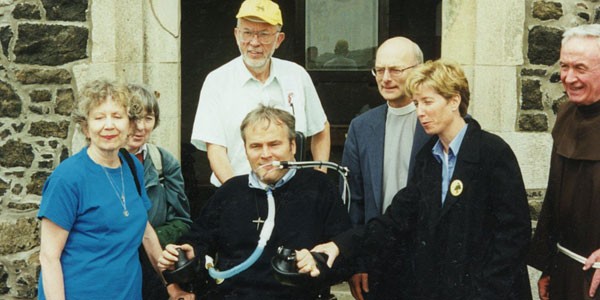
[.imgcaption] Capellán del NYFD Fr. Mychal Judge, Detectivo Steven McDonald, y autor Johann Christoph Arnold llevan su mensaje de perdón y resolución no-violente de conflictos a Irlanda del Norte. [.imgcaption]
Cuando visité a Steven en su casa en Long Island, inmediatamente quedé impresionado por su bondadosa manera, sus ojos chispeantes, y el alcance de su invalidez. Es bastante difícil para una persona mayor vivir confinado a una silla de ruedas. Que a un hombre lo arranquen de la vida activa a los veintinueve años es devastador; agrega a esto tener que respirar por una traqueotomía, y un hijo de diez años cuyo papá nunca ha podido abrazarlo – ahí tienes a Steven McDonald. Pero no percibí ningún enojo, ninguna amargura.
Con calma y con firmeza me abrió su corazón. Habló de aquel balazo como de una «bendición», una dura prueba de fe, que sin duda lo había acercado más a dios, y lo había obligado a enfocarse más en lo espiritual y lo eterno:
[.blockquote] Al principio, el perdón era una manera de seguir adelante, una manera de dejar atrás aquel horrible accidente. Pero luego me di cuenta de que yo había vivido una vida pecaminosa y egoísta, y que yo mismo necesitaba perdón. Era muy simple. [.blockquote]
Ahora, Steven ha encontrado un propósito para su vida: enseñar a perdonar. Regularmente habla en escuelas primarias y secundarias, y en ceremonias de graduación. Considera su trabajo como un encargo de dios. Puesto que perdonó, y compartió con otros su acto de perdonar, Steven tiene la esperanza de que la gente vuelva a descubrir a Dios.
Once años después del balazo, su esposa Patti sigue fielmente a su lado. Luchan a diario con la realidad de su incapacidad y los efectos que tiene sobre su matrimonio. A menudo Steven tiene que batallar contra el desaliento, y hasta ha luchado contra pensamientos suicidas. Pero cuando le pregunté si el perdonar en sí había sido una lucha, dijo que no, que era más bien un don, una gracia.
No debe ser fácil perdonar cuando uno ha sido tan gravemente herido. Pero aún en la agonía más profunda tenemos que elegir entre amar u odiar, perdonar o condenar, buscar reconciliación o venganza. Steven podría haberse amargado, pero escogió el camino de la paz y la reconciliación, y hasta el día de hoy está transformando la vida de otros.
Uno de los héroes de Steven es Martin Luther King Jr, el renombrado dirigente de derechos civiles (Civil Rights Movement). Durante nuestra visita pidió a la enfermera que le sostuviera un libro que nos quería mostrar; era una colección de los discursos de King, y nos leyó un pasaje favorito:
[.blockquote] Hay tanta frustración en el mundo porque hemos dependido de dioses, en lugar de depender de Dios…Lo que tenemos que descubrir nuevamente es la fe en Dios…El perdón no es un acto aislado; es una actitud arraigada. [.blockquote]
Antes de despedirnos, Steven me pidió que orara con él. Lo hicimos, y la cara le brilló de alegría. Rara vez he visto a un hombre tan contento, tan tranquilo y seguro del propósito que tiene su vida.
Steven spent the next eighteen months in the hospital, first in New York and then in Colorado. It was like learning to live all over again, this time completely dependent on other people. There were endless things to get used to – being fed, bathed, and helped to the bathroom.
Then, about six months after I was shot, Patti Ann gave birth to a baby boy. We named him Conor. To me, Conor’s birth was like a message from God that I should live, and live differently. And it was clear to me that I had to respond to that message. I prayed that I would be changed, that the person I was would be replaced by something new.
That prayer was answered with a desire to forgive the young man who shot me. I wanted to free myself of all the negative, destructive emotions that his act of violence had unleashed in me: anger, bitterness, hatred, and other feelings. I needed to free myself of those emotions so that I could love my wife and our child and those around us.
Then, shortly after Conor’s birth, we held a press conference. People wanted to know what I was thinking and how I was doing. That’s when Patti Ann told everyone that I had forgiven the young man who tried to kill me.
Steven and his assailant, whose name was Shavod Jones, could not have been more different. Steven was white; Shavod was black. Steven came from the middle-class suburbs of Long Island’s Nassau County; Shavod from a Harlem housing project. Their brief encounter might have ended right there. But Steven wouldn’t let it. Knowing that his attacker had just altered the course of both of their lives, he felt an uncanny connection to him:
Strangely, we became friends. It began with my writing to him. At first he didn’t answer my letters, but then he wrote back. Then one night a year or two later, he called my home from prison and apologized to my wife, my son, and me. We accepted his apology, and I told him I hoped he and I could work together in the future. I hoped that one day we might travel around the country together sharing how this act of violence had changed both our lives, and how it had given us an understanding of what is most important in life.
Eventually the exchange fizzled out. Then, in late 1995, Shavod was released from prison. Three days later, he was killed in a motorcycle accident. Others might feel Steven’s efforts to reach out to his attacker were wasted, but he himself doesn’t think so:
I was a badge to that kid, a uniform representing the government. I was the system that let landlords charge rent for squalid apartments in broken-down tenements; I was the city agency that fixed up poor neighborhoods and drove the residents out, through gentrification, regardless of whether they were law-abiding solid citizens, or pushers and criminals; I was the Irish cop who showed up at a domestic dispute and left without doing anything, because no law had been broken.
To Shavod Jones, I was the enemy. He didn’t see me as a person, as a man with loved ones, as a husband and father-to-be. He’d bought into all the stereotypes of his community: the police are racist, they’ll turn violent, so arm yourself against them. And I couldn’t blame him. Society – his family, the social agencies responsible for him, the people who’d made it impossible for his parents to be together – had failed him way before he had met me in Central Park.
When visiting Steven in his Long Island home (since meeting in 1997, we have become close friends), I am often struck by the extent of his incapacitation. Life in a wheelchair is hard enough for an elderly person to accept, but to be plucked out of an active, fun-loving life in your prime is devastating. Add to that a tracheostomy to breathe through and total dependence on a nurse and other caregivers, and life can seem pretty confining at times. Steven is matter-offact about this:
There’s nothing easy about being paralyzed. I have not been able to hold my wife in my arms for two decades. Conor is now a young man, and I’ve never been able to have a catch with him. It’s frustrating – difficult – ugly – at times.
So why did he forgive? Again, he himself says it best:
I forgave Shavod because I believe the only thing worse than receiving a bullet in my spine would have been to nurture revenge in my heart. Such an attitude would have extended my injury to my soul, hurting my wife, son, and others even more. It’s bad enough that the physical effects are permanent, but at least I can choose to prevent spiritual injury.
Again, I have my ups and downs. Some days, when I am not feeling very well, I can get angry. I get depressed. There have been times when I even felt like killing myself. But I have come to realize that anger is a wasted emotion…
Of course, I didn’t forgive Shavod right away. It took time. Things have evolved over fourteen years. I think about it almost every day. But I can say this: I’ve never regretted forgiving him.
Patti Ann feels the same:
It’s been hard, very hard, for me to really forgive the boy that shot Steven. Why did he have to do it? I still want to know. Why couldn’t my son grow up having the same experiences other kids have with their dads? We still struggle over that one. But I learned long ago that in order for us to get along as a couple, I had to let go of my anger. Otherwise Steven and I wouldn’t have been able to go on ourselves. Because when something like that festers inside of you, it just destroys you from the inside out.
Today, Steven is a sought-after speaker at schools in and around New York City, holding entire auditoriums captive as he retells his story and launches dialogue on the broader issues surrounding it. To him, the cycle of violence that plagues so many lives today – including young lives, like that of Shavod – can be overcome only by breaking down the walls that separate people and make them afraid of each other. The best tools for this, he says, are love, respect, and forgiveness.
Quoting Robert F. Kennedy, Steven likes to point out that “the victims of violence are black and white, rich and poor, young and old, famous and unknown, but they are, most important of all, human beings whom other human beings have loved and needed.” And somewhere in each address, he finds a way to refer to Martin Luther King – a man who gives him unending inspiration:
When I was a very young kid, Dr. King came to my town in New York. My mother went to hear him speak, and she was very impressed by what she heard. I hope you can be inspired by his words too. Dr. King said that there’s some good in the worst of us, and some evil in the best of us, and that when we learn this, we’ll be more loving and forgiving. He also said, “Forgiveness is not an occasional act, it’s a permanent attitude.” In other words, it is something you have to work for. Just like you have to work to keep your body fit and your mind alert, you’ve got to work on your heart too. Forgiving is not just a one-time decision. You’ve got to live forgiveness, every day.
FromWhy Forgive?