Stupidity Is the Greatest Sin
Studying the liberal arts beyond the classroom can help combat the intellectual dullness that continues to afflict our world.
May 28, 2026
Try 3 months of unlimited access. Start your FREE TRIAL today. Cancel anytime.
START FREE TRIAL NOWStupidity Is the Greatest Sin
Studying the liberal arts beyond the classroom can help combat the intellectual dullness that continues to afflict our world.
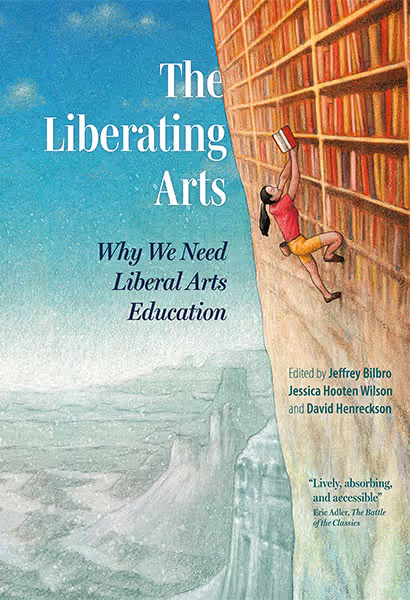
[.smalltext]From The Liberating Arts: Why We Need Liberal Arts Education.[.smalltext]
[.article__paragraph--cap][.small-caps]“Stupidity is the greatest sin”[.small-caps] was a favorite saying of Eberhard Arnold, the German theologian and educator who, a century ago, founded the magazine I now edit. On its face, the statement sounds insufferable – how can someone’s lack of intellectual gifts be cast as a moral failure? Interpreted this way, Arnold’s one-liner comes across as a cruel dunk on the unlettered, the under-privileged, and the mentally slow.[.article__paragraph--cap]
But Arnold means something close to the opposite. Far from a slur denigrating those who lack a college degree or who score low on Raven’s matrices, stupidity in his sense is a vice of complacency that particularly afflicts the educated bourgeoisie – the very people who make up the bulk of the readership of any small magazine.
What Arnold means by stupidity becomes clear from reviewing a sampling of the places he detected it. He saw stupidity, for instance, among many of his fellow intellectuals, “know-it-alls who can talk about everything but don’t know how to do much of anything” and who acted superciliously toward the working class who did. He saw it among many of his fellow Christians, whose “self-centeredness and self-contemplation make the spirit stupid and dull.” And he saw it in the National Socialist regime that hounded him during the two years before his early death in 1935:
[.blockquote]Modern fascism is such that one could weep about it day and night. Freedom of thought is forbidden. Objective justice is abolished. Goebbels says, “If we are right, it follows that no one else is right. For us there is no other justice than that which serves our interests.” Stupidity reigns.[.blockquote]
Whatever its manifestation, stupidity in Arnold’s view stems from a choice: a refusal to take up the task that comes with being human, beginning with the refusal to know the truth about oneself. His maxim reflects a well-known aphorism coined by Nietzsche: “To forget one’s purpose is the commonest form of stupidity.” The result is apathy – an insensitivity toward the true, the beautiful, and the good as they appear in the various spheres of life, from religion to politics to nature to the arts.
[.imgcaption][.smalltext]Photograph by Blair Fraser / Unsplash.[.smalltext][.imgcaption]
Accordingly, Arnold’s mission as a writer and publisher amounted to an ardent campaign against stupidity. The magazine’s task, he believed, was to stir people out of their self-satisfaction with a “summons” to “living renewal,” as he put it in a 1920 editorial that still serves as the magazine’s mission statement. This means inviting everyone, whether academically trained or not, into a life of continual learning within an “educational community,” in which ancient wisdom is brought to bear on modern dilemmas: “We must get down to the deepest roots of Christianity and demonstrate that they are crucial to solving the urgent problems in contemporary culture. With breadth of vision and energetic daring, our publishing house must steer its course right into the torrent of contemporary thought.”
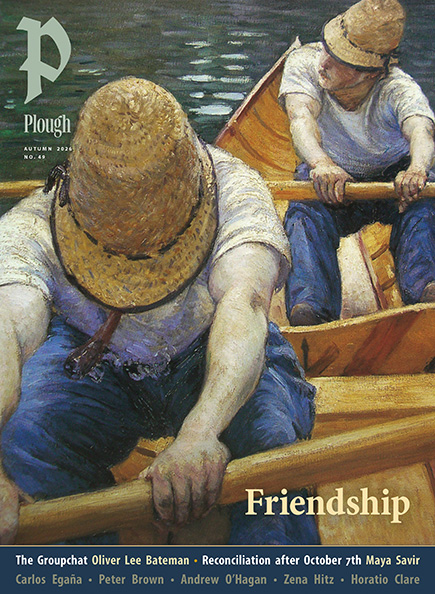
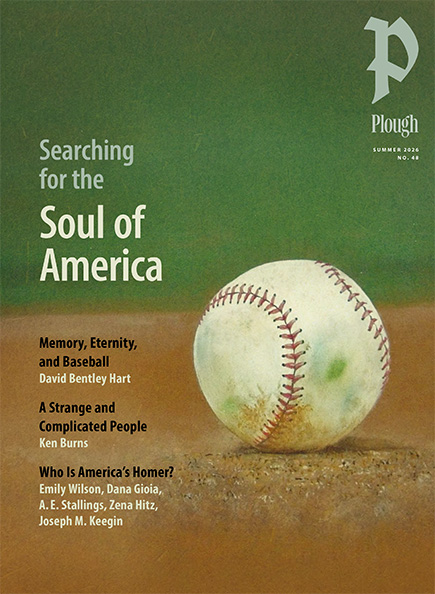
This is a mission that remains as challenging today as ever, and just as crucial. The current incarnation of the publication Arnold founded is Plough. (Plough Publishing House also publishes a line of books.) Each issue is themed around a topic that its editors believe has pressing significance, such as capitalism, medicine, vocation, or faith and politics. The means are various: big essays, on-the-ground reporting, readings from classical and medieval authors, personal narratives, comics, poetry, and art and photography. The aim of small magazines like Plough is not simply to inform or entertain but to offer fresh perspectives that help readers think differently and equip them to live their lives more intentionally. Nor is that a one-way street: from readers who offer contrasting views, argue, critique, and sometimes unsubscribe, editors and writers can learn to see the world from perspectives they otherwise would have missed.
It’s exhilarating to see the power of small magazines to draw together an unlikely assortment of thinkers, readers, and doers into the kind of educational communities that Arnold envisioned. A few publications that have been doing this well are The Baffler, Comment, Commonweal, First Things, The Hedgehog Review, Jacobin, The Lamp, Local Culture, Mere Orthodoxy, Mockingbird, The New Atlantis, and The Point. Increasingly, small magazines like these are facilitating local gatherings of their readers in various towns and cities, to build community through face-to-face conversation.
A common pitfall of the present moment is that any publication risks becoming predictably partisan and then being pigeonholed and dismissed as either right-wing or left-wing. It can be tough to resist the currents tugging a writer or an editor into an attitude that assumes an “us” while excluding a “them,” or that simply serves up regular helpings of whatever kinds of hot take will reliably fire up one’s base. I’ve found that a strong antidote is a rigorous commitment to seeking truth together with people with whom I disagree and an openness to discovering common ground in surprising places.
It’s essential that this truth-seeking be rooted in a way of life – that we find ways to put the insights we gain into practice. Ultimately, it’s within real, not virtual, communities that the lifelong learning of Arnold’s “educational communities” can best be sustained. The small magazines I’ve just mentioned are each, in different ways, focal points for networks of people who want to not just think well, but do well. (Of course, they vary widely in their sense of what this actually looks like.)
To take Plough as the example I know best, this is a network of readers, writers, and practitioners drawn to the magazine for any number of reasons. From surveys, we know they span the political spectrum and hold a wide range of philosophical and religious beliefs. Yet they share a common conviction summed up by the magazine’s motto: “Another life is possible.”
Although today the word “community” carries a suspicious odor thanks to its abuse by corporate marketing departments, for the readership of a small magazine it’s an accurate term. In the case of Plough’s staff, this is true even more literally: the same year that Arnold founded Plough, he also founded the Bruderhof, the Christian intentional community that publishes the magazine and of which many (but not all) of the editors are members. The flesh-and-blood communal life behind the magazine is proof that the collective task of discovering and remembering our purpose as human beings is not just an idealistic project but also an eminently practical one.
As it happens, this somewhat unusual case study provides substantiation, too, for the liberating arts’ broader claim that the search for truth is not something reserved to the academically educated. To speak from my own experience, on the Bruderhof where I grew up, in New York’s Hudson Valley, I got to know older members who were the evidence of this. There was the tool-and-die maker who loved Dostoyevsky, the sheep farmer who sang Schubert’s Lieder, and the former factory worker who kept a copy of Kierkegaard on his coffee table. This was just what Arnold, who himself regularly spent time turning the communal farm’s manure pile before heading to his study to write and edit, had in mind. From a 1920 essay:
[.blockquote]We should be ready to spend several hours each day (provided we are in good health) doing physical work. Intellectuals, in particular, would discover the wholesome effect this has. Daily practical work allows each person’s special light, his or her gift, to be kindled. This spark in each one, though maybe hidden, gives a glimpse of various gifts – possibly in scholarship, music, the use of words, creative art in woodwork, sculpture, or painting. Or simplest and best of all, a nature-loving person may have a particular gift for farm or garden work…. Idleness and tedium are symptoms of death. Where there is life, people have alert, creative minds and are ready to serve and help one another. This is not mere fantasy about an unattainable future; it is a present reality in a growing community.[.blockquote]
Such lifelong educational community, whatever the varying forms it may take, is the goal of the liberating arts. It’s the way that we can remember our purpose as human beings possessing bodies, minds, and souls. And it’s an effective answer to the stupidity that continues to afflict our world.