Essay
What’s in a School Story?
Education is for encouragement, not for escape.
August 24, 2026
Try 3 months of unlimited access. Start your FREE TRIAL today. Cancel anytime.
START FREE TRIAL NOWWhat’s in a School Story?
Education is for encouragement, not for escape.
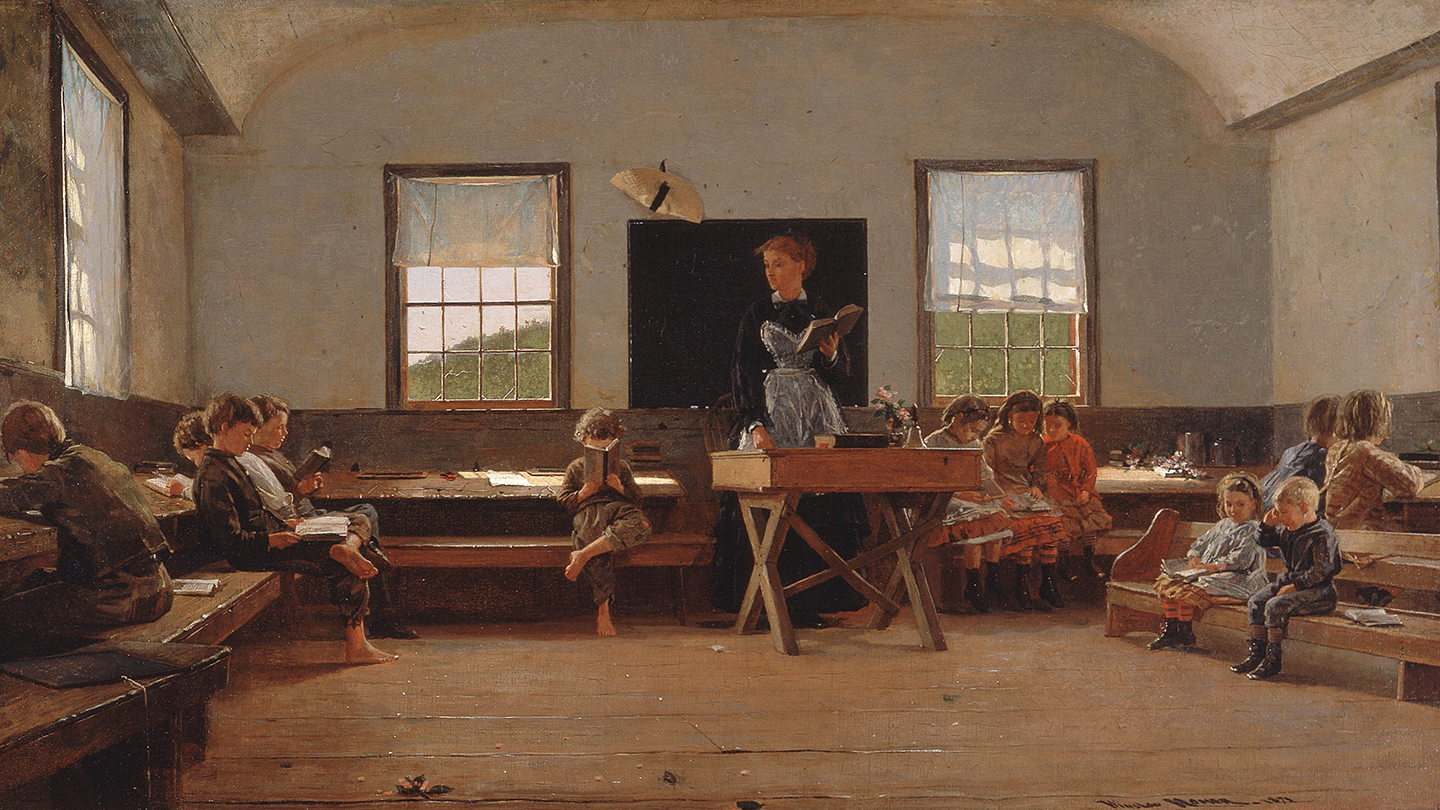
Winslow Homer, The Country School, 1871, oil on canvas. [.smalltext]Wikimedia Commons (public domain).[.smalltext]
[.article__paragraph--cap][.small-caps]At the opening[.small-caps] of The Silver Chair, C. S. Lewis announces that “this is not going to be a school story,” going on to describe quite a wretched-sounding school indeed, or so he means to describe it. It is co-educational and the people who run it “had the idea that boys and girls should be allowed to do what they liked,” which is to say, dreadful things. Its name, perfectly, is “Experiment House,” and Lewis leaves us in no doubt how the experiment is turning out.[.article__paragraph--cap]
This remark about the school story has always puzzled me, right from the first time I read The Silver Chair, probably at some point around third grade. What did he mean by a school story, in the first place, and why were the admittedly quite impressive adventures detailed in The Silver Chair and the other Narnia stories superior to it? I, for one, have always loved a school story, that is to say, a story about people in a school, and I was sorry to think that there might be something awkward about this sort of plot. School stories have a natural orderliness to them, September to May, which can indeed become stultifying without care; but I grew up not liking my school much, and I did love to read about the ones that sounded better.
In the course of his fiction, Lewis does not explain his preference. And so for many years I was left to my own devices, to puzzle over to myself why such a story would be insufficient. The best answer I can think of, as an adult, and a teacher, is something like this. It’s akin to one of Socrates’ most frequent themes, often brought out when Plato wishes to paint him at his most indignant: Human beings have got everything about human life backward. We seek for things like political glory, kingship, the applause of the populace, cash, thinking that these are the true substance of our human life. We do this, but what is properly first is not these, but rather, as Socrates puts it in the Euthyphro, seeing that the youth become as good as possible, and, from the Republic, that they come to learn as much of the truth as they can. Only then do we have any real hope of seeing any old misery of ours really subsiding, in the next generation, when the next, rather wiser king comes to rule.
That humans generally find the pursuit of how things really are, including the pursuit of good schooling, to be fundamentally childish, is our perennial failing and flaw. A school story, I thought, dreaming, looks childish because we wish to hurry on to action outside of the story’s admittedly artificial bounds. And certainly, if all novels were about school, who could read them? But still there must be something to the genre. For was not Plato’s Republic the mother of the school story of them all? Of course, though, this couldn’t be quite what C. S. Lewis meant in The Silver Chair. After all, his most famous critique of school was that, all being in Plato, there was never enough Plato in school? – a point on which I heartily concur.
When I first read Plato’s Republic, however, I did not find it to be even pleasant, but rather, a most infuriating book. It is Socrates at his most indignant, his most tyrannical, even, as he first refutes all present at will, and then at last is goaded into describing not only the most beautiful kingship, but also his ideal of an ideal schooling, which is sometimes appealing and sometimes preposterous. This Socrates does, at the behest of the youths – while also involving himself in a mass of contradictions on the nature of images and the natural world; and just as everyone is falling asleep, old and young alike, describes a sort of marvelous spindle at the heart of the world. It is a strange book, and it got under my skin in a way that no other ever had.
[.article__paragraph--cap][.small-caps]When that[.small-caps] school year came to an end and, pace employment, I was left temporarily to my own devices, I was puzzled at what to read next. I had spent the first year of college doing a substantial amount of Plato-reading beyond the bounds of our curriculum, and had a few of these projects going still. But I also knew I was going to have to find something, well, easier to rest myself with a bit, in, as Chaucer has it, the “grene and lusty May.”[.article__paragraph--cap]
At the top of our college library, close to a favorite chair, I had noticed that there was a children’s section, and one day, I found myself putting down whatever I was reading of serious things and picking something off the shelf. It was delightful, and perfect; and that summer I ended up reading the shelf from start to finish, that is, I read all the things from it I already knew and had read before. Several things became vivid for me in the course of this – The Phantom Tollbooth’s play with words was particularly congenial to my new respect for grammar – but the most vivid I have from that summer’s resting was Louisa May Alcott’s Little Men, the first of the two sequels to, as you know, of course, Little Women.
Here was a school story indeed. At the end of the original Women, Jo March threatens to open a school for boys, and while her family laughs at her odd notion, in Men, she really does. And strangely enough, although this character is most beloved for her turmoils and despairs in the first book, in the sequel, the wilderness of boys that Jo March foresaw has made her really, truly, and convincingly happy. The marriage, her writing, her children contribute; but it is the school that makes the day, a surprising plot-twist, yet strangely recognizable.
Good teaching, as Eva Brann, my first teacher of Plato, would say, is somewhat ineffable. There is no rule or measure that will be fully predictive of who will be good at it, or what methods they will follow to do their best work; you have to know it when you see it, within a long human chain of teachers as unbroken as possible; and the fact of the matter is, there will never be enough good teachers to go around. In this way, some of humanity’s perpetual frustration with school becomes more understandable; for even at school’s best, you still might not get to go, and so be forced to take your ambition elsewhere after all.
What makes Jo remarkable as a character is the rarity of her ambition. She was loved in Little Women for her writing desires, but such ambitions are now a dime a dozen; at least, they are so now because women saw themselves in her. The rarity that remains is her insistence, as her own bildungsroman closes, that she can see the precise moment at which she would like to intervene with others in the same; and then, rarest of all, joyfully, her wish granted by her author, she accomplishes it to precision.
Jo’s genius, however, is not a vague aspiration: rather, the specificity of her intervention is her peculiar talent. As she describes it,
“I really don’t know which I like best, writing or boys,” she said, laughing to see Nat stare in astonishment at the last item. “Yes, I know many people think boys are a nuisance, but that is because they don’t understand them. I do.”
Boys, she explains, have a precise moment of hobbledehoy awkwardness, where they are large on the outside but still growing within; and as she points out, many of them “go fast to ruin” for want of kindness and patience at just this time. They come, of course, with radically different sorts of characters; the story starts with a child who has done street music but can’t read, another who simply lived by his wits and so must lose the “hard and careless, suspicious and willful” persona he’s taken on in self-defense. One has a humpback, one is a skinflint, a few are simply of no account, and some lie; one has lost his reason to brain fever, after being pushed too hard by an ambitious father. By the end of the book, a handful of girls join the school and prosper, one with particular physical courage discovering her ambition to become a doctor, at Jo’s behest. All in all, the focus of the school is on balancing the body with the soul, to not letting books and letters pinch the wholeness of the composite, Jo and Bhaer united in the attempt, and to learn to direct desire toward good things for their own sake. All this: while spending extraordinary amounts of time in the free play of the imagination and feats of athletic prowess.
In short, seeking to rest, I had come across a sort of microcosm of the Republic, the very book I had been seeking to avoid. Yet now these same things, body, soul, music, gymnastic, and always a careful balance of all, were in an American, even Emersonian, context – with just a touch of the Montessori-esque sort of freedom in learning the Republic remains content to hint at. And somehow, in Little Men, while the children are, dangerously, often free to do what they like, what they like can be turned by their teachers to what is not all bad.
I admit to having being elated by this summer reading, without fully being able to explain it. Socrates’ arguments are endlessly fascinating, and after years of thinking them through, in the manner of a mathematical hyperbola, they often sit asymptotically still, just beyond one’s reach. And when you hear them first, they are often only a terror, to the extent that many readers feel safest simply tossing them out. I was not unconvinced of this potential relation between soul and virtue on which Socrates, often quite undemocratically, had waxed long. But I do remember feeling, as I came back upon the Alcott story, a second moment of real recognition that soul and virtue were true: that here was an independent attestation of something it was simply possible to see for one’s self – not to mention the warning about the brain fever, point taken. In this way, these things were now also mine; through the benefice of this lady author I’d known from childhood. Female readers of Little Women often describe a sense of being ratified in their desire for writing books through the action of the story and the existence of Jo; this school-story ratified me.
[.article__paragraph--cap][.small-caps]But then,[.small-caps] if all this is true, what on earth shall we do with the Lewis objection after all? What could this Platonist mean by his rejection of the Platonic genre? In a well-loved essay, “Three Ways of Writing for Children,” a public speech defending the worth of fantastic literature for both children and adults, Lewis explains himself. All fictions seek to satisfy, imaginatively, he remarks, the wishes of the heart. But while fantastic literature leaves desire usefully inchoate, realistic fiction, “especially when directed on something so close as school life, is ravenous and deadly serious,” especially in what it does to our desires. The problem is, he argues, that imagining oneself as a successful schoolboy, hero of the cricket team, is fundamentally compensatory, and compensatory for disappointment. As such, it is dangerous, and as a genre it is “all flattery to the ego,” which “sends us back to the real world undividedly discontented.” And so, Lewis argues, even to imagine oneself suddenly a king or queen in a foreign land, sans education regardless, is better for the soul.[.article__paragraph--cap]
This critique, as sincerely as it is meant, and standing, really, as more of a side note to the more central and beautiful defenses of quite a different genre--as it is stated, however, it cannot be right. One sees in it the despair of the late-nineteenth-century British schoolboy, where school indeed was not merely cruel about things such as cricket, but cruel within the violence of coercive youthful sexuality and sadism run amok. And in Lewis’s distaste for the freedom of Experiment House, one sees the fear that any freedom toward doing what one likes might well devolve even more quickly into Lord of the Flies than even the violent beatings with canes of the complexly regulated British public school. “The fantasies,” Lewis writes, with truly piteous forthrightness, “did not deceive me. The school stories did.” Yet in this speech he cannot bring himself to say why; only record his relief that in his children’s stories, certain subjects, such as sex and desire, were perforce not in genre, and so safely beyond his writerly concern. In his critique, therefore, of the danger that the image of the successful schoolboy does to the soul, Lewis seems to fall back on picturing the same kind of proto-adult he finds so objectionable in other spheres. The school-boy is still, perhaps, always Mark Studdock of That Hideous Strength, as he was at that age, the incipient prig yearning after the inner ring, the false adulthood of an exclusive social circle, for whom school is the pre-established microcrosm of static adult hierarchy, as tacitly unjust as all the rest.
But: by the grace of God, I can imagine a better school. And consequently, I see no reason why school has to be like this; nor why a school and its stories could not safely be a place where true youthfulness is treasured for its own sake, and a place where also, as Plato would have it, one is initiated into the treasure of insight into the Real. Indeed, I suspect this “flattery to the ego” notion is a bad argument; for as stated, it will have to apply to good schools as well as bad. And so it remains a kind of rhetoric of despair. Let us therefore strive to keep the fairy tale without sinking the school story, is my advice.
Yet an underlying truth remains; the sharpest aspect of Lewis’ critique is the Platonic one I believe he is trying to insist upon: that we are what we imitate, and we often become what we imitate through the stories we admire most when young. It is more than possible that such youthful stories will narrow our fundamental sense of what life is about, should we fix too strongly on the wrong ones: thus much Socrates. And to be sure, given all this, is not to say the Platonic forms might not be well pursued in fantastic fiction, of the sort at which Lewis is so remarkably successful. When the bad queen of The Silver Chair tries to talk the trio out of the light of the sun with a dreadful lamp, the way Puddleglum puts his bare foot therefore into the fire, the better to say the difference: this is Neo-Platonic canon.
But once we grow up, we may consult the source ourselves, one poet closer to the truth. For in Plato, the Forms at their closest point to human grasp are always the crowning glory of the best sort of school or teacher, and the human paradox remains, that you can never have the one without the other. No king without a school. This is so, no matter how much the school might seem like tyranny, or fail, via its all-too-human governors, to reach escape velocity past its flaws; and is so even though we’ll never fully be able to start from scratch. But for the reader as well as for the student, it is always an exercise in humility to begin at the beginning – even if, to start, it might seem as not as much fun to read.
[.article__paragraph--cap][.small-caps]For here’s what’s[.small-caps] most important. The heart of the disagreement between Lewis and Alcott and Plato seems to be something about the nature of childhood itself. There is overlap: both Lewis and Alcott speak of the necessity of a kind of perpetual remembering of what childhood felt like from the inside; “as lived,” Lewis notes in his praise of Edith Nesbitt, it “was immeasurably different from what our elders saw,” and must be imitated as such. Of Jo in Little Men Alcott writes that “she was not at all handsome, but she had a merry sort of face that never seemed to have forgotten certain childish ways and looks, any more than her voice and manner had; and these things, hard to describe but very plain to see and feel, made her a genial, comfortable sort of person, easy to get on with, and generally ‘jolly.’” This quality of the interiority of childhood, of being wholly at the mercy of the wondering world and wholly able to give it the fig, wholly able to take to the streets to play music if necessary, as memory, seems true to the remarkable liveliness that the works of both authors enjoy.[.article__paragraph--cap]
And yet for Lewis, there is a wrinkle. Childhood, he argues, is something that remains with us always, unaltered in its own right, a point of true equality between children and adults, and like the rings of a tree, is added to adulthood but not by its being fundamentally transformed; “where I formerly had only one pleasure, I now have two,” sweet lemon soda and Riesling wine. (I would be remiss if I did not mention that this is a riff of an argument from Republic IX; the wise man has pleasures the hedonist knows not of.) It’s by this working theory that Lewis seeks to write books enjoyed by children yet also loved by adults; and as an artist, few have succeeded more. But does this image of the rings of the tree really describe the progress of education? Are we the same kind of plant, or not? For what we wish to remember from childhood must also reflect our best hopes for ourselves as we reach toward a good death, both in the properly human sense of waxing to our fullness, and the sense in which we aim at higher and more divine things still.
This is what I love about a school story. In it, childhood is the most important thing, not as a moment of stasis, or as something which we can or should fully reinhabit, but because here we start to imagine how we would order it rather better – not for ourselves, but for our sequels. Being grown-up is a good thing; for then we might have children ourselves, of body or soul or both. Nothing should matter more, or does matter more, to the human condition than that the children become as good, as excellent, as happy as possible. To argue for anything less is despair. To remember our childhood in all the reality of it, is first to remember our joy in existence, and the sense of freedom we experienced when it seemed that the rest of everything was taken care of while we played; these are things we must never forget, and it’s our human task to recall them and find new ways of making them alive, most especially once we realize how really dangerous freedom really is.
But no less important to this recollection are the deep lonelinesses in it: the friends we wanted but did not find; the things adults failed to notice or willfully overlooked; when nothing more serious than childish ignorance or high spirits seemed to them a nuisance to their plans for the day; when their adult ambition failed to take into account our weaknesses, or when the nascent quality of some future excellence was left untended, in a corner, the moment for mastery missed forever. This was a failure, not of our character, but of their teaching – someone took a temperament or a tendency as some essential vice, when it was only a tendency, capable of improvement; someone lost their temper when they should not have. It’s in these moments that children first learn despair.
And yet in their hope, and love of what is beautiful, they still await the right teacher, who would ratify what was good in them, and help them so to live – that is, until they begin to forget to look, and become, in Alcott’s warning, “hard and careless, suspicious and willful” – that is to say, like the rest of everyone.
To imagine a better school is the joy of this despair, its turn, its reverse, and the sort of hope we cannot do without. What’s best in childhood is a sort of hope for the hope for being more than we can immediately see, that learning might be more than simply an introduction to the worst vices of political life; that by holding on to what we really see and know to be true, we might make it out of childhood alive. Our American Platonist Louisa saw this and wrote of it; in this light, let the good of the school story be understood.