Essay
What Does It Mean to Be British?
Not long ago the answer seemed straightforward. Now, once again, some are questioning who belongs.
June 22, 2026
Try 3 months of unlimited access. Start your FREE TRIAL today. Cancel anytime.
START FREE TRIAL NOWWhat Does It Mean to Be British?
Not long ago the answer seemed straightforward. Now, once again, some are questioning who belongs.

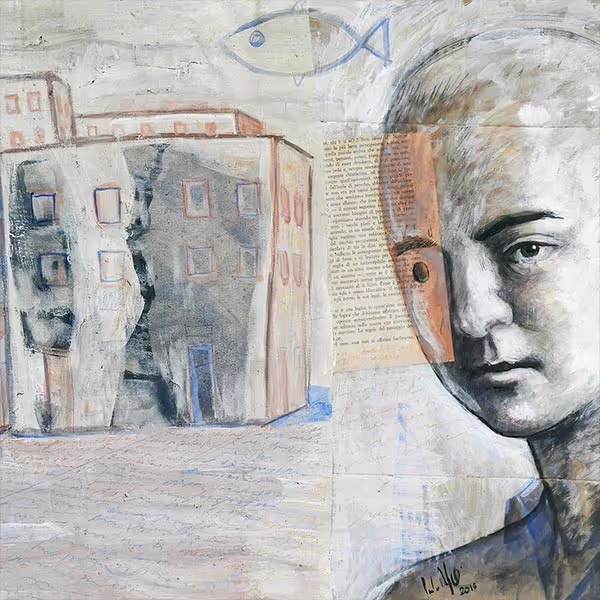
Photograph by Gareth Copley / Alamy Stock.
[.article__paragraph--cap][.small-caps]Questions of ethnicity,[.small-caps] integration, and belonging have become central to political discourse in recent times. The rise in ethnonationalist rhetoric in some quarters can be attributed to real and material concerns around immigration and the effects of rapid demographic change on social life and identity. Many people perceive and frame these matters as existential to the future of British civilization. [.article__paragraph--cap]
Not long ago, the answer to “Who is British?” seemed relatively straightforward: someone born and raised in Britain was British, full stop. A regional accent, along with familiarity with cultural touchstones, was enough to mark you as “one of us.” British identity was not understood as purely ethnic. There was a strong civic component. At least this is how I experienced it as a child of Nigerian immigrants born in 1990s London. I was aware from an early age that my ancestry was not from the British Isles. My name was foreign. I did not have grandparents or extended family nearby like many of my peers, never mind the same skin color. Yet London, or more specifically Lewisham, was still home. I never felt hostility or awkwardness, only a quiet awareness that my genealogy did not begin here. I grew up alongside many other second- and third-generation Britons of Jamaican, Pakistani, Vietnamese, and native British descent. We participated in the same inner-city urban subculture that shaped our tastes, humor, sensibilities, and understanding of local life. It became part of how we understood our place here. We all spoke a similar language. It never felt like we did not belong.
Growing up in the early 2000s I encountered Britain, almost instinctively, as a post-racial society. Moments like the 2004 Athens Olympics, with Kelly Holmes winning double gold in the middle-distance events and Mark Lewis-Francis anchoring the men’s 4 x 100 meter relay victory over the Americans left a strong impression on me. Here were athletes of varying ethnic backgrounds, shaped by British schools, sporting institutions, and local communities, proudly representing the country on the world stage. They were local talents who had progressed through the same national systems and belonged to the same civic culture as everyone else. The team itself reflected a Britain confident enough to understand belonging as something lived rather than inherited through blood.
Beyond sport, this ease extended into everyday cultural life. Craig David, a singer of Caribbean and Jewish descent, was constantly on the radio, his sound distinctly urban yet unmistakably British. The same applied to Comic Relief cofounder Lenny Henry, born to immigrants from Jamaica, through his public presence and charity work, and to TV news presenter Trevor McDonald, born in Trinidad. They were not treated as exceptions to Britishness, but as ordinary expressions of it. I understood them as part of the furniture of British life.
But that sense of belonging has shifted. I first became aware of a change in the aftermath of the July 7, 2005, London bombings. This marked a turning point in the national consciousness, the moment when “homegrown terrorism” entered public reality. Integration, once understood as something gradual, relational, and largely implicit, became more explicit, more scrutinized, and increasingly politicized. The following decade deepened this unease. The murder of British Army soldier Lee Rigby by Islamist terrorists in my corner of London in 2013, the emergence of figures like Jihadi John and Shamima Begum, British citizens who left the United Kingdom to join the Islamic State, seemed to reveal a troubling pattern: being raised in Britain did not guarantee attachment to it.
For centuries, Britain anchored its identity in shared narratives: Christian heritage, empire, and the monarchy. Whether one embraced or resisted them, these stories offered an invitational vision that stretched beyond ethnicity and race. They were grounded not only in loyalty to the crown, but in a deeper metaphysical conviction, that one could become “one of us” through participation and contribution to society. Figures such as Ignatius Sancho and Olaudah Equiano, both former slaves who became involved with the British abolitionist movement, reveal eighteenth-century Britain as a layered civilization: an ethnic-historical nation, an imperial power, and a society shaped by a Christian moral inheritance. Both men entered Britain through this third layer. They were not absorbed because ethnicity was irrelevant, but because a shared Christian grammar created a pathway to recognition. Both were baptized into the Church of England and formed within an Anglican imagination that shaped how they engaged British society. Sancho’s writings were infused with explicit Christian language, and he moved within circles embedded in the Anglican social and religious world. Equiano, meanwhile, operated as a kind of moral translator. By speaking within Britain’s Christian framework, he exposed the contradiction between its professed beliefs and its social practices. In doing so, he did more than protest injustice, he claimed a share in the moral inheritance of the nation itself. This narrative, however contested, acted as a form of social glue. It enabled a sense of belonging that was neither purely ethnic nor merely legal, but moral and participatory.
Since the Second World War, secular liberalism has gradually replaced Britain’s Christian metaphysical foundations. It was intended as an inclusive framework, one capable of accommodating a diverse society without demanding adherence to a single way of life. And to some extent, it has succeeded. Britain remains one of the most open and pluralistic societies in the world. Yet this settlement has struggled to generate a coherent national narrative. Values such as diversity, equality, and inclusion, while important, remain abstract without a shared vision of the good. British identity has become increasingly elastic, detached from any substantive account of the common good. Citizenship, in this sense, risks becoming little more than “paper citizenship,” legal but thin and transactional.
Part of the problem is the assumption that secularism is neutral. In reality, it is a worldview with its own prejudices, especially its marginalization of the transcendent. Traditions that locate authority beyond the individual or political institutions are often pushed into the private sphere. Secularism more or less managed to do this to Christianity, but for traditions such as Islam, where faith encompasses the whole of life, the tension is sharper. An example of this friction between value systems occurred at Batley Grammar School in 2021, when a teacher showed Charlie Hebdo caricatures during a lesson on blasphemy and free speech. He was cleared professionally, yet faced protests and death threats and was forced into hiding.
More fundamentally, secular liberalism narrows moral vision to the language of choice, rights, and procedure. It can sustain coexistence, something deeply necessary in an increasingly pluralistic Britain, but a shared life requires something deeper. Historically, British identity drew strength from Christianity, local rituals, civic traditions, and the rhythms of shared life. These practices gave people both membership and a stake in the nation.
During my early childhood, the local church youth club was still an important center of community. Many came simply to spend time there, regardless of faith. The church maintained a deep involvement with local schools and ran afterschool services. Its ability to cross surface-level boundaries and genuinely embed itself within the community made many of us feel that we belonged. Last year, I met someone at my boxing gym who had attended my primary school before moving away as a child. One of the first things he mentioned was the church youth club, despite not being Christian himself. That was simply the lived reality of the area. The church, summer fairs, and local football clubs acted as shared cultural touchstones that provided participation, memory, and a story to inherit.
Despite this lingering church social structure, the secularization of national life has left an empty center: a citizenry without a shared story. The National Health Service (NHS), the welfare state, and multiculturalism cannot provide transcendence, destiny, or a thick account of what Britain is for. The NHS may save lives, but it does not cultivate shared participation or communal inheritance.
As that national story has thinned, people have turned toward identities they perceive as stronger. Some on the right retreat into ancestry and blood-and-soil politics; some on the left seek moral purpose through activist ideologies. In this context, ideology becomes a substitute for religion: abstract and emotionally powerful but without religion’s grounding in local geographic communities of neighbors. Social media intensifies this process, creating microclimates in which people raised in the same country inhabit radically different visions of life.
The consequences are already visible: polarization, weak civic cohesion, and a growing identity crisis. Many white Britons feel anxious about rootedness and cultural direction; many ethnic minorities wonder what, in practice, makes one truly British. Legal citizenship alone no longer feels sufficient.
This is not to deny what secular liberalism has achieved. It has helped make Britain tolerant, open, and plural. But the glue holding this settlement together was never neutrality alone. It was the lingering inheritance of a Christian culture grounded in a shared life, not merely mutual tolerance. As that culture fades, Britain needs more than liberal proceduralism. It needs a deeper story: one capacious enough to hold diversity.
The Christian life offers one of the clearest examples of such a vision. Here belonging is meant in its fullest sense, not merely as a passive identity but as a lived commitment to one another in a body of believers that anyone and everyone is welcome to join. The church calls you to belong, to serve, to contribute. I did not inherit this tradition through blood but through moral and spiritual formation. My parish, rooted in the local community for over 150 years, did not simply welcome me; it entrusted me with its continuing legacy and with the life of the wider body.
The church, in this sense, is unlike any other institution. It does not operate by contract but by covenant, a shared life shaped by faith, responsibility, and mutual obligation. You belong because you are accepted and commit yourself, not because you meet a criterion. You are affirmed, but also formed, challenged, discipled, and stretched. One does not simply enter a building; one steps into a story. Few institutions, traditions, or social groups offer such grounding and hope. To inhabit this way of life is to begin to see what it means for Christians to be “salt of the earth,” by living out a form of unity grounded in something beyond the self. This unity is rooted in the person of Christ, and it does not rise and fall with the shifting preferences of the age.
It is this kind of faithful presence, quietly sustained over time, that has so often been the seedbed of real change. These are the marks of a faithful church, the quiet foundations upon which an enduring sense of belonging can rest. If Britain is to recover a deeper sense of belonging and nationhood, it will not be through policy or rhetoric alone, but through the renewal of communities capable of forming people in this way.
Yet the Christian vision does not place nation at the center. Our deepest identity is not ultimately found in ethnicity, citizenship, or even national belonging, but in Christ. It is through participation in the body of Christ, a community that transcends tribe, class, and nation, that love of neighbor is properly ordered and understood. Christianity does not abolish love of place or nation, but it offers a wider horizon. Patriotism, at its best, is not an act of exclusion or self-worship, but an expression of gratitude, stewardship, and shared responsibility.