Review
To Be Alive Is to Experience Drama
Is Józef Tischner’s The Philosophy of Drama an antidote to our culture?
November 27, 2026
Try 3 months of unlimited access. Start your FREE TRIAL today. Cancel anytime.
START FREE TRIAL NOWTo Be Alive Is to Experience Drama
Is Józef Tischner’s The Philosophy of Drama an antidote to our culture?
[.article__paragraph--cap][.small-caps]The dominant style[.small-caps] of contemporary theater is the Instagrammable, and the job of a playwright has become relatively easy. Come up with a good title, some kind of discursive hook, a big plot twist, and have enough big moments that look good and heart-stopping when photographed or can be clipped in a five-second reel. The contemporary dramatist is less important to their own production than the graphic designer, the marketing director, the photographer, and much less important than the social media presences of the actors in the play.[.article__paragraph--cap]
It naturally follows that contemporary plays lack drama because, from the very beginning of the process, the collective expectation, both internally to the production and externally to the audience, is that values are reified, comfort is had, boundaries are respected, and that the stage on the whole maps onto the Instagram square, or rather is a materialized version of the Instagram square of the marketing. As Gen Z culture increasingly becomes culture at large, their vapid, undramatic, twee vision of dramatic art may become all that there is.
We should expect, as is already the case, more and more plays that are about being a teenager and summer camp, or an influencer, or misguided conservatives in small towns, and age-gap relationships, and all the other obsessions and MacGuffins of the Instagram generation. What we should not expect, on the other hand, are characters who are able to break archetypes, who threaten the archetypal molds created by phone culture and who exude ontological realness, who, in the literary critic Harold Bloom’s formulation, seem more real than their creators. The play must sound like how it looks, and it should not leave the audience wanting more from life than they already have. The primary message of new theater in the back half of this decade is that people are nothing more than flattened projections who can either be spicy or funny, virtuous, or canceled.
[.article__paragraph--cap][.small-caps]Drama is a deceptively[.small-caps] complex concept. As a dramatist, I think of drama as something that I write, but on some days, I’m dealing with “personal drama,” or reading about political drama, or watching a dramatic sports event like Sinner vs. Alcaraz. There’s drama in my weekly poker games. There is drama in the Straits of Hormuz. When we scratch the rhetorical surface of the word drama, we discover that dramatizing is a universal action, and drama is a universal condition of things.[.article__paragraph--cap]
Life itself is dramatic, and to be alive is to experience, in one way or another, drama. An eagle chasing a sparrow is dramatic action; so is a cat chasing a squirrel up a tree, or a dog receiving its dinner in its dish. The survival of the organism conditioned to live, or the immune system trying to expel a pathogen, is the most fundamental level of drama.
Drama is common currency. Drama is penny. He’s so dramatic, she’s so dramatic, someone’s stirring up drama, causing drama. The colloquial use of the word nevertheless betrays its status as a very distant derivative of the practitioner’s idea of drama, as a universal dialectical friction that animates the soul and lays bare the necessity of choosing for all human beings. There’s a cruel irony in using “drama” to describe events that aren’t, in this deeper sense, dramatic at all: gossip or bad behavior, tedious social politics or erotic misbehavior.
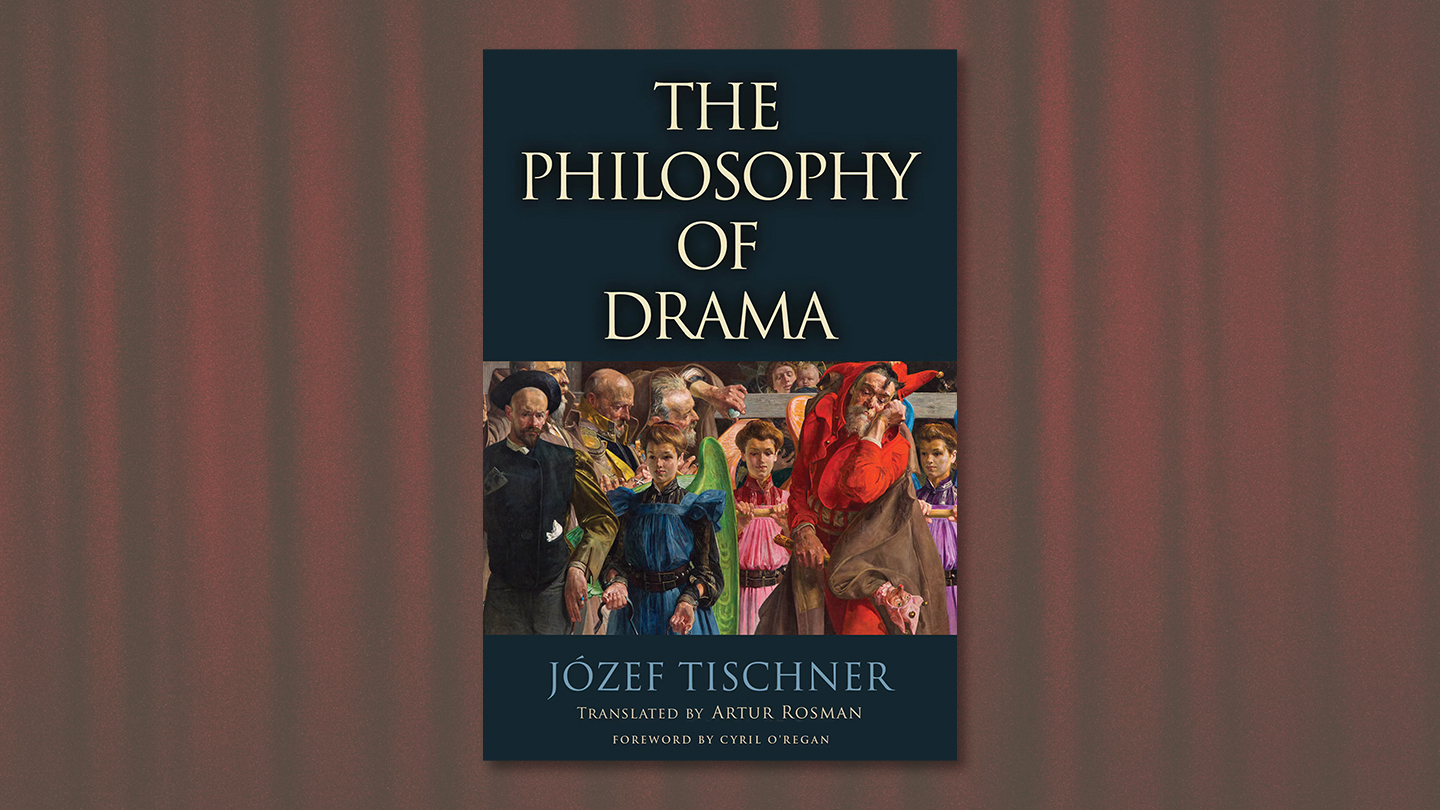
The republication, in translation, of the Polish Catholic philosopher Józef Tischner’s The Philosophy of Drama is, for the present critic, a welcome chance to renew his contact with the fundamental first principles of his profession, in my case dramatic writing and theater.
Tischner’s central idea is that aestheticized drama, the drama of tragedy, is a fractal of the drama of human life in which tragedy is possible, because evil can defeat the good in a limited time frame, but also the inverse, because drama speaks to the larger cosmological struggle between good and evil in which good must win.
The tragic aspect of tragic people is that their tragedy plays out in time frames that are irrelevant to God. Prometheus, Oedipus, Hamlet, Macbeth, Hedda Gabler, Estragon, and Gogo cannot encounter a good which is “both indestructible and evident” from their vantage point in time and space. The Levinasian paradox of encountering dramatic art, or encountering aspects of tragic drama naturally in life, is that we’re able to glimpse the good, the potential for the victory of the good over evil, if only in fragments.
Tischner’s vision of drama is one in which tragedy is a dialectical component, but not the whole of dramatic possibility, cosmologically, existentially, or aesthetically. Drama propels us into thinking about first ethical principles and first metaphysical principles that we might otherwise trick ourselves into ignoring.
How is it possible that Prometheus should suffer because of the good, that the retreating Oedipus should become the victim of fate, that Judas would betray and that the righteous one should die on the cross? In such a question, rebellion is mixed with acceptance. We rebel against exposing the good to evil. We accept the good endangered by evil. The question born from such roots is concerned with the essence of existence: to be, is it good or evil? Existence is a mysterious category in which the good might unite or intertwine with evil. (page 31)
Tischner’s aesthetic, if it may be called that, is an aesthetic of encounter.
We experience the other by encountering him. Encountering is something more than consciousness that the other is present next to me.... The encounter is an event. An encounter involves a significant change in the space of being-with. The one who encounters goes beyond – transcends – himself … to encounter is to experience transcendence. (page 1)
Central to this encounter is Tischner’s insistence, provocative because it is so out of fashion, on the face. Drama in his sense requires presence: a world in which everyone is a tagged ID, spiritually defenestrated, is a world in which real face-to-face encounters, and therefore drama, struggle to happen.
Real, universal drama, on the other hand, is like a particle accelerator that sheds and produces new kinds of awareness and truth; the tension of dramatic time is the momentum of pause and initiation into the tragedy, when we sense the hero is about to meet his fate:
Dialogical time is non-identical with ... internal time consciousness – a time determined by retention, protention, and the actual present, for which the question of the other and one’s answer to it are not significant, a time without presence, but also without any non-presence of anyone.... The actual present is presence, my presence for the other and his presence for me … the near future is unveiled to me as a moment for the other. Something must be sacrificed in this moment. Some “yes” or “no.” (page 53)
The implication is that drama gives us a sense of intensity, a taste of the aliveness of life, and raises our moment-to-moment experience, for a few moments, to what T. S. Eliot called the condition of music. Drama as an art form gives shape to heightened experience: watching someone die or give birth, watching a lover walk away for the last time at the end of a breakup, bombs falling over the Capitol, a political assassination. The automated flow of time suddenly breaks up and seems to wait for a choice to be made. This is the time of Antigone or Hamlet, in which the flow of time seems to halt before the choice: the moment before husband and wife say “I do” at the end of the aisle. The internal time of an isolated consciousness enters into dialogue with at least one other person.
Tischner’s philosophy of drama, both as a general phenomenology and as applied to aesthetic questions connected to dramatic writing, has great value in an era of solipsism and narcissism, an era in which the isolation of the streamer, (the Clavicular or Hasan Piker or Nick Fuentes talking into a camera), has, like a parasite or virus, replaced the “conversation and recognition” (page 60).
Reading Tischner’s book, I couldn’t help but feel that the folk sense of “causing drama” fails, evades, or conceals, the essential philosophical truth of the dramatic quality of life. The Philosophy of Drama might be called the recovery of drama, or the rediscovery of the spirit of drama, in the same way that the young Nietzsche thought Wagner had rediscovered the spirit of the Dionysian. The inability, or the fear, of experiencing is one of the staple conditions of late modernity, in the same way that Kierkegaard (heavily cited by Tischner) understood that the Danish Protestant bourgeoisie could not really grasp the choice of Abraham holding a knife to his son’s aorta, we have trouble experiencing drama; drama instead implies something more like the entertaining, the titillating; the vicissitudes, horrors, tension, the possibility of redemption; the violent paroxysms of being a mortal creature are not included in the modern American sensibility.
Characters die to move a plot along or to illustrate a moral principle. Drama might imply that. The characters holding a gun are yelling, but what’s sorely missing from optimized American culture are moments where characters are allowed to structure their own situational mortality through language. We do not much hear the dying fall. I think of Max Friedlich’s 2023 play, “Job,” about a disgruntled tech worker who brings a gun into therapy. There, the tech worker’s existential horror at having to moderate violent online forums, or I should say potential horror, is overwritten by a breathless plot, by a propulsive sense of revelation of plot, at the cost of slowness and revelation; it is not an exaggeration to theorize that American contemporary drama is essentially therapy speak nested inside of cliffhangers and twists.
Drama can’t be recovered if you confuse it for melodrama. And this is where Tischner is particularly helpful. Drama is saved when we remove it from the category of the dramatic and return it to the incantatory, the prayerful, the realm of the soliloquy, in the chamber. Tischner writes that in the dramatic encounter or the encounter with drama, we encounter representations of shame, which are “an expression of the misery of desires.” Shame is something which releases the feeling of being at fault to the gaze of the other or the viewer or the audience and allows us to put down the mask of perception.
[.article__paragraph--cap][.small-caps]Tischner’s work is[.small-caps] an occasion to relink thinking more broadly about cultural criticism, the function of dramatic writing, and the experiences the theater has in American culture. There’s also an opportunity to use Tischner’s thinking to squeeze higher standards out of the American theater, or to articulate grounds for what a counter-revolution in theater might look like.[.article__paragraph--cap]
If the collective unstated demand of the next generation of theater makers and goers is to be made safe in their assumptions and pleased by their encounters with the archetypal and the familiar, then they will find little that is useful in this philosophy of drama. Tischner’s thinking reminds us that the dramatic is the primal kill or be killed, slaver and slave, see and forgive, grieve and transform; it is the “destitution” of the naked face, related to “the questions of the stranger, the widow, and orphan.” The dramatic is also about the dialectical relationship of the individual to the whole, the tragic hero to the chorus, the thesis to the antithesis.
There are deep, structural, even eternal elements to the dramatic.
Institutions, workshops, awards, and criticism, all the workings of the industry, are not moving us in this direction, or do so rarely and usually by accident despite themselves.
Arguably, however, elemental, philosophically resonant theater is as necessary now as it has been in a very long time, even if the techno-feudal future is indeed futuristic on the surface; its structures, its power relationships, dynamics, and its politics may be closer to Elizabethan England or ancient Athens. This era will contain new dramatic. It will generate new specters and illusions, new character types, and redeploy old human nature in new ways.