Report
Playing Saint Thérèse of Lisieux
I joined a traveling French theater troupe performing a play that reveals the real Thérèse Martin behind the plaster saint.
October 30, 2026
Try 3 months of unlimited access. Start your FREE TRIAL today. Cancel anytime.
START FREE TRIAL NOWPlaying Saint Thérèse of Lisieux
I joined a traveling French theater troupe performing a play that reveals the real Thérèse Martin behind the plaster saint.
[.smalltext]All photographs by Raphaël Pyrat. Used by permission.[.smalltext]
[.article__paragraph--cap][.small-caps]“Put out into the deep”[.small-caps] (Luke 5:4), our Lord said to Simon. Though the fishermen had caught nothing all night, they obeyed, straining against the oars, casting the soaked net overboard, expecting another disappointment. Saint Thérèse of Lisieux suggests that “if they had caught a few small fish, our Lord would not have worked a miracle. But they had nothing! How could he resist?” Love stoops to conquer – He is drawn to the littlest, the weakest, the most helpless. He calls those poorest few to enter into the deep waters of love, and it is because of their littleness that they can inherit the greatest treasures of heaven.[.article__paragraph--cap]
Thérèse Martin (1873–1897), a Carmelite nun, considered herself small and weak. She chose to embrace her nothingness, abandoning herself totally to God’s love, and for this she received the inestimable wisdom contained in her autobiography, Story of a Soul. Not half a century after her death, her writing had been translated into dozens of languages and her charming statue was a sure find in every Catholic Church in France: a cute, smiling nun with rosy cheeks, holding a bouquet of roses which strew their petals across her feet. She is called “The Little Flower” and she follows “The Little Way,” teaching the whole world that to please God one needn’t accomplish marvelous deeds. One has only to “do little things with great love,” because even “picking up a needle out of love can convert a soul.”
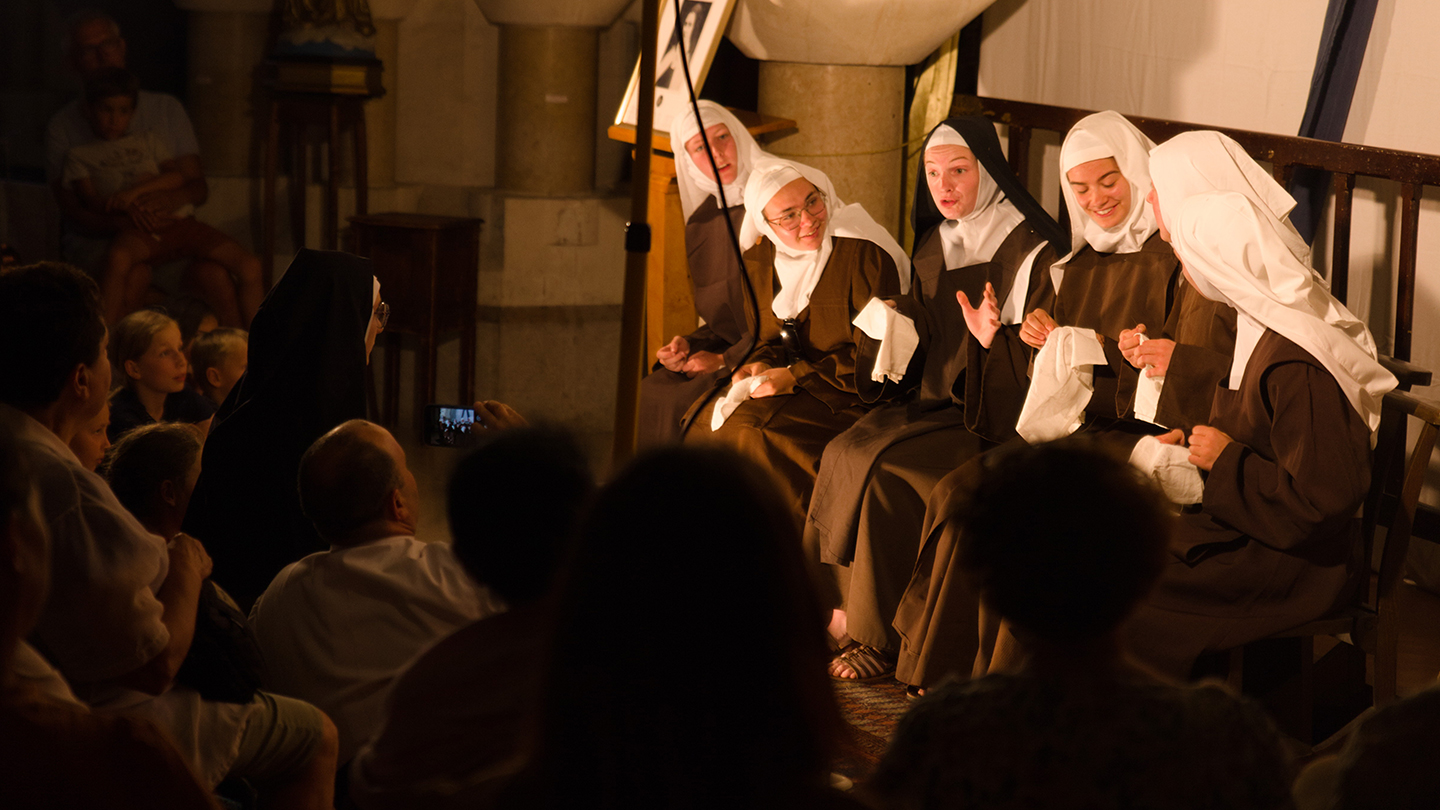
To our modern, sophisticated ears, her spirituality appears childish and banal. My theater troupe puts on a play which wrestles with this perspective. In the prologue, two intellectuals who can’t stand Thérèse come face to face with her silent statue and try to convince a priest to get rid of it as a worthless waste. Isn’t she just a candy-pink children’s book hero, opium of the masses disguised as schlock? Isn’t Story of a Soul a collection of frilly metaphors impossible to take seriously? The priest agrees; Thérèse’s aesthetic is nauseating to some. But look beneath the roses, and you find the thorns. “We thought it [the book] was syrup,” says the priest, “but it was blood.”
The play is called Briser la Statue, literally “To Shatter the Statue,” and it was written by Gilbert Cesrbon in 1947 to reveal the real Thérèse Martin hiding behind the plaster saint. Doing little things is easy – but doing them out of great love demands endless sacrifice.
Thérèse put out into the deep, trusting in God to supply through grace whatever she lacked by nature. But our Lord did not grant her a miraculous catch in this life. Before her death at twenty-four years old, her fellow nuns worried that her life was too boring to fill out a proper obituary; from an outside perspective, she had never done anything extraordinary.
The miracles came after her death: she cast her net from the depths of heaven and continues to catch fish to this day. Some of the fish she catches are quite unexpected, such as my theater troupe Duc in Altum, which has played Briser la Statue all over France for the past twenty-four years. Taking as its name the Latin translation of Luke 5:4, this troupe’s mission is to follow in the footsteps of Saint Thérèse and reveal her true face, allowing her to change the lives of more and more people.
From April to June, I helped to plan Duc in Altum’s summer 2026 mission. (We don’t go on tour; we go on mission.) I had to find fifteen locations, typically parishes or religious communities, who were willing to let us put on Briser la Statue and host us for the night. I hate making phone calls, I can’t keep track of anything, and I have no idea how spreadsheets work, but I was taking a gap year and had time to spare. In Duc in Altum, goodwill is the only qualification necessary. I gave my time to the troupe, and my incompetent efforts bore fruit.
The key destination was Corsica. Asking for free room and board from people who don’t like the French and live entirely off vacation rentals during the busiest time of year was madness. Once, I texted Père Guillaume, the troupe’s founding leader, “I have toiled all morning for three consecutive months and found no place for us to sleep; can’t we just rent a campsite for a night?” He responded, “put out into the deep” (I’m paraphrasing). I obeyed, sent a prayer to heaven, made another phone call, and waited to see when (not if!) Providence would respond.
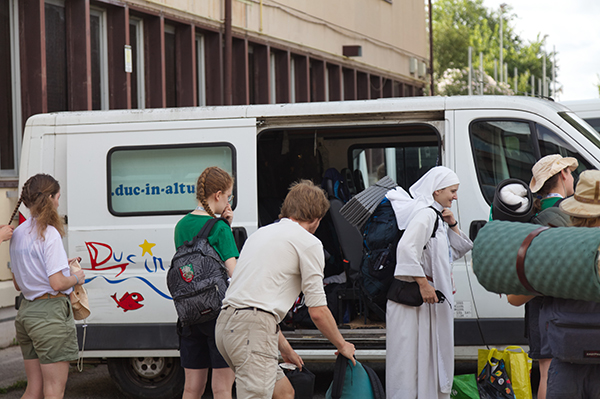
From July 27 to August 4, a dozen of the overworked priests of Corsica saw two odd vehicles roll in to their parish driveways – the legendary “Ducs” (pronounced “dukes”), white nine-passenger vans decorated with cute red and blue sea creatures. One expects a group of preschoolers to clamber out of them. Instead, they contain fourteen Catholic high school and college students. The older one, “la vielle Ducs,” tends to stall: last summer we got used to jumping out in the middle of a busy road and pushing the vehicle to help it start again. It contains the costumes, rods, backdrop, microphones, and props. The other Ducs, in which we store our personal belongings, has air conditioning and attracts more passengers.
Corsica during peak season was easier to plan than Rome during the jubilee year of 2025. Last year, for my first mission with Duc in Altum, we drove to the Eternal City to participate in a gathering of one million young people from around the world. I remember seeing anxious messages on our WhatsApp group reporting that we still hadn’t found lodgings in Rome or that we couldn’t even find a place to perform, or, later, that we had been given lodgings that were a two hour commute away from the city.
None of those issues were resolved by the time we left on July 22 to play in Béziers, Arles, Marseille, Cannes – names which, to the French, ring of vacation. It was a bucolic time, more road trip than mission. We took a selfie on the rooftop of Béziers’s cathedral, walked by the Roman arena of Arles in costume, ate mango ice cream in Marseilles, and visited a historic villa in Cannes. When we crossed the border into Italy, we stopped in a beach town to swim in the warm Mediterranean. Père Guillaume always insists that we have fun.
To join the troupe, no theater experience is required. There are only three conditions. You must: 1) be between seventeen and twenty-five years old; 2) desire to grow in your faith in the footsteps of Saint Thérèse; 3) like eating Nutella at breakfast. Upon hearing these rules for the first time, the future member says jokingly: “the first two sound great, but I don’t know about the third one.” I’m not joking; it happens every time.
We always have Nutella at breakfast. After all the Ducists (pronounced Duke-ists) have crawled out of their sleeping bags, someone hunts for coffee and silverware, and the others lay out the breakfast things which are haphazardly stored in a large tote bag we leave under the seats of the Ducs. Two jars of Nutella make their way around the rough circle we draw over the floor or cluttered tables. Lunch, if it isn’t provided by our hosts, happens the same way, except that the Nutella appears at dessert.
Then, we pack up, hear Mass in the nearest open chapel, and drive off to put on the play somewhere else. We usually play nightly, unless a particularly long journey makes us arrive late at night. Long drives, when we recite the play together, are our only rehearsals. We arrive on the first day of mission having learned our parts, ready to get on stage. We switch roles almost every performance. Veteran Ducists know every role in the play. Today there are over two thousand of us – over two thousand young people in France have inside jokes related to the life and death of Saint Thérèse of Lisieux.
Many girls have played Thérèse; two or three every mission learn and perform her two hundred lines. In Marseilles last year, a young woman played Thérèse for the first time in the packed crypt of the Saint Vincent de Paul church, the very Church where she was baptized as a baby. When a parish member learned this, she dug through the archives to find the baptismal certificate and gifted it to the new-born Thérèse.
The very first Thérèse, back in 2002, gave her life to Christ and entered a Carmelite monastery. Since then, a pattern has appeared. Many girls, as a direct result of their involvement in the play, have received the grace of a religious vocation. Even those who don’t become nuns leave the troupe with a deep spiritual foundation on which to build a life of service and love.
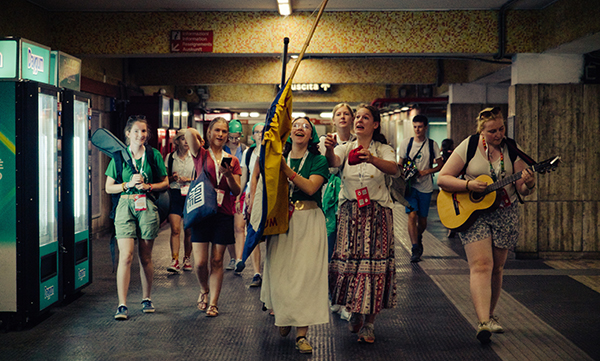
When we got to Rome in the last week of July, the city was “black with people,” as we say in French – chattering, flag-waving young people with green bandanas backed up every grocery store line, filled every restaurant, covered the cobbled streets, outnumbered even the pigeons. As expected, we had found acceptable lodgings and a place to perform the play.
On a Wednesday afternoon, the lights went down in a classroom of the Gregorian Pontifical University. The nuns were in costume, the statue was on stage, the two intellectuals and the priest were waiting for their cue, and the seats were full of Italian and Spanish speakers. As the only Spanish speaker in the troupe, I had to explain to them that the play was in French with defective Italian subtitles that had taken us over one thousand slides and at least six hours to complete (not counting the time it took an unhappy volunteer to translate the whole play into Italian). They stayed anyway.
Our lecture hall stage was awkward. In the center of the hall there was a raised platform on which a desk and computer monitors were fixed, which forced us to set up the backdrop in the area by the doors, right where the group of thirty Spanish-speakers stealthily stomped out after the first act. Luckily, there were enough francophones in Rome to fill up the two hundred seats for the next three shows. The setting of these four Roman performances was fitting, because the play is a lesson: a lesson in faith, charity, and constancy.
Thérèse of Lisieux, though experiencing the first symptoms of the illness that would kill her, and battling interior darkness, patiently instructs her five recalcitrant novices. She encourages them to live entirely for Christ, dedicating to him “every minute of every hour of every day. All for him, everything! … And struggle, struggle! Victory is a sub-product, only the struggle counts.” She tells them to trust in God like little children do, because “the childlike spirit kills vainglory far more surely than the spirit of penitence.” But none of them understand her radical doctrine.
Every night, for two and a half weeks, the Ducists hear these and other beautiful words. Like any batch of theater kids, we quote the play as often as we can in our conversations, but only in the most obnoxious way possible. We don’t quote the beautiful spiritual maxims; we prefer the poking remarks of Thérèse’s antagonists. We resemble them much more than we resemble her, especially as our fatigue grows.
In Rome, after one and a half weeks of traveling, falling asleep on a hard floor became easier and crawling out of the sleeping bag in the morning grew ever harder. But we never stopped singing morning prayer during the hour-long commute to the city. Père Guillaume would pull out the guitar in the metro and bleary-eyed Romans were forced to listen to our cheery scout songs. We always held Mass together before leaving. We even kept up the daily regimen of our half-hour’s silent prayer. In this we followed Thérèse quite faithfully: she often fell asleep during prayers, and the troupe’s mental prayer on day four of Rome was a collective nap taken on the marble floor of the exquisite Ara Coeli church, overlooking Piazza Venezia. As Thérèse says: “Little children please their parents as much when they are asleep as when they are awake.”
That Saturday, August 2, was held the jubilee week’s main event, a large prayer vigil with our brand-new pope, Leo XIV. Before attending, many groups, including our own, visited the Basilica of Saint Paul Outside the Walls, one of the four major churches of Rome. We parked the Ducs in a lot behind the Basilica.
Our fervor had drained away by that point. We wandered like zombies through the bubble of chatter in the Basilica’s alabaster light, vaguely praying. Then we returned to the parking lot and noticed there was a bag lying under the newer Ducs. One of our bags. We opened the trunk.
When we had first parked there, a middle-aged man had offered to watch over the cars while we were gone. Père Guillaume had scoffed a little and handed him a two-euro coin.
We called the cops and they promised us a vehicle dispatch. None came. The Carabinieri stationed by the Basilica were no help either. We asked the nearby restaurant whether the parking lot security cameras could be accessed. No, they were private cameras. The passersby we questioned gave us only pitying, knowing glances. No one helped us except for the man in charge of the parking lot, who saw us struggling to open the trunk of the old Ducs which had been attacked, the lock broken but the trunk not accessed, and obligingly brought us some wire to use as a lockpick.
And yet, no passports were stolen. No one lost a credit card. The computers and all of Père Guillaume’s sacristy materials were in the other vehicle. I felt it, I knew it: we were protected.
After the initial crying and confusion, we started to look in alleyways and trash bins to see if any of our stolen bags might have been discarded. Four of us, too tired to go on, pulled out the guitar and started to sing worship songs, contemplatives praying for the active folk, just as Thérèse had done in her monastery for seven years. When Therese felt powerless before her interior temptations, she said, “This is the time of perfect joy. I will stare at the sun; I know that far beyond my night, it is shining.”
Two hours after the discovery of our empty trunk, one group left to find a place to park and something to eat before going to the vigil – because we were still going to the vigil, with or without our stuff.
The other group, led by a furious Père Guillaume, continued looking, asking passersby where one might find objects that had hypothetically been stolen from one’s car. Eventually, an answer came: look in the dumpsters by the high school. Having spotted the dumpsters, the Ducists approached warily – there was a Roma camp a stone’s throw away. Two red shoes lay just behind a dumpster as though a sleeping corpse were hidden there. That’s what drew our searchers at first: Was it a person? Was he OK? Then they noticed that the shoes were none other than a Ducist’s own Vans.
A woman passing by laughed tellingly at the six teenagers and a priest knee-deep in a dumpster, crying for joy over three trash bags.
We recovered clothes and toiletries. Our hiking bags, phone chargers, and pocketknives were stolen. We stuffed the recovered goods in the Ducs, parked the cars back-to-back in the lot of a parish that had spontaneously agreed to let us park for the night, and took the metro to Tor Vergata, joining the flow of one million young people on their way to meet the pope.
Not once did we ask, “Why us?” Not once did we blame God for having abandoned us. I couldn’t state it at the time, but a year after the fact, I can see how Thérèse’s example led us through hardship upon hardship. As amateurs, our baseline is one of “nothingness.” Those who organize the missions, as I can attest, have no idea what they’re doing. Most of us have no theater experience, most of us can’t acquire a sufficient quantity of rest by sleeping on the floor every night, and getting robbed is not one of the nice things that happen to travelers.
We impart Thérèse’s lesson of confidence and trust to whoever will listen, but principally to ourselves. As she says, “if God had found a weaker soul than mine which abandoned itself to him more fully, he would have given it even greater favors.” We have the gift of learning how to pray and trust like Thérèse. We receive priestly and religious vocations. And we are given trials, heavenly favors that can be joyfully accepted to glorify God.
“Everything is grace!” We can’t forget that Saint Peter was martyred and Saint Thérèse gave herself up to a brutal agony and an early death. To reveal her true face and follow in her footsteps means accepting what we are, accepting what we’re not, and trusting God to supply the rest. That’s what it means to put out into the deep.