Essay
Teaching September 11
If we don’t talk about it, the recent past can feel more remote than a historical period where a consensus has been made, a picture fully rendered.
September 4, 2026
Try 3 months of unlimited access. Start your FREE TRIAL today. Cancel anytime.
START FREE TRIAL NOWTeaching September 11
If we don’t talk about it, the recent past can feel more remote than a historical period where a consensus has been made, a picture fully rendered.
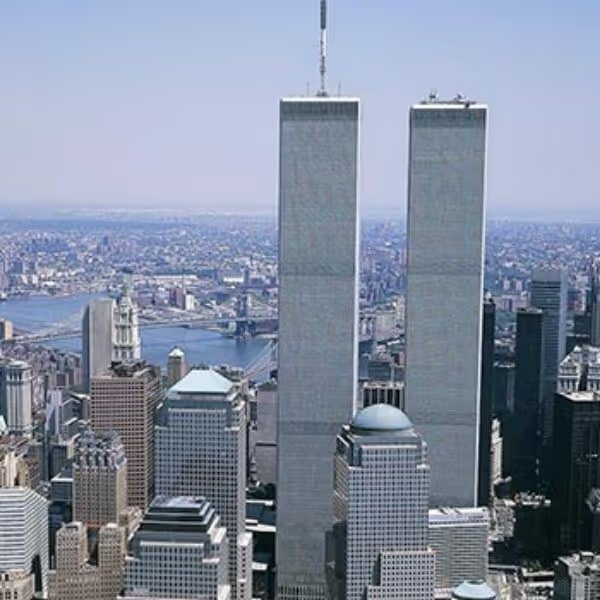
[.smalltext]Photograph by Robert Goebel / Alamy Stock.[.smalltext]
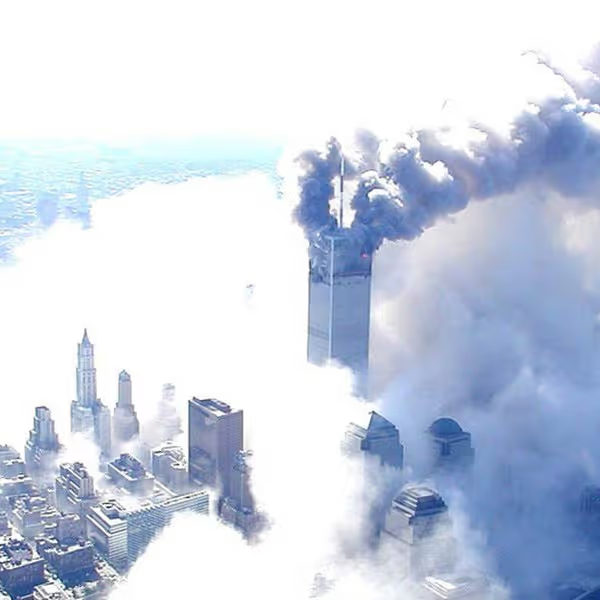
[.article__paragraph--cap][.small-caps]It is a clear April morning[.small-caps] as I sit in my classroom watching television with eighteen high-school seniors, each of whom were born around 2008. We are watching a CRT television, deep and heavy, with physical buttons and RCA connections on its face; the whole contraption sends out a high-pitched tone my adjusted ears can no longer hear, though the kids complain about it. This is a morning of firsts for these teenagers who, upon entering my classroom, take to studying the television cart like they would a new student. More than one kid claims to have “never seen one in real life before,” while another suggests she has “only seen these in, like, old movies.” The students settle in quickly and are distracted as the black and white “snow” shakes out into a standard definition rendering of Diane Sawyer and Charles Gibson telling us what little they know about “some sort of explosion at the World Trade Center in New York City.” As the picture shifts to the black smoke stack of the North Tower, what side conversation there is in the classroom ceases, and eighteen sets of teenage eyes understand there is nowhere else to look this morning.[.article__paragraph--cap]
The students are sucked into the same spectacle those of us old enough to be alive watched on the morning of September 11, 2001. Though they are acutely aware of the events that will take place over the following 102 minutes (and the next twenty-five years), they stare intently as if at something new and secret. The first minutes of shaky, disorganized confusion within the ABC broadcast are ultimately mirrored by the kids. After a few minutes, some students reach for notebooks, others stay staring with their mouths slightly open; no one looks at each other, and not a single student excuses themselves to the restroom for the entirety of the period.
I have dropped my students into this experience without prompting, with hopes that I might convey something real to this generation about the recent past. In this classroom, there is a sensation of warping time, that at this moment the events of 9/11 are just as real and vital as they were a quarter century ago. And though everyone in the class roughly understands what is going to transpire, they’re unaware of the speed at which the tragedy unfolds. The seventeen minutes between Flight 11 crashing into the North Tower and Flight 175 crashing into the South Tower go by in a New York minute. The televised impact of the latter comes as a surprise, as a few kids mimic, in near unison, Don Dahler and Diane Sawyer’s exclamations of “Oh my God.” Before this class, the vast majority of these well-educated students had never seen video of the impacts on the towers. They had never seen the silhouette of Flight 175 enter from the right of the screen and explode out the back of the South Tower.
It is important to teach this tragedy now, while dialogue with those who hold vivid memories of the day is still possible. Because there is a change happening, a movement of 9/11 from “recent past” to its permanent resting ground as “history.” If we don’t talk about it, the recent past can actually feel more remote compared to a period where a consensus has been made, a picture fully rendered. To this end, I ask the students afterward to interview their parents about their memories of that day. Building this shared experience opens them to a dialogue with not only their elders but with the rest of the world, as they gain an understanding of the attacks via the same televised medium as the waking world on September 11, 2001. The ultimate aim is that on the other side of this history they might have a functional grasp of both the historical magnitude and emotional impact of the event that changed our world forever, regardless of whether they were alive for its crux.
[.article__paragraph--cap][.small-caps]Brief conversations[.small-caps] with teenagers surrounding 9/11 involve broad, gestural “facts” that roll off the tongue with equal skepticism and uncertainty. As they navigate the superhighway of facts and misinformation they ask things like, “Wasn’t it actually an inside job?” and, “But weren’t the towers really detonated?” They rush to draw conclusions, to read the postscripts without engaging the foundational text of the horror.[.article__paragraph--cap]
I ask my students to put aside what they think they know in order to see the events of this day as an affront to humanity. This adjustment is crucial to confronting any tragedy without cynicism and doubt, but rather with an initial consideration that people were in pain, hurting, scared, and that humanity was changing for the worse. I try to remind them that having the answer to any of their “why?” questions still does nothing to bring back the dead who should remain the focus of the trauma.
This sentiment plays itself out in the form of an on-air gaffe from Peter Jennings, who announces via Reuters, at 9:40 am that the attack was claimed by the “Democratic Front for the Liberation of Palestine.” The mistake is not missed by my students, some of whom cock their heads and squint while one offers the quasi-statement, “That was wrong though, right?” It takes Jennings until 10:20 am to admit that the earlier report was an unsubstantiated anonymous call to Abu Dhabi Television that ABC ran with. The conversation about this whiff concludes that had Jennings made this mistake in the social media era, there would be, in one student’s words, “no stuffing that genie back in the bag.” But what the students so astutely catch on to is not so much Jennings’s lack of an apology for the error but rather his immediate assertion that “maybe we should put aside trying to understand who did this.” They note that the feeling of solving an actively unfolding mystery pulls focus away from the victims who are most affected.
[.article__paragraph--cap][.small-caps]Building a cultural understanding[.small-caps] of what these buildings symbolically represented before the attacks offers context for what made them desirable targets, first for human accomplishment and then, thirty years later, for destruction. These were American cathedrals of commerce, meant to house women and men whose job it was to move money. For several years they were the world’s tallest buildings. For Al Qaeda, the towers and the Pentagon, specifically, represented everything they hated about American economic and military power.[.article__paragraph--cap]
The tale of building the towers is often reduced to the amount of time it took them to fall. This is unfair to the 10,000 people who built the towers over the course of five years (more than sixty of whom lost their lives during construction). I relay some facts to my students: that the buildings were made up of ten million square feet of office space, eventually occupied by more than 430 businesses operated from twenty-eight different countries. Both towers had 110 floors and each stood over a quarter-mile tall while housing almost fifteen miles of elevator shafts spread out over nearly two hundred elevators. The concrete poured for the towers was enough to build a regulation sidewalk from New York to Washington D.C. This fact seems to impress the kids, as well as how the towers served so many people that they required their own zip code (10048). But where the students finally balk is at the human figures; the towers hosted an estimated 50,000 full-time workers, while more than 140,000 people came through the World Trade Center Complex over the course of a typical workday. I point out that only 4 percent of cities within the United States in 2001 contained entire populations of more than 50,000 people. A “that’s crazy” ekes out of a tenuously engaged student with the realization that the towers were themselves cities.
Then there is Philippe Petit, whose unsponsored, illegal, high-wire walk across the 131-foot gap between the towers’ tops on a damp August morning in 1974 helped usher the towers into artistic consciousness. Petit sought the towers as a stage for the grandeur of his performance, without consideration for the buildings’ use. He was imbued with a passion to conquer this impossible space, to bridge it with wire and body without an answer to why. I ask my students (who screened Man on Wire as a precursor to the 9/11 coverage) to consider the stakes of Petit’s performance and what beliefs allowed his walk to be successful. The students turn to the severity of Petit’s conviction that, if he should fall: “what a beautiful way to die.” It is a consideration that suggests comparison with the terrorist’s willingness to die.
[.article__paragraph--cap][.small-caps]The initial news coverage[.small-caps] repeatedly reinforced the symbolic importance of the towers. Whether you watched Peter Jennings on ABC, Dan Rather preaching “steady” on CBS, or NBC’s Tom Brokaw speculating on the buildings “needing to be brought down,” the overwhelming sense from each of these broadcasts was that these were structures being attacked, but the human toll was abstracted. The distant camera angles showed only the buildings; their intricate hives of humanity remained hidden from the public view.[.article__paragraph--cap]
The nightmare scene being largely contained within the structures took the onus of censorship out of media control. And as transfixed as the class is during the broadcast, afterward the students speak to the difficulty of feeling genuine sadness when the coverage was so devoid of people. NBC’s Katie Couric does the best job on any of the major networks of reminding viewers of people both stuck inside and running into the buildings as they burned.
It causes me to wonder: If more people had been broadcast, or if we had footage from inside, what effect on my students would that have had? The scariest truth may lie in a trending desensitization and lack of empathy within this generation; one student told me that, because of access to social media, he “routinely sees people gruesomely injured or die before 8 a.m., every day.”
We find out that when the “jumpers” bring the inside out the human impact is universally felt. For these students, the photographs of jumpers reveal the day’s horrors as not just political warfare, but a human experience. It has been estimated that between one hundred and two hundred people died on 9/11 by jumping from the towers, rather than be burned to death inside. While the news crews made some effort to shield the public from these deaths as they unfolded, the extensive photographic evidence and bystander reports laid this horror bare.
The most famous of these photographs is Richard Drew’s The Falling Man, which is controversial for the outcry after its publication, both from the public and from the family of the man (inconclusively) identified as Jonathan Briley. The image is deceptive in that its portrait of death is almost beautiful. What makes the photograph so stunning is how it depicts both high velocity and silence; it is a quiet, glowing image so peacefully composed that one might forget the torrent of sound filling the void around the man.
In context, the image is one of a series that tells the full, more frantic, story of a human tumbling to his death. Looking only at the solitary image holds back the more brutal truths of the day; it repackages some of the trauma into something that could be mistaken for art. Still, it was not, as Phillipe Petit eerily foretold, a “beautiful way to die.” Unlike the terrorists, the falling man did not choose to die and, unlike Petit, he did not choose to accept a certain risk. As a person, he was a victim of tragedy; as an image, he is a symbol of something bigger.
Reflecting on 9/11, the theologian Rowan Williams writes, “It is always people who suffer and are killed, not symbols. When we strike out at a symbol … we hurt nothing except perhaps the self-esteem of those who use the language of which it’s a part. When we decide[d] to treat people as symbols, the story is different.” Williams warns of the risks that come with reducing human beings to abstractions, as the terrorists did to the Americans they killed, and as many people did to innocent Muslims in the wake of 9/11.
But there is a way in which considering the event symbolically provides a point of entrance to understanding it, amid the overwhelming horrors of the day. In The Falling Man there is the image of Icarus, the hapless mortal who flew too close to the sun. It calls to mind Pieter Bruegel the Elder’s Landscape with the Fall of Icarus (1555), where Icarus splashes headfirst into the green waters while everyone else continues about their business – plowing the land, tending to sheep, fishing in and sailing through the same waters of the tragedy.
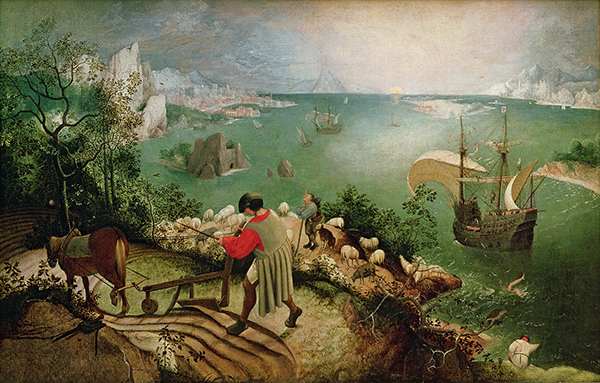
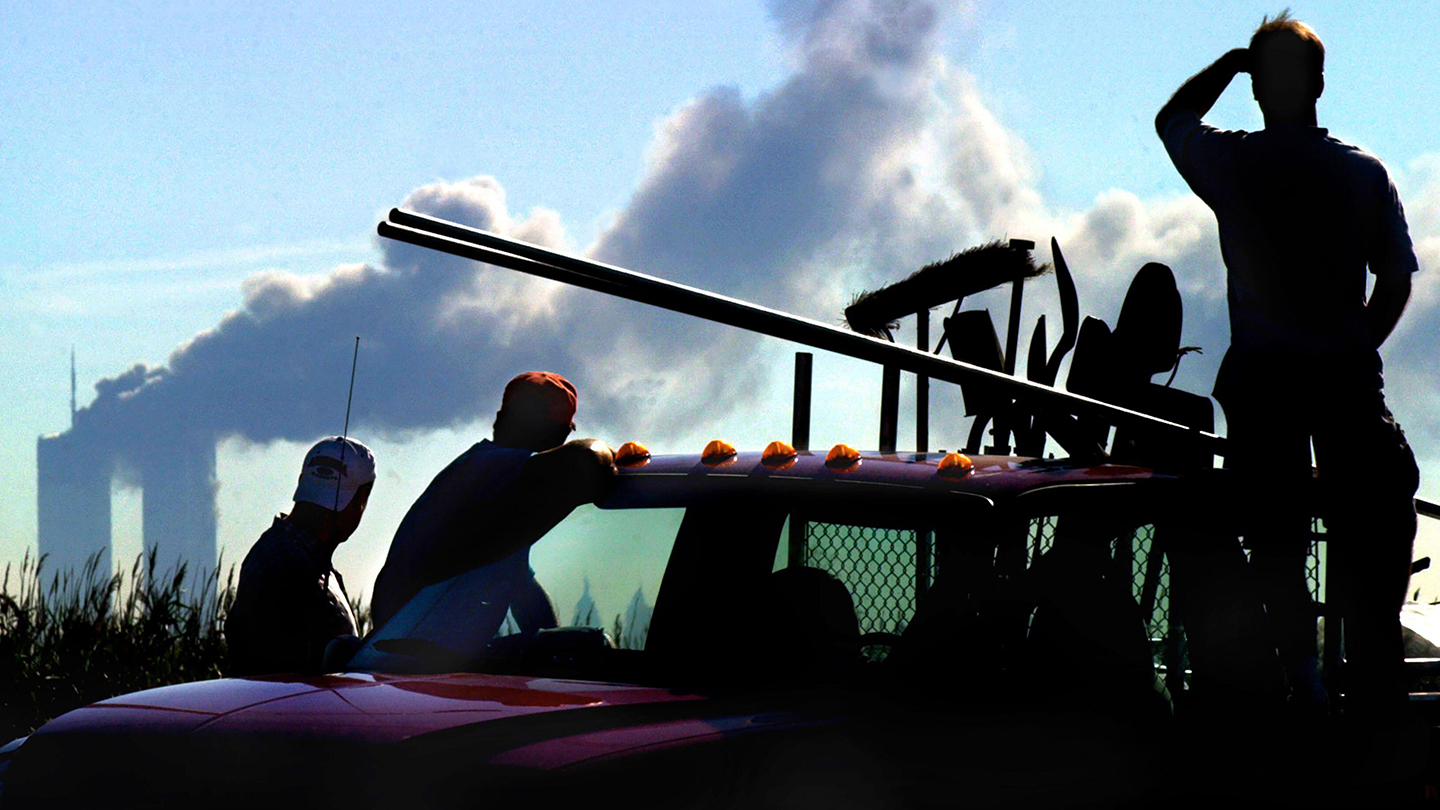
Isn’t it startling, about the human experience, how Bruegel’s painting of the interpretation of a myth still sums up the complexity of tragedy 450 years later? Furthermore, how easily the painterly characters in Bruegel’s image transform – fade, even – into the sunbathers in Thomas Hoepker’s photograph, View from Williamsburg, Brooklyn, on Manhattan, 9/11. The apparent placidity of the onlookers in view of these tragedies is unsettling; it highlights the powerlessness of bearing witness.
In his poem “Musée des Beaux Arts,” W. H. Auden concisely describes Bruegel’s painting as being “About suffering.” Auden reminds us that “dreadful martyrdom must run its course” and that the reason Bruegel’s ploughman doesn’t turn to see Icarus fall (though he certainly heard his cries) is that for the ploughman (not unlike my students), “it was not an important failure.” In class we reframe these moments not as failures, but rather as learning experiences. The “falling man” is not a failure, of course, nor are any of the other jumpers. They are people who can be immortalized, like Icarus, if we agree that it’s not too soon to respect them as symbols and use them to understand history.
“And then it was like heaven poured down into the harbor,” one witness described the falling of the South Tower in an interview with a student. In that moment, like the falling man, the image was so shocking as to be almost sublime.
The description called to mind the Tower of Babel, raised to the heavens and then brought down. “Let us make a name for ourselves,” say its creators in Genesis 11:4, just as the Twin Towers elevated American dominance to the stratosphere, to be worshiped by the rest of the world and bring us an almost divine sense of power. While this hubris might garner hate, it does not make civilians deserving of such violence. But the attacks reveal a vast discrepancy in the American sense of invulnerability and entitlement; the reality that we are corruptible mortals just like everybody else.
In the Babel story, there is an attempted unity, followed by a scattering. In America, there was an overwhelming sense of unity following 9/11, which devolved into racism, xenophobia, and eventual tribalism born out of our national response. Our fragile American countenance couldn’t agree on an enemy. Part of that lack of agreement came from a homegrown paranoia that quickly turned against our friends and neighbors with Middle Eastern heritage. People in these communities were forced to live underneath an extra layer of fear, discomfort, and unfair treatment after 9/11 that inflicted immeasurable damage. That part of our pride in who we are, e pluribus unum, was fractured in ways we may never be able to correct.
Alternatively, the vision of heaven pouring down suggests that perhaps the falling man is himself an angel. No random angel, specifically Walter Benjamin’s “Angel of History,” of which Walter Benjamin writes:
His face is turned toward the past. Where we perceive a chain of events, he sees one single catastrophe which keeps piling wreckage and hurls it in front of his feet. The angel would like to stay, awaken the dead, and make whole what has been smashed. But a storm is blowing in from Paradise; it has got caught in his wings with such a violence that the angel can no longer close them. The storm irresistibly propels him into the future to which his back is turned, while the pile of debris before him grows skyward. This storm is what we call progress.
But as we train our eyes toward the past, we have a powerful decision to make that can determine whether or not we see history as “one single catastrophe” or a series of circumstances that might enlighten us to the present order of the world. The truth is that we do not have to settle for the historical narrative politically dictated to us; we get to choose how we see and talk about history. From the angel’s perspective, with so much violence packed so close together for so long, it can’t be blamed for seeing history as “one single catastrophe.” But Benjamin sneaks in an air of rare positivity in how he pits us (“we”) against the angel; that we perceive history differently, as “a chain of events,” meaning we can differentiate between the injustices and maybe even find something good to talk about between them. That Benjamin’s “progress” is a “storm blowing in from Paradise” with a “violence” that keeps the angel from slowing his ascent is, in Benjamin’s mind, keeping with the most brutal course of history. It is a way of finding some sliver of possibility within the tragedy.
[.article__paragraph--cap][.small-caps]What does it really mean[.small-caps] to “never forget”? Countless writers have pontificated that, though the phrase has punctuated speeches, commercials, and bumper stickers, we are never told specifically what it is we are not forgetting. If you asked any number of people, “What are we ‘never forgetting?’” you would receive an array of answers all pointing in different directions. To some, it is a warning: to “never forget” that something like this might happen again. But this suggests nostalgia for a bygone era of safety that never actually existed. To others, never forgetting is a challenge: a mission statement emblazoned on military posters and the tails of fighter jets, meant to convey the power and control (however well- or ill-directed) of the US government. To some, it is an invitation: that the period of unity, however short-lived, is what should not be forgotten; that we can put aside irreconcilable differences and see each other as humans, bound by suffering.[.article__paragraph--cap]
For this teacher, a solid foundation for an answer to “what are we not forgetting” should start with the 2,977 people who lost their lives in the attack that day – and the many more who died in the wars that followed.
But to actively remember anything, we have to be willing to talk about the weight of our collective memory. What if we shift that weight into a more active approach that suggests action and longevity, something like “Remember Forever”? That narrative belongs to the people to actively maintain and not to politics, which will distort it in order to perpetuate a flawed reasoning for the War on Terror that killed hundreds of thousands, including over eight thousand Americans, and displaced millions. Part of using “Never Forget” in a productive manner requires a collective understanding that the politicized narratives of 9/11 have won out. Talking about the attacks and sharing their impact with young people is one step toward wrangling the humanity of the tragedy back from the political interests that controlled it for so long.
Ten years after he crossed the wire, Philippe Petit wrote:
With Voracious eyes, staring at the forest of pillars, I am ready to bite the wings of every appeasing thought.
Instead, a sound.
From the crypt. Rising near. Penetrating the grain of the lower slabs. A melody, now. Pouring over the choir, through the transept, along the aisles. And growing. The grand trumpets of the organ are let loose. A prelude. The sun breaks in. The magnificent Gothic vessel is shaken. Fire and clamor consume its sacred geometry. Echoes . . .
To teach 9/11 is to guarantee this echo.
As the North Tower collapses, the collective held breath of the room is released, and the students get restless as if the show is over. As the dust settles into the screaming streets of New York, the fire in the Pentagon rages on, and a fourth plane is confirmed hijacked and heading east, where it will perish in Shanksville, Pennsylvania. For these kids there will be more questions later, but for now they have to get to their next class.
In the classroom, once the students have left, for the first time I notice the sun in the background of Bruegel’s painting. While Icarus, freshly fallen, writhes in the shallow waters just off the shore, I can’t help but wonder how long such a fall must have taken for the sun to only now be setting just as he’s hit water. It invites two explanations: either Icarus was so high that his screaming fall must have taken hours, far longer than he would have needed to come to terms with his mistake, or else he’s been there, thrashing away in the shallow waters for ages, ignored and unable to right himself alone.