Reflection
Suffering and Joy
Do we have any right to be happy when millions suffer?
June 14, 2026
Try 3 months of unlimited access. Start your FREE TRIAL today. Cancel anytime.
START FREE TRIAL NOWSuffering and Joy
Do we have any right to be happy when millions suffer?
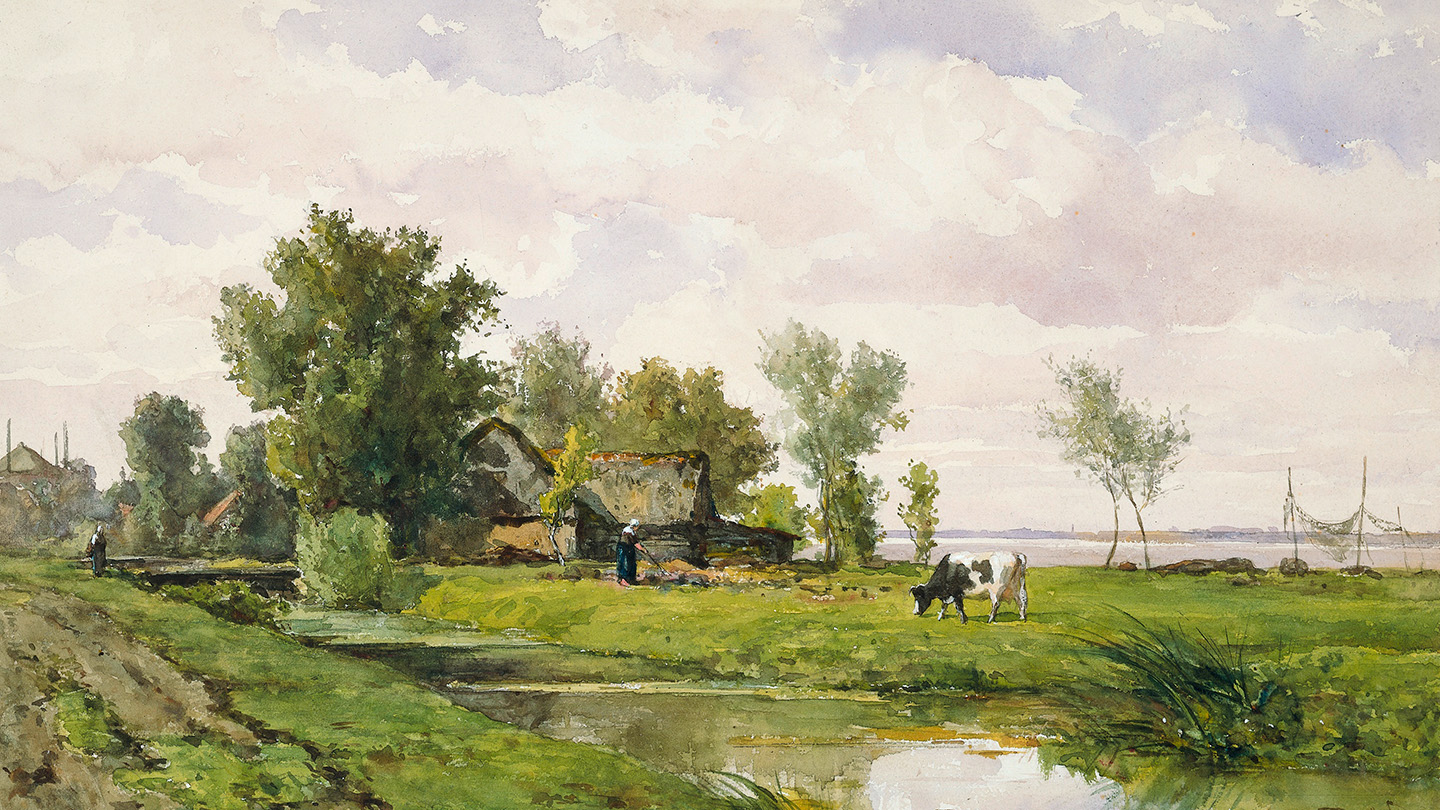
Willem Roelofs, Farm on a Ditch, watercolor, 1875–1880. [.smalltext]Wikimedia Commons, public domain.[.smalltext]
[.article__paragraph--cap][.small-caps]When I live through[.small-caps] beautiful spring days or a summer such as we had this year, or when I have opportunity to live in a happy family with children, I often think of the young mother who lost her child one winter, and when spring came, cried out bitterly, “My child cannot see it.”[.article__paragraph--cap]
There are millions in this world today in whom this cry lives, millions for whom the beauty of nature in the spring and all the happiness of other people are only terrible pains, making despair harder to bear. Have we any right to enjoy anything, to be happy with our families when we know the millions in despair?
I not only say that we can enjoy; I say that we must find again the strength to enjoy – but not by forgetting what we have lost or what others have lost, certainly not by forgetting our shortcomings and our sins. There is another, stronger way.
There was a time when beauty and happiness only deepened my own despair and pain. The spring and summer of 1933 were good to look upon. But my children were scattered, my family destroyed, my life’s work broken. My friends were in danger; some had fled; others had been imprisoned; many had been killed. And around me was the success of what I knew was the power of destruction and injustice. I hated the beauty of that spring and I fled the sight of families and the sounds of music. Hiding its terrors behind sparkling life made fate seem doubly cruel.
But then came the experience of Christ’s presence, and it became stronger and stronger in my being. And out of it came again the challenge of him who was happy with children, who calls us to enjoy the lilies of the field and the birds of the air. More and more it came to me that all joy and happiness are great gifts of God, his greetings, showing us something of the goal which will be achieved when love and truth are victorious on earth. In the beauty of nature, in the lively innocence of children, in the joys and pleasures of young people, I felt more and more a hidden presence. All joy is holy.
Because he violates what should be holy, man brings suffering into this world. He loses and then destroys the reverence owed to all life, all happiness, all real joy. Can we not save these for ourselves so that our suffering will be a means of saving them for others? Only now perhaps we know what joy really is, only now, taught by bitter suffering, when we see the deep holiness of all life. Even when we do not have joy for ourselves we can reverence it in others.
Do not, therefore, close your eyes before the sufferings of your neighbors. Do not fear that it will destroy your happiness if you live in sympathy with them. This indeed brings something like a shadow into your life, and at the first moment you feel you cannot endure it; so you try to forget it. No. Hold it fast; take it into your life. Bring it into touch with your own happiness and joy. All that is only superficial will vanish, but the real happiness of family, of art and song, of nature and friendship and devotion – all will grow and become more real until they become that holiness in which they are a part of God’s presence in our lives.
[.article__paragraph--cap][.small-caps]My daughter had died.[.small-caps] Her husband was a refugee. We did not know where he was. All my other children were scattered through the world. I was alone with the boy of four years who had lost his mother. It was a time of helpless darkness out of which only the miracle of which I have told could have saved me. Life was so full of pain that every happiness seemed sin. But what would become of the boy? Must I not live for him? And if I lived for him, should I be a sad empty-hearted grandfather, never happy and never bringing happiness? Oh, I knew that a child will not talk, will not even sit beside you if he does not find happiness. But God gave me love for this boy, and I could be happy with him, more and more happy, and through him alive to the joy of other people.[.article__paragraph--cap]
Is not failure to enjoy other people’s happiness a very real source of hatred and unrest? There is envy, because you feel the success of other people’s work or the handsomeness of their children or the peace of their home – or even the helpful spirit by which they try to make you happy. An important truth: if we can share other people’s joys and happiness, we find an important link uniting us with them. If we cannot, we will be separated from them – even if we do mighty works to help them in their need.
It is a great thing to help others, to comfort them in sadness and to strengthen them in deep suffering. I often say to a person who cannot overcome his suffering: try to find a person whom you can bring help and strength in his life. Christ’s love then will greet you and strengthen you. But the same is true, perhaps more true, of sharing joy. It is possible only if the joy of others is your joy. How good is the experience of man in deep suffering, when, look, he sees before him the chance to bring a small bit of joy to a child.
When people have to go through really deep sorrow, when something of the fundaments of their lives is destroyed, they feel as if they walk and live under a great glass bowl. They see and hear other people, but they seem separated from them by an intense pain that others, even the most sympathetic, cannot feel. But if love works its great miracle, it reaches through the invisible wall. You do not forget what you lost, but sometimes you think that now for the first time you feel the innermost reality and beauty of joy, the creative power which comes to you out of it.
Thus to men and women struggling amid the hard sorrows of life, there is given something of the charm which Jesus means when he says, “Become as little children.” It is the secret of serene old men and women who have come through a life full of sorrow and hard work, and who perhaps have to go on in more pain and more toil. Suffering and joy are in a miraculous way connected with each other in this world of God.
[.smalltext]Source: Emil Fuchs, Christ in Catastrophe: An Inward Record (Pendle Hill, 1949), 16–18.[.smalltext]