Interview
Storytelling with Martin Shaw
I traveled to meet Martin Shaw, the British bard, mythologist, and storyteller who wants to offer an orphaned generation a home again in ancient stories.
August 19, 2026
Try 3 months of unlimited access. Start your FREE TRIAL today. Cancel anytime.
START FREE TRIAL NOWStorytelling with Martin Shaw
I traveled to meet Martin Shaw, the British bard, mythologist, and storyteller who wants to offer an orphaned generation a home again in ancient stories.
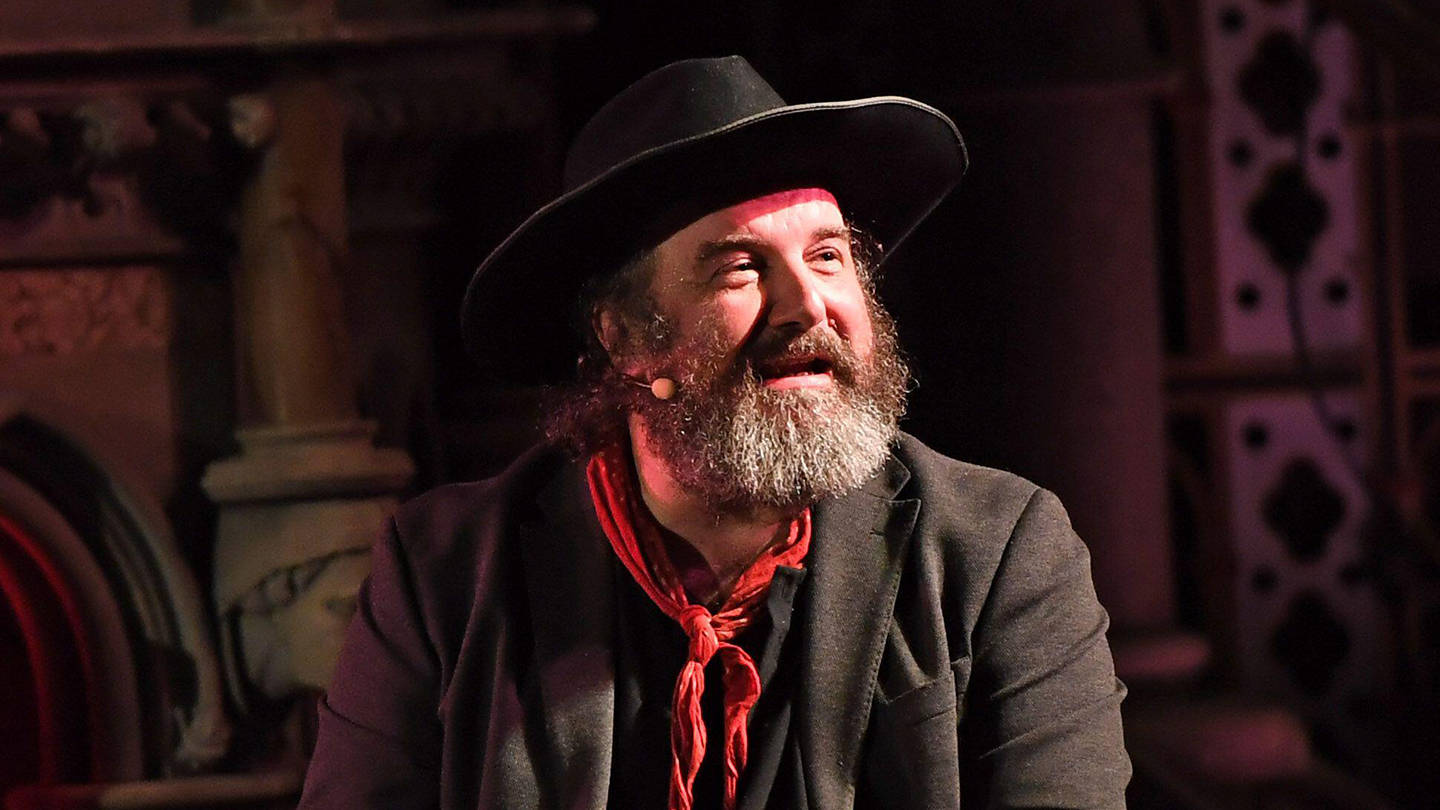
Martin Shaw performing at Union Chapel in London, England. [.smalltext]Photograph by Capital Pictures / Alamy Stock.[.smalltext]
[.article__paragraph--cap][.small-caps]“Long ago, long ago,[.small-caps] long ago, there was a village and in that village stood a hut and in that hut was a baby.” This is how the English-Irish storyteller Martin Shaw begins an old fairy tale, while drumming ominously on his djembe. “It was a very beautiful girl, but there was something about her, she discovered, as she grew older. She discovered that she had only one arm, one leg, one hip, and one eye. She was only half a girl. It made her sad and insecure, but when she asked her parents what was wrong, she never received a satisfactory answer. But the half-girl – as we shall call her – grew up, as best she could. Once she reached the rocky path that separates the adolescent from the adult woman, she could not bear it any longer. One night she crept out of the village and ventured out into the world.”[.article__paragraph--cap]
With his large gray beard and inseparable hat, Shaw is a bard, a seanchaí as the Celts called it, who, with his warm, weathered voice, knows how to transport his listeners into a world of half-girls, wolves, talking swans, and evil princes. He tells the story of the half-girl on his YouTube channel Jawbone, which deals with stories of crisis, wilderness, and transformation. Shaw is a master storyteller; his sentences are beautiful and vivid. His books are bestsellers. As a mythologist, he teaches students at Stanford and Cambridge, or at his own School of Myth in Dartmoor, Devon, where he lives. But he prefers taking people into the wilderness, in Dartmoor or Wales.
If I want to speak to a seanchaí, naturally, I can’t do it via a screen. I have to make my way over the hills myself, between the woods and the grain fields and the endless hawthorn hedges, where I see the half-girl trudging along in my mind’s eye, searching for an answer. It is twilight. Without navigation, I follow the signs along remote roads in Norfolk, west of Cambridge. I narrowly avoid pheasants and a partridge, crossing as if the world belongs to them, and so I eventually find Walsingham, a charming medieval village, the only place in England where Mary is said to have appeared, a thousand years ago. It has a few brick churches and, in the middle, a pub, the Bull Inn. Shaw is here this weekend at a conference on medieval British saints, which he helped organize. For a moment, I think I am in the wrong place because there is no one on the street, but when I open the door of the village hall there are more than a hundred people packed together. The stage and the hall are draped with branches of lilac and ivy. Shaw entertains the audience with fairy tales and lives of saints, stories full of life, laughter, dreams, and visions. His family lives here, so it is a home game, and every now and then he calls his nephews and nieces onto the stage to shout “oooh” to fill the hall with the sound of the wind.
“Do you know why the Romans never dared to conquer Ireland?” asks Shaw. “Because they had heard that all the Irish turn into wolves once a year. And the best part is that my surname means wolf in Irish.” Shaw is an entertainer, or a “raconteur,” as he prefers to call himself, but not just for the sake of amusement. Fairy tales and myths are very serious, he says. If we need anything in a world of information, distraction, and advertising, it is the stories that connect us to the landscape, to nature. “Myths are the language in which the earth speaks to us. They are bigger than us.”
[.article__paragraph--cap][.small-caps]The next day,[.small-caps] I meet Shaw on a bench in front of the Bull Inn, under a tree, with a pint of Guinness in front of him. He has just finished a lecture on Celtic saints: the monk Ciaran, whose first followers were a bear and a badger, and Gobinet, the hermitess who was instructed by the angel to found a community on the spot where she would see eleven white deer (the location, of course, was not a quiet island, but precisely where she was with her troublesome family). Now he is tired; he needs to recover from the intense weekend. A quiet conversation in the sun on a green terrace is a welcome break.[.article__paragraph--cap]
“People no longer have a story in these times,” he says. “The result is that they become more afraid. Of course, we hear stories; in fact, we are bombarded with stories. But they are not stories that wish us the best. They are stories that drag us down. They lack depth and do not teach us to be brave and moral heroes. They are meager stories, whereas we need thick stories. Stories that teach us what courage, heroism, and goodness are. We desperately need that in our time.”
His eyes betray that life has taken its toll on him. When he was young, he toured England as a drummer in various punk rock bands. “The musician’s life cost Martin a lot,” Shaw’s father had just told me when we chatted in the village hall. “It ruined his hearing, and his marriage too. It was the stories that helped him get back on his feet back then.”
“You know the ‘mosh pit,’ right?” says Shaw. “That’s the place, at the front of a concert, where I always jumped off the stage. At some point, we all take a beating in life’s mosh pit. I developed severe tinnitus when I was twenty-six. There was a lot of alcohol. I felt myself slipping away into the cracks of life.” He knew only one thing left to do: leave civilization behind and go live in a tent in the woods. “Our soul,” says Shaw, “doesn’t just live in a body. A soul also lives partly in the woods, the mountains, the stars, and the birds. And it is the old myths and folk tales that connect it all. I wanted to find my soul again.”
Shaw stayed in the woods for four years. And he made a pact with himself to learn a folk tale every day. In Wild Liturgy, he writes: “The problems and adventures in these stories helped my soul take shape. I became less afraid of the depths. I began to trust myself. I discovered that kindness mattered. I began to become someone I dared to look at in the mirror. And by being in nature for so long, I no longer felt like a visitor on earth.”
When he finally crawled out of his tent, he decided to pursue this academically. He earned a PhD on the meaning of metaphors in rites of passage, with a special focus on Irish and Siberian mythology, and he is still affiliated with various universities. He wrote books and translated Celtic poetry, and he collaborated with the Chinese artist Ai Weiwei. But what he also began doing was taking other people into the wilderness and guiding them through a “rite of passage” in the forest. He still does this today. He takes troubled youth, terminally ill patients, or people experiencing a midlife crisis to Snowdonia in Wales or to Dartmoor for a retreat, where four days of solitary fasting is invariably a component. “What you learn there, you receive not from people, but from the old bones of the forest, the cawing ravens overhead. You learn to listen to your dreams and to the animals around you.” It is a language that transcends our capacity for comprehension, says Shaw. “And what many people then experience is the feeling of coming home. Contemporary stories that remain within the narrative of endless growth and boundlessness cannot do that. That is mythology-lite, myths that challenge nothing – tiresome celebrations of our own self.”
[.article__paragraph--cap][.small-caps]There is nothing lite about the life[.small-caps] of a girl who has lost half of herself. “She had already been on her way for four weeks, but in our time it could just as easily be four years, and she was still trudging along. One day, a hot day, she saw a river glistening. It was a sacred river, according to some. And on the bank she saw someone standing: another girl, or rather, another half-girl. And that girl had exactly the half she was missing.” Then a great deal happened, but to cut a long story short, the half-girls got into a fight and dragged each other into the river, biting and growling, and there they went down together in the dark water.[.article__paragraph--cap]
It remained quiet for a moment. But then a hand came out of the water, and another. A girl crawled ashore, one girl, with two hands, two legs, two eyes. A whole girl. It took a while before she could walk and move properly, but everything worked. And she began to walk, walk, walk, until after a few days she arrived at a village, with a gate, and at that old gate stood an old couple. The girl asked if she might be allowed to stay the night here. They said: “Beloved daughter, do you know that we are your parents, and that we have been waiting for you all this time?” Only very slowly did it begin to dawn on her that she had come home. Her parents called all the villagers together, the food was prepared, the musicians began to play, and all night long everyone celebrated a big welcome party.
Beware, says Shaw, such a fairy tale is not a “fantasy” devised by ignorant people seeking stability in an uncertain world. It is a very mature story. “It is about us. It is about what it means to become human.” It is something very different from the stories of influencers who help us become smarter, more efficient, more attractive, or more muscular. It is not about success, says Shaw. Like all fairy tales, it is about downfall, and how we emerge renewed. “How do we learn to lose, instead of win?”
A central concept for Shaw is the word “initiation.” “We no longer know how to deal with events in our lives. In our culture, we no longer pass through adolescence. We have lost the stories of initiation. We lack initiatory language. These are rituals that help us grow into adulthood. Rituals make us humble. The wilderness makes us humble. They awaken awe within us. If we do not do that, we get stuck in crisis.” If we learn to speak that language again, we can get through it and emerge richer.
In doing so, myths establish the connection between our lives and the lives of all people before us. “They are stories rooted in the forests and the rivers. I call them the memory of the bone. The myth goes deeper than facts. The story of the matter goes deeper than the facts of the matter. We must search for the river beneath the river. And part of that is about dealing with adversity. We are often no longer able to do that. We must teach people to read the dark storms of their hearts in a proper way. There is much sorrow on the cold social plain. There are a great many people with a second home who do not even come close to being home.”
Is Shaw’s point that we should be more open to magic in a disenchanted world? “I don’t know,” he says cautiously. “I actually see a lot of enchantment. The trance we are in while on our phones. The message from advertising that we can become anything we want. Myths say something different, namely that we must become something very specific. We actually need myths to break the spell.”
Myths are not always about good gods or forces. “But precisely by telling stories about Zeus or Aphrodite or Loki, we can learn to name and recognize the various passions within us. These often lie beneath the surface. By giving them names, we can subdue them and call upon them at the right time. I would advise ancient stories to anyone wishing to understand their own impulses. Go to the Greeks, the Aboriginals, the Siberians, the Irish. They tell us so much about life. They show us the great foundation of lived experience.”
[.article__paragraph--cap][.small-caps]There are other well-known writers[.small-caps] and thinkers who draw inspiration from mythological stories and structures. Shaw himself stands in the tradition of the “mythopoetry” of the well-known American writer Robert Bly. The mythopoetics used myths to explore the meaning of coming of age in a culture they called “orphaned,” and they organized New Age-style conferences on masculinity. Bly built upon Carl Jung, who believed that a collective unconscious exists and that we can extract archetypes from myths that are real forces within our culture. Shaw has collaborated extensively with Bly. “I led his Mother Earth conference for seven years. But I do have my own ideas about it. I do not believe in the Jungian unconscious.” Myths have no magical power, Shaw believes. “However, similar themes have emerged in all the stories people have ever created. That is a source from which we, as humans, drink. I see it as storehouses of wisdom about how we should live. I am not really a Jungian, nor a pagan, rather just a romantic, in the tradition of the English writers Lewis and Tolkien.”[.article__paragraph--cap]
That doesn’t mean he only believes in what you can see. “There are more forces in the wilderness, I have experienced, forms of consciousness I hadn’t thought would exist.” He hesitates a little when I ask about it. “Those kinds of experiences are very private. People can easily misinterpret them.”
[.article__paragraph--cap][.small-caps]Shaw is not easy[.small-caps] to pigeonhole; he creates his own blend of Bly’s mythopoetry, Tolkien’s romanticism, the poems of the Celts, and the fairy tales from his beloved Devonshire. From myths, stories, sagas, and legends, he draws a language that does not speak of self-improvement, success, and control but of loss, transformation, and being part of something greater. It is a language that confuses, inspires, and evokes a longing for beauty and wilderness, for adventure and coming home. And in doing so, he is perhaps above all a therapist, a guide for city-dwellers, whom he encourages to allow themselves to be confused and surprised more often.[.article__paragraph--cap]
That still happens to him as well. A few years ago, he felt as though he were becoming domesticated. “I decided to go into the woods for 101 days in a row and tell a story to the woods every day.” On the last evening, a cold January night, he had sat still for hours when he was suddenly overwhelmed by an intense spiritual presence. He felt that this was bringing him back to the God of his parents and ancestors. It was not a rational consideration. “It was what Yeats called the ‘uncontrollable mystery of Christ.’ It is not that I suddenly changed my faith. I discovered that I had always believed in this. It was exactly what myths had taught me about life. Living, dying, and rising again – that is the fundamental human pattern. But Christ lived this out fully. As C. S. Lewis calls it: the myth that became reality.”
An Irish wolf in a church pew is hard to imagine. “On the spectrum between pirate and saint, I’m still closer to the pirate,” he says. But to his delight, he found a small Eastern Orthodox church in Devon with enchanting words and rituals. “The liturgy is a kind of dreamland so deep that there is no beginning or end.” You might say that this is far too foreign for someone who wants a connection with his own country and ancestors. But Shaw sees it differently. It takes him back to an ancient form of Christianity, before the Roman and Byzantine churches parted ways, when biblical stories were not yet told in Latin, but in Celtic and Anglo-Saxon, close to nature, in a rugged, untamed way.
"It challenges me to live out this myth more fully myself, to live the way Christ talked about in his Sermon on the Mount. It’s about transformation. Life isn’t cute; I’ve seen enough horror in my life to know that. Odysseus has to descend all the way, to the level of a beggar, before he gets his wife and his house back."
[.article__paragraph--cap][.small-caps]Is Shaw ever worried[.small-caps] about these times? “Certainly, there is much misery around us. But that, too, is of all times. My instinct tells me that we must keep an eye open for the miraculous. The myths tell us that it is precisely in times like these that miraculous things can happen. We don’t have to be a caravan of despair. But that hope rarely appears in the form of a condor landing in the forest and saying: ‘Don’t worry, your new name is Sweetgrass and we will get you out of here in a moment.’ The structure of God is grainy, more like pieces of plum cake than miraculous rescues.”[.article__paragraph--cap]
You can get to know that structure if you let yourself be touched by the old stories. Or by the beauty in nature. “Beauty feels like truth. Why is that? The famous French philosopher Gaston Bachelard said nature feels as if it wants to be admired by us. I feel that too.” That is the reason Shaw drags people along on retreats to fast alone on top of the hill. “The wilderness makes you humble. It takes you to areas within yourself that lie outside the socially accepted.” But it shouldn’t be escapism. The most important thing is how you return. “I know too many people who went into the wilderness and never came back. And I get a lot of young people following me who say they are going to leave everything behind and go live comfortably in the forests of France.” But you have to come back, with a gift for home.
Shaw’s favorite saint is Petroc, the son of a Welsh warlord in the fifth century. Petroc is still venerated as a saint, both in the Orthodox Church and in Devon and Wales. “He founded communities, but then went back into the wilderness. He went back and forth. He didn’t just stare into deep waters but also cared for people. He lived on an island for six years, where he befriended a wolf. But he came home again.” When you are truly grown up, you don’t stay in the wilderness. “It is easy to keep living wildly, as a funky artist. But you will have to go back into the village, with a gift for others.”
The half-girl, too, brought something back to her village. For the story is not yet finished. When the festivities began, she saw for the first time that something was wrong with all the other boys and girls in the village: they were all half. She had never seen that before, Shaw recounts. “And from that day on, the girl, the woman who had become whole, sat in the middle of the square, under the hot sun, and she continued to do so for the rest of her life. She told all the stories she had caught with her cloak during the time she had stumbled through the world on one leg. And it is really true, they say: when she died, she became a big tree. And if you were to come there now, under the tree, on a hot day, you would see that all the half-girls and half-boys would seek coolness there, in the shade of the great stories.”