What Gives Iranian Christians Hope
Several converts talk about why Iranians in the diaspora and in Iran are being drawn to Jesus.
June 8, 2026
Try 3 months of unlimited access. Start your FREE TRIAL today. Cancel anytime.
START FREE TRIAL NOWWhat Gives Iranian Christians Hope
Several converts talk about why Iranians in the diaspora and in Iran are being drawn to Jesus.
[.article__paragraph--cap][.small-caps]A group of Iranian refugees[.small-caps] are gathered in our living room in the city of Utrecht, the Netherlands. Our biweekly neighborhood meal has just finished, the last guests are leaving, and the dishwasher is running. The Iranians are staying longer to have a Bible study in Farsi. Black tea is placed on the table with cookies and large dates. It is busier than ever. Iranians are eager to be together to share the latest news. People are deeply worried and hopeful at the same time. Will change finally come? Will the dictatorship disappear? And would that be enough to bring peace to a country torn apart by trauma?[.article__paragraph--cap]
We live in a cohousing community, connected to a small neighborhood church. In recent years, we have seen quite a number of Iranians come to faith in our network. We work with and support many refugees and usually first get to know them when they ask for a job, a room, or for legal advice for their asylum procedure, but many have a hunger for knowledge about the Bible. Many of the Iranians we meet struggle with pain and deep questions about forgiveness. This usually has less to do with political persecution than with personal and family situations. They come from all sorts of backgrounds; some are university educated while others received their education on the streets.
Mohamed Reza Behbudi is one of these, a new friend with whom I play rapid chess whenever we meet. He is a tough-looking man with incredibly kind eyes. “In Iran, I was the king of the jungle,” he says. His weathered face and broken teeth still betray something of the life he led before.
We were involved in stealing, drinking, drugs, everything. It was a dark time. I saw a lot of destruction. I lost almost all my friends to violence, to drugs, to suicide, to the death penalty. And I had to flee the country and leave my family behind.
In Europe, he continued this lifestyle and ended up spending several years in prison.
After that, I went to the Netherlands. One day, I was sitting on a park bench and was given a Bible out of the blue by someone sitting there. That changed my life. I went to church and went looking for God. I also got baptized.
Behbudi laughs disarmingly.
God has given me one more chance, and I am not going to mess it up again. I quit alcohol and drugs. I want to change my entire way of thinking. That is only possible thanks to Christian friends who help me with shelter or with healthy words when I feel overwhelmed. But God makes the crucial difference. In the past, I was always afraid. How do I get a house, how do I get a job, how do I get papers? But now, whatever happens, even if I don’t get a residence permit, I am grateful that I am alive! God will take me where I need to be.
He is eager to tell everyone about the path he has found.
I tell it to asylum seekers I meet in the camp, to homeless people on the street, and to family members over the phone. I call them very often. They are all surprised; everyone knows what I used to be like. They want to know why I’ve changed so much. And my sister wants to follow this path now too! I read the Bible with her online. The way of Jesus brings light, not just a little, but a lot.
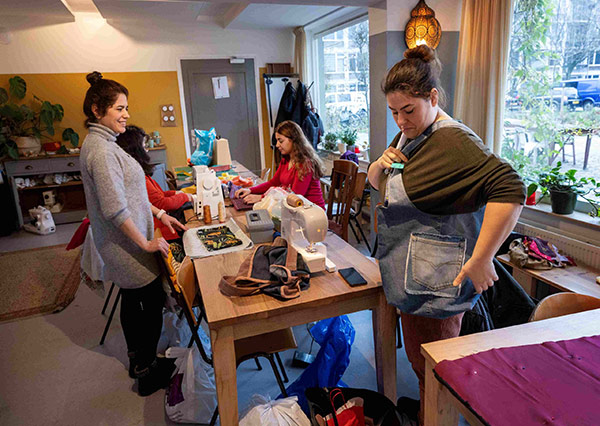
Behbudi became part of our church community through Shima Sabghi, an Iranian woman in our house who has a big heart for all refugees and works as a missionary worker. She helps people find jobs, rooms, or a doctor. But she also prays with people whenever she can, and gives pastoral care. As I write this, she is preparing a bowl of rice with saffron for a church group. Sabghi’s own life has not been a bed of roses either.
I am a woman from the East. Our lives as women there are marked by feelings of inferiority. You really cannot overestimate how deep the hurt is. All the families I know first loved their sons. As a girl, I first had to prove myself to my parents. I first had to show that I could clean hard or be smart. When I played with my cousin Hassan, they all looked at him with affection. That is how you grow up with the identity of a worker, of an assistant. We have all been raised with the feeling that we are outsiders. And we will do anything to get that recognition, but inside us we feel resentment and anger.
My family was wealthy, and I had connections everywhere. But when I encountered corruption at work and got into trouble with the police, I had to flee. I had to leave everything behind. I had nothing left except jewelry – until someone stole it from me. After a long story full of camps and police, I found myself in a small room, without papers, crying. I remember that I didn’t even see the sun, my heart was so dark. And then I cried out to God. I had always been a devout Muslim; I had even been to Mecca. But at that moment, it suddenly occurred to me to call an Iranian pastor I had heard about. He took hours to explain the gospel to me. This changed me completely. It didn’t take very long before I gave my life to Jesus. I attended a Bible course in my neighborhood, run by Dutch people, and it was about anxiety. “Do not worry but seek first God’s kingdom and his righteousness, and all things will be given to you.” I felt so happy. This was the key; I felt it. But what do I have to do? Do I get everything then, do I get my mother back too, and my country? I think I spent at least three months thinking about those words continuously.
When you change on the inside, the outside changes too, although it can take years. I have been a Christian for ten years now. In the meantime, I have got a husband and a little daughter, and I am a member of the house community where I once attended that first Bible study. God did that, not me. But one choice of mine was important: on that day in my little room, I accepted that I am powerless and poor. I had never learned that before. I was always strong and smart and connected. Only when everything, absolutely everything, was gone did I look in the mirror and see the hole in my heart. That was the key to change.
Sabghi is also a member of an Iranian church in Amsterdam, Naviderahaie (“good news”). The pastor, Peyman Shabanlari, drives up and down the country, seemingly tirelessly, to seek out Iranians, equip them, advise them, or give them a blessing. He is a friendly man with a large beard who fled to the Netherlands over thirty years ago. Nowadays, he sees countless Iranians come to faith. Not always for the best motives, he says. “Many Iranians get baptized because it helps them obtain a residence permit. But that’s not always bad! I started that way too, when I was in a refugee camp. But two years later, I really started reading the Bible, and then I was born again. That happens to many people.”
Reflecting on the situation in Iran, Shabanlari thinks that the experience of living under a repressive theocracy has created a new openness. “There is a broad movement of people who no longer want any religion at all. They are looking for a new identity.” Some find it in atheism, he says. Some turn to their old religion, Zoroastrianism. But others find it in Jesus. A lot of Iranians are hurt by the strict Islamic law and its consequences. They are touched by the image of a loving Father who loves them. “That is really something of the last twenty-five years,” he continues. “There were hardly any Christians, now there are very many.” Estimates range from three hundred thousand to ten times that number. “Many conversions take place in Iran itself, where it is strictly forbidden. They often believe entirely on their own, or with a few family members together.”
European churches have played a role in this revival, says Shabanlari.
Elam Ministries is a Farsi study center in London, which started in the nineties. And then the Fatherhouse Movement started in the Netherlands, in 2003, which equipped and trained Iranians as disciples and leaders. It played a very important role in establishing churches in Iran. Pentecostal churches in the Netherlands, in particular, supported this. Local Iranian churches and bible study groups have sprung up all over the Netherlands.
Naviderahaie, the church founded by Shabanlari, has dozens of believers who gather in Amsterdam on Saturdays. They also have over a hundred active members in Iran who follow their online Bible studies, prayer groups, and marriage courses. “And most of the members also have a few Christian family members around them.” The lessons cover topics such as forgiveness, truth-speaking, and relationships, in other words: discipleship.
The background of these churches is evangelical. They pray with their hands raised and sing songs modelled on American Pentecostal examples. “But we call ourselves interdenominational,“ says Shabanlari. “We are grateful for what Western Protestant and Catholic churches have given us, but we do not want to adopt the division into denominations. We believe that we must be one.”
The greatest challenge in the Iranian church is trust, says Shabanlari.
We are all brought up with a deep feeling of rejection. I call it a spirit, which permeates our culture. It is deeply part of the religion we are brought up with. Even within the Islamic world we feel inferior; as Shiites we are called “the rejected” in Arabic.
Connected to this are patriarchal structures and dictatorial policies which left a lot of people with personal trauma. People have learned to separate an inner self, which is often hurt, from an outer self, which must always look perfect. “People are so sensitive, it is almost unbelievable. It is very complicated. I can safely say that most new believers leave again because they are hurt about something. Sometimes I am very tired of it. What gives me hope is the second generation of Christians. The children of Iranian believers no longer have that struggle; we must bear this, they will reap the fruits.”
In our Dutch, multicultural community, too, we often see Iranians leave again. Yet a small group of strong believers is emerging, people with a lot of life experience who have decided to stick together through misunderstandings and let their hearts be changed by Christ. Sabghi says:
Every culture brings patterns that we should be liberated from when we follow Jesus. In our culture that’s mainly the feeling of rejection. Between men and women for example. We have all believed that men are in charge and that women must manipulate men with their beauty. This is not just solved by changing the Islamic regime. We have all participated in it. We must repent of that. God can change us. In our church we help men and women to look each other in the eye again and ask each other for forgiveness. I know that it changes people. I see a tenderness in their eyes that I have not seen before.
Eventually, the current Islamic regime in Iran will fall, says Shabanlari.
I am certain of it. The violence of today is the consequence of our own behavior. We did not want to live as God wanted. Jeremiah 49 states that God breaks the bow of Elam, which is now Iran, and will scatter the people. But the scattering is not without reason. I think we are scattered to find the truth and bring it back home. Jeremiah says that at the end of time we will return to Elam and that God will establish his throne there. This does not mean that a theocratic government must come into being, but that God’s kingdom is going to rule in the hearts of the Iranians.