Report
Staying on the Front Lines
These Christians in Ukraine’s embattled eastern region could evacuate – but choose to continue serving their neighbors.
August 31, 2026
Try 3 months of unlimited access. Start your FREE TRIAL today. Cancel anytime.
START FREE TRIAL NOWStaying on the Front Lines
These Christians in Ukraine’s embattled eastern region could evacuate – but choose to continue serving their neighbors.
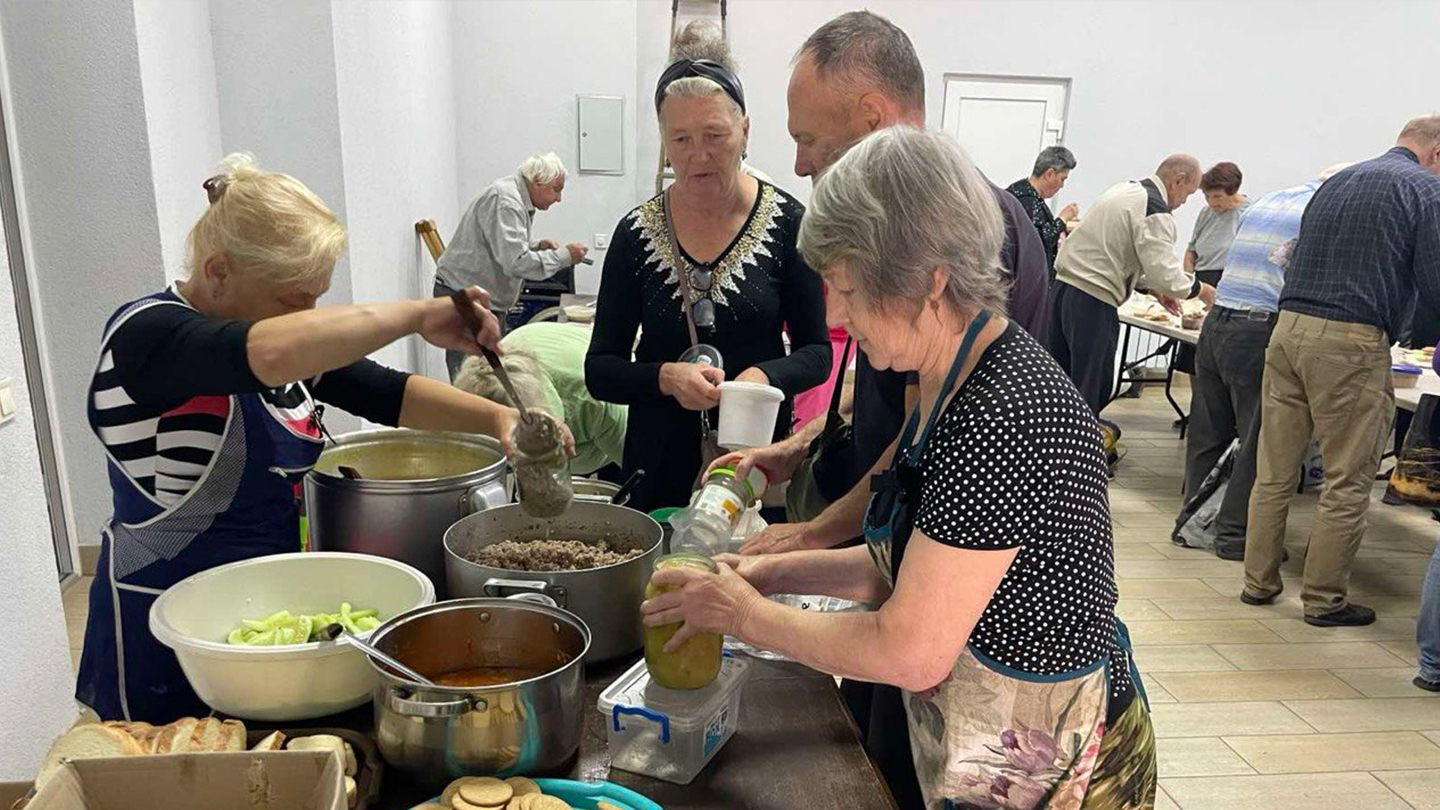
The soup kitchen operates once a week at the Good News Church. [.smalltext]Photograph courtesy of Viktor Pávenko. Used by permission.[.smalltext]
[.article__paragraph--cap][.small-caps]Viktor Pávenko is one[.small-caps] of the last remaining pastors in the “kill zone,” near the front lines of the war in Ukraine. In the kill zone, no one, soldier or civilian, is safe. Russian drones and missiles are a part of daily life – and often death – here in Kramatorsk, a once-calm industrial town in eastern Ukraine’s Donetsk Oblast.[.article__paragraph--cap]
But daily bread is part of life as well. To this purpose, Viktor, the sixty-five-year-old pastor of the Good News Church, is here to bless the weekly food distribution. He calls for quiet as he prays for the crowd – at least fifty people, mostly senior citizens. They would go hungry without the food aid – or go crazy without spiritual support like Viktor’s.
Before the pastor finishes his prayer, the people have already begun jostling for position in line. They need basic groceries, like semolina, pasta, beets, and onions, as well as aspirin and other simple medicines arrayed on the table.
As Viktor says “Amen,” a terrifying boom – possibly a Russian drone, or an anti-drone gun from the Ukrainian side – sounds out across the church’s wide, paved courtyard. Several pigeons, which had been pecking in the nearby grass, take flight in a panic. Shrinking at the sound, a few of the seniors cross themselves, then return their focus to getting what they came for. Next week’s distribution is a long time away.
[.article__paragraph--cap][.small-caps]Viktor has run[.small-caps] his church’s humanitarian aid ministries since the start of the full-scale war in February 2022, he told me during a reporting trip I made to Kramatorsk in June. It was the start of Ukraine’s fifth summer of war. Besides the weekly food handouts, Good News runs a soup kitchen twice a week and maintains a courtyard water tap at all times. The church delivers groceries and goods to those too frail to leave their homes.[.article__paragraph--cap]
Viktor himself is a picture of good health: tall and trim, he speaks with a force and volume that suggests a long habit of authority. A former factory director, Viktor built his Pentecostal church from nothing, using his own time and resources to establish an evangelical community here. Other Pávenkos also serve in ministry, across Kramatorsk and in the neighboring town of Sloviansk. Their communities are just ten miles from the front lines.
Kramatorsk lies on Ukraine’s “Fortress Belt,” a string of four large towns that form the last, strongest defense on Ukraine’s eastern edge. In this part of Donetsk Oblast, part of the broader Donbas region, Ukraine has built up a band of physical defenses as nowhere else in the country. Barbed wire, concrete blocks, and trenches wide enough to swallow advancing tanks stretch across the land for miles.
Russian forces have made Donetsk Oblast a key military objective – and a constant demand in the war’s on-and-off diplomatic negotiations. In late July, Russia’s foreign minister reiterated that full control of the Donbas was a condition for any future cease-fire.
Russia has in recent months waged a much-intensified assault on the region, to force civilians out and to persuade Ukrainian troops that holding the Fortress Belt is simply too costly. Russia notched grim records in civilian attacks all summer: May brought the numbers of Ukrainian dead and wounded to a four-year high, before June brought even more, and July more than June. More than three thousand civilians were killed or wounded in July – a 30 percent jump from June, according to United Nations data.
Despite these terror tactics, Ukraine has dug in, in every sense: bolstering its defenses, concentrating troops and strategies on the Donbas, and striving for a defense that matches Russia’s offensive efforts.
Civilian evacuations are a daily occurrence from Kramatorsk, and the Pávenkos are active in helping their neighbors flee west toward safety. Viktor tells me he has the option to take off, too – but can’t stomach leaving his church and community behind.
“I have the means to go elsewhere,” he says. In spite of, or because of, having children and grandchildren in the area, he chooses to stay.
In this way Viktor thinks of the vulnerable before himself. He describes the difficult lives of those to whom he makes home deliveries, using the Russian word invalídov, or “invalids,” which does not carry the pejorative sense it can in English. Between their poverty and the shrinking public utilities Kramatorsk can still provide, those who are disabled often go without light or heat at home.
“How are the invalids to live?” he asks.
For himself, Viktor would rather grapple with the known difficulties of living in a frontline town than rebuild a new life away from his home.
“If I have to drop everything and leave… ” he wonders, as his voice loses its tone of command. “I don’t even want to think about that.”
[.article__paragraph--cap][.small-caps]From inside[.small-caps] the church’s white room, the crowd narrows into a line, hunger imposing its own discipline. The needy file in, holding out paper plates, bowls, and filmy plasticware to take more home. Kerchiefed women, all volunteers, dish out chicken soup, scoops of grechka – buckwheat, served loose, which is a staple of many Slavic diets – and gray strips of meat. Into cups and mugs the women ladle tea from a vat, pushing aside the tea bags floating inside.[.article__paragraph--cap]
The attendees eat standing up, the better to squeeze in the hungry, unless a visitor’s health requires that they sit down. The room showcases the diners’ pride and their tempers. One woman wears lipstick for the occasion, applied with an apparently shaky hand. One man spoons the chicken bits from his soup down to his dog seated at the table’s edge. Two diners start to argue, perhaps over their standing room or the slices of bread on the tables. One grabs the other’s bowl of yellow soup and sends it splattering across the white wall.
Those remaining in Kramatorsk are often from lower levels of society, Zheniya Pávenko told me later. He is Viktor’s nephew, and works at the Ark of Salvation Church, another Pentecostal congregation across town. Before the war, he says, people found themselves in trouble and sought to help themselves and each other. Today, the town’s “alcoholics, various poor, and the unemployed” make up the bulk of those who come to be served.
“They don’t want to do work themselves,” he says. “They want us to help them.”
The new needy pose a spiritual test for ministry workers like the Pávenkos. “It’s less pleasant to work with them,” Zheniya says. “But still, we must.”
Outside the dining room, I spoke with several locals who had come for assistance. Nearly all were advanced in age. All depended, to varying degrees, on the church.
Irina, who gave only her first name, asked rhetorically what else she could do. “Where to go?” she said. Her real question might have been: With what money? She receives a pension that could be more rightly called pocket change. At 2,500 Ukrainian hryvnias per month – about fifty-six American dollars, given wartime inflation – it covers few of her needs.
“It’s hardly a pension,” Irina says. “It’s peanuts.”
Oleg, a former miner, describes similar straits. His sleeveless vest, tattoos, and bandana gave him the look of a biker. Yet his speech reveals a softness, as his several gold teeth flash in the sun.
When help is offered, “We don’t refuse,” Oleg says. He is also a refugee, one of the 3.7 million Ukrainians displaced within the country, according to the United Nations. Roughly a quarter of these are from the Donbas. Oleg lived in nearby Toretsk until Russian forces captured the town a year ago, after a long and grinding struggle. He worries for the future of his seven children and fourteen grandchildren.
Oleg’s wife, Larissa, shares his burdens and the attribute of more gold teeth. Her thoughts fixate on curious things, showing that displacement’s sharpest pains can come from unexpected objects of attachment. She wonders what will happen to their house in Toretsk – and to their washing machine, bought recently, for which they had saved for years.
“It’s back in Toretsk,” Larissa says, “but it’s too dangerous to go and get it.”
She might have been speaking about the lost appliance, and her lost home, at the same time.
[.article__paragraph--cap][.small-caps]On a hot, bright[.small-caps] afternoon, Zheniya drives me to his parents’ house in Sloviansk. We pass under anti-drone netting, which is laid over frames above the road, forming a square tunnel of protection for drivers and pedestrians. The odd burned-out car awaits removal by the roadside.[.article__paragraph--cap]
Occasionally, in the grass, there glint what look like lengths of fishing line – and is actually fiber-optic cable. Certain types of Russian drones use the cable to avoid signal jamming or other Ukrainian defensive tactics. Here, as across the Donbas, reminders of drone attacks suggest a danger both past and present.
Zheniya’s father, Leonid Pávenko, has pastored the Ark of Salvation Church for decades. Zheniya’s mother, Lyuba Pávenko, suffers from arthritis and has to stay home – much like those Zheniya serves in Kramatorsk.
The older couple welcomes us into the lush garden by their house. Here the Pávenkos grow cherries, strawberries, and other fruit. The scene feels too natural, too peaceful, for a conflict zone. The sun keeps shining. Birds sing in the trees above. My audio recorder picks up the buzz of flies and other insects around us.
“Lately, it’s gotten worse and worse,” Leonid says, describing the new intensity of Russia’s campaign. “The rocket strikes are scary. Unpredictable. You never know where they’re going to fall.”
Given their place on the Fortress Belt, the specter of a Russian advance poses special problems for Leonid and Lyuba. Both have limited mobility and depend on their children for transportation. Lyuba’s departure from Sloviansk might take more time than a Russian offensive would give them.
Perhaps paradoxically, Lyuba’s frailty has kept her away from the worst stresses of the Pávenkos’ humanitarian service. It has preserved her peace of mind.
Lyuba marvels at what she sees as God’s work in the region. Needy locals have come to the church for practical and spiritual support – and have received a powerful witness from families and volunteers like the Pávenkos.
“People gather around the church, on the road, on the sidewalk, standing, with [babies in] strollers. They cry, ‘Bread! Bread!’” she says.
Lyuba noted that the family’s humanitarian work has improved the standing of the church as a force for good across society – and has commended the Gospel in the process. It is a notable change, given that Protestant communities have sometimes been seen with suspicion in mostly Orthodox eastern Europe. Lyuba referred to Matthew 5, in which Jesus exhorts his followers to be as a lamp lighting the way for unbelievers.
“You are the light of the world,” the passage says. “Let your light shine before others, so that they may see your good works and give glory to your Father who is in heaven.”
“We are a light, responsible before God,” Lyuba says. “Unbelievers now honor the church. The army respects us, too.”
More than four years running, the Pávenkos appear to have grown their witness to a mass scale. Their partners include government and private actors, from inside and outside Ukraine. Zheniya estimated that, at Ark of Salvation alone, some two thousand people have stayed the night, sheltering on the church’s numerous cots. The church was, until this spring, a rallying point for the buses, vans, and other vehicles used in evacuating locals or villagers from other frontline areas.
While at Ark of Salvation I saw officials from Proliska, a large Ukrainian evacuation provider, in their trademark blue uniforms. Other signs of assistance, like bags from the US Evangelical charity Samaritan’s Purse, typified the stacks of supplies crowding the church offices. A stream of traffic, counting cars, civilian and military, pulled up to the church, dropped off or picked up supplies, and took off again, sustaining the lifeline this Pentecostal community has held out since 2022.
In total, Ark of Salvation has facilitated transfers of about twelve thousand people through its premises, Zheniya says.
From the relative, delicate peace of his garden, Leonid reflects on his church’s varied, and largely effective, ministries of mercy. His faith gives him confidence about the future. He seems to speak for his whole family.
“We’re optimistic,” he says. “We believe that God will do his will.” The Pávenkos are staying here to live, and serve, in light of that hope.