Essay
Rome Versus Christian Conscience
Where did the concept of religious liberty originate?
August 22, 2026
Try 3 months of unlimited access. Start your FREE TRIAL today. Cancel anytime.
START FREE TRIAL NOWRome Versus Christian Conscience
Where did the concept of religious liberty originate?
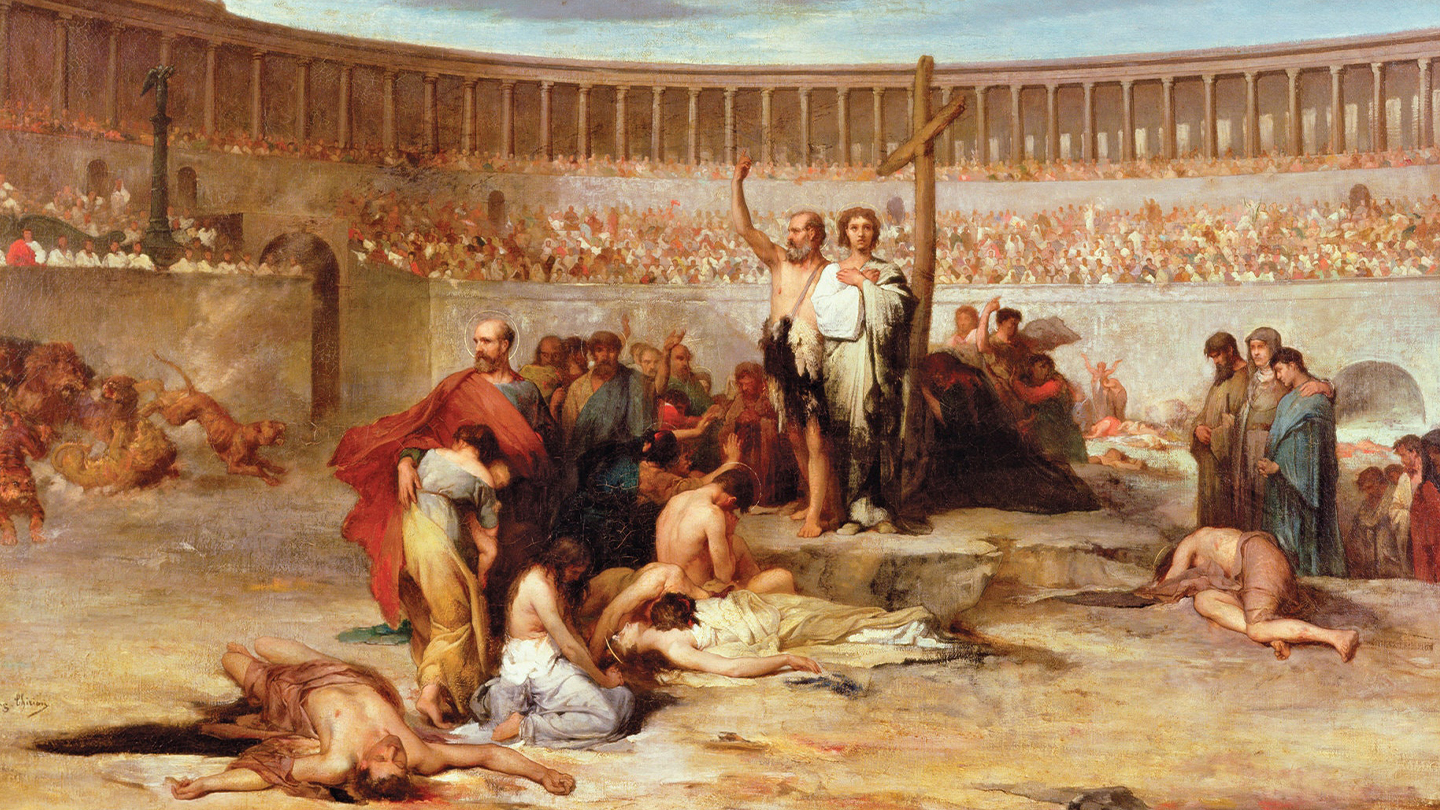
Eugene Thirion, Triumph of Faith. [.smalltext]Wikimedia Commons (public domain).[.smalltext]
[.article__paragraph--cap][.small-caps]A Roman governor[.small-caps] found a way to tell a real Christian from a false one. Make them curse Christ. A true Christian, he reported, could not be made to do so.[.article__paragraph--cap]
Pliny governed Bithynia for the Emperor Trajan around AD 112. He received reports about Christians in his province. He interrogated some of them and described to Trajan what he found: they gathered before dawn, sang hymns to Christ as to a god, and bound themselves by oath not to commit fraud or theft. So far, nothing criminal described. But what gave Pliny concern was their refusal to burn a pinch of incense to the emperor’s image. Even when offered the chance to save one’s life by cursing the name of Jesus, many would not.
Those who persisted, he executed. He told Trajan, “Whatever it was which they were confessing, their obstinacy and their inflexible stubbornness should at any rate be punished.” Pliny was unsure he judged rightly, and wrote his emperor for guidance. Trajan’s reply was cold and direct. Don’t hunt them down, but if they were reported, brought before Pliny, and would not recant, punish them. Recantation was to be proven through the act of sacrificing to the gods. If they did, let them go.
He had established a test for loyalty. If a person performed the rites, they lived. What Pliny could not account for was that many in this strange sect would rather die than perform an act they did not believe.
From AD 112 to AD 250, for six generations, this was the position of the most powerful empire on earth toward the people who called themselves followers of Christ.
Rome was more hospitable to other religions than one might expect. The empire welcomed foreign gods, so long as adherents also honored the civic cult.
The public cults were civic obligations, not voluntary devotions. They were what held the city together, the divine protection that kept the grain flowing in and the armies intact.
Refusal to sacrifice was treated as a social issue, not merely theological. Christians were a problem for what they refused to do, not for what they believed. The space inside one’s mind apparently was, to Pliny and Trajan, beside the point. What happened in public was not.
Celsus, a pagan philosopher writing in the second century, thought the Christian claim to conscience was antisocial, bordering on subversive. Every tradition had to contribute to civic religion, he argued. Rome’s tolerance of other religions depended on their participation in civic religion. Christians who refused to participate were, therefore, parasites.
The historian Robert Louis Wilken reconstructed how Rome’s critics described the early church. He found the greatest charge leveled against them was that they had broken nomos, the inherited customs of a people. To abandon the ancestral ways was, in Celsus’s words, “sedition.”
[.article__paragraph--cap][.small-caps]This is not to say[.small-caps] Rome lacked a concept for the inner life. Epictetus, a former slave writing around the same generation as Pliny, argued at length in his Discourses that the ruling faculty of the mind, what he called the hegemonikon, was the thing no external power could touch. The emperor could take your body, your property, your freedom, even your life. He could not take your capacity for rational assent.[.article__paragraph--cap]
Even Cicero, writing over a century prior, maintained a studied agnosticism in his De Natura Deorum while fully participating in civic rituals. Modern minds might hear hypocrisy, but this was a mark of sophistication for a man of his class. Private philosophy was one domain, public obligation another. The Stoic sage performed the sacrifice, and remained inwardly free because public obligation was not something a private philosophy could exempt.
The Romans, however, did not believe that personal belief could limit what the state could require of an individual. We don’t see writers putting forward such arguments until AD 212, when a master of legal rhetoric named Tertullian produced a defense of Christianity to the proconsul Scapula, who was busy torturing and executing Christians.
In Ad Scapulam, Tertullian called religious freedom a human right and a natural liberty, humani iuris et naturalis potestatis, arguing that it is definitively unjust to force one’s worship. Religion, he wrote, required willing participation. Forced religion was not religion, but theater.
Tertullian wanted the persecution to stop. He was making a case, but with a new argument: that the interior assent of the worshiper was something the state could not and should not try to reach. The performance of sacrifice Trajan demanded could not prove what Trajan thought it proved; the inner reality the performance was supposed to demonstrate lay beyond the state’s force.
[.article__paragraph--cap][.small-caps]Tertullian drew[.small-caps] a map; others would explore the territory. He knew the state could not step within the interior life. A hundred years later, another writer would explain why the interior life was what really mattered – why God, specifically, could only be approached through willing response and not through force.[.article__paragraph--cap]
Lucius Caecilius Firmianus Lactantius was a rhetorician and teacher from North Africa, teaching in the eastern city of Nicomedia. When Emperor Diocletian launched his systematic persecution of Christians in AD 303, destroying churches, confiscating scriptures, removing Christians from civic standing, and eventually demanding sacrifice under penalty of death, Lactantius lost his position, his livelihood, and much of what secured him to public life.
He spent the next years writing. The result was the Divine Institutes, seven books written to a pagan educated audience. In Book V, he entered the argument Tertullian had opened but never completed. He made the theological argument for why religious coercion not only failed as a political matter but failed at its own stated purpose.
According to Lactantius, religion could not be compelled. It had to be voluntary. God’s desire was the genuine internal turning of a person toward himself, not the performance of a rite. Sacrifice, prayers, hymns, and worship were only meaningful as expressions of something that had already occurred inside the worshiper. One could not force that into existence.
He then went a step further. “Religion is to be defended,” he wrote, “not by putting to death, but by dying; not by cruelty, but by patient endurance.” To defend it with bloodshed and torture was not to defend it, because “nothing is so much a matter of free will as religion, in which, if the mind of the worshiper is disinclined to it, religion is at once taken away, and ceases to exist.” A distilled version that later readers would carry forward: religio cogi non potest. Religion cannot be coerced.
Lactantius wrote this as Christians were being persecuted for refusing to perform the sacrifices to the gods. His argument was that Rome’s approach to the problem of civil disobedience rested on a mistake. What the state demanded could not be produced through threat of torture.
[.article__paragraph--cap][.small-caps]In AD 313, having[.small-caps] won a civil war in which he attributed his success to the God of the Christians, Constantine met with his co-emperor Licinius in Milan. What came out of this meeting was the Edict of Milan. The policy was executed through letters sent from Licinius to eastern governors. Its text, which Lactantius preserved, reads: “The Christians and all others should have liberty to follow that mode of religion which to each of them appeared best … so that God, who is seated in heaven, might be benign and propitious to us, and to everyone under our government.”[.article__paragraph--cap]
Not Christianity, not paganism, but whatever one would choose. The document’s logic was explicit: to win the favor of the power governing the cosmos required that every individual be free to worship according to his or her own conscience.
This was Lactantius’s argument made at the level of imperial policy. Lactantius was no stranger to Constantine; the emperor had brought him into his household and made him tutor to his son. The man who, in the middle of the persecution, wrote that religion could not be coerced had been drawn into the emperor’s circle. The empire was now issuing as policy the principle he had defended as theology. The historian Elizabeth DePalma Digeser has suggested that Lactantius may have read the Divine Institutes aloud at Constantine’s court, that he dedicated a later edition to the emperor, and that Constantine’s own letters afterward echoed its arguments.
Constantine did not make Christianity the religion of the empire. He legalized and favored Christianity, but the empire he ruled over remained openly plural to the end of his reign. Almost seventy years later, Theodosius made Nicene Christianity the state religion through the Edict of Thessalonica. Later laws moved against pagan worship. What the Edict of Milan offered was liberty to everyone. Lactantius’s argument – that coerced faith is not true faith, and that the state cannot reach what God wants – was unmistakably present in the edict.
The Stoics had a rich account of the inner life and knew that Caesar could not reach it. But theirs was a type of philosophical endurance, far from a political claim. The Stoic met the demands of state without being changed by it. He did not, however, argue that the state was wrong to make it.
Yet the longing for a free conscience was intuitively appealing, even to the pagan empire. Julian the Apostate, the emperor who set out to undo Constantine’s impact on Christianity in AD 361, initially argued against forcing citizens back to paganism, on the grounds that compulsion was counterproductive and beneath the dignity of the old gods. This was a pagan emperor making a surprisingly Lactantian argument.
Tragically, the argument Julian made could not survive the corrupting nature of its own power. Lacking a theological anchor for mercy, Julian ultimately abandoned his own ideals. By AD 362, he banned Christians from teaching rhetoric and grammar, effectively creating a state-sponsored religious test for civic professions. Ammianus Marcellinus, a pagan soldier and historian, declared that the emperor’s cruel ban “ought to be buried in eternal silence.” The pagan world could glimpse the beauty of a free conscience, but it did not possess the worldview capable of sustaining it.
Lactantius was not offering a generic distaste of forced conversion. He grounded his case in the nature of the very God being worshiped. That grounding was only available because of the God he was describing. Unlike so many other gods, the God of the Bible enters the world as a persuader, not as a conqueror. Throughout the Gospels, Jesus is constantly making cases: telling stories, posing questions, turning common situations upside down so people can see angles they might have missed. When a rich young ruler walks away unchanged, Jesus lets him go. He watches a man choose wrongly, and lets him. The kingdom of heaven is not an earthly empire to be expanded through forced enrollment. In Acts 17, Paul stands in the Areopagus in Athens and reasons with the philosophers. Instead of issuing a coercive command, he finds common ground, quotes their local poets, and invites them to consider the claims. The word used in 2 Corinthians for how God deals with humans through the good news of Jesus is the word for appeal, for entreaty: “We implore you on Christ’s behalf: Be reconciled to God.” The good news comes as divine plea. This plea does not come to us as a political mandate implemented through the sword.
Julian could oppose coercion based on optics; it was beneath the gods. Cicero could treat it as unnecessary; the gods wanted the form of religiosity, not the conviction. The Stoics could endure it on philosophical grounds; it could not reach what really mattered. None of them worshiped a God whose means of operating in the world had been that of persuasion. Lactantius argued that coercion was theologically incoherent, working from his understanding of a God who chose to interact with humanity through argumentation, healing, invitation, and, ultimately, sacrifice rather than through conquest. Coerced worship contradicts the nature of the one being worshiped. The church that relies on the state to maintain itself has, on its own theological terms, already conceded its argument.
[.article__paragraph--cap][.small-caps]The modern assumption[.small-caps] of religious liberty, the First Amendment, the Universal Declaration of Human Rights, the far-reaching belief that the state has no authority over the conscience of its citizens, did not travel in a straight line from Lactantius’s Divine Institutes to Philadelphia.[.article__paragraph--cap]
The road ran through centuries of conflict, much of it involving self-professing Christians doing exactly what Lactantius said was incoherent. Charlemagne, for example, conquered the pagan Saxons and made refusal of baptism a capital crime. This was not lost on his contemporaries. One wrote that the fierce necks of the Saxons bowed to the yoke of Christ, though by coercion. The sharpest objection came from inside his own court. Alcuin, the emperor’s trusted scholar, argued that faith arises from the will, not from compulsion. You can force a man to be baptized, he wrote, but this will not instill the faith in him. Charlemagne eventually softened the policy. The case Lactantius made had not died. It was being pressed against a Christian king by his most trusted advisor.
But the premise that made the argument possible, that coerced faith is not faith, that the inner assent of a person is not the state’s to command, that a God who wants willing worship has no use for forced conversion; that premise was worked out by a man writing with no political power, during the worst persecution, from a theological account of how God has chosen to be known.
The Christians who refused to sacrifice knew something that neither Pliny nor Trajan understood. There are things a person carries that no force can seize, no sword can reach, and for which no performance can substitute.
The sacrifice test could rally a man to the pagan altar, yet it could never reach the thing it was built to declare. As many view the splintering of our culture, the gravity toward the old Roman way becomes more appealing. We reach for compliance and call it virtue – compliance, through institutional pressures and the social exile of cancellation. We punish those who refuse to speak the prescribed vocabulary and hot takes of our moment. In our rush to mandate uniformity, we resurrect Trajan’s mistake. We settle for a theater of conformity, indifferent to whether anyone actually believes what they are forced to perform.
But the God Lactantius was describing still works the way he always has. He asks. He waits. He lets you walk away. The plea is still open, and it still arrives without a sword.