Overwhelmed by the Spirit of Jesus
When this simple, loving spirit resolves all conflicts among us, we will not be afraid of anyone.
July 23, 2026
Try 3 months of unlimited access. Start your FREE TRIAL today. Cancel anytime.
START FREE TRIAL NOWOverwhelmed by the Spirit of Jesus
When this simple, loving spirit resolves all conflicts among us, we will not be afraid of anyone.
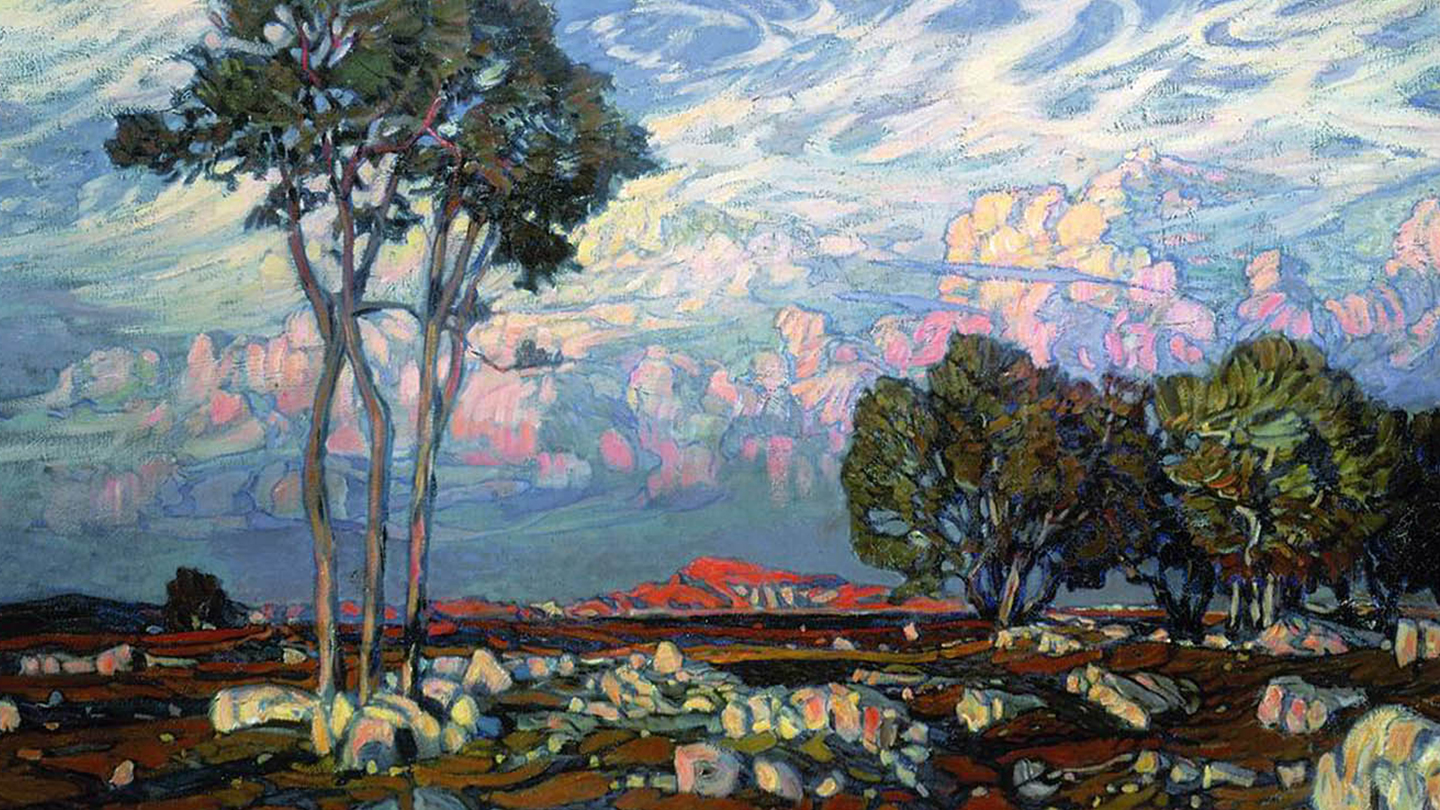
Konstantin Bogaevsky, The Last Rays of the Sun, c. 1944. [.smalltext]Wikimedia Commons (public domain).[.smalltext]
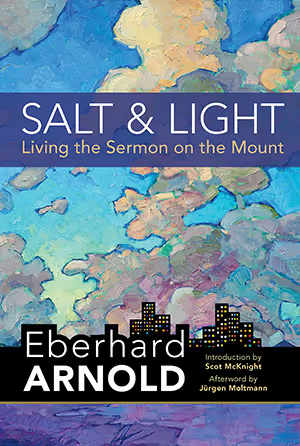
[.smalltext]From Salt and Light, this week’s featured book.[.smalltext]
[.article__paragraph--leading]This piece is based on a talk Eberhard Arnold held on October 22, 1933, at a time when his community was under increasing pressure from the National Socialist government.[.article__paragraph--leading]
[.article__paragraph--cap][.small-caps]There are people[.small-caps] who, in spite of their most earnest efforts to reach the subjective goal of religious orthodoxy, are not yet overwhelmed by the Spirit of Jesus Christ. These people do not belong to his fellowship or to its mission. Try as they might to help themselves by loving other people and attending to their own salvation, they do not belong to God’s kingdom. This is a painful fact, but it is the truth.[.article__paragraph--cap]
Only those who, by the imparting of God’s grace, have actually received the divine Spirit, which is wholly different from every human spirit, belong to God’s kingdom and to the church community of Christ. This Spirit does not strive for itself – and those who bear it are not focused on their own holiness, their own salvation. It does not try to make itself out to be good. It is a spirit that recognizes and honors God and God’s interest alone.
This is a mystery that Jesus expressed firstly in his parables, though also in the Sermon on the Mount, where he spoke more directly and literally about what it is that counts. The Sermon on the Mount shows us a tree that God plants (Matt. 7:15–20); the sap in the tree, which our blood cannot produce; a salt that we cannot manufacture, but whose nature is given by God. It shows us a light that we cannot kindle; an essence that comes to us (Matt. 5:13–14) not from our own human resources, but from the fount of God’s being alone.
The Sermon on the Mount contains a mystery that has often been completely misunderstood, even by its advocates. Take Tolstoy, for example. Despite his interpretation, this is no new set of laws – five new commandments to take the place of the old ten.[.footnote-link]1[.footnote-link] What is revealed here is a new tree, a new light, a new salt, a new essence – God’s heart, which was revealed to humankind in Jesus Christ and attains dominion in his coming kingdom.
The Lord’s Prayer is a central focus of the new light at the heart of this mystery (Matt. 6:9–13) – the prayer that his kingdom come, that his rule break in, that his being be revealed and honored in his name, and that his will be done. And there is more: the request for daily bread, both spiritual and temporal, for the forgiveness of sin, and for the redemption of the whole world from the devil’s might. There is the seeking of protection in the hour of temptation that is to come over the earth. This is the call to God contained in the Sermon on the Mount, and in fact, it encapsulates everything contained in the gospel.
But there is also a demand for human action and human decision set into the middle of the Sermon on the Mount: Your inner eye must change (Matt. 6:22–23)! That is, the vision of your most hidden being must be altered. Until now you have only been seeing cross-eyed. Your inner eye has been looking in all directions at once. Conflicting desires and concerns animate you at every moment, and you have never been capable of concentrating on one single thing, and being true to this one thing. But now your fields of vision must become concentric; your inner eye must become focused. You must become completely resolute, set on one, and only one, thing: God’s kingdom and his justice.
Thus you must not own property (Matt. 6:19–21). You must not gather wealth, for that would divert your eye from God’s rule and his justice. But you must not have worries either – about your livelihood, food, clothing, and shelter, or about more petty things. These must never make you their slave (Matt. 6:25–34). You must not be the sort of people who are tyrannized by gray Dame Care.[.footnote-link]2[.footnote-link] Freedom from possessiveness is the necessary demand of the one pure Spirit that seeks God’s rulership and its justice and nothing else. Gripped by it, you will be so free from worry over material things that you will be like the flowers of the fields, which do nothing for them-selves, but simply bloom as part of God’s creation – so free that you will become like the birds of the air, which receive their nourishment from the creation, neither planting nor sowing, plowing nor tilling.
Only those who completely immerse themselves in God are capable of finding this freedom from possessiveness and from the spirit of worry. And when they do, they will also become free from bondage to the conditions and circumstances that prevail today. For them it makes no difference what ruling this or that court agrees on and hands down, for they do not turn to the law for their answers. For them the words “Do not judge!” are a decision against all juridical institutions (Matt. 7:1). They would sooner take off their coat and shirt than instigate a quarrel over any material thing (Matt 5:38–42). They would give up their nighttime hours – their sleep – rather than refuse a request to accompany someone or lend a helping hand. They will go out of their way to meet an opponent or enemy, whether real or perceived – so set are they on preventing a single spark of hostility or judgment to lodge in their hearts and catch fire there. And it is clear to them that a concentrated, single-hearted focus leaves no allowance for exaggerated promises, and certainly no swearing of oaths, including those sworn before government authorities (Matt. 5:33–37). They prize the simple, plain truthfulness that says what is necessary without idle phrases or rhetoric and says nothing less, but also nothing more, than that.
This spirit gives the clarity that makes it impossible for hostility and enmity to arise here in the region of God’s kingdom. Here there is love for all opponents. Here is love that wins others over, perfect love. Here is the love that, through the inward glow of the heart, draws everything into its sphere. Here evil is combated not by resisting it forcibly, but instead by not allowing evil’s principles and practices to find their way into life’s struggle. Here evil is countered by means of good, through love (Rom. 12:21).
It follows that in the sphere of human love as well, full clarity must rule. Here no unfaithfulness in human relationships can be tolerated (Matt. 5:27–30). Here no greed for variety prompted by lustful desires can be allowed to take root. Anything that makes the covetous eye wander is recognized for what it is – sin – and done away with. Instead, that singleness of heart is proven which is expressed by the unity of two in a Christ-centered marriage. This is the secret of the attitude that knows only one law: perfect, pure, true love, manifested in all areas of life.
For this very reason Jesus, in his Sermon on the Mount, distinguishes in the sharpest way between different spirits. His attitude has nothing of the softmindedness that could say yes to everything (or no to everything). It is a clear yes to the only important thing – God’s kingdom and his justice – and therefore a clear no to all other endeavors. Test the spirits (1 John 4:1)! By their works, by their fruits, you will recognize them (Matt. 7:15–20). It is not what people say or assert but the deeds they produce that determine the spirit dwelling in them. It is what they actually do that discloses the cause they serve.
Two creatures show us the crucial contrast here. The wolf shows us the cunning of a predator. The lamb shows us how members of the flock gather together and stand side by side in solidarity, ready to be sacrificed. All works must be tested as to whether they demonstrate the nature of the beast of prey, which lusts and lacerates and wants to possess and kill, or the nature of the lamb that stands with others, ready for sacrifice. The lamb’s nature knows what serves the whole flock.
In the Sermon on the Mount, Jesus sums up the call to follow the narrow path through the narrow gate with this watchword (Matt 7:12–14): Treat others as you wish them to treat you. Strive to attain for all people whatever you strive to obtain for yourselves, whether in terms of physical necessities for living, or the needs of your soul and spirit. That is the narrow path and gate. In whatever you do, think of all. Whatever you achieve, achieve for all. That alone is the way of Jesus Christ. What is decisive here is to act according to these words. If you do not, your life will topple in ruins. But if you do, you are building on rock (Matt. 7:24). You will live from the sap of the tree of life – from God, from the Spirit of Jesus Christ. This is the way we are called to go.
Let us not become anxious! Let us not be cowardly! Let us not slacken our efforts, but be courageous. With courage, let us take reality as it is: that as human children here on earth, we are bound to be dogged by numerous imperfections, shortcomings, and weaknesses, and to lack gifts in every possible area. Anyone who knows anything at all about human life must realize that, objectively speaking, it cannot be otherwise.
The first thing, then, that we must understand, is that we cannot make superhuman demands of one another. That would be unfair. It would lead to a legalistic, moralistic state of affairs whereby those who have the gift of organization and order push aside and despise those who do not. This evil spirit of hostility and arrogance is the greatest enemy; we must reject it and banish it from our midst. We must gain the humility – the courage – to be small, knowing that if a person has more gifts in one area, he probably has fewer in another. We need to be able to bear one another in love and in daily forgiveness. Otherwise community is impossible. No group of people will ever come together with gifts so perfectly attuned that no conflicts due to human weakness arise. There is no such community on this earth.
That is the first thing. But the second is equally important. We must never lose our faith as a result of our sober insight into these conditions, because that would mean losing everything. It is our faith that the Holy Spirit, which penetrates our innermost beings, also wants to bring what is outward and material under its rule. It is our faith that the boundary between the one and the other cannot be found in the distinction between spirit and matter, or between depth of faith and practical work. Instead, we believe that this dividing line passes through the spiritual as well as the material, through the economy and finance as well as through Christianity and piety.
It is our faith that material objects and work arrangements can be fully mastered by the innermost spirit of perfect peace and unity – in the sense of the Spirit, though with the limitation I mentioned before, the one caused by our lack of human gifts. Yet as far as the Spirit itself is concerned, as far as God is concerned, this penetration is complete. To the extent that we believe the Spirit and allow it to work in us, the building up of the cause of Christ so that it can serve as many people as possible, and all material concerns connected to this, will be complete. To the extent that the Holy Spirit rules in our work as in our lives, the church will give a true picture of God’s kingdom, including the outward aspect of material things and work relationships. Only to the extent that human peculiarities, the curse of stubbornness and other regrettable weaknesses, and a lack of gifts plague us – only insofar as these come to the fore – will the picture be imperfect.
It is just as Paul puts it in the seventh chapter of the Letter to the Romans: Who will set me free from this body of death? I am not able to do what I would so much like to do. And again and again, I do the evil I do not want to do at all (Rom. 7:24, 18–19). In myself as a human being I can find no good. But after the seventh chapter comes the eighth; and here we read that there can be no condemnation for those who are in Christ Jesus (Rom. 8:1). No judgment can be carried out on them, because that which is born of God overcomes the world (1 John 5:4). The law of life that comes from the Spirit in Christ Jesus has set me free from the natural law of sin and death (Rom. 8:2).
According to this eighth chapter, then, there is a situation in which the Spirit of life overcomes and rules and has control of earthly and material nature, which is subject to the natural law of death. We must believe in this. But it can take place only through the spirit of humility and love, for that is the Spirit of Jesus Christ. It can take place only if we, together with groaning creation, direct our sight toward the end, so that the dazzling splendor of the throne of God’s kingdom is seen, so that the redemption and deliverance of the children of God shines out over the whole of creation (Rom. 8:19–23). And this is just why the church is instituted: to dare to take part in this future world now – so that what will be perfect in the future world of God’s realm may now begin.
The same apostle says this again in a different passage: that God’s kingdom consists in justice, peace, and joy already now, through the Holy Spirit (Rom. 14:17). The will to perfect love depends on this faith – faith that the Holy Spirit will, in spite of our human weakness, work to fill our hearts with glowing love and penetrate and conquer and form all working materials, and all human relationships, and all creative powers of work.
In short, the first secret of the Sermon on the Mount, the singleness of the inner eye, the simplicity of the concentric vision (Matt. 6:22–23), must become manifest in practical life. This is why we ought to strive for simplicity in everything, as much as is humanly possible. Simplicity of form, clarity of conduct, poverty as liberation from the gathering up and storing of treasures – this is the goal. The more plainly and simply we give shape to our work, and the more plainly its lines can be seen, the more clearly will we be able to offer a picture of God’s kingdom and its deepest meaning.
Again, material things cannot be allowed to tyrannize us, or we will be lost. We must place them in the hands of the Holy Spirit; then all objects will fit together in such a way as to show a picture of ultimate simplicity and harmony. Then we will be in a position whereby we can serve even more people, and more faithfully care for objects in this sacred sense of love, and devote their use to all those still to come.
Jesus prayed not only for those who were entrusted to him, but also for all those who were still to be won in the future by the word of the apostles (John 17:20). Thus our daily work must be undertaken in such a way that everything we do is a prayer, a loving prayer for all those who might come to the church even years from now, through the witness of our work, and be provided by the church with shelter, clothing, and food. In everything we do, love must lead us to do this: whatever you expect for yourselves from the community, do the same for everyone else, including the many people who are yet to come in the future (Matt. 7:12)!
Whenever we are newly gathered together in the full unanimity of this simple, loving spirit, all conflicts among us will be resolved. Then we will be able to greet one another in peace and unity with courage and joy. And we will not need to fear political persecution either. If the profound joy of our deepest unity fills our hearts, we will not be afraid of anyone. The reverence of perfect love drives out the fear of others. Whoever fears God fears no man. Perfect love drives out fear (1 John 4:18).