Essay
Oases in the Urban Wasteland
Does the good life require ten acres and free-range chickens? What about city-loving transients like me?
October 19, 2026
Try 3 months of unlimited access. Start your FREE TRIAL today. Cancel anytime.
START FREE TRIAL NOWOases in the Urban Wasteland
Does the good life require ten acres and free-range chickens? What about city-loving transients like me?
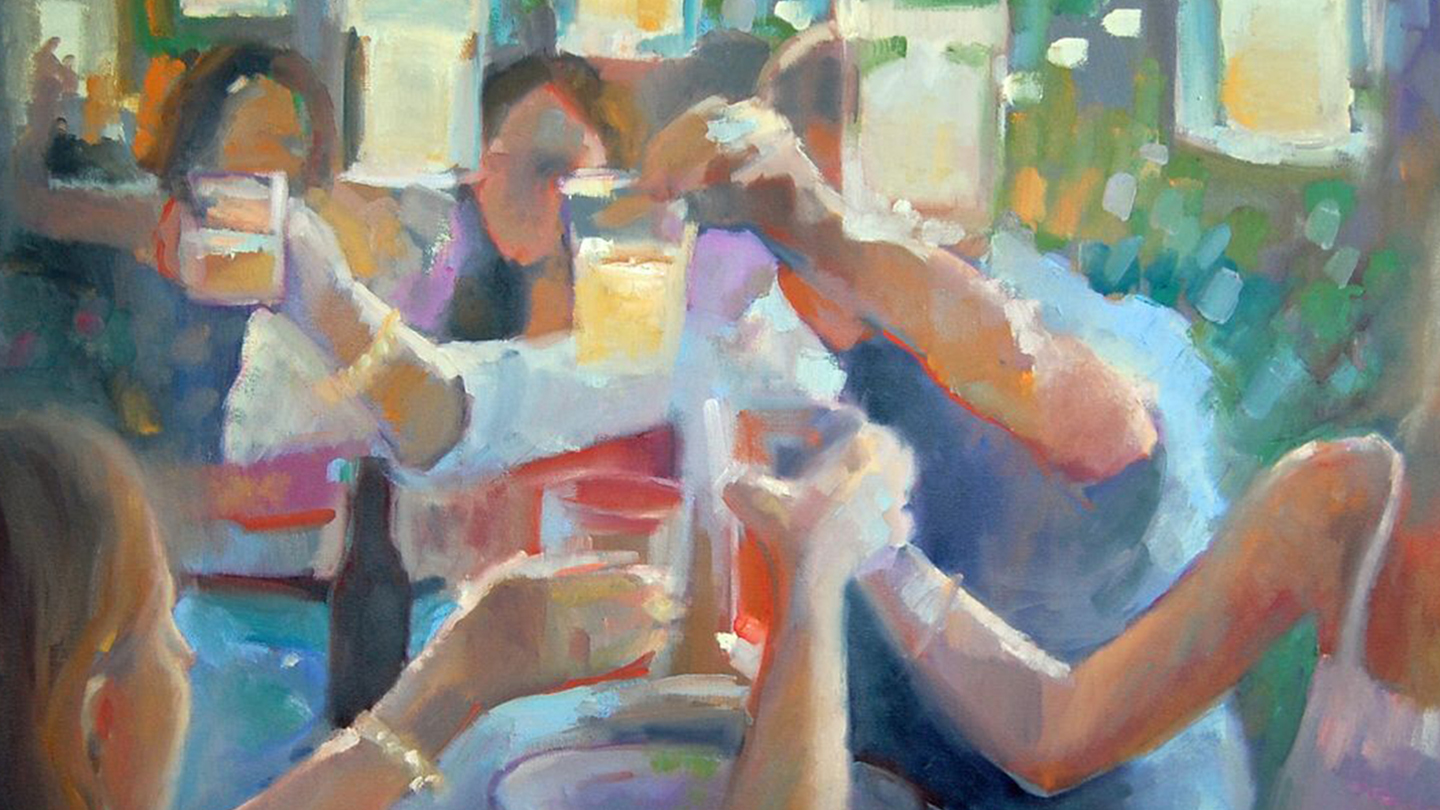
Erin Fitzhugh Gregory, Cheers. [.smalltext]Used by permission.[.smalltext]
[.article__paragraph--cap][.small-caps]My upbringing[.small-caps] involved at least twelve homes – the backseat of a car, three real houses, hotels for months, a church basement, two tiny apartments, a trailer park, and an RV. My parents never owned a home or land.[.article__paragraph--cap]
Now, I have decorated walls around me and comfortable furniture, but I still feel as if I don’t belong to a particular place. No generational homestead of either geographic or familial significance. When people talk about “going home for the holidays” I don’t really know what that feels like.
This is not to say that I have never felt at home. I have, but only in places and at times that could not last. I’ve felt at home at about half past nine in Lower Clapton’s Hand of Glory pub surrounded by painters and writers whom I hardly knew in practical terms but with whom I felt a strong affinity. I’ve felt at home in Prague at Christmastime, roaming the streets with friends and drinking unlawful amounts of glühwein. And I have felt at home with my siblings at an Irish-themed Florida restaurant, joking in that insider way that only siblings can, eventually transitioning to deep conversations, laughing, nearly crying, and generally being chaotic to the point of wondering if the folks around us might be bothered. But all those days and nights had to end.
As I am very recently married, the concept of home, and making a home, has taken on new and insistent urgency. I don’t want my children to feel the same way I’ve felt. Despite the Christian implication that this world is not our home (Heb. 13:14, Phil. 3:20), questions about where to settle and what settling looks like crowd my long-term vision.
Exploring these questions within my context as an artist and a Christian has led to unease with how rural aesthetics and land-based rootedness seem to be given a lot of preference. A traditional (or multigenerational) family living in the country as self-sustainingly as possible is the image for which to strive. The modern, technology-possessed, urban biome is cast as a wasteland of individualism and pseudo-upward mobility, not to mention a virtue-absent cesspool. In vogue now is analog living and glancing with suspicion on other-than-traditional familial and communal orientations.
I struggle with this conversation because I love the city. I love the urban ecosystem and the digital mediums that make life and community tolerable in the wasteland – the machine-driven metropolises which allegedly dehumanize. I love my friends who are single parents, those who have never experienced a “traditional” family structure, whose careers demand transience and long-term separation from blood relatives. I love those who love cities as I do because it is the place where we find capability to build a sustainable life. To make a home.
While the idea of owning ten acres and free-range chickens is attractive, the word Scripture uses to speak of the home we ought to long for is the Greek polis … city.
“Here we have no lasting city, but we seek the city that is to come.”
The implication (and imperative) is that a good life was to be had in that ancient context of community oriented within and around the city – even if our cities today feel more like T. S. Eliot’s The Waste Land than the coming capital of an eternal King.
If the urban wasteland is our present reality, perhaps our task is not to escape it, but to cultivate oases within it – virtuous spaces where we can find belonging and home.
[.article__paragraph--cap][.small-caps]The first time[.small-caps] I tried to articulate these thoughts was two months before moving back to the United States after several years abroad. I was not yet married but had plans to propose. Where would we make a home? How would we build community? What good, beautiful, and virtuous things would we build in a context new to both of us? A context which, due to the nature of my job, has an expiration date.[.article__paragraph--cap]
I think we stumbled into some answers in the city where we’ve settled for now. But first, I had to get over myself.
Despite my awareness of the desire to find and build community, it is far easier (and sometimes more attractive) to be a loner – to center life around solo interests and make my home a personal oasis. I’m an introvert, good with people when I have to be, but perfectly comfortable on my own for days. In fact, I find periodic solitude necessary for my well-being. This mentality might be excused if I lived a considerable distance from my nearest neighbors, but when my closest human connection (besides my wife) is fifteen seconds away, something’s gotta give.
Shortly after we moved into our neighborhood, my wife and I pulled into the driveway and sat for a minute, chatting about something. In the rearview mirror, we saw our neighbors across the street tending to their front yard.
“We should go meet them,” my wife said.
Inside, I groaned. I was peopled-out and ready to call an end to social interaction for the day. But I relented.
That interaction led to a church invite, a lunch invite, numerous pickleball invites (which haven’t panned out), numerous swaps of cookies, jam, lawncare tools, and backyard-grown grapes. We have someone to keep an eye on our house when we’re out of town. And a bowl given as a gift has become a permanent fixture in my office, holding candy for anyone who wants an excuse to pause and chat for a minute while enjoying a tiny sweet treat.
I feel like I’ve got people (my neighbors) in my corner – folks who will warn me about swaddling the spigots outside before a winter snap in Florida. I like that feeling.
[.article__paragraph--cap][.small-caps]Second, I had[.small-caps] to take a few risks. Building community is not for the faint of heart. Finding community in a city – where options seem endless, threshold for entrance seems high, and everyone has routines they wouldn’t dare interrupt for an outsider – can be scary. Social anxiety is at an all-time high and, often, it’s just easier to hole up in our non-communal holes.[.article__paragraph--cap]
But oasis-creation is an active pursuit. It will not be accomplished passively, and that means taking risks with strangers.
At church – the one we eventually joined, not the one recommended by our lovely neighbors – I greeted a guy I’d never seen before as “Jason Momoa” – because he looked like Jason Momoa. It was a light, passing moment. But two weeks later, my wife and I are attending study group for the first time, and this guy walks in with his wife. We have a proper introduction. Amid all the other introductions that night, I fumble his name in my brain and seriously refer to him as “Jason” again. By the end of the night, after overhearing someone else talk about his wife’s cooking, I invite my wife and myself to dinner at their house. We have an uproarious time.
That invitation has been echoed in both directions numerous times. Now, being over at each other’s houses is not an event. It’s a given – one that comes with babysitting their newborn, meeting each other’s friends and family, trading drinks and recipes, and testing out a paddleboat and a smoker found on the side of the road.
With nothing beyond willingness to risk approaching a stranger, we’ve grown into a sense of loyalty to our friends. And community with a sense of loyalty is critical to building oases in the wasteland.
[.article__paragraph--cap][.small-caps]Finally, openness[.small-caps] makes all the difference. Dietrich Bonhoeffer said, “The man who fashions a visionary ideal of community demands that it be realized by God, by others, and by himself. … When things do not go his way, he calls the effort a failure. When his ideal picture is destroyed, he sees the community going to smash.”[.footnote-link]1[.footnote-link][.article__paragraph--cap]
An oversimplified translation reads this way: “The person who’s in love with their vision of community will destroy community. But the person who loves the people around them will create community everywhere they go.”
I believe that. And I’ve found that the oil on the hinge of community is openness, freedom, and a lack of need for control. The ability to get swept into things has greatly contributed to the sense of oasis in my life.
This summer, my wife, myself, and a couple of friends got so excited about a theology book that we read it in parallel and met every few weeks to discuss what we’d read. We had no intention of starting a short-term book club, but now we’re making T-shirts to commemorate the effort. Throughout this time, our circle of community expanded to include their spouses and children – we’ve been to breakfasts and dinners and game nights together.
(Why does so much of this oasis-making revolve around food?)
[.article__paragraph--cap][.small-caps]This oasis-making,[.small-caps] such as I’ve described, situates me with an undeniable sense of refuge even in this city where we know we won’t settle forever. As I look back on the past year, some of it seems too easy. Why wouldn’t one introduce oneself to one’s neighbors? Or start an impromptu book club when you happen to meet others interested in the same subject matter? (The decision to start dating my now-wife is largely the result of us realizing we had the same book next on our TBR list.)[.article__paragraph--cap]
Yet I don’t want to misstate the challenges of twenty- and thirty-somethings trying to build oasis in a fast-paced urban environment. Some in our community have children and some don’t. Some work nights and weekends. Some are in school; others have long-term health challenges.
The amount of coordination in group chats – who is available when, who can host, who can drive to where, and can we fit this in around a toddler’s nap time – can be discouraging. It makes one wonder if all the effort is worth it. After all, it is easier to stay home. Netflix – that great pillar of the fragmented wasteland – is right there.
Yet, it is partly this status of fragmentation that makes the pursuit of oasis worth it. We can take Eliot’s words as alluding to this: “These fragments I have shored against my ruins.” Oases serve as pillars of support for the transient citizen. Ask a stay-at-home mother of toddlers how she feels after two hours of conversation with people her own age and you’ll know immediately what I mean.
If the city is a wasteland, then the places where we gather deliberately – for no reason except that we can – become the green river in the desert. The place might, in fact, be insignificant because life-giving community is not defined by location. The war against atomization is waged in everyone’s living room, regardless of whether that living room is in a farmhouse or a second-story flat.
The aesthetic trappings that so often cloud visions of benevolent community – acreage, inheritance, rural independence – fade when we see city spaces transformed by oasis people who are open, selfless, risktakers.
The past year has shown me that oases are not built through grand gestures or industrial hospitality but through ordinary consistency. It takes work. It takes not giving up on the group chat and sometimes having adult conversations while toddlers wrestle on the couch. The behaviors that push back the wasteland are undeniably mundane and arguably more accessible in the urban biome where so many are searching for life-giving fragments to shore against their ruins.