Book Excerpt
No One Ever Wins a Fight
Of all weapons, love is the most deadly and devastating, and few there be who dare trust their fate in its hands.
September 24, 2026
Try 3 months of unlimited access. Start your FREE TRIAL today. Cancel anytime.
START FREE TRIAL NOWNo One Ever Wins a Fight
Of all weapons, love is the most deadly and devastating, and few there be who dare trust their fate in its hands.
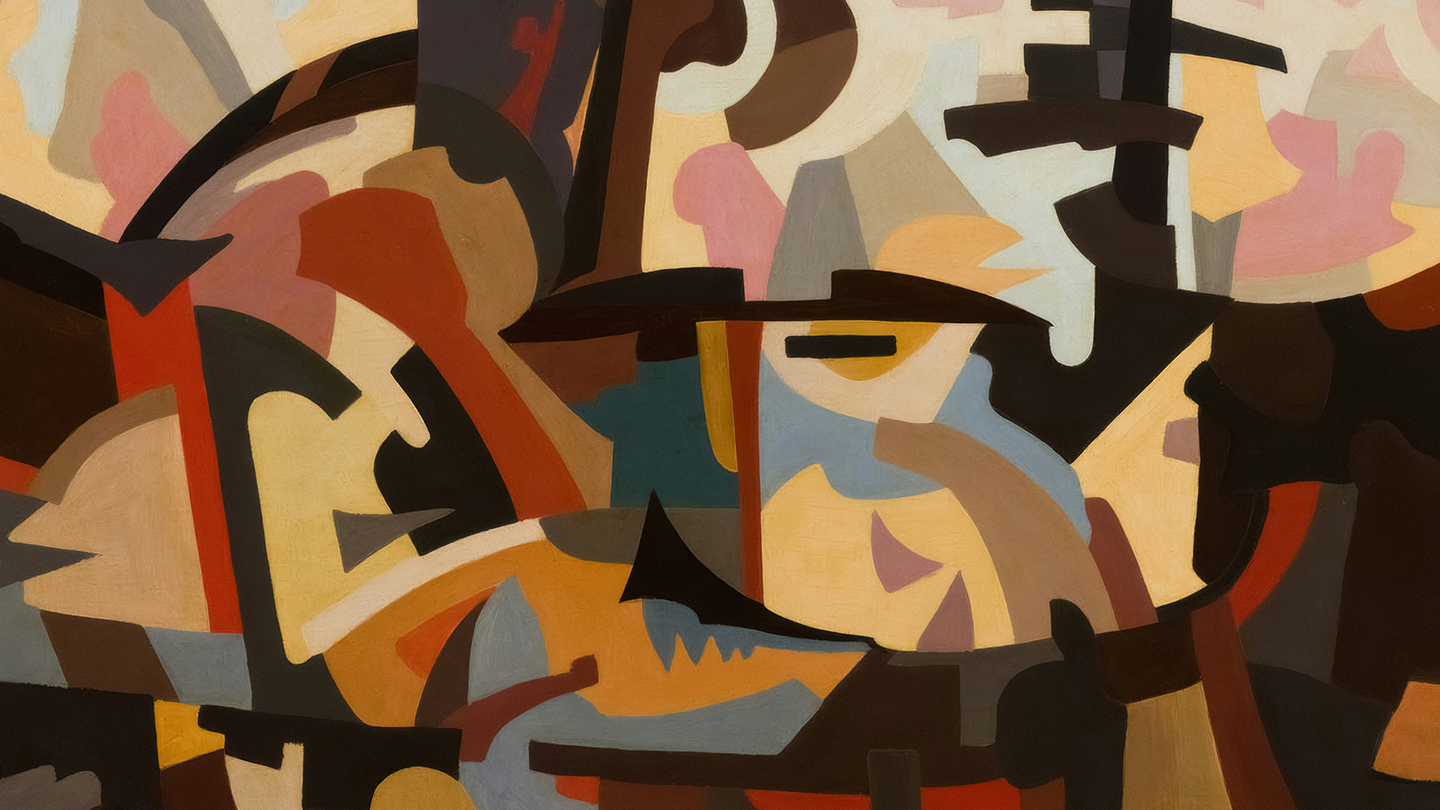
Ado Vabbe, Composition, 1926. [.smalltext]Unsplash (public domain).[.smalltext]
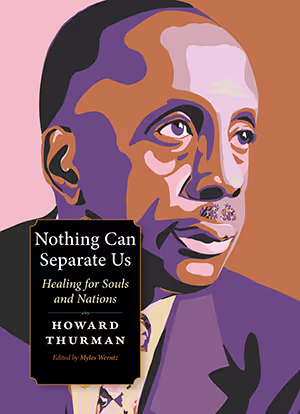
[.smalltext]From Nothing Can Separate Us, a new book from Plough introducing Howard Thurman’s writings.[.smalltext]
[.article__paragraph--cap][.small-caps]“No one ever[.small-caps] wins a fight” – thoughtfully, and with eyes searching the depths of me, my grandmother repeated the words. I was something to behold. One eye was swollen, my jacket was ripped with all the buttons torn from their places, and there was a large tear in the right knee of my trousers. It was a hard and bitter fight. I had stood all I could, until at last I threw discretion to the winds and the fight was on. The fact that he was larger and older and had brothers did not matter. For four blocks we had fought, and there was none to separate us. At last, I began to gain in power; with one tremendous effort I got him to the ground and, as the saying went, “made him eat dirt.” Then I had come home to face my grandmother. “No one ever wins a fight,” were her only words as she looked at me.[.article__paragraph--cap]
“But I beat him,” I said.
“Yes, but look at you. You beat him, but you will learn someday that nobody ever wins a fight.”
Many years have come and gone since that afternoon in early summer. I have seen many fights, big and little. I have lived through two world wars. The wisdom of these telling words becomes clearer as the days unfold. There is something seductive about the quickening sense of power that comes when the fight is on. There is a bewitching something men call honor, on behalf of which they often do and become the dishonorable thing. It is all very strange. How often honor is sacrificed in defense of honor. Honor is often a strange mixture of many things – pride, fear, hate, shame, courage, truth, cowardice – many things. The mind takes many curious twistings and turnings as it runs interference for one’s survival. And yet the term survival alone is not quite what is meant. Men want to survive, yes, but on their own terms, and this is most often what is meant by honor. “No one ever wins a fight.” This suggests that there is always some other way; or does it mean that man can always choose the weapons he shall use? Not to fight at all is to choose a weapon by which one fights. Perhaps the authentic moral stature of a man is determined by his choice of weapons which he uses in his fight against the adversary. Of all weapons, love is the most deadly and devastating, and few there be who dare trust their fate in its hands.
[.article__paragraph--cap][.small-caps]It is a matter[.small-caps] of amazing significance that the Creator of life assumes that human beings are able to absorb most of the negative and destructive things that happen to them without disintegration and collapse. There is nothing more staggering to contemplate than the sheer endurance of personality. It is tender and tough. It is soft and hard. It is lucid and opaque. Even the human body exhibits staggering endurance. … Almost all “well” people are fighting and winning in their bodies the battle of disease. Or consider the adjustment that one has to make to noise. Have you ever picked out the different noises heard on a busy city street? Every single sound takes its minor or major toll of energy from one’s storehouse, and yet these sounds can be so absorbed that the emotional balance of the personality will not be thrown off. Such an item alone is crucial. Or think of what is required in making one’s adjustment to all sorts of people with whom one is thrown into more or less direct contact. The people with whom one works and who may be mutually irritating, or the people with whom one lives, may require major adjustments in order to keep the emotional balance.[.article__paragraph--cap]
Some years ago, a farmer gave two apples to a friend of mine, visiting in the state of Washington. Each apple had a deep scar extended from the stem halfway around the circumference. The scar was marked by shriveled apple flesh. The rest of the apple had grown rounded-out, but the dead place remained. The story the farmer told my friend was this: When the apples were very young on the trees, a hailstorm bruised them deeply. The apples did not rot, they did not fall off the tree; they did live. It was as if they decided to absorb as much as possible of the violence of the hail storm and go on with the business of self-realization. The world is full of people who are like the apples. It is the greatest tribute to personality that the Creator of life assumes that each manifestation of life will have enough inner strength to fight its battles with such simple tools as may be at its disposal. A part of the business of living is to get better tools and to increase the tool-technique, but the fundamental assumption remains.
[.article__paragraph--cap][.small-caps]The very act[.small-caps] of affirming the nonexistence of another human being is at once, in positive terms, an act of self-affirmation. Hate may become the basis of one’s own self-estimate when one is faced with the will to one’s own nonexistence. When a man is despised and hated by other men and all around are the instruments of violence working on behalf of such attitudes, then he may find himself resorting to hatred as a means of salvaging a sense of self, however fragmented. Under such circumstances, hate becomes a man’s way of saying that he is present. Despite the will to his nonexistence on the part of his environment or persons in it, he affirms himself by affirming the nonexistence of those who so regard him. In the end, the human spirit cannot tolerate this. Men are made for each other, and any sustained denial of this elemental fact of life cannot stand.[.article__paragraph--cap]
Thus nonviolence occurs and recurs on the horizon throughout man’s life. It is one of the great vehicles of reconciliation because it creates and maintains a climate in which the need to be cared for and understood can be honored and effectively dealt with. The mood of nonviolence is that of reconciliation. It engenders in the individual an attitude that inspires wholeness and integration within. It provides the climate in which the things that are needed for peace, or for one’s own peace, may be sensed, disclosed, and developed. It presupposes that the desire to be cared for and to care for others is one with the very essence of all one’s meaning and significance. It thus provides a working atmosphere in which this mutual desiring may be normal, reasonable, and accepted.
But nonviolence is not merely a mood or climate, or even an attitude. It is a technique and, in and of itself, a discipline. In the first place, it is a rejection of physical force, a renunciation of the tools of physical violence. These may be renounced because they are not available; such a renunciation has only tactical significance. Here nonviolence may be used effectively by violent men as a practical necessity. In this sense it has the same moral basis as violence. This is one of the ancient weapons of the weak against the strong and is a part of the overall tactic of deception. It is instructive to note that when nonviolence is used in this way in response to external necessity, this may not at all vitiate its creative impact upon those against whom it is used. The importance of this cannot be overemphasized. Because nonviolence is an affirmation of the existence of the man of violent deeds, in contradistinction to the fact that violence embodies a will to nonexistence, the moral impact which nonviolence carries may potentially realize itself in a given situation, rendering the violent act ineffective and bringing about the profoundest kind of change in attitude. All this may take place in encounter, even though the users of nonviolence are full of violence themselves. This is apt to be true in situations where the tools for physical violence are not available, or because even if used, the chances for their success are poor. It is entirely possible for an individual to use nonviolence with detachment – as an effective weapon and a substitute for weapons of violence – while the mood continues to be violent, a mood that inspires hate, that wills the nonexistence of another.
The logic of hate is to kill. It is to translate the willing of the nonexistence of another into the literal deed of his extermination. Men who war against each other, if they are to be effective in their undertaking, must hate. They must will the nonexistence of each other. Once this happens, all moral responsibility disappears and they are free to do anything to them, to perform any act of violence or outrage upon them, without undermining their own sense of worth or value. Nonviolence and not killing mean, therefore, essentially the same thing.
In the second place, nonviolence may be a rejection not merely of the physical tools of violence – since their use is aimed at the destruction of human life, which is the ultimate denial of the need to be cared for – but also of the psychological tools of violence as well. Here we assume that, even if the tools of physical violence were available and could be of tactical significance, their use would be renounced because their purpose is to kill – to make good the will for the nonexistence of another human being. And this is to cut off his chances for actualizing of his potential sometime in his living future by dealing with him in the present.
But the psychological tools of nonviolence are of another order. Their purpose is to open the door of the heart so that what another is feeling and experiencing can find its way within. They assume that it is possible for a man to get real insight into the meaning of his deeds, attitudes, or way of life as they affect the life of his fellows. A man faced with nonviolence is forced to deal with himself, finally; every way of escape is ultimately cut off. This is why there can be no possible limit as to time or duration of nonviolent acts. Their purpose is not merely to change an odious situation but, further, to make it urgent for a man to face himself in his action. Finally all must face the same basic question: Is what I am doing an expression of my fundamental intent toward any man when I am most myself? The more persistent nonviolent acts become, the more threatening they are to the person who refuses to deal with the ultimate question.