Personal History
My Father’s Tattoos
Now that he’s gone and I’m a father myself, I admire him for the hellraiser he once was and the pastor he became.
June 20, 2026
Try 3 months of unlimited access. Start your FREE TRIAL today. Cancel anytime.
START FREE TRIAL NOWMy Father’s Tattoos
Now that he’s gone and I’m a father myself, I admire him for the hellraiser he once was and the pastor he became.
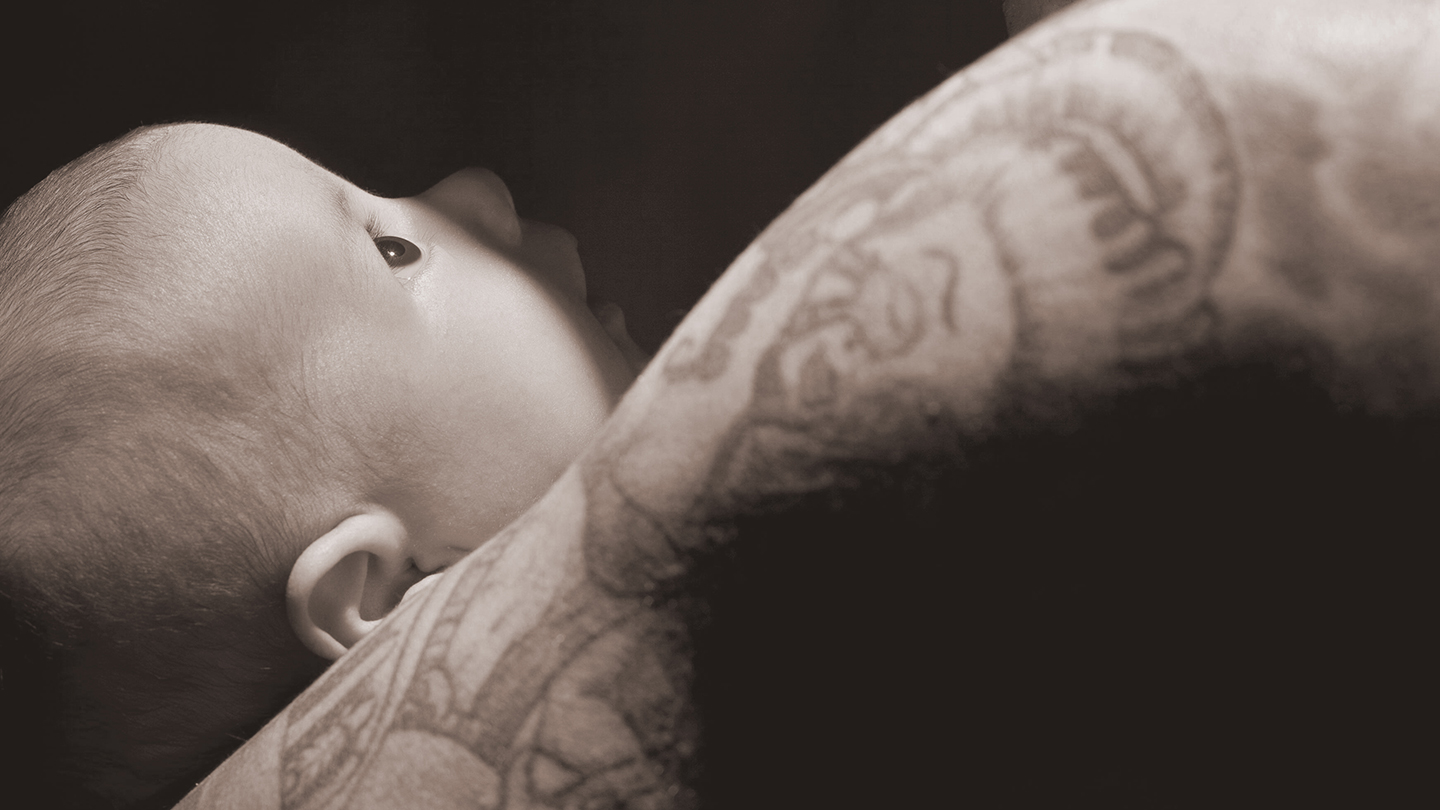
Photograph by Andy Dean / Alamy Stock.
[.article__paragraph--cap][.small-caps]Five years ago,[.small-caps] the church ladies had stocked one of the classrooms with Taco Cabana and Sunny D. I stooped forward to keep spills off my suit and looked out the window, trying not to think of what my father looked like the day before he died. Cracks spread across the window that had waited years to be repaired, like so many things around the small church my father pastored: the mold stains and flickering light bulbs and busted auditorium speaker. Outside, the grass field that separated the church from Parkerville Road rippled in one long fallow wave. I hadn’t looked at the casket.[.article__paragraph--cap]
When someone close to you has died, people approach you like you’re a stray. A lady who had known me at the church for twelve years stopped in the doorway and studied me in the far corner before walking up gingerly to wrap one arm around my back.
“How are you?” I asked.
She smiled wearily and let her arms drop to her sides. “Well,” she said. “I’m doing all right. But we all loved him.”
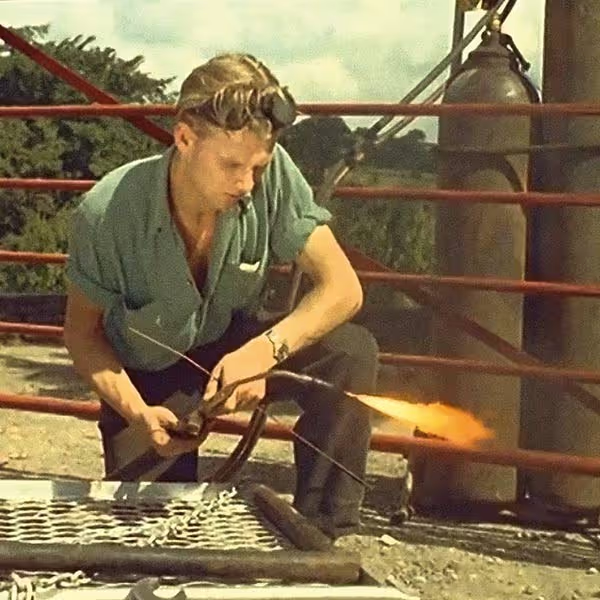
[.article__paragraph--cap][.small-caps]Four months ago,[.small-caps] my wife gave birth to our first child. Neither of them will ever meet my father on earth, and when I try to describe him, I find myself apologizing for the man he became, the man he worked for so long to become: the calm, studious pastor and Bible college adjunct professor. I find myself reviving earlier versions: the freshman seminarian, alien among oxfords and tweed in his Skynyrd shirts with the sleeves ripped off; before that, the brawny laborer given to sudden combustions of rage; the bluesman performing late nights in the dark bars behind the lurid bail-bond rows of every city in Texas; and before I was born, the habitual brawler, the blunt-roller, the jail-hopper. Through God’s wonderful unlikeliness, the roots he came to regret blossomed into a faith that beckoned many men to new life from the jails and recovery homes where he ministered. But when I think of the man who raised me, I do not think of the meek, saintly hands we committed to the earth, nor can I tell just when they succeeded the powerful fists that came before.[.article__paragraph--cap]
Now I stand at the end of an upbringing in which he steered me away from his mistakes, tasked with raising my daughter to avoid repeating my mistakes. And yet I find myself clinging to the flesh that strove as well as the soul that conquered, cherishing both the earthly life that ebbed as God drew my father to heaven and the love for God he imparted. I relish recalling moments he regretted – thundering rows, colorful oaths (he was a prolific swearer, restrained only, and scarcely, by the pulpit), occasionally harsh punishments – because they course with the same ardor as the courage we loved in him. After God gentled him through slow habituation to the demands of a small and aging church, and through his second, fatal cancer, I wonder who he’ll be when I meet him in heaven, whether sickness took something God has since restored, or whether God used the cancer to slough away vestiges of who my father used to be.
[.article__paragraph--cap][.small-caps]A doctor first told my mother[.small-caps] that her husband would die sixteen years ago. Mom told us on a long car ride that we had two weeks to tell him goodbye. Dad’s healing then was a miracle, the oncologist said. Memories of that time come to me in pieces: my father standing six foot one and 130 pounds; the sight of his long white hand unfurling to hold the guitar our church had bought for him; the sound of their prayers in tongues and the electric feeling they made in the air; the fluorescent flicker of lights in the hospital room.[.article__paragraph--cap]
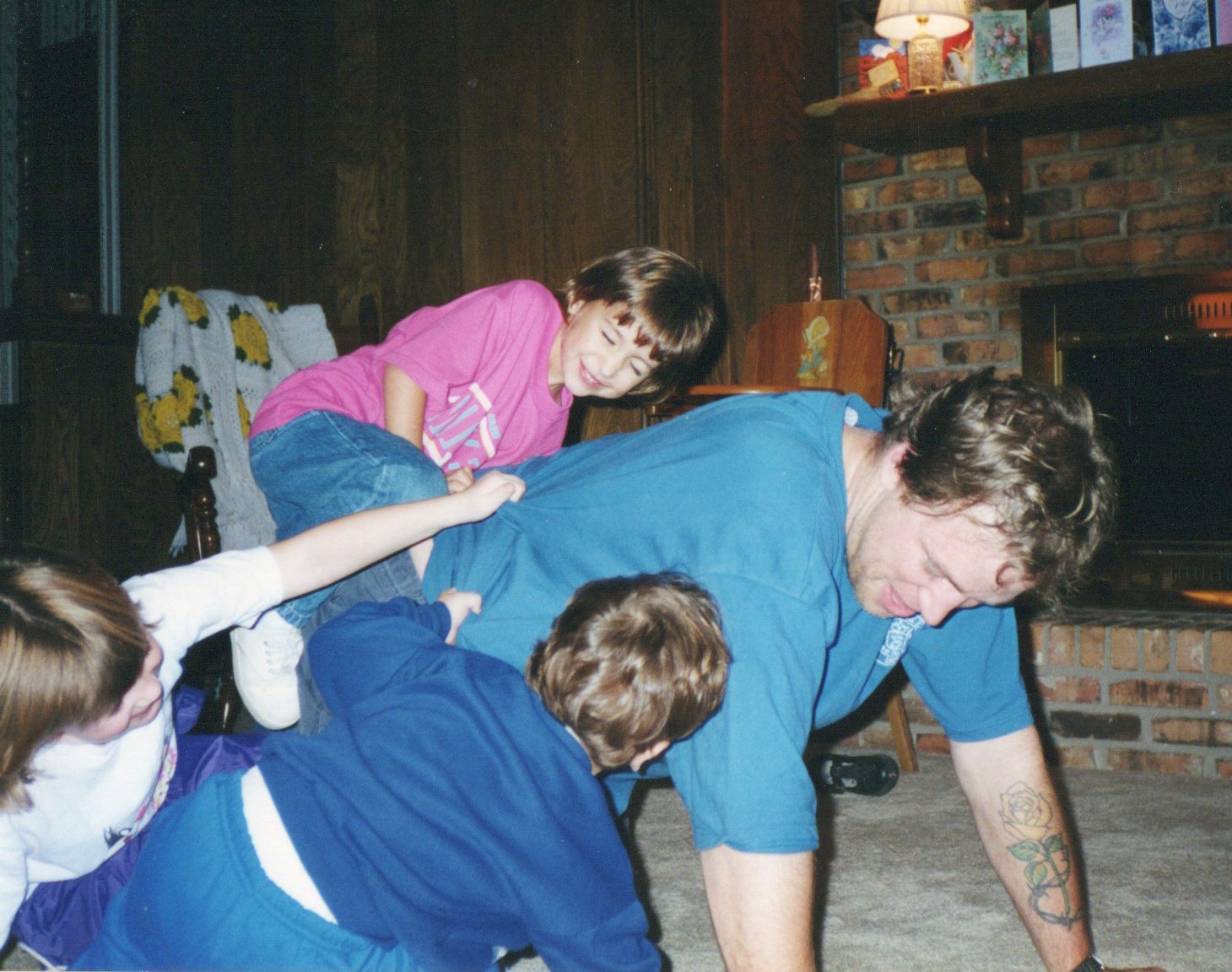
The day before the funeral, my two brothers and I spent the morning plumbing our memories for stories for the eulogy. Streams of memory loosened and flowed as we recalled Michael Mitchell, the biggest in his family, a yellow rose tattooed on his thick forearm and a gait like a colossus. Michael Mitchell, who emerged unbowed and untouched from so many confrontations unfit to describe in church (“You’ll sure miss it when I shove it up your ass,” he famously answered a road-rager who threatened that he kept a twelve-inch knife in his glove box), who quoted Eliot and Emerson from memory and pistoned out one-handed pushups with his feet on a chair. Even now, his outsized character frustrates my efforts to flatten him onto the page. Stories from before we were born: throwing a drill sergeant during a hand-to-hand combat exercise at Fort Sill; our mother’s memory of first seeing him, a trim blade of a man with a guitar inked on his sternum (subtitled Charlene, a Fender Stratocaster his neighbors had salvaged), standing in line at the Kerrville Folk Festival; building a house with her father, who called him Tattoo.
His life seemed to taper as it ran onward to a single point: the gospel promise of rebirth for a man plucked from drug addiction, imprisonment, and death. Then the transformation into pastorhood that we watched over years: his gradual immersion in the study of Greek and Hebrew in the cave of his office, from which he would emerge to visit sick church members, steer marriages from divorce, paint the auditorium walls, hang letters on the church sign, print and cut the bulletins, and preach.
Five years ago, he called me while I was changing a tire on the side of Loop 410 in San Antonio. His voice low and nearly apologetic, he told me the cancer had returned. Over the next five years, he grayed and thinned as cancer, for the second time, stripped the muscles from his bones.
[.article__paragraph--cap][.small-caps]In the front rows[.small-caps] sat the family – a predominance of boots. My grandfather draped his big forearms over his knees and leaned forward, his face blank, watching the casket as though it would move. Beside him sat my grandmother, stock-straight, bleary-eyed, and gray. Her son smiled at her from the bulletin in her lap: Devoted father, loving husband, dedicated pastor, and gifted musician Michael Mitchell, 51, passed away June 4, 2021, at his home in Maypearl, Texas. Behind the family spread representatives from the great expanse of my father’s life: apartment neighbors from his musician days in Arlington, Pentecostals solemn in peacock colors, fresh-faced young couples he had married, drab theologians who looked at the floor during the sermon and pursed their lips, high school friends who hadn’t spoken to him since he left Gainesville for the army, untucked cigarette addicts standing behind the back row rocking on their feet and looking at the ceiling corners – all gathered in the moon-pulled tide around the body of my father. At the front sat my mother, tragic, her hazel eyes misted red behind her glasses as she watched the casket. Her hair was raven black when she met him, but it silvered early. It had brushed against the silver of his beard on the bed when she stooped over him and wept.[.article__paragraph--cap]
My uncle, one of my dad’s two brothers, held a hat belted with conchos in his ham fists as he trundled past the coffin and shook his head. “That ain’t my brother,” he sniffed, disgusted. For the first time, I approached the casket and knew that he was right, that the body which lay before us was as inert as the box that held it, but furthermore, that the man who had lived in the final days before this funeral was not the brother my uncle had known, or the father I had looked up to.
“The hospice nurses say it’s common for them to say things like what he’s been saying,” I recalled my mother telling me over the phone before I came home, her voice one thin and finely wrought line. “Symbolic language. ‘Let’s get out of here.’ ‘I want to go home.’ The other day he looked at me and said, ‘Where are we?’ So I told him, ‘We’re at home, Mike.’ And he said, ‘Well, that’s where I want to go.’”
As my brother launched into the eulogy, I remembered the last prayer I prayed with Dad, early Monday morning before dawn, when the bedside lamp cast the bulges of the tumors under his skin into moonlike chiaroscuro. His great shoulders had thinned and the rose on his forearm looked withered. We prayed to God, thanking him for the new body and healing he would provide. When we finished, he sat on the edge of the bed, rested his elbows on his knees, and looked at the carpet. I turned to look at him again as I left the room, my father sitting there, shouldering the great burden of decay. He cleared his throat and coughed in one sharp and violent spasm and laced his fingers.
“You’re a good man,” he said. And though I saw him again before he died, that was the last thing he ever told me.
[.article__paragraph--cap][.small-caps]“I don’t think he’s breathing,”[.small-caps] my mother ran outside to tell me on his final day, wide-eyed, panicked.[.article__paragraph--cap]
I strode behind her into the bedroom and stopped to watch his chest. It was still. I held my hand to his heart, but it was only a shade colder than it was before. I pressed my ear to him, listening, pleading for something in the silence. Behind me Mom was breathing fast and uneven. The lids of his eyes were half open and one hung lower than the other like loose drapes over the shell-pale rings of blue. I held my fingers to his neck and felt the same silence. My mother crumpled onto him and dampened his chest with tears, rocking back and forth.
[.article__paragraph--cap][.small-caps]We stood back[.small-caps] and studied the spray of flowers on the grave. The marks of backhoe treads ran out from under the flowers on the flattened mound that rose from the earth like a scab.[.article__paragraph--cap]
We were quiet for a time before Mom clasped her hands and looked up. She squinted at the sun, shadows inking the creases of her brow. “You know that’s not your father,” she said. “And that’s what he’d tell you. He won’t be back on this earth until he’s resurrected with a new body.”
But beneath us lay the bones we had embraced. I nudged a clod with my toe and looked out over the headstones and flower clusters and the trees that knelt over the low cast iron fences. Now and then, the notes of mockingbirds would sift down through the leaves and then it would be quiet. To the south, the hills rolled away and you could see, by the way the trees moved, how the wind traced the hillsides in long rippling sweeps, the tree-winnowed wind laced with the smell of juniper. The day was clear and the blue of the sky paled at the horizon where it met the earth. A vast stillness drifted over the rumpled hills and the graveyard, a silence deep in the death-nourished soil and in the boughs it fed between the cries of the songbirds.
The earth holds the body, the tress-kissed tear-dampened face, the man become matter. From the grave, grief leaches up through our feet into the soul and streaks ache across it like rust. Heaven beams gently, unobtrusive but real, and the heart glows with yearning, homesick for a paradise it has never seen.
“Paradise,” Mom said. “That’s where he is.”
[.article__paragraph--cap][.small-caps]At the end of a wakeful night,[.small-caps] I carry my daughter outside while my wife sleeps. The pale morning smooths my daughter’s face and she quiets under the sky. The soughing trees lace and unlace in the wind, green shadows darkling in long ripples, yet in all the morning’s beauty I find no craftsmanship of God more perfect than the little weight of her hand on my own. How furiously I would fight for that little hand. [.article__paragraph--cap]
I thank God for her and for our being there together, and I ask him to show me how to be a good father, how to protect her, and how to love the world as well. I kneel to touch her feet to the grass, and I wonder whether, in some way, Adam misses Eden in heaven. And then I sing my daughter a Blind Willie Johnson song my father sang: Won’t somebody tell me, answer if you can, I want somebody to tell me just what is the soul of a man.