Portfolio
In the Wake of Mass Shootings
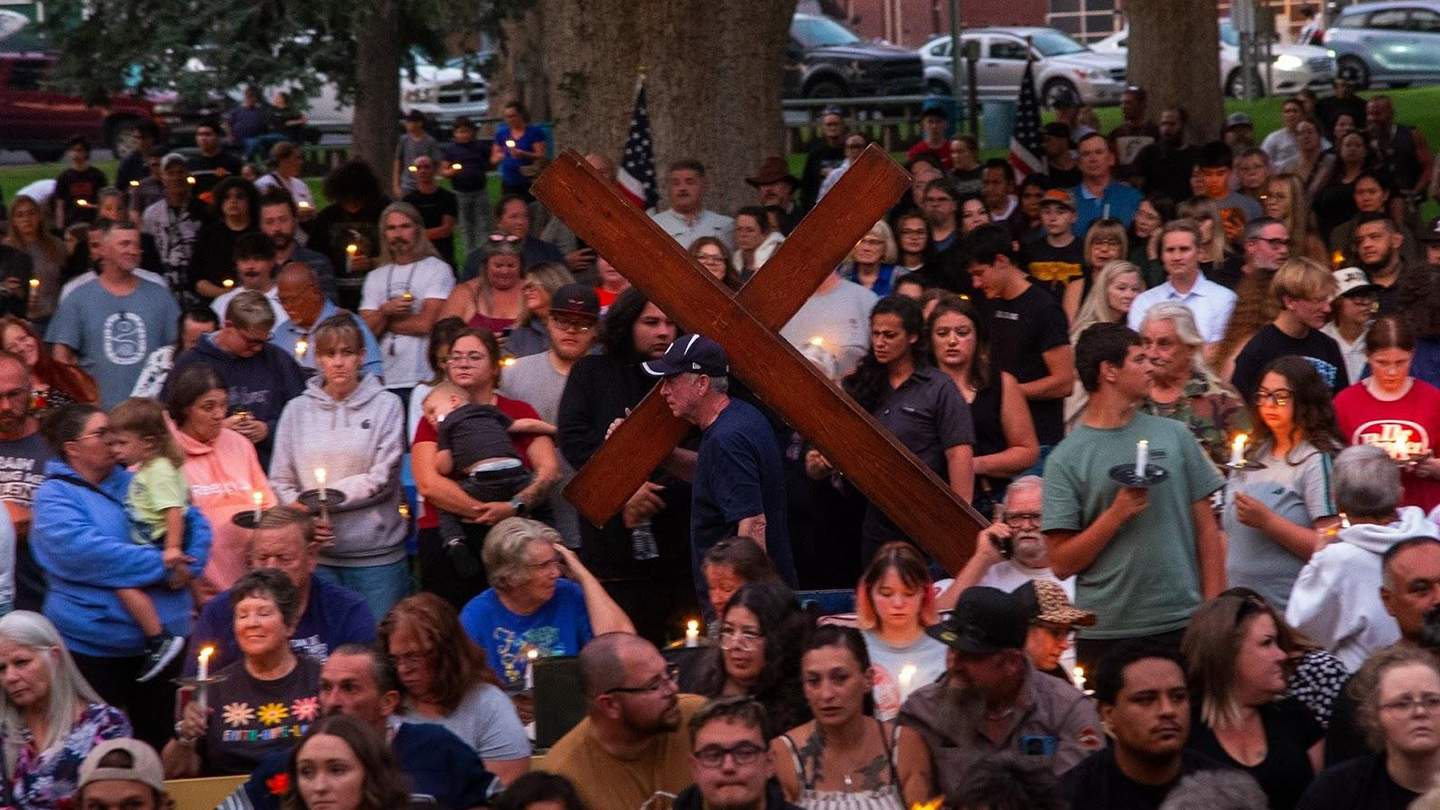
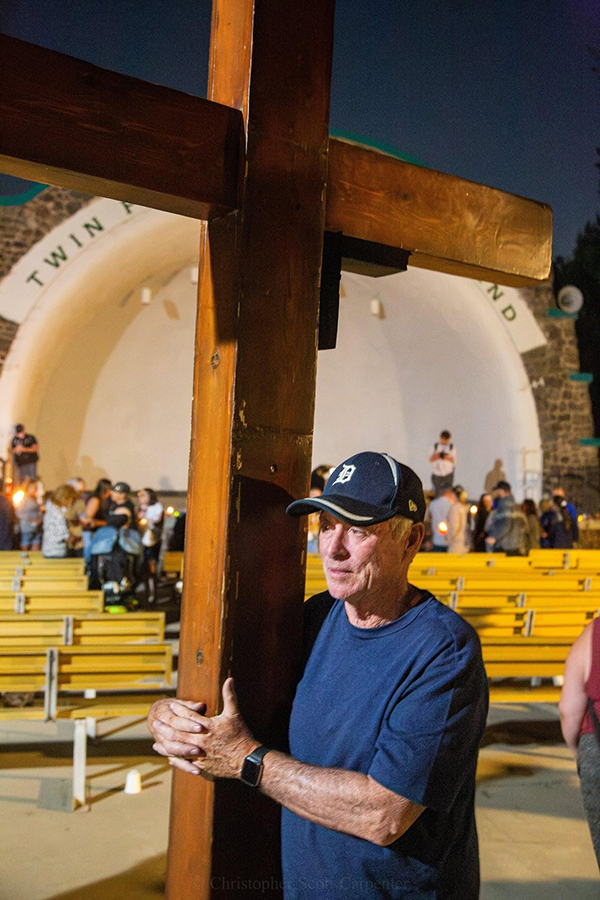
Standing by a giant cross, Daniel Beazley offers prayers and comfort.
October 28, 2026
Try 3 months of unlimited access. Start your FREE TRIAL today. Cancel anytime.
START FREE TRIAL NOWIn the Wake of Mass Shootings
Standing by a giant cross, Daniel Beazley offers prayers and comfort.
All photographs by Christopher Scott Carpenter. [.smalltext]Used by permission.[.smalltext]
[.article__paragraph--cap][.small-caps]In-N-Out Burger discreetly[.small-caps] displays lines of Biblical verse on several of their products. On every soda cup, for example, tucked along the interior bottom ridge, you can find “John 3:16”; and on the wrapper of the Double-Double hamburger, “Nahum 1:7.” The company’s latest restaurant opened on July 24, 2026, in Twin Falls squarely in the middle of the Magic Valley of southern Idaho, one of the most socially conservative swaths of the United States. One week later a mass shooting occurred there, killing four – including the gunman, and injuring seven.[.article__paragraph--cap]
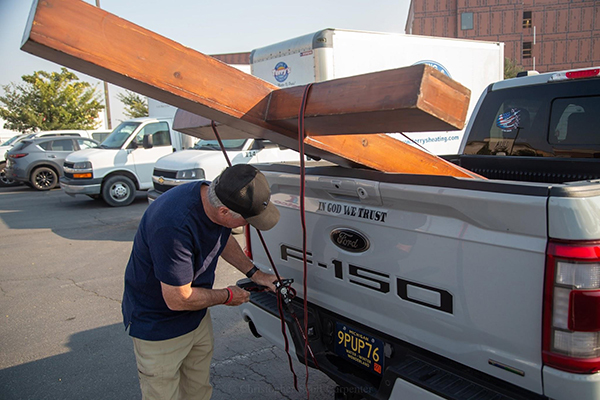
“I felt like they’d be receptive here,” Daniel Beazley tells me as he unlatches the restraints on a giant cross protruding from the bed of his pickup truck. Beazley, a realtor from Detroit, Michigan, drove almost thirty hours – clear across the Midwest – to stand alongside his ten-foot-tall cross near the spontaneous victims’ memorial that runs adjacent to the restaurant, one of the many memorials that sprout across the country each time a community reels from an act of great violence.
Beazley was first inspired to construct a cross for public display when the world was deep into the Covid-19 pandemic, and news of lockdowns, hospitalizations, and deaths made the days feel darker. It was the image of the evangelist Joel Crumpton walking with his own cross through the streets of Atlanta – shared over social media – that ultimately provided Beazley the blueprint, both literally and spiritually, to act upon this mission from God. Beazley suddenly fell to his knees and wept, he tells me, at the revelation that his mission was to build a giant cross – despite having never built anything in his life.
And this mission is a simple one: stand quietly near a memorial, cross upright, and attend to the spiritual needs of anyone who might stop by. The cross, with its imposing height, acts like the “lamp stand” described in Matthew 5, a biblical comparison Beazley quickly evokes in conversation. The idea is to send a silent message of peace and comfort to those affected by violence and tragedy and afflicted with grief.
There is no shortage of opportunities. “I think I’ve been to more vigils and memorials than anyone else in America,” he tells me. “Could be up to 100 at this point.”
The highest profile deployment of the cross thus far was to the memorial service for Charlie Kirk, who was shot and killed at a university in Utah; indeed, a photograph from this event was how I first came to learn of Daniel Beazley and his ten-foot cross.
Frequent road trips through the American landmass to various sites of violence and tragedy have brought even more recognizability to the endeavor. Once, while stopping for bagels, a man approached him after seeing the cross; both men rolled their car windows down and prayed together in the parking lot.
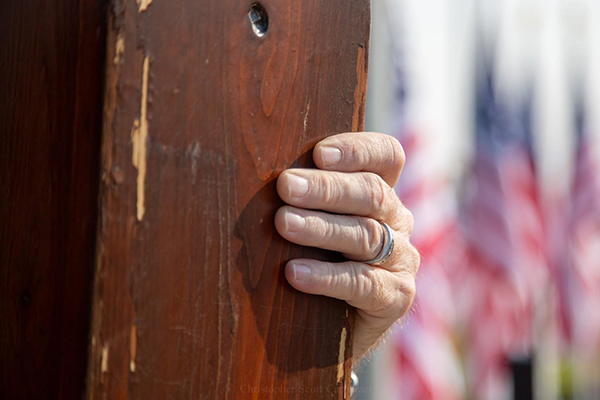
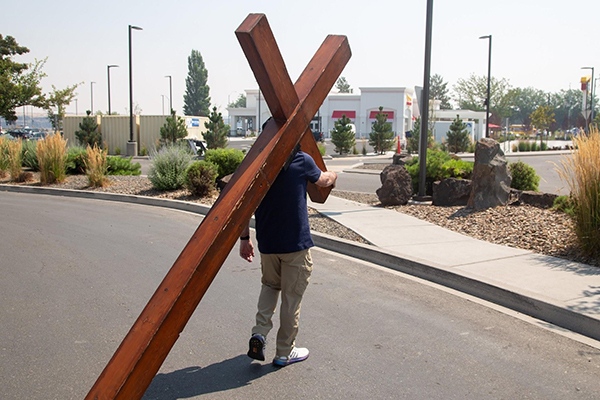
I photograph Beazley as he lowers the cross to the asphalt, and then as he hoists it atop his shoulder for the short walk to the memorial site.
Beazley leans the cross forward to engage the two small wheels bolted to the base for ease of transport, and we depart.
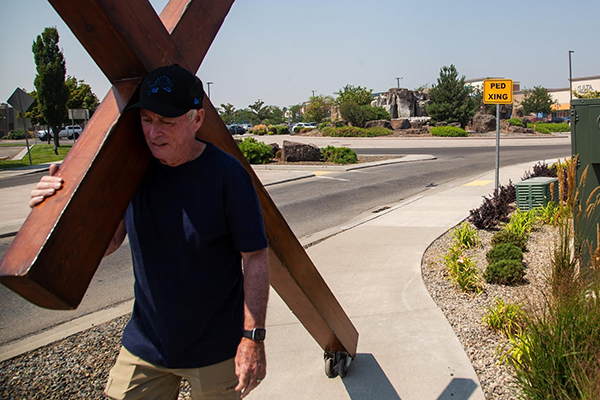
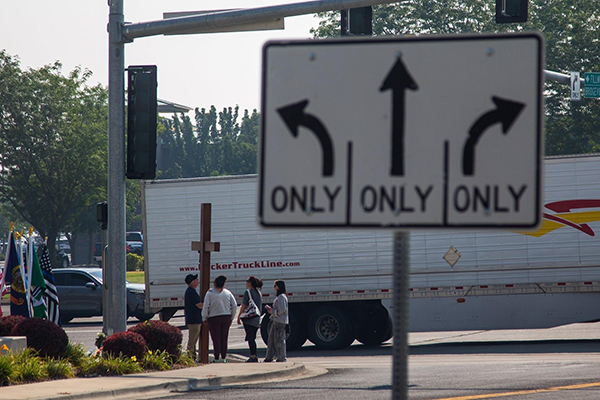
The Twin Falls In-N-Out Burger sits at a transitional nexus for US Highway 93, which, after hopping the Snake River, winds inward toward the city through a massive intersection, right past the restaurant. Our conversation is constantly interrupted by private and commercial machinery rattling by at high speeds.
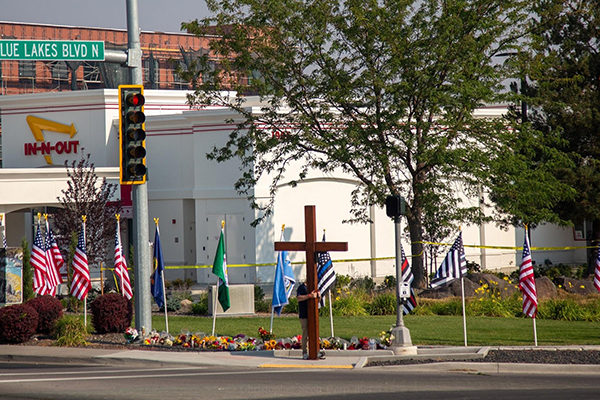
The memorial is typical; various notes, candles, and bouquets of flowers lie clustered at the perimeter of a small patch of grass a short distance from the yellow tape of the crime scene.
Beazley leans over to me as my eyes drift around the memorial. “You know, once this place opens back up, I don’t think people should be afraid to come out. In fact, I think they should come out in numbers to support these businesses. You can’t let the enemy win.”
Few people are out today. Across much of the country, few people are ever out. Wide, highspeed thoroughfares lacking continuous sidewalks discourage foot traffic. The American preoccupation with car-centric infrastructure means most everyone drives, and drive they do, past the small cluster of tributes and offerings hugging the lip of the site of a mass shooting. Many look, some honk, assumedly in support; but by noon, with the sun high in the sky and the In-N-Out security guard graciously delivering a third water bottle, there hasn’t yet been anyone to minister to.
“Don’t worry. People will come.” Beazley tells me. “It’s always slow in the mornings.”
On April 28, 2025, in the Springfield, Illinois, suburb of Chatham, a woman suffering a medical emergency lost control of her vehicle and crashed through the front window of an after-school camp center. The collision was devastating. Five people died: four young children and a camp counselor just eighteen years old. This horrific tragedy compelled Beazley to deploy the cross, to travel down to Chatham to stand in quiet memorial for the victims and offer comfort to those who sought it.
Weeks later, after the communal wound had scarred over into remembrance, a mother called Beazley with a short story. Her daughter, one of the after-school campers, was so touched by the presence of the cross after losing friends in the accident that she started painting small wooden crosses to distribute to other kids affected by violence and tragedy. For a young child, a big cross – sometimes standing at a height more than double her own – feels too overwhelming to understand, but not when it is small, able to be held between one’s fingers. Beazley keeps a basket full of such crosses in his pickup truck to set at his feet during vigils and memorial events for any kids who approach.
By five o’clock, with the workday over, the people of Twin Falls start visiting the memorial a little more frequently. One family was driving to a birthday party when they saw the cross on the street corner; Mom felt compelled to swerve her car into the nearest parking lot in order to walk over and see it up close. A young boy skating by suddenly halted his ride and kicked his board up into his hands; when he approached, Beazley asked if he wanted to pray, to which the boy replied, “Can you do it? I don’t know how.” Several journalists and what I can only assume are religious influencers stop by, filming equipment in hand. They speak with Beazley; a few conduct formal on-camera interviews. One man with a beard sweeps his camera dramatically over the array of flowers and candles a few times, trying to get the best shot. The street corner memorial develops a more social atmosphere, the giant cross providing a much-needed conversational reprieve from the depraved violence that occurred nearby.
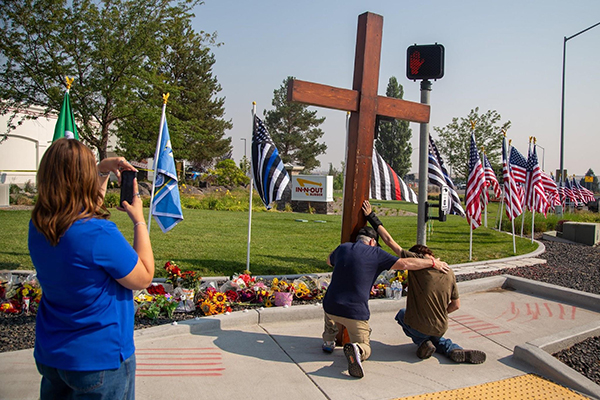
But when someone approaches carrying flowers or other tributes, the atmosphere quickly hardens into one of somber reflection. A group of young women arrive with a bouquet, some of their faces pink and contorted with tears. Not much is known about the victims at this point, but the age range of the women makes me think they know the employee who was killed, herself just a young woman. One steps toward the memorial with the bouquet, and the others stand behind her, linked together in a chain of hugs. She softly says a short prayer, then stoops to lay the flowers alongside all the others.
The bearded man approaches from behind. “Can you do that again?” he asks her, turning on his camera.
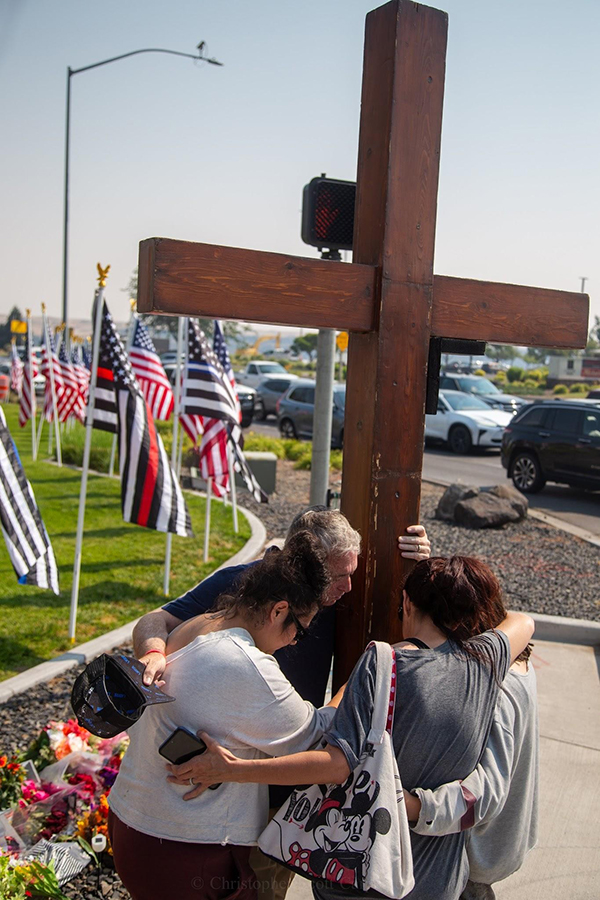
“I used to be much more willing to work with media people,” Beazley tells me as the sun dips beneath the horizon. “I’d pose or do things they asked me to do, but that’s not what the Lord instructed me to do. That wasn’t the purpose of doing this. I don’t mind the photography, just so long as they let things happen.”
[.article__paragraph--cap][.small-caps]On April 17, 2025,[.small-caps] in Tallahassee, a man opened fire at the Student Union building on the Florida State University campus. Two people were killed, and six others were injured.[.article__paragraph--cap]
After this horrific tragedy Beazley took the cross down to Tallahassee to stand in quiet memorial for the victims and offer comfort to those who sought it.
“Now, with the way the cross sits in the back, I can’t see it from the driver’s seat. And once, I was driving back north from Tallahassee after a shooting at the school there,” Beazley shares as he loads the cross back into the truck bed, “and after a long time driving on the interstate, I just happened to look in my rearview mirror – and what did I see? Those straps flapping in the wind.”
Beazley tells me he feared the cross had come loose somewhere along the route and had fallen on the highway. He took the nearest exit and made a beeline for a parking lot to inspect the situation. To Beazley’s relief, the cross was there, safe. The tailgate had evidently not been latched, and the cross fell loose from its restraints. But there in the back it stayed.
On September 28, 2025, in Grand Blanc, Michigan, a man intentionally rammed his vehicle into a Mormon church during a morning worship service before opening fire inside with an automatic rifle. The man then set the building ablaze. Four people were killed in the attack, and nine others were wounded.
Beazley deployed the cross again to travel up to Grand Blanc to stand in quiet memorial for the victims and offer comfort to those who sought it. Despite not using the symbol of the cross, survivors and Mormon faithful still found comfort in its presence.
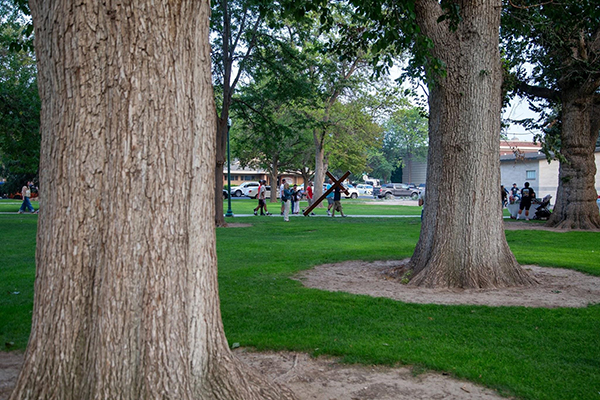
The people of Twin Falls hold a vigil in the evening. Beazley and I both attend. Everyone gathers at the city park, a space more secluded and peaceful than a strip of highway sidewalk where reflection and prayer are bedeviled with the incessant din of traffic.
With his giant cross, Beazley is offering an informal service for those seeking a way to pray or to receive spiritual counsel. But after I float around the vigil a bit, I realize Beazley is far from the only one offering this. A robust religious response has mobilized to meet the spiritual needs of the community: a group of volunteers clad in matching T-shirts emblazoned with the phrase “Come Pray With Me,” a trio of gritty-looking Bikers for Christ decked in leather vests that partially obscure the tattoos underneath, a pack of church-sponsored therapy dogs, a bevy of regional pastors and priests, and one rabbi all lined up on the park’s amphitheater stage.
A man in shorts and flip-flops ascends a short pedestal and grabs the community’s attention. I don’t know who he is. He doesn’t introduce himself.
“There is nothing I can say right now to help heal us, except for us to be with each other. I cannot tell you how much it means to me that each and every one of you are here. This is how we heal our community – right here, right now. Do not let the darkness win. We can’t allow it. Period! We need to fight for each other and stand by each other. There’s some candles over here.” He motions to a community table nearby. “Find a pastor, pray with them. Do whatever. But we cannot let the darkness win. And that’s the only speech we’re going to have tonight. And God bless each and every one of you!”
With these brief remarks, he steps down off the stage. Nobody really knows how to react. With the short speech concluded, a hesitant smattering of applause ripples through those gathered. Somewhere in the crowd a woman shouts, “Look for the light!” The people are evidently wanting a little more to be said.
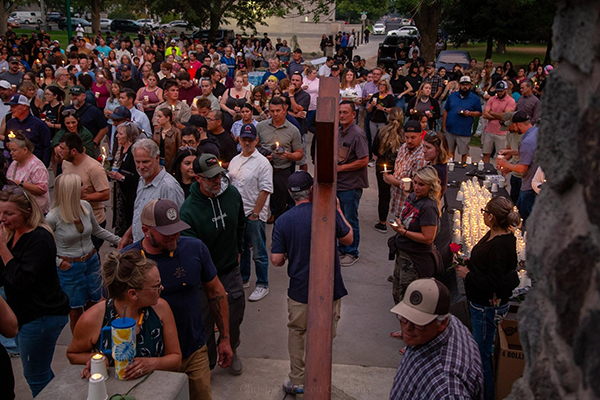
I look out and see small sporadic prayer circles forming, people huddling in close with one another to ask God for guidance and comfort. Although its caretaker isn’t visible among the bodies, the ten-foot cross looms above them, right in the center. It’s always easy to see.
I make my way over. Beazley is speaking with the sheriff of Twin Falls, who is delivering emotional thanks to Beazley, or at least as emotional as a gruff Magic Valley sheriff can be. As the sheriff leaves, Beazley retrieves a small painted wooden cross from the basket at his feet, and hands it to him.
Beazley turns toward me. I’m not certain, but I think I see a shimmer in his eyes. His mission seems complete.
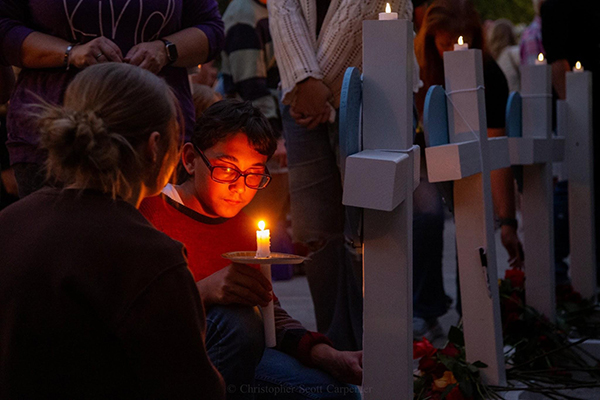
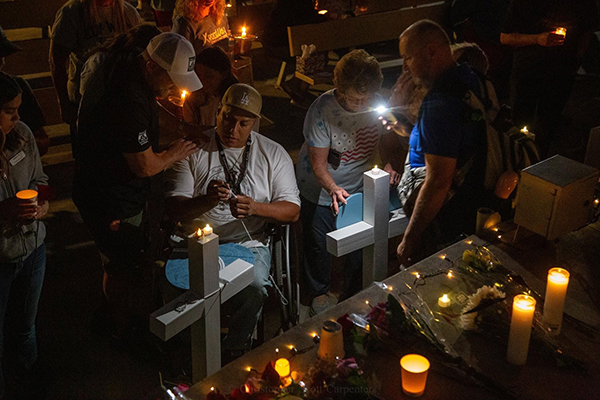
“I’ve been to enough of these to know what people need,” Beazley says to me. We’re standing again near his pickup truck. It’s now the morning after the vigil, and the day is rapidly warming. “I don’t agree with how they ran it. You need someone to stand up and deliver a strong message. People need to be directed and inspired. The best ones always leave people with a message of hope and love. Nobody knew how to heal last night."
“Anyway,” Beazley continues, “I’ll take a couple calls and then head out. The In-N-Out prayer vigil isn’t until next week. Plus, it’s hotter today than yesterday.” We shake hands in the parking lot. “Don’t be afraid to reach out. You have my number,” Beazley says. “Maybe I’ll see you at the next one.”