Book Excerpt
Happy Marriages Are Not Ideal Marriages
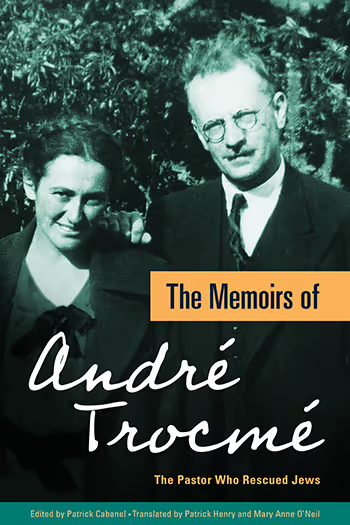
In this excerpt from his memoirs, André Trocmé describes his honeymoon with Magda and the secret to a happy marriage.
November 5, 2026
Try 3 months of unlimited access. Start your FREE TRIAL today. Cancel anytime.
START FREE TRIAL NOWHappy Marriages Are Not Ideal Marriages
In this excerpt from his memoirs, André Trocmé describes his honeymoon with Magda and the secret to a happy marriage.
[.smalltext]From The Memoirs of André Trocmé this week’s featured book (ebook free for subscribers).[.smalltext]
[.article__paragraph--cap][.small-caps]On the evening[.small-caps] of our wedding day, waiting for the train that would take us from the Gare de Lyon into Italy, my young wife and I wanted to have dinner but not in a restaurant. That was when I learned how much my wife loved picnics, which I can’t stand. We landed on the steps of a stairway and nibbled on crusty, buttered rolls with ham that we had bought.[.article__paragraph--cap]
The train compartment was old and smelled like damp smoke. We didn’t sleep all night. At Culmont-Chalindry, a shabby train station on our route, we looked outside and listened to cows expressing their sadness at being packed into the train next to ours.
In the morning, we were in Switzerland, where I had never been before! Oddly enough, I had explored the mountains in Africa and America before those in Europe. It was November, but the days were still marked with a dazzling brightness. There were still flowers around the attractive houses. … Venice was, by turns, sunny, rainy, and windy. After eleven days, we took a small hydroplane to Trieste. We got into the contraption through a hole in its top, and we rushed to portholes the size of dinner plates. An enormous woman sat between us. We couldn’t see each other but we let each other know what we saw. Magda cried out, “I see a boat with red sails,” and I responded, “I see the estuary of the Piave!”
From Trieste, we went on to Fiume, and from there, by boat, to Ancona. Our goal was Assisi. Marvelous days awaited us there. While the morning fog covered the Umbrian plain, Assisi, its churches, chateaus, and Mount Subasio emerged from this ocean like islands bathed in sunshine. Emptied of its summer pilgrims, the city recaptured its eternal self: women seated in front of their homes embroidering, goats passing in the hills, deserted churches in solitary meditation. We had a room in the Santa Chiara Inn, where the sound of the neighboring church’s bell woke us in the morning. The dome of the church, covered with rose-colored Romanesque tiles, emerged against the dazzling fog covering the valley.
[.article__paragraph--cap][.small-caps]Thus Magda,[.small-caps] alone in the world, became my wife, so much more so than other women who look back on their paternal home with regret. She identified her life with my life. She married not only a man but his career, his vocation. She did so with uncommon passion and attention because she was devoid of any temptation to look back. And I, who never loved the past, whose eyes are always riveted on the future, now had a partner whose intense sense of the present and of the human dimension of life would fill the gaps in my character. For my part, I brought Magda the security and calm that she desperately needed.[.article__paragraph--cap]
Happy marriages are not, I think, ideal marriages. Happiness comes from the lack of self-interest in the two spouses, and temperaments that complement one another. There is also the matter of equal weight. Magda and I, it seems to me, have maintained this balance. Sometimes she’s the more important one – when it’s necessary to do things quickly and well, to dare to undertake something, to distinguish between the true and the false. Sometimes it’s I – when it’s important to distinguish the essentials among fretful and secondary activities, to give our ship an unwavering steady course, and to organize our time.