Essay
An Urban Dutchman Reads Wendell Berry
How a farmer from Kentucky inspired a city-dweller on the other side of the ocean.
November 11, 2026
Try 3 months of unlimited access. Start your FREE TRIAL today. Cancel anytime.
START FREE TRIAL NOWAn Urban Dutchman Reads Wendell Berry
How a farmer from Kentucky inspired a city-dweller on the other side of the ocean.

[.smalltext]Apartment Block in Overvecht, Utrecht, Netherlands. Photograph by Panther Media Global / Alamy Stock.[.smalltext]
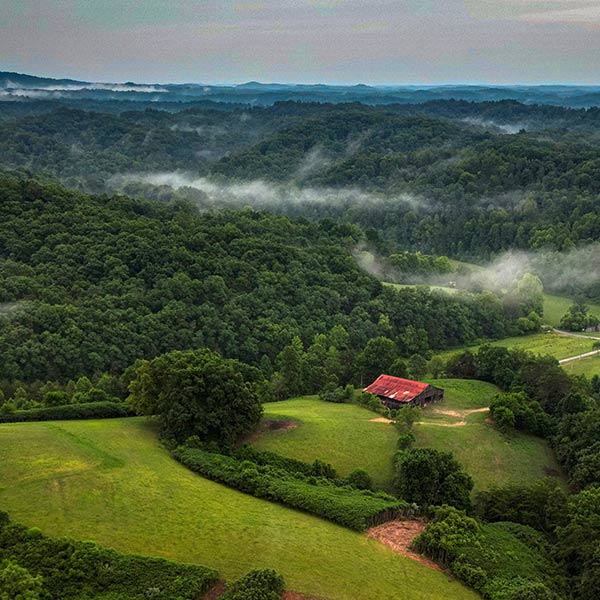
[.article__paragraph--cap][.small-caps]Since the death of Wendell Berry[.small-caps] – one of the fathers of agroecology in America – I’ve been rereading some of his writings. How can this farmer from Kentucky be such an inspiration for a city-dweller on the other side of the ocean? From the place where Wendell Berry wrote his books, with a view on the Kentucky River, it’s 4,215 miles to Utrecht, the city where I live, in the Netherlands. I am working with a view of nine apartment blocks and two magpies fighting for a bag of chips. There’s a constant roar of traffic; there’s a train and the siren of an ambulance. Someone’s yelling through the window; I’m afraid it’s my own daughter who just discovered that her screentime is up. I’m reading through a beautiful collection of Berry’s essays titled The World-Ending Fire. It’s not hard to explain why Berry is still a huge inspiration for this urban journalist.[.article__paragraph--cap]
In the ’60s, Berry famously changed his ambitious and “promising” life in New York for a life of work in an allegedly backward area in Kentucky; the community of Port Royal, marked by racism, agricultural mistakes, and industrial mining. Together with his wife Tanya he didn’t want to be connected to the world in general, but to a specific place, a place that he knew well and for which he cared. This is not very much unlike the choice my wife and I made, twenty years ago, to leave a vibrant university town behind, a city of young, smart and beautiful people, or “high-potentials” as they are called. We settled down in a large neighborhood, Overvecht, famous for its anonymous parks – shrubs have been cleared for reasons of safety and budget – and its concrete apartment blocks which house immigrants, single-parent families, and other people dependent on social housing.
“Nice to meet you, are you visitors?”, was one of the first exchanges I had with an old Antillean lady in our street.
“No, we live here”, I said.
“Ah I see. Because you are looking for a house?”
It took a while before she understood that these young, professional-looking newcomers were not living here to wait for another house but, well, to actually live here.
It takes time to grow roots in an environment like this, a place with a lot of unhappy people and a lot of unhappy architecture, where groceries are making room for temporary phone dealers or “crap for nothing” shops. But when you persist, and when you make friends, and love people, and are loved by people, and find an empty building in which you can live together with others; when you start to have dinner with neighbors, send your children to their school, pray with believers and watch soccer tournaments together, things start to change. Slowly we started to love the place. We started to care for it, sometimes by just collecting plastic trash from the street. Like Berry’s, our place is marked by pollution, and racism, and an economy that regards many people as obsolete. But it’s also marked by its own particular loveliness: hard-working immigrants, friendly barbers, activists with vegetable gardens, praying grandfathers, beautiful trees, and, once in a while, snow that makes everything look like Narnia.
So it’s not strange that when I discovered Berry, a few years ago, I felt related. I was touched by his lack of idealism, in a sense. He was not a utopian; his goals were realistic, rooted in the hard life of community and history. He spoke with compassion, not only for the animals and the trees but also for the village people he met. I was struck not so much by a certain convincing argument but because his stories, even his essays, were friendly and, beautiful. That was how I wanted to write, too.
[.article__paragraph--cap][.small-caps]I wanted to write[.small-caps] a profile about Berry for a Dutch magazine, to introduce him to Dutch readers who have no translations of his work available. But since he didn’t use a computer or a telephone, I could only try to reach him by sending a letter. For a stubborn Nokia-using smartphone refusenik like me, this made him my hero and my example. When people tell me I’m crazy, old-fashioned, annoying, or that I can’t be a serious independent journalist without a profile on X or LinkedIn, I smile and think of Berry. He was more independent and authentic than everyone else.[.article__paragraph--cap]
Berry was well aware that he couldn’t do without technology. He drove a car and worked with a chainsaw, after all. That wasn’t his point. His point was that he didn’t have any sympathy for the need to maximize progress, speed, and efficiency; an efficiency that seeks to remove humans from the process, replacing them with something smarter and more predictable. He emphasized the relationships between people in a community and the relationship between people and the rest of nature, and showed that we all depend on each other. Berry was connected to his environment, to creation, and to those around him. He had a humility that came from a strong sense of self-awareness. That is why his essays radiate a warmth, a love. Like the title of one of his lectures “It All Turns on Affection.”
Last Summer, I spent my entire holiday in front of my tent talking with my adolescent son about Elon Musk, whose biography he had just read. “What a visionary,” he said, “at least this man has an objective!” None of that dawdling and messing about on the fringes, the nitpicking and fussing of incompetent people. Musk is a real Macher as we say in Dutch. He identifies obstacles and does away with them. For example, my son says, if he finds someone in his company who can’t explain why he uses a particular screw instead of something better, he fires them, without hesitation. We want to go to the moon, we want to go to Mars. No time for failures! That is how you actually solve problems, according to my son. (Who, I suspect, senses deep down just how flimsy this whole narrative is, yet yearns above all for heroism and grandeur, something which I can appreciate.)
It’s a contrast I sometimes think about. One man dedicates his life to making the world more logical and efficient; clearing obstacles, building data centers in space, mining metals on the moon, and becoming ultrarich. The other focuses on local economies, organic farming, and pacifism, continuing to write by hand until the age of ninety-two without a lamp and without a telephone. The difference between these two approaches is not only “boomers” versus “stickers” (a distinction Berry made) but also a mechanistic versus an organic view of reality. A mechanistic view searches for functions and looks for a view from above; an organic view searches for connections and sees itself as part of the whole. A mechanistic worldview seeks utility and aims to overcome limitations; an organic worldview seeks meaning and desires to be part of it. As a man with a strong left brain hemisphere, I am inclined to see the world with mechanistic eyes, but Berry helped me to change that.
[.article__paragraph--cap][.small-caps]It’s easy to romanticize nature[.small-caps] and to create a false separation between economics (bad) and the wild paradise outside (good). Usually it’s urban people like me who do this; maybe because we take it for granted that the supermarket shelves are full of food, but also because we deeply miss the connection to the green world outside. We are surrounded by bricks and concrete. It’s no coincidence that most of us Dutch get into our cars each summer and pay a fortune to spend a few nights in a tent on a strip of grass somewhere at a river.[.article__paragraph--cap]
As a journalist who has written about nature and climate for a long time, I very well understand the need and the functions of our ecosystem. Trees are a great solution for, well, actually everything. Planting forests is one of the best things we can do for our world, it is healthy for the soil, the birds, the landscape, the climate, and for us. In my country the economic way to do this would be to plant a mixed-purpose forest, to combine ecology, recreation, and timber production. But I instinctively don’t trust the market. I’m afraid that commercial motives will be stronger than the others, so I’m inclined to prefer state-subsidized solutions: put a fence around the forest and don’t touch it.
But then I read “A Forest Conversation,” in which Berry argues that care for the forest can neither be left to a multinational company nor to a government official far away in the capital. It’s utopian to think of nature in this way, like some “ecomodernists” do who think we should all live in hyperefficient cities, eating from hyperefficient greenhouses, so we can leave nature untouched. There is no nature, says Berry, without a community that cares for it. People need to have a common economy in which the forest has a place. People care for a forest if they can live from the surplus it generates. The opposition between nature and economy is false. Economy is not bad, earning a wage is not bad. Work is good, labor is good, and living from the rent of what nature provides is good. We should build an economy, but a sustainable, local economy, together with other creatures.
Berry’s story was the reason for me to look for sustainable economic models that would benefit forests. I looked to different concepts in different countries. I went to Spain for a story about cork forests. The south of Europe is tormented by extreme wildfires, because the majority of the forest is owned by individuals who don’t have the time to care for their plot of land. The neglect causes the overgrowth of bushes, which in dry seasons function like a firelighter waiting to be lit. Business models, like selling cork for wine bottles, have collapsed. It’s hard for people to find a way to live from their forest and to spend their working time there. The solution is not to create nature reserves, but to rebuild local markets for forestry produce; from cork, to mushrooms, to wood, to organic pork. Where this happens people can connect to their land again, and work together, discovering better practices than a government official ever could.
There is an even more fundamental lesson in this particular forest essay. Berry didn’t write an argument, he wrote a story. A warm, respectful story, full of love, not only for the forest inhabitants but also for the forester, his labor, and his knowledge. It was an inspiration. I didn’t write my article from behind my laptop, but I went to Spain, picked up an axe and joined a cork harvest. There has to be sweat in a good story. I found workers who love and try to care for the forest. I found a photographer who has an eye for beauty and is in love with cork. I wanted the story to be as much about forestry as about people, and about beauty.
Maybe this is what people call slow journalism, but I would call it organic journalism. Not analytical and solution-oriented, but a story that touches the heart, connecting it to other people, to history, and to other creatures; birds and trees and earthworms and mycorrhiza in the soil.
[.article__paragraph--cap][.small-caps]Three weeks after I wrote my letter to Berry,[.small-caps] I received a long, friendly answer on my doormat, in which he comprehensively explained his position on the topics that I had asked him about. It was typewritten, probably by his wife, who famously transcribed everything he wrote by hand. He had added some written corrections himself. Berry wrote about agriculture and about the political divide in the States, neither side of which questioned the industrial growth model. He wrote that the Gospel had always been central to his thinking. “I may not be a stereotypical Christian,” he began, “but I take Jesus’ command to love our neighbors and our enemies literally and extremely seriously.” By “neighbors” he meant the entire rural community, including the animals, the forests, and the land itself. “If we fail to do that, we will ultimately pay the price.”[.article__paragraph--cap]
His focus on neighbors included economic neighbors, he explained. Economics means sharing a household. In this period I was just discovering the economics of my own neighborhood, where thousands of people from different backgrounds live in social housing. Many people are jobless and dependent on state-subsidized care. It is a strange situation: they come from countries where practical jobs are held in high regard. Many of my neighbors are very well able to cook, build, repair bicycles, or run a business. But I don’t trade with them, I don’t have any economic relations with them. I don’t do paid work for them, and they don’t bake bread for me. The baker, the butcher, and the grocer on my block closed their doors long ago. We drive to the supermarket for our shopping. There are jobs available, but they are far away, in distribution centers, where they package and distribute the stuff I order online.
Berry helped me to discover how economics is about relationships, and how we need work and to live a fuller, relational life. In the intentional community where I live, we receive a lot of guests. Many are poor, but what they need is usually not help. They need the sense of belonging which comes from a sense of meaningfulness. We run a secondhand shop and a sewing workshop in which we try to create work, to create a household in which people can play a meaningful role. And whenever I can, I take people to work at farms, to harvest, and to plant trees, giving them the chance to earn some money for this.
[.article__paragraph--cap][.small-caps]There is a debate about agriculture[.small-caps] in the Netherlands that is in a complete deadlock. We are a city-state with 18 million inhabitants, but we are the second biggest agricultural exporter in the world, with a lot of large, industrialized farms. We are a leader in high-tech agriculture, featuring milking robots and automated greenhouses where computers manage the cultivation of tomatoes on rockwool.[.article__paragraph--cap]
Berry was clear about this, in his letter. “Large-scale industrial agriculture goes against all the laws of nature. Industrial agriculture relies on toxins that destroy life. But it also runs counter to the law of human nature – as most religious traditions teach us – namely, caring for our neighbors: our human and non-human neighbors.”
Our agricultural export model with its industrial cattle production puts a big strain on nature in terms of pollution, soil degradation, carbon emissions, and nitrogen emissions. This last especially has created a political mess. There is so much nitrogen in our soil that complete ecosystems acidify and are on the verge of collapse. Levels are higher than those set by European regulations, so environmental pressure groups are able to block all permits for any farmer, factory, or even building project. Many people, mainly from urban backgrounds, blame the farmers for the mess. The government is trying to buy out farmers, lower the level of emissions, and to stop the acidification and over-fertilization of protected nature reserves.
Many rural people, on the other hand, completely distrust anything which comes from the Randstad, the urban area between Amsterdam and Rotterdam where most politicians and ecological movements come from. They feel betrayed, because the government historically supported the upscaling, intensification, and mechanization of agriculture. Even now, when the government wants to roll back (some of the) excesses, officials relate to farmers in a technocratic, bureaucratic, and haughty way. Farmers’ demonstrations have started to get out of hand, some farmers even wear yellow stars because they feel treated like Jews in the Nazi regime. The divide is deepening.
Berry helped me to understand what would be the right way forward. He didn’t isolate nitrogen or animal welfare. He looked to agriculture as an organic system, in which men and plants and animals all play a role, also economically. Infinite mechanization and industrialization is not only depleting our soil, but also our communities, who consist of laborers, consumers, suppliers, maintenance workers, food markets, animals, and healthy soil life. They all have organic relations, everybody plays a role, and we can’t neglect any of them. We can’t organize it in a mechanical way, with a hi-tech farm here, run by a robot, and a nature reserve there, run by an official in the capital. We have to live together, the nature and us. We have to live from it. Berry helped me to find a third way. Not betting on the best intentions of the global market, nor of the government, but believing in communities. So when I now write something about the future of agriculture here, or about nature, my message is short, clear and definitely true: we don’t need fewer, but more farmers. We don’t need more nature reserves, but more agroecology.
I don’t know if my opinion will influence the outcome. The commercial powers are strong, not only in the cities but also on the farms. The human desire for ever cheaper food remains strong as well. Berry himself could be quite sharp, or even prophetic. He wrote: “Industrial agriculture operates on a scale limited only by technology. It’s destroying people’s connection to the land. So, if that is the chosen method to ‘feed the world,’ then we can only feed the world for a very short time. If it relies on toxins, if the scale is too vast, and if human relationships are replaced by technology, then there is no way to avoid destructive consequences.”
[.article__paragraph--cap][.small-caps]The mechanistic worldview[.small-caps] is still gaining ground. We look at the world with mechanistic eyes and we are blind to everything that doesn’t fit this frame. We are heading towards a life with more apps, more robots, more drones, more automatization, and more screentime. Our politicians are talking about countries as if they were mechanisms, about our planet as if it were a mechanism, and about humans as if we were mechanisms, and calling upon us to consume more and digitalize our lives, otherwise we will “stay behind” America or China.[.article__paragraph--cap]
When I hear this kind of talk, I think about a speech Berry gave during the Vietnam war.
“I care more for my household than for the town of Port Royal,” he said. “I care more for the town of Port Royal than for the County of Henry, more for the County of Henry than for the State of Kentucky, more for the State of Kentucky than for the United States of America. But I do not care more for the United States of America than for the world.”
The world and the household, those are the poles between which he wanted to balance his morality. “The most meaningful dependence of my house is not on the US government, but on the earth. No matter how sophisticated and complex and powerful our institutions, we are still exactly as dependent on the earth as the earthworms.”
So that’s why, he said, we should always follow the truth that nature teaches us. For that we will need to have a conversation with nature. Berry demonstrated that truth and beauty are interconnected, so whenever I think I need to communicate something true or just, I know that it has to be beautiful, too.