Essay
A Tiger, a Bear, and a Son of Heaven
What had God been up to in Korea in the centuries before the first Christian missionaries arrived?
July 24, 2026
Try 3 months of unlimited access. Start your FREE TRIAL today. Cancel anytime.
START FREE TRIAL NOWA Tiger, a Bear, and a Son of Heaven
What had God been up to in Korea in the centuries before the first Christian missionaries arrived?
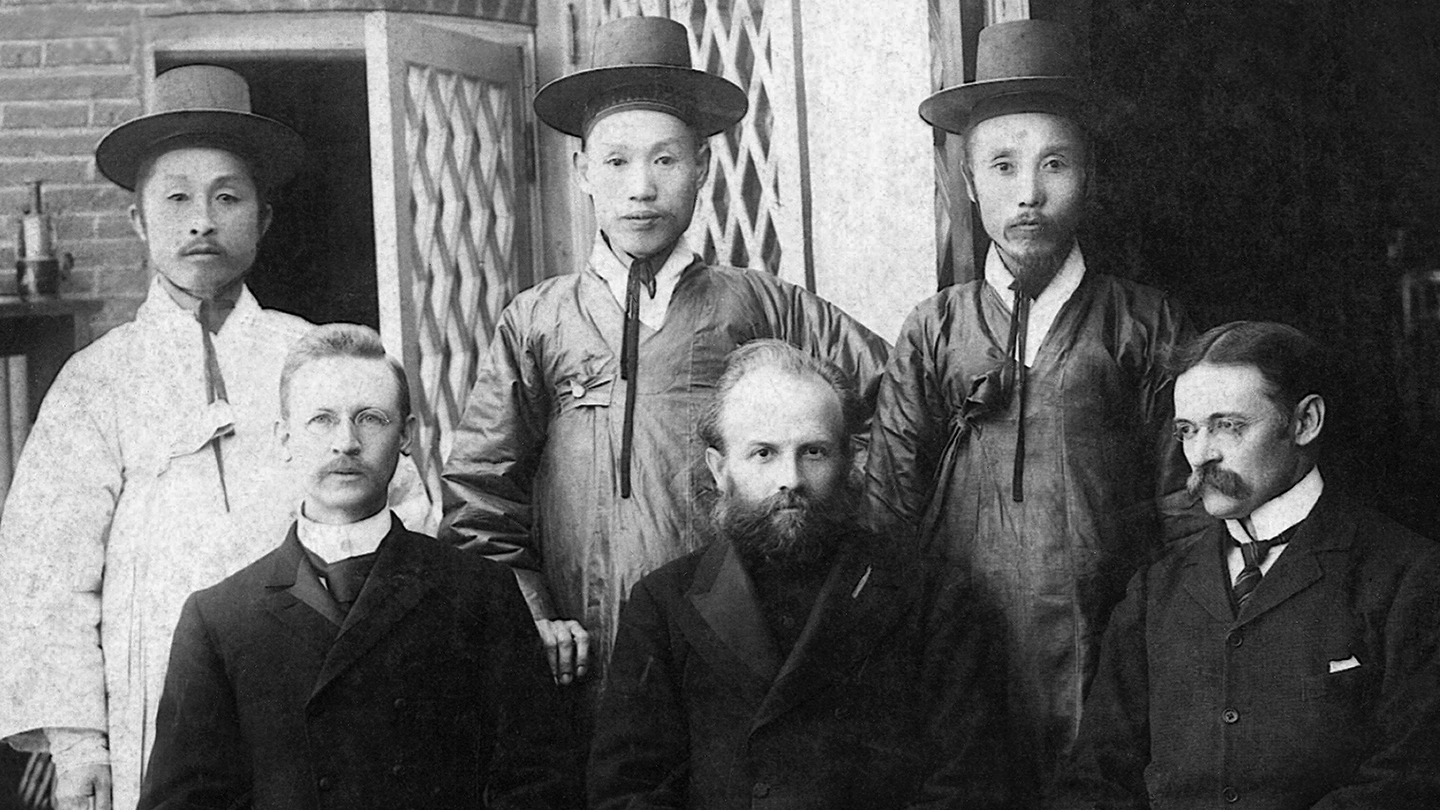
The Board of Translators of the New Testament, Pyongyang, 1904. Seated in the front row, from left to right: W. D. Reynolds, H. H. Underwood, J. S. Gale. Back row: Kim Chung-sam, Kim Myong-jun, Yi Jang-jik. [.smalltext]Photograph by CPA Media Pte Ltd / Alamy Stock.[.smalltext]
[.article__paragraph--cap][.small-caps]It is no easy task[.small-caps] to choose a name for God. In 1894, Protestant missionaries to Korea felt the momentous weight of their options. T’yonjyu. Hananim. Syangdye. Each of the names bore its share of advantages and baggage, and each translator used the name that seemed best to him. One missionary in particular, Horace G. Underwood, used all of these names plus two more in 1894 alone for his translations of church literature. But as they worked together, these Presbyterians, Methodists, and Anglicans knew they must reach a consensus soon.[.article__paragraph--cap]
For some, T’yonjyu (“Heavenly Lord,” from the Chinese Tianzhu) was an unsatisfactory term because it originated outside of Korea and was too closely associated with earlier Catholic translations. Syangdye (“Supreme Deity,” from the Chinese Shangdi) had similar issues. But Hananim, which New Testament translator John Ross etymologized as a combination of “Heaven” (hanal) and “Lord” (nim), was the name of a deity of native Korean worship, and this term became the frontrunner in the debate.
Hananim was familiar. But – was it wrong to use a familiar name? Could this deity be an early understanding of the Christian God, or was it merely the name of one shamanistic god among many, a name that would be better put aside to avoid syncretism and to introduce the God of the Bible?
By 1906, through a handful of concurrent developments traced by historian Sung-Deuk Oak, it seemed the missionaries had found their answer. The Protestants – including Underwood – were convinced that Hananim was the name by which the Koreans knew the one true God.
Chief among the persuading factors was, of all things, a myth.
“Two thousand years ago there was Tan’gun Wanggom.” So begins one the earliest extant written records of the Tan’gun myth, recorded in the Samguk Yusa in the late thirteenth century. Translators Vos, Breuker, and Walraven relay the tale in English:
In antiquity there was Hwanung, son of a secondary wife of Hwanin. Frequently he thought about the world below and wished to save mankind. His father knew his ideas; down upon the earth he saw T’aebaek with its three peaks and believed it worth his while to widely benefit humankind. Thereupon he gave three heavenly seals to his son and sent him down to go and manage the world. Hwanung, leading three thousand followers, descended upon the summit of T’aebaek-san [Great White Mountain] under a sacred tan-tree and gave the name of Divine City to that place. He was called Heavenly King Hwanung. With the earl of the wind and the masters of the rain and the clouds, he ruled over the cereals, the span of life, illnesses, punishments, good and evil – in all he ruled over the more than 360 things which concern humankind. He ruled the world and civilized it.
At the time there were a bear and a tiger living in the same cave. They constantly prayed to the divine Hwanung to transform them into human beings. Then the god gave them a coil of miraculous mugwort and twenty heads of garlic, saying: “If you eat these and do not look at the sunlight for a hundred days, you will obtain human shape.” The bear and the tiger accepted the mugwort and the garlic and ate it. After avoiding the sunlight for twenty-one days the bear acquired a female body, but the tiger was unable to avoid the sunlight and so he did not obtain the form of a human. The bear-woman had nobody whom she could marry. Wishing to become pregnant, she therefore recited incantations again and again under the tan tree. Thereupon Hwanung temporarily changed his form and married her. Having become pregnant, she bore a son who was called Tan’gun Wanggom.
Though the Samguk Yusa was compiled by a Buddhist monk, missionary and linguist Homer B. Hulbert saw in the myth a Trinitarian structure. Hwanin was the divine Creator who sent Hwanung, “the Spirit King,” to earth; in turn, Hwanung’s union with the virgin woman begot Tan’gun, a god-man, the founder of ancient Choson (Korea). Father, Spirit, Son. The presence of the Trinity and the Incarnation here could indicate a vestigial, Messianic knowledge about God that had been gained and preserved from an earlier time – perhaps even as far back as a long-forgotten descendant of Noah who migrated to East Asia.
Other missionaries, like Canadian James Scarth Gale, initially had doubts about Hulbert’s reading of the Tan’gun myth. But, spurred by Korean scholars, Gale himself had begun to reconsider the etymological origin of “Hananim.” If “Hananim” originated not from hanal for “heaven,” but hana, for “one,” it would mean that the ancient god’s name should more accurately be translated as “The One,” or the “One Great Lord of Creation.” It would mean that an understanding of one great God existed in this land where the missionaries had only heard about idols and evil spirits. A myth about the Trinity and a name that inherently acknowledged the existence of one sovereign God: the more the missionaries studied, the more it seemed the adoption of Hananim as the name of God would be a natural fulfillment of a story already long embedded in the history of the Korean people.
[.article__paragraph--cap][.small-caps]God was barely known to me[.small-caps] when I started sixth grade at a Christian international school in Seoul in the mid-1990s.[.article__paragraph--cap]
Though I had attended a Catholic church with my family as a child in North Carolina, I didn’t feel I knew much about the one to whom we prayed at the start of every class. I didn’t know what the teachers meant when they asked him to bless our lunches “to our bodies”; I had never heard any of the songs that were sung to and about him in the weekly chapel service. Funnily enough, the strangeness of this new culture wasn’t intimidating; I sensed that all these elements would likely become second nature to me in time. And they did. But I didn’t expect that the greater story underpinning the prayers and the blessings and the songs would come to make sense to me as well. Sometime in that first year, I accepted the rescue and redemption offered to me by Christ.
After this, I found nearly everything related to this story interesting. I memorized the order of the books of the Bible, the sons of Jacob, the Book of James, the gifts that the Magi brought. I read all the missionary biographies I could get my hands on. I rifled through my mother’s old BMG CDs for any music by Christian artists and ended up listening to Amy Grant’s albums from the ’80s on my Discman during my commute to school.
But the faith whose history we were taught at school seemed only to begin when I stepped inside the school doors. Christianity was something born of the Hebrew and eventually English-speaking Western world; it stood apart from the other, wider life of expectations, traditions, and cultural mores that most of my classmates and I went home to when the final bell rang.
I’m certain our teachers did not mean to antagonize our backgrounds. Yet I gained the impression that the country of my heritage was merely stewing in shamanism, Buddhism, and Confucianism until the Catholic priests – or perhaps the later Protestant missionaries – arrived. Warnings to not participate in ancestor worship accompanied me to holiday gatherings; I heard about a classmate’s parents who had tried to see a shamanist soothsayer and were chased away because they had the aura of Jesus about them. So it was that over time I grew to have little interest in Korean culture and its history and its strange folktales about talking animals and heavenly beings. All the action – all the important matters of faith and reality – seemed to be happening elsewhere. Well into my adulthood, I did not question the great blank space of my familial and cultural history.
Several years ago, however, I started an essay on my years in Korea. In the silences between my typing, I began to wonder if my perception of the country – and even of my experiences within it – was lacking. The essay came to fruition three times, in three versions for different publications; it was all as true as I could express it, and yet it still did not feel complete. My core point was that God had been drawing me to him long before I could comprehend his presence, perhaps even calling to me through the particularities of a culture where I had always felt out of place. But as I revisited the old stories I had heard about my family – the suffering, the joy, the fullness of life that came before my own – my thoughts wandered outside the borders of my own life into earlier ages, generation upon generation upon generation. What had God been up to in those empty centuries before the first evangelists arrived to bring the gospel? Anything at all?
[.article__paragraph--cap][.small-caps]In his History of the Korean People,[.small-caps] written between 1924 and 1927, J. S. Gale observes: “A great mass of material pointing more or less directly to [Tan’gun] has been gathered and yet the mystery remains. The echo of his mission on earth is like that of a Messiah who came to enlighten and save.” For Gale and his colleagues, the Tan’gun myth was a form of praeparatio evangelica: a story that laid the groundwork of themes and concepts for the news of Christ.[.article__paragraph--cap]
They were not the first to engage with the myth by searching it for details resonant with their worldview or objectives. Another version of the myth, published only about five years after its first appearance in Samguk Yusa, connected Tan’gun with specific regions and peoples in early Korea, establishing the story as a foundation tale of the nation. Seventeenth- and eighteenth-century neo-Confucian scholars discussed Tan’gun’s role as civilizer in forming Korean culture. From the late eighteenth century onward, some Japanese historians asserted that Tan’gun was the same as the Shinto deity Susanoo. These are only a sampling of the myriad perspectives in the myth’s long history of reception.
Like many myths the world over, the tale of Tan’gun has had an outsize effect for its length. And little wonder; from the very beginning it carries the atmosphere and gravitas of a story meant to break through the bounds of the immediate and the tangible: “In antiquity there was Hwanung.” It tips an inscrutable nod to the earl of the wind and the masters of rain and cloud, and causes this modern reader to wonder – what are the 360 matters that concern humankind? Within the span of a few paragraphs, we are made witness to events that are both greater in import than everyday life and yet as intimate as our own routines; we climb to the sovereign heights of the heavens and descend to the earthy closeness of a cave, in which the birth of a founding king hinges upon a single act of faithful endurance. These mythic features have understandably provoked a response through the ages – whether in the neo-Confucian literati who shied away from the more fantastic details or in the activists who embraced them as the cornerstone of a nation’s identity.
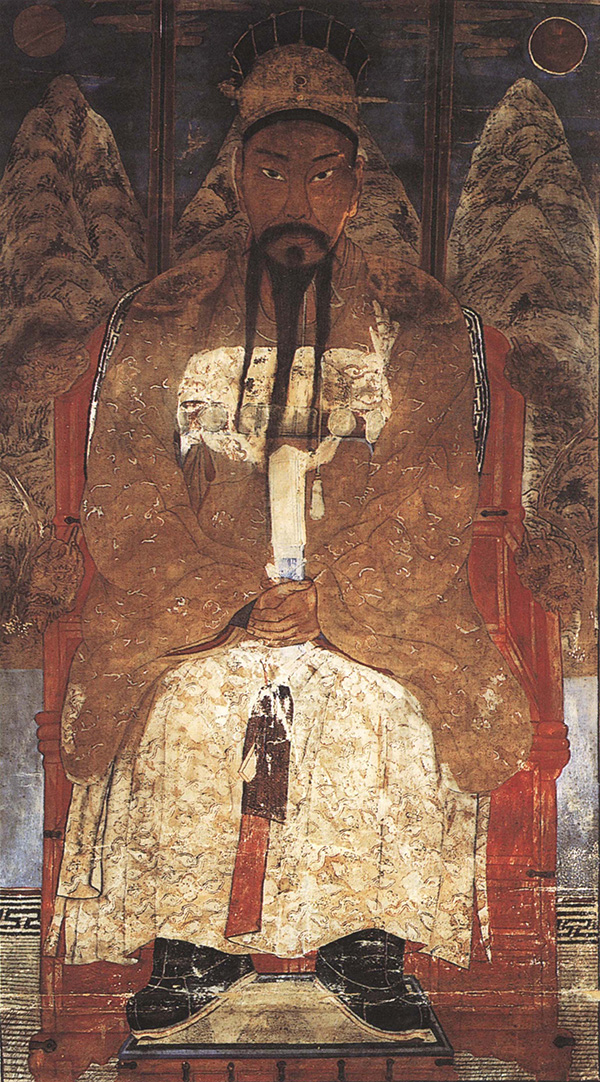
For my own part, the myth has led down a pathway of thought stemming from my earlier question: What was God up to in Korea in those centuries before missionaries came to talk about him? If the Tan’gun myth is evidence that the Korean people knew of him, why would he choose to work through a myth to hold that revelation and carry it down through the ages?
The Book of Acts states that God “made from one man every nation of mankind to live on all the face of the earth, having determined allotted periods and the boundaries of their dwelling place, that they should seek God, and perhaps feel their way toward him and find him” (Acts 17:26-27a, ESV). It is the “allotted periods” and “boundaries of their dwelling place” that have arrested my attention lately: the idea that God would place a person in a particular time and place so that those very conditions might guide her to seek him. In such a world, cultural elements from a given generation may be vessels through which individuals can begin to understand God – vessels through which he chooses to make himself known. The tale of a tiger and a bear and a son of heaven might have something distinct to say of him – perhaps even something that cannot be conveyed in any other way.
For a myth does something that a bare direct address cannot: it “works upon us by its peculiar flavor or quality, rather as a smell or chord does,” to borrow a description by C. S. Lewis. Something numinous, grave, and awe-inspiring lingers with us in the wake of encountering a myth, Lewis points out, even after we have pulled it to pieces in our efforts to explain it allegorically. It may be that the story-vessel of Tan’gun primed a people who were keenly aware of supernatural spirits and the wildness of nature to hear about a God of seen and unseen things. It may be that holding a story like this in one’s history or heart – a sweeping myth about a god who cares about humankind – widens the boundaries of one’s imagination and makes space for a hunger to know the Redeemer of the universe.
When I consider these things, I do not find it difficult to think that thoughts higher than mine could be behind the creation and transmission of the Tan’gun myth – indeed, that grace can be so patient and enduring that it lays plans for centuries before revealing its name in the fullness of time.
[.article__paragraph--cap][.small-caps]When I was small, through the landscape,[.small-caps] through stories, through music, through films, there were moments that seemed to speak to me, however brief, of a wider mystery abroad in the world. A hidden grief and glory.[.article__paragraph--cap]
I caught it in the large paintings of a Korean storybook titled The Woodcutter and the Heavenly Maiden. The loops in the maidens’ glossy hair and their hanbok ribbons as they descended to bathe, the desperation on the deer’s face as he searched for a hiding place: these imparted a sense of otherworldliness that melded with the wild places I knew, speaking of secrets that even wildlife might carry, if they were somehow wiser and more forbearing than we.
I saw in Mary Lennox’s secret garden, for the first time, the idea that beauty could bring healing. My hands had not yet cleared dead undergrowth to allow a rosebush to breathe, and I simply had to take Burnett’s word for it that one could find a wick green heart of life at the core of a withered-looking stem, but the life silently filling and enfolding the garden exuded out of the pages like the dark green aroma of a forest after rain. I have not forgotten it to this day.
Eastern tales, Western novels – the numinous also struck in stories set outside the world altogether. In Apollo 13 I heard Jim Lovell sum up his miraculous nighttime rescue in a malfunctioning plane with the words: “You, uh, you never know what events are going to transpire to get you home.” The loss of electricity in his cockpit had enabled him to see the glow of phosphorescent algae miles below in the darkness, leading him to a ship that had churned up the glowing trail: a haunting, sublime image. What is more, for years afterward I mistakenly remembered “transpire” as “conspire,” as if there had been some kind of life-giving plot hatched by Lovell’s instruments, the night, and the glowing waves. It was a misunderstanding that only compounded my sense of poignant wonder.
These moments expanded me; they broadened the boundaries of my soul to make space for Christ to duck under the transom and step in. Praeparatio evangelica does not only occur on the level of nations. All of my most memorable childhood experiences in both the United States and Korea gave off a certain air, as crisp as if it flowed from the Great White Mountain of a myth, which I recognized in the story of Christianity years after I received the gospel. That air has been crucial to my understanding of the new creation, of grace that exists even when anxiety darkens the edge of my vision, and of the hope I have of entering into the joy of my Master. In this I see he wasted nothing; those earlier stories laid the foundation for my capacity to take in the breadth and depth of his reality as I took root in it.
The praeparatio of story, music, and art has taught me to look for the character of God in nature as well as in Scripture, on an epic as well as a lyric scale. The fact that the Spirit prepares and tills the ground of our being in these ways means that artists, writers, poets, musicians, filmmakers, and craftspeople are tasked with a vital work. For it was not only John the Baptist and his call to repentance that heralded the coming of Christ; the sons of Korah with their music and poetry, Bezalel and his fellow craftsmen at the tabernacle, and Mary singing her Magnificat shaped the heart and imagination of Israel in preparation for the Incarnation. Through the honest artistry of fellow humans, we see that God “is actually not far from each one of us” (Acts 17:27), and we begin to exchange our inklings of him for myth-sized truth.
I think of the works strewn across the table of my own imagination from the minds and fingertips of daring men and women: books, collections of letters, paintings of gardens, four notes from the introduction of a song, myths. It is an odd hodgepodge – and yet not really a hodgepodge at all. Under the human fingerprints are the increasingly detectable marks of a triune Master Creator. More and more, his shared joy and his plan for redemption make me want to cast my pen and interests and energies into his keeping, because there is no telling where a collaboration with his line of work may lead – whether it will fall by the wayside for a harvest of humility or wing out to nourish a soul. For if the stories that have shaped us are any indication, you never know how he’s going to conspire to bring us home.