Reflection
A Pleasure Greater Than the Siren’s Song
Shun not a spiritual hymn, nor be ill-disposed to listen to it.
June 28, 2026
Try 3 months of unlimited access. Start your FREE TRIAL today. Cancel anytime.
START FREE TRIAL NOWA Pleasure Greater Than the Siren’s Song
Shun not a spiritual hymn, nor be ill-disposed to listen to it.

Thomas Moran, Ulysses and the Sirens, circa 1900, oil on board. [.smalltext]Wikimedia Commons (public domain).[.smalltext]
[.article__paragraph--cap][.small-caps]The old man of Ithaca,[.small-caps] according to the legend of the Greeks, when he wished to hear the song of the Sirens, on account of the charm of their voluptuous voice, sailed to Sicily in bonds, and stopped up the ears of his companions; not that he grudged them the hearing, or desired to load himself with bonds, but because the consequence of those singers’ music to those who heard it was death. For such, in the opinion of the Greeks, are the charms of the Sirens. Now I am not within hearing of any such song as this; nor have I any desire to hear the Sirens who chant men’s dirges, and whose silence is more profitable to men than their voice; but I pray to enjoy the pleasure of a divine voice, which, though it be often beard, I long to hear again; not that I am overcome with the charm of a voluptuous voice, but I am being taught divine mysteries, and expect as the result, not death but eternal salvation. For the singers are not the deadly Sirens of the Greeks, but a divine choir of prophets, with whom there is no need to stop the ears of one’s companions, nor to load oneself with bonds, in fear of the penalty of hearing. For, in the one case, the hearer, with the entrance of the voice, ceases to live; in the other, the more he hears, the better life will he enjoy, being led onward by a divine Spirit.[.article__paragraph--cap]
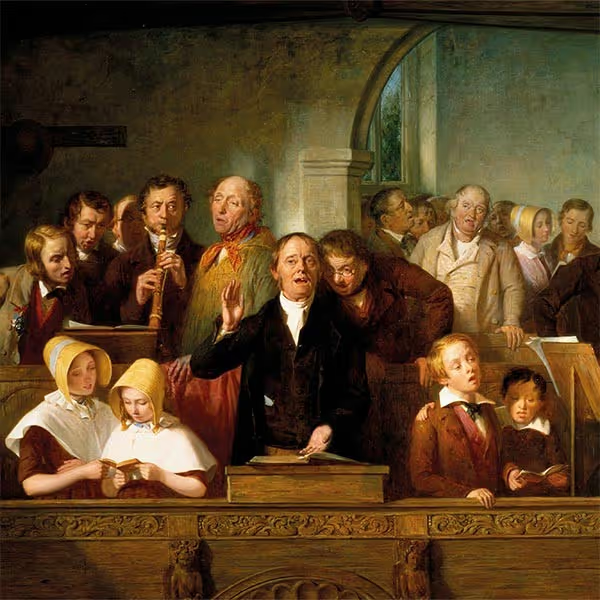
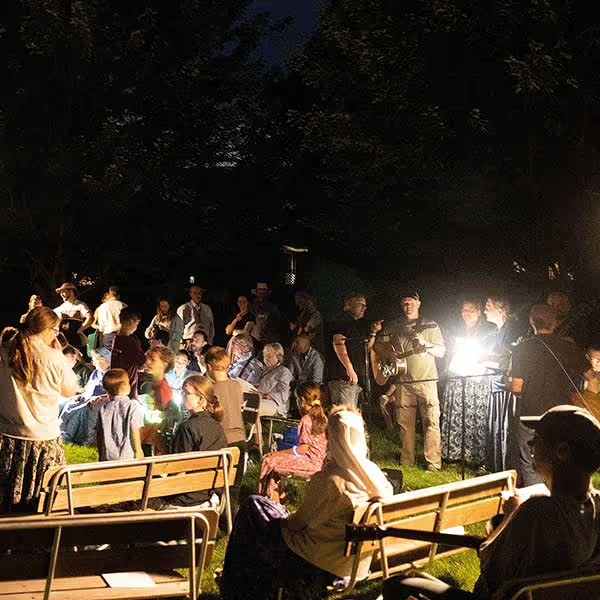
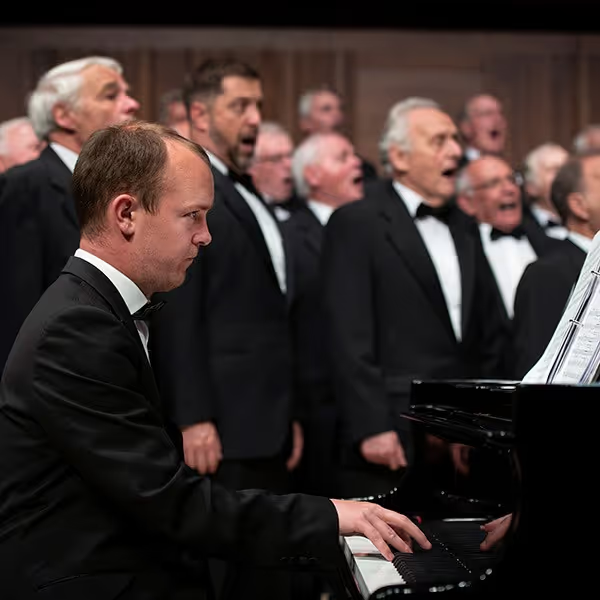
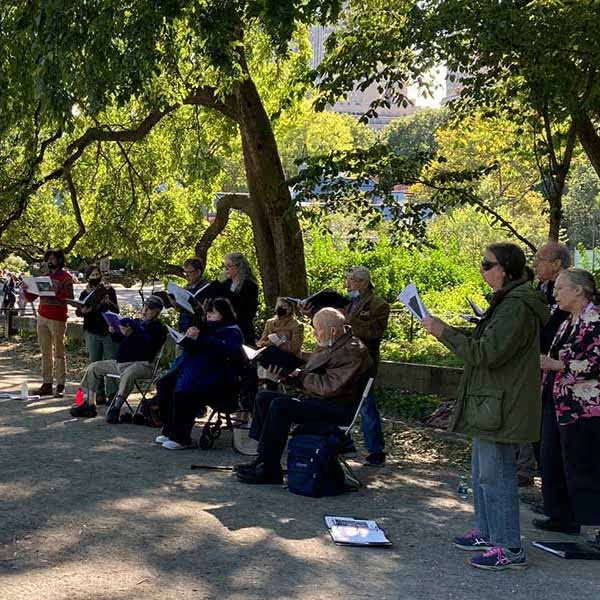
[.article__paragraph--cap][.small-caps]Let every one come,[.small-caps] then, and hear the divine song without any fear. There are not with us the Sirens from the shore of Sicily, nor the bonds of Ulysses, nor the wax poured melting into men’s ears; but a loosening of all bonds, and liberty to listen to every one that approaches. For it is worthy of us to hear such a song as this; and to hear such singers as these seems to me to be a thing to be prayed for. But if one wishes to hear the choir of the apostles as well, he will find the same harmony of song. For the others sang beforehand the divine plan in a mystical manner; but these sing an interpretation of what has been mystically announced by the former. Oh, concordant harmony, composed by the Divine Spirit! Oh, the comeliness of those who sing of the mysteries of God? Oh, that I also may join in these songs in my prayer. Let us then also sing the like song, and raise the hymn to the Holy Father, glorifying in the Spirit Jesus, who is in his bosom (John 1:18).[.article__paragraph--cap]
Shun not, man, a spiritual hymn, nor be ill-disposed to listen to it. Death belongs not to it; a story of salvation is our song. Already I seem to taste better enjoyments, as I discourse on such subjects as these; and especially when there is before me such a flowering meadow, that is to say, our assembly of those who unite in singing and hearing the divine mysteries. Wherefore I dare to ask you to listen to me with ears free from all envy, without imitating the jealousy of Cain (Gen. 4:5) or persecuting your brother like Esau (Gen. 27:41) or approving the brethren of Joseph (Gen. 37:4), because they hated their brother on account of his words; but differing far from all these, insomuch that each of you is used to speak the mind of his neighbor. And, on this account, there is no evil jealousy among you, as you have undertaken to supply your brother’s deficiencies. O noble audience, and venerable company, and spiritual food! That I may ever have a right to share in such pleasures, be this my prayer!
[.smalltext]Source: Ante-Nicene Fathers, Vol. 6. Edited by Alexander Roberts, James Donaldson, and A. Cleveland Coxe. Translated by William R. Clark. (Christian Literature Publishing Co., 1886). Revised and edited for New Advent by Kevin Knight.[.smalltext]