Essay
A Faith Worth Dying For?
As a mother grappling with faith, what am I to make of stories of early Christian mothers killed in the arena?
October 2, 2026
Try 3 months of unlimited access. Start your FREE TRIAL today. Cancel anytime.
START FREE TRIAL NOWA Faith Worth Dying For?
As a mother grappling with faith, what am I to make of stories of early Christian mothers killed in the arena?
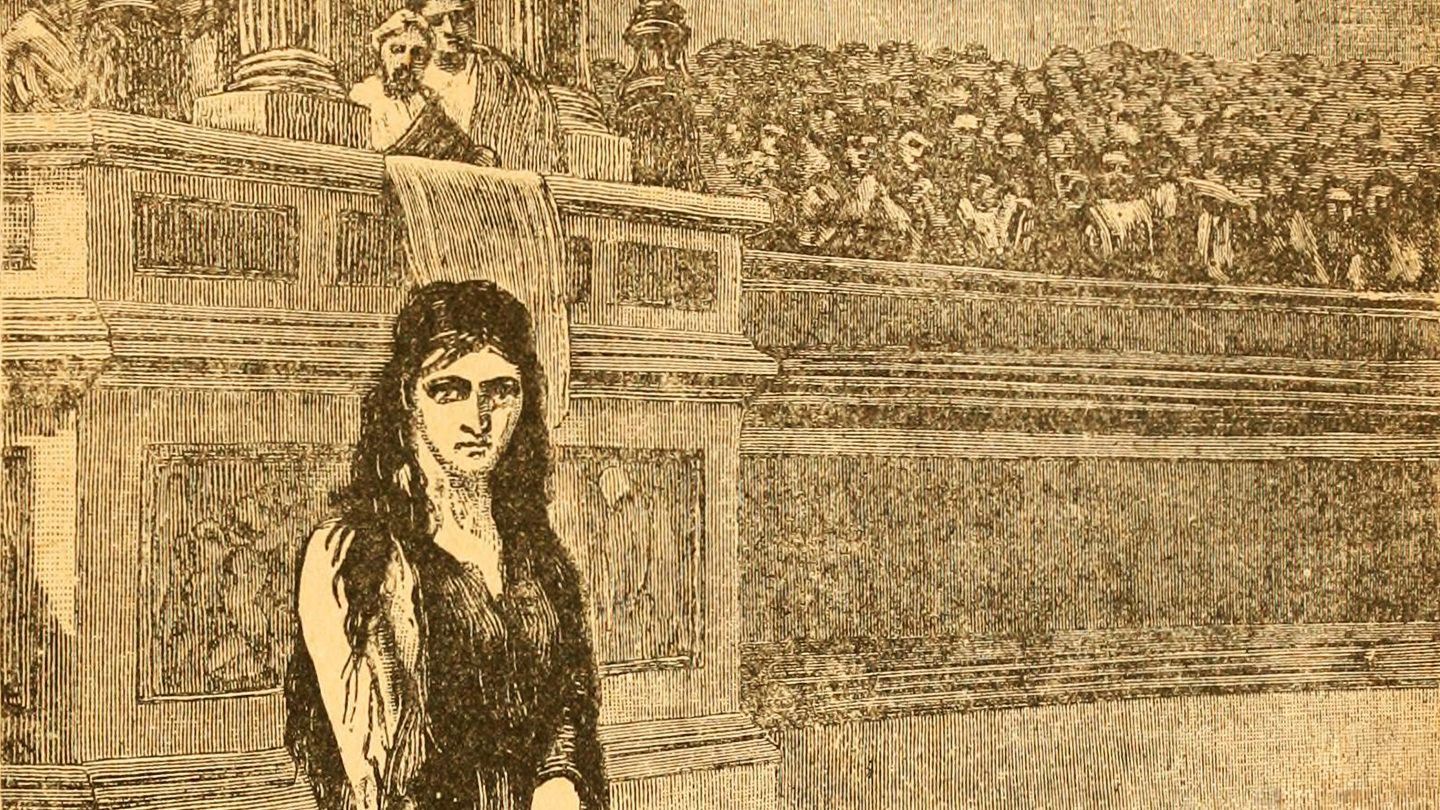
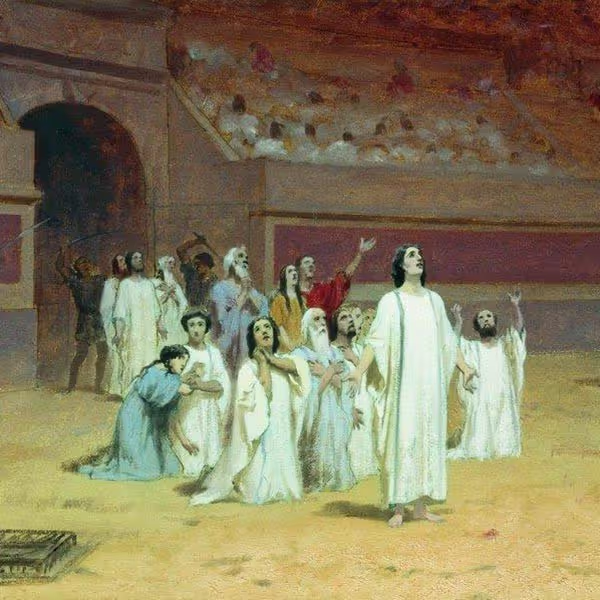
Illustration from History of Christianity by John S. C. Abbott. [.smalltext]Wikimedia Commons (public domain).[.smalltext]
[.article__paragraph--cap][.small-caps]I have a fondness[.small-caps] for spiritual literature that comes my way by chance. The lunchroom at my Quaker meeting house often has books and pamphlets available for free. Some are leftover booklets from bygone Yearly Meeting speakers, or books that people don’t want anymore. Often, they are leftover libraries from someone who has recently died.[.article__paragraph--cap]
I am an accidental mystic; I didn’t believe in spiritual experiences, and then I had one. It’s left me with an intense spiritual need to try to say only those things I can genuinely attest to. Conveniently, the rule in a Quaker meeting is to be silent, unless prompted by the Spirit to speak. This means I am disallowed from speaking insincerely.
There is a beauty in such obedience.
The Martyrdom of Perpetua is small enough to be a Quaker booklet, though more professional in its paperback binding. My husband found it in a pile of decommissioned university library books. The central text is Perpetua’s own account of her imprisonment prior to facing the wild beasts in the arena in the year 203, alongside contemporaneous explanation of who she was and how she died. Novelist and feminist Sara Maitland gives an introduction and commentary.
Maitland recounts being annoyed to hear Perpetua described as a “miraculous virgin.” The account has few-if-any overt miracles, and Perpetua was not a virgin; she was a breastfeeding mother. Among those martyred alongside her there is another woman, Felicity, who was pregnant. Felicity gave birth in prison, and went to her death the next day.
[.article__paragraph--cap][.small-caps]It took about a year[.small-caps] for my son – then a rather clingy four-year-old – to start asking to come to Quaker meeting with me. I was touched that he’d ask, and tempted to refuse.[.article__paragraph--cap]
The younger children have their own meeting, twice a month, after which they rejoin the main meeting for the last five minutes. Depending on the kid, a lot of parents stay with their children, and I did not expect that my son would be willing for me to leave him on his own. Nor was I sure that a strange adult would understand him.
I have heard my son wail when he bangs his head. I have seen him wince when he skins his knee. I have heard him whimper when he’s sick. But I have not once heard him say in words that he is in pain. He’s autistic. He can talk, but he struggles to articulate emotions and internal states.
Unlike my son, I have never struggled to articulate physical or emotional feelings. Spiritual feelings are a different matter. There, I feel keenly the shift upon discovering, at the age of thirty-seven, that there was an aspect of myself that I had been responding to, all my life, without understanding that it was there, developing avoidances that I only half understood, while responding to needs that had no justification, in my non-religious worldview, beyond the simple personal freedom to do as I wished.
Stuck in the children’s room with my son, I missed the quiet of the main worship sessions terribly. I was only just coming to understand that I could have spiritual needs. Faced with a competing claim, was I supposed to set that spiritual need aside?
If it had been a simple clash between the spiritual and the worldly, I would presumably have been justified in discarding the latter. But I knew it wasn’t. What about my son’s spiritual needs?
[.article__paragraph--cap][.small-caps]To see Perpetua[.small-caps] as a virgin martyr is to obscure a central, tragic tension of her plight. Perpetua is breastfeeding. When they are separated by her imprisonment, her baby is hungry. When she is allowed to feed him, she says she can happily be imprisoned if only she can have her baby with her.[.article__paragraph--cap]
I want to scream at her. Don’t you know that you’re about to be separated from your baby in the starkest way possible? You’re about to die! Is that going to be OK just because you aren’t around to experience it? What about your baby? What if he dies?
In fairness, this argument was being made to her at the time.
My own competing claims were minor, by comparison, but they mattered. I knew, begrudgingly, that I ought to care for my son’s spiritual needs – whatever they might turn out to be – by spending time in the children’s meeting with him. That duty, performed every other week, could supersede some of my time in quiet worship.
It could not, however, substitute for it. I still needed to pray.
Quaker tradition is clear that you don’t need anything special to pray. Yet to me it did not feel so simple. There might be any number of things that could give me what I needed; that did not mean that just anything would.
Staring at the ocean helps; I’ve always liked water. I have found, too, that sometimes in the dead of night it is the right time to get on my knees and put my forehead to the floor and just fold, submitting to things as they are. In front of others, this would look weird, old-fashioned, demonstrative to the point of implying potential judgment of others. On my own, in the dark, it feels right.
There is a Catholic cathedral just down the street from where I work. A sign on the door informed me that they were temporarily feeling obliged to lock the place. The exception was an hour each day, prior to midday mass, when the cathedral would be “open for adoration.”
Did I belong here? There were two senses in which I was asking. One was whether I felt I could be there, on a personal level. The other was whether it would be disrespectful of the spiritual structure of the place to use it as a way to pray with others, sneaking in after adoration began and then sneaking out before the mass. Were we sufficiently aligned, or not?
The stained-glass windows at the back of the cathedral had a curving geometric pattern, like water ripples. I took that as a good sign.
[.article__paragraph--cap][.small-caps]The children’s meeting[.small-caps] remained difficult. My son can seem so normal that his disabilities get read as something else. It can be hard to mediate.[.article__paragraph--cap]
Have You Filled A Bucket Today? asked a book for the children. Everybody has an invisible bucket, it explained. You can fill it by doing something kind to them. Why not try filling someone’s bucket now? You could do it with something as simple as a smile.
The only other kid in the children’s meeting that day was a little two-year-old. She smiled adorably.
My son looked away and did not respond.
How about telling someone you love them, suggested the book.
My son remained silent.
The woman who was running the children’s meeting stopped reading from the book, and tried some attempts of her own. “How about your parents? Do you love your parents?”
It sounded like an easy prompt. I knew it was not one.
“Do you love your parents?”
Still no response from my son. I tried to wave a hand, to show it didn’t matter. Truly, for me to have been offended by this would have been like being offended if your child who cannot walk were to fail to run and greet you. But the social reality between my son and me, in which this was normal, was not the prevailing social reality of the room.
“Do you love your parents?”
My son, finally, managed a response.
“I don’t know,” he said.
In the lunchroom, afterward, he wanted to help with the tea. We wouldn’t let him hold the hot teapot, but he claimed the milk jug.
“I have to fill buckets,” he explained to an old woman.
I started to try to explain, but she caught on immediately. “Can I tell you a secret?” she said. “You are already filling my bucket, just by being here. You don’t have to do anything at all.”
My son, undeterred, very seriously poured a splash of milk into her cup.
[.article__paragraph--cap][.small-caps]I felt I owed[.small-caps] something to the cathedral for giving me a place to pray even when I didn’t necessarily belong. The natural currency was attention, and there was always plenty to pay attention to. Saints in the windows. Gilded icons. A flickering candle, third from the left in the candelabra, winking at me from some distant, unknown cause.[.article__paragraph--cap]
All this for one man? His form still hangs above the altar, of course, memorialized in suffering for almost two thousand years. It is tempting to rationalize it. The friends of Jesus saw a man die who did not deserve to die, and they loved him so hard that there he still is, dying, for us to contemplate. Even if he were just one man and no more, is it really too much? What’s a few thousand cathedrals, between friends?
Eventually we even managed to build societies in which you don’t get killed for your religion.
I owe some of my own freedom to that lingering cry at the injustice of it all. I can obey the sense that I need to be silent, need not to worship named things, and nobody will try to force me otherwise. I can find the small, natural restrictions, and try to read and follow them.
“You should have milk in your tea,” my son insisted.
“No.”
“You should.”
“I do not like milk in my tea.”
I prevailed, that time, but not every time. At home, my son found a tea bag that said it was “perfect with a spot of milk” and triumphantly pointed it out. I let him have that one. Another time, at Quaker meeting, I was too tired to protest and let him add the milk.
It felt truly unfair. Sometimes it is as if I am spending my whole life at the mercy of incomprehensible whims. We must buy a single bunch of eight or more bananas. I am not allowed to sing. If we’re both eating a bagel, then he has to finish first.
I just want my cup of tea, without milk.
[.article__paragraph--cap][.small-caps]For Perpetua[.small-caps] and Felicity, the cost of religious freedom was high. We are told Felicity’s baby was raised by a sister, but do not know what happened to Perpetua’s baby. After they were separated again, Perpetua wrote that her baby’s need to suckle had been miraculously removed. Was she right? Perhaps her baby survived. There is no way to be sure.[.article__paragraph--cap]
“I am a Christian,” says Perpetua, and this is a truth she cannot alter. I do not know if I would risk my child for so important a truth, if I held one such. I do not want to know. As I was drafting this piece, I considered saying that of course I could not do any such thing. It felt like the properly humble thing to say. It felt like a suspiciously comfortable thing to say. It would be reassuring to think that there could be no risk to that sense of obedience that I find in the quiet.
There is a reason why I am very careful where I put my faith.
[.article__paragraph--cap][.small-caps]Last time[.small-caps] we were in the lunchroom together, I finally let my son use the teapot, with care. “Do you want to add milk too?” I asked him.[.article__paragraph--cap]
“No,” he said. “This one doesn’t have milk in it.”
My son sometimes avoids referring to people, and almost never uses names. “Is it for me?” I asked.
“Yes.”
I actually hadn’t noticed until then that he was probably trying to fill my bucket. If it really does make sense to think of God as a parent, then I trust God is quicker on the uptake than me.
[.article__paragraph--cap][.small-caps]Perpetua achieved[.small-caps] what we all want, says Maitland. She made it into the canon; she’s part of the institution. She defied her father, she was a leader among her fellow martyrs despite being female, she was complex and human, she’d had sex, and yet, here she is.[.article__paragraph--cap]
Do I want to be part of an institution? Not necessarily. Institutions can be overrated. Communities are important, and spirituality doesn’t have to be recognized in order to be real. That’s part of what truth means. You could maintain in as many ways as you like that women can’t do this or don’t experience that, and the truth would still have more authority than you.
In the silence of a Quaker meeting, I can feel the rightness of not speaking carelessly. Yet I know how worthwhile a task it is to try to put the truth into words. My limitations are many, and my failures are all too likely. Still, I am trying to speak.