Podcast
Existential Gratitude
There’s something about the experience of being in the world that evokes wonder.
May 19, 2026
Try 3 months of unlimited access. Start your FREE TRIAL today. Cancel anytime.
START FREE TRIAL NOWExistential Gratitude
There’s something about the experience of being in the world that evokes wonder.
[You can listen to this episode of Another Life on Apple, Spotify, Amazon Music, or wherever you get your podcasts.]
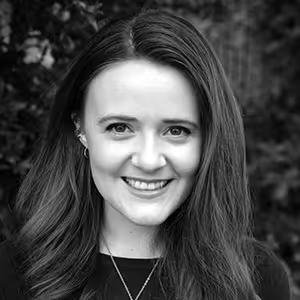
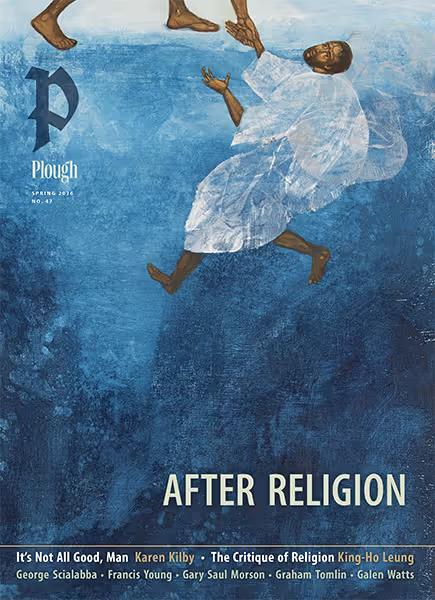
Joy Marie Clarkson: Hello everyone and welcome to Another Life, a podcast of Plough magazine. I’m your host, Joy Clarkson, and it’s a delight to be with you all today. So for the past five episodes, we’ve been exploring the themes of our most recent issue, “After Religion.” In this issue, we wanted to grapple with two things. One was how we think about living in a world where religious participation and affiliation, at least in the West, is in decline, but also where we see people being after religion, right? Seeking after, whether it’s spirituality or rejoining churches and grappling with those two things together. And for our final episode in that series, I am delighted to welcome to the show Dr. King-Ho Leung, who was our guest editor and helped us think through some of the nuances and exciting avenues for this issue.
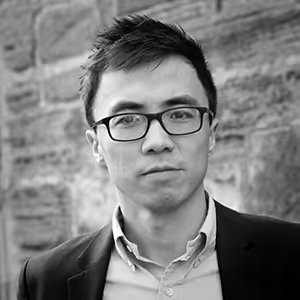
Dr. Leung is a lecturer in theology, philosophy, and the arts at King’s College London, and his research is primarily at the intersection of philosophy, theology, and culture, with an emphasis on the phenomenology of human existence and experience, particularly spiritual yearnings and desires for the divine and the ultimate. His most recent book, which we will be talking about today, is Spiritual Life and Secular Thought: A Phenomenology, which came out this past January in 2026 with Oxford University Press.
He is currently completing a short book on theology and metaphysics under contract with Cambridge University Press. He is working on a multi-year project on existential gratitude and spirituality funded by the John Templeton Foundation. So welcome to the show, Dr. Leung.
King-Ho Leung: Hi, thank you very much for having me.
Joy Marie Clarkson: So I always like to begin by asking people where they are physically in the world, though this is one of the rare occasions where I’m actually recording with someone in real life. We are sitting together recording in London So tell us a bit about yourself and what you do and how you spend your days.
King-Ho Leung: Yeah, so I am a lecturer or assistant professor, however you might describe it, at King’s College London where Joy or Dr. Clarkson also works. But I’m currently actually on research leave for a few years. So I actually mostly work from home, doing a fair bit of reading and writing, but well, still being caught up in various admin tasks, which I’m trying to … not do too much of, but there we go.
Joy Marie Clarkson: So as I said, Dr. Leung we tend to have someone come in at the beginning of every issue and help us brainstorm questions about what we want for this issue. And you’re the person who did that really helpfully. So it’s been exciting. It usually takes up to a year and half basically from when someone came on to do this to when the issue is out into the world or around a year.
And today I want to talk to you about two things. One is this book that you’ve just come out with, which is Spiritual Life and Secular Thought: A Phenomenology, which is quite a grand title if I may say so. And also your more recent research project that is how you are on research leave, which is of course the dream of all academics for a while, which is on existential gratitude. And if you enjoy today’s episode, you can get a bit of both of those strands in the article that he wrote for this issue, which is “The Critique of Religion.” But let’s start with talking about your book, Spiritual Life and Secular Thought. So this book, which came out earlier this year in January, explores the idea of philosophy as a spiritual practice. Now, for those amongst us who have that as a phrase in our head, someone we might immediately think of would be Pierre Hadot, who wrote … there’s a famous book called …
King-Ho Leung: Philosophy as a Way of Life is the main title but in some of the French editions it’s also called Spiritual Exercise.
Joy Marie Clarkson: Which of course is a reference or is a homage to the Ignatian spiritual exercise, I think, so tell us a bit about this book how does it relate, or does it relate to Pierre Hadot at all how does it differentiate from it and yeah tell us a bit about the book.
King-Ho Leung: Yes, this book does relate to Pierre Hadot and in some sense it tries to take some of Hadot’s ideas quite seriously but I suppose it differs a fair bit from what Pierre Hadot is articulating, at least in terms of its method. So for the listener who might not know, Pierre Hadot was a French historian of philosophy who specialized in the ancient Greeks and one of his main, if not his main thing, his main pitch, if you will, is that philosophy, at least as understood by the ancient Greeks, was what he calls a way of life or a spiritual exercise, is a way to conduct oneself or one’s life and bring about certain modes of transformation. And one of his, the implications or the take, take away, if you will, of his pitch is that we too, people in the modern world, contemporary world, should also practice philosophy in that way.
And as he writes in some of his interviews, he was surprised to see that as a renewed or revitalized interest in things like stoicism, epicureanism that you might find in the big bookshops, whether in the philosophy section or the self-help section, those self-help-ish philosophy books or highbrow self-help books or whatever you want to call them. But what I want to do in this book is in some sense to think about similar ideas or similar areas of ideas but do it in a more formal or formalized way. So whereas Hadot says, “look at the Greeks, let’s just bring back that style.” What I want to do is actually give
in some sense a tighter or some definition of what it might mean to practice something called spirituality or spiritual practice.
Joy Marie Clarkson: So In this book, you deal with a lot of different philosophers and you look at this disposition towards a unity of life and thought If you had to pick one of the philosophers that you engage with in your book to spend a whole day with, who would you pick? And I say this thinking perhaps there’s one that you would really enjoy spending a day with but also that perhaps they could be a bit unbearable. So, which one would you choose if you had to spend a whole day with one of the philosophers that’s featured in Spiritual Life and Secular Thought?
King-Ho Leung: Yeah, That’s a bit difficult, so Heidegger was a Nazi, Deleuze often did drugs … I don’t engage with him too much in this book, but actually maybe David Hume, who pops up a few times and I consider Hume to be, well, partly because he speaks English, which would help. But also, I do consider Hume to be arguably the greatest British philosopher ever lived. And there is something … both no nonsense but also incredible about how he thinks but also how he writes.
Joy Marie Clarkson: And in all of his portraits he’s always wearing cool little turbans so that seems like fun too. I am not a philosopher so everything I’m about to say is going to be based on very crude impressions from the outside, but the first place that I encountered Pierre Hadot actually aside from knowing about him from philosophy things, like an undergrad philosophy class. It through some friends when I was doing my masters, some of whom were what we might call post-religious, so they came from religious background, but they were not identifying with that anymore and still seeking ways to have meaning in the world, or people who were not religious at all, but liked the idea of this providing something like meaning-making.
But in some ways, Hadot was … it was almost like he presented philosophy as a spiritual practice or as an exercise as an alternative to religion. And I think you see that actually in … the other places I started to see this again … is there are all of these, I think there’s quite popular podcasts that are devoted to like stoicism and contemporary world and that thing. But it strikes me that in your book, you nuance that contra religion a little bit from Hadot. Is that a fair thing to say?
King-Ho Leung: No. I actually sharpened it! Partly because a lot of folk, a lot of philosophy people actually draw a lot on Hadot to think about the phenomenon of religion. So a lot of the impulse behind that is that all philosophy of religion has been too focused on belief statements, on definitions of what God is or what love is and so on.
And they want to expand their understanding of religion by using Pierre Hadot’s account of philosophy as a spiritual practice or spiritual exercise to think a bit more about how practices form or influence religion or constitute part of religion. But one of the things I try to take quite seriously in the book is that Pierre Hadot himself was post-religious, literally in the sense that he trained in seminary, was going to become a priest, but … quit and ultimately quit Christianity completely.
And I don’t want to go into some psychological guesswork of what was going on in his mind, but at least on paper he drew a very sharp opposition, between religion and philosophy. So for him, all that stuff with stoicism, epicureanism is actually … it’s not meant, it’s not a nuanced account between the intercessions between religion and philosophy, but rather he’s basically advocating for philosophy as an alternative to religion. And at some point he says, I won’t get the quote directly completely correctly, he says that philosophy begins as a critique of religion.
Joy Marie Clarkson: I guess maybe what I was trying to get at, though, is in your book, you say you try to create a definition of spirituality, which can be applicable to the religious and the non-religious. So that sense you want to let Hadot do his thing, but you also want to say, “what is it that we’re talking about when we talk about spirituality?” Is that something closer to …
King-Ho Leung: Yes. Yeah.
Joy Marie Clarkson: And in this, two concepts that are quite important for you are life and thought. So of course that’s in the title itself, Spiritual Life and Secular Thought. But I also just wanted to read from the very closing lines from your book. You say, “To practice philosophy as a spiritual exercise, whether in a secular or religious, theistic or non-theistic context, is to live such life-orienting thoughts, allowing the practice of such thinking to permeate and orient our lives. It is to let our thoughts shape our lives, or even let our thoughts come alive.”
So I wanted to ask you about these two concepts or words that seem to be important throughout your book, which are life and thoughts. Can you tell us a little bit about what work they are doing in the book?
King-Ho Leung: Yes, thank you. they are both quite vague words, but basically what my book tries to do is to give a … somewhat ambitiously … give a definition of spirituality, which I try to defend and define as the pursuit of a unity or alignment of life and thought. So to be spiritual is to try to, you know, align or unify your thinking and your living. Now, life and thought, as I sort of alluded to, can mean very different things to different people. But I suppose one thing that I think is somewhat agreeable to most people, I would think, and I would talk about disagreements shortly, would be that all acts of intuitivity, we might say, are dependent on the phenomenon of living. So in other words, thinking requires living as a necessary condition. So, no life, no thought, that sort of thing. Although you can have living things that may not think, for example, a plant, we bracket out the so-called ideas of plant thinking or plant intelligence. So that’s the basic hunch of the book.
One thing that I try to argue or think about is that we often think of thinking as a lifeless activity. So we don’t often think, we’re not often aware of, or attend to the fact that thinking always involves living. What I want to think about in this book is in some sense say, well, yeah, actually, thinking is always a living thing and by attending to more of that, that’s also how we pay attention to how we live as well so a thinking that is aware is always dependent or even united to living, is a way of living and thinking spiritually. So that’s the main picture of the book and one thing I should maybe note and I don’t really address this in the book – it comes up in one footnote somewhere I think – is that some people might disagree that thinking depends on living. Namely, those who, well, to put it in a quite hyperbolic way, those who believe that machines think, if they believe that machines aren’t alive.
So if you think that machines are alive and also think, that’s sort of problematized it a bit more, but there is a mode of understanding intelligence now. Particularly if you put artificial in front of the word intelligence, that assumes that thinking is possible without living, what we might call a kind of lifeless thinking. And in a sense, my book is trying to push against that conception of what it means to think. So to be a thinker in the spiritual way, or however you might put it, that I try to attend to in the book is to practice thinking, not like a robot, if you will, or at least not in the way that you think you can get away in a sort of lifeless mode. But rather, true thinking, proper thinking is a living way of thinking, such that you live out your thoughts and then use your thoughts to think about how you might live.
Joy Marie Clarkson: Something that also comes up in the book is the idea of making explicit – something along, I think, in my non-philosophical understanding – something along the lines of what you’ve been describing, which is making explicit these relationships between living and thinking, which you draw from Heidegger. And I think it’s also something that maybe helps us attend to things that might be spiritual that we might not otherwise notice as spiritual. Could you tell us a bit about the idea of making explicit?
King-Ho Leung: The notion of making explicit is taken from Heidegger. It’s sort of how Heidegger defines the philosophical task of interpretation. And at one level, the practice of making explicit that my book presents is to say that, well, “guess what, guys? If you’re reading this, you’re probably alive and you’re probably thinking as well!” And that sort of thinking that you’re trying to think with the book presupposes that you are alive. So there is some implicit or natural unity of life and thought that you already have as a human being, as what the philosophical tradition sometimes calls a rational animal, or as I like to translate it, a thinking, living being. And what spirituality and sometimes a practice in the form of philosophy, what it does is to make explicit this unity of life and thought that you already have. So if you will, it’s to cultivate a cultured or nurtured unity of life and thought that is in addition to your natural unity of life and thought. If you will, a quote unquote, super natural unity of life and thought. And I suppose one of the moves the book tries to make is to say that in many theistic traditions, and I would argue, especially in Christianity, you get a definition of God as life itself, or as intellect or thought itself. And in many ways, and I think I talk about this a bit in the Plough article in “After Religion,” religion or worship is understood as the devotion of our life and thought to God, who is the source of life and thought, who is, if you will, capital L, Life itself.
And so part of what the book is trying to do is to argue this, if you call it a religious or theological structure of devotion, I think trying to unify one’s life and thought or dedicate one’s thought to life, be it capital L Life that is God or a lowercase l life that is my own life. These acts of devotion can be also used to analyze or help us understand other modes of thinking and living which we might call spiritual but not necessary in a religious way. So you might say that the banker is so obsessed with money that he devotes his entire life and thought to the bank or to … pursuit of wealth. Yeah that sort of thing, so you can say well yeah he finds his unity of life and thought in money or in capitalism, whatever. Or you can say similar things about football or basketball or that sort of thing, or even online personas, that kind of thing. Part of what the book is trying to do is to make explicit these yearnings, desires, devotions; as I would call it in the book, to see how people might just be working out spiritual pursuits in ways that we don’t normally recognize as religious or even as spiritual.
Joy Marie Clarkson: That’s really helpful. And it relates to something that I noticed both in things you’ve written for Plough, you’ve written a few articles for Plough over the years, but also in this book specifically, which is this … I see it as an attention to, well, it’s devoting serious thought, or taking seriously people’s ways of life, and not seeing them as just off-brand Christianity. So, by that I mean, in this book specifically, you’re taking quite seriously the category of spiritual but not religious. So you look at the sociological definitions and different ways that this group of people who are supposedly one of the growing contingents and especially in the West of people who say they are spiritual but not religious.
And one of the ways that this is often accounted for is just to say, well, they’re just sort of a commodified, commercialized, consumeristic version of religion, right? That they’re just picking and choosing bits of various religions and doing their own thing. But there’s this sense in the book, I think, that you want to take quite seriously; you want to take people seriously, that you’re trying to provide a way to speak about this, that takes this attitude of life spiritually and can have some ways to speak about it on its own terms. And I think you do a similar thing, well least I observe that you do a similar thing, with the way that you take these various thinkers on their own terms. So there can be this tendency sometimes to take Heidegger as like a secularized Kierkegaard sort of thing. So I was just curious about if that, if I’m correct, that seems to be one motivating factor that is you know, the subtitle of the book is “a phenomenology,” right? So there’s some sense of taking seriously these attitudes toward the world and providing ways to speak about them that take them seriously on their own, but can also be in conversation with more religious ideas of spirituality.
King-Ho Leung: Yes, yeah, thank you. I suppose one way to think about this, just to pick up from maybe a few phrases you used. So you described Heidegger as a secularized Kierkegaard. And then you also previously talked about, I think some of your former friends from university, not former, former university friends. I say hopefully they’re still friends, who are quite post-religious. it’s, and that to me is interesting because these two terms secularized, and post-religious, it’s often how folks think about what we sometimes just call secular. But what does the IZED or IZED or ISED, however you might put it, what does the secularized, what do the last few letters add to secular?
And I suppose one thing I want to try to think about all these experiment with, with this book I’ve written but also maybe implicitly at work and sometimes how I think about things in relation to the stuff I wrote for Plough is to think that well what if we don’t think about the secular in terms of secularized or the post religious such that once everyone was just happily religious and now we are after or post-religion – what if we think about the secular as a more pre-religious condition? What if the secular names is not the secularized, but what comes before what we now call religion? And that’s partly what I was trying to think about in the book. And I alluded to that, that natural unity of life and thought that is, if you will, that which makes possible the cultivation of a supernatural unity of life and thought. So in Christian theology jargon, this is sometimes called natural theology, it’s thinking about, the book in one sense is to think about what does it, what might it look like to have for humans to have a natural desire for God or what some Catholics call a natural desire for the supernatural. But I suppose my book’s task is not theological, but it’s, philosophical or phenomenological. So I hope that answers your question.
Joy Marie Clarkson: Yeah it does. So now I want to turn towards something you’ve been doing, you’ve been researching more recently, which is the idea of existential gratitude. Do want to tell us a bit about what that is and some work you’ve been doing on it?
King-Ho Leung: Yes. Existential gratitude, as we define it in this project I’m working on with a colleague at the University of St. Andrews, Mara van der Lugt is her name. The two of us have been working on this project on what does it mean to feel thankful for existing, be it for one’s own existence or even for all existence. And one of the things I did in the last year was to run a poll with the British public. I was working with the Policy Institute at King’s College London, and we interviewed, well, we commissioned an interview, a survey which interviewed over 2,000 British adults to see whether they feel thankful for existing. Now, the vast majority we found, so basically over 70 percent of people said that they were thankful, not only for their own lives or for the lives of others, but even for all life in general. And that was a bit shocking to some of my sociologists colleagues who helped me run the poll, even though I was like, yeah, yeah, that proves my point to them.
But for Mara and myself, who are working on this project, what we’re interested in is how might this notion of existential gratitude relate to what some might call gratitude to God. So for a religious believer, if one believes in God as the creator of existence or of life, then it’s like, yeah, if I’m thankful for life, whom do I thank? God. But what about people who don’t believe in God, what we might call non-theists? Well, the poll that we ran actually found that most people, almost 60 percent of people, thought that you do not need to believe in God or a higher power in order to feel thankful for your life. So in some sense for our project, it was a proof of concept to say, yeah, some people do feel existentially grateful, but do not think you need to believe in God to hold such gratitude. And I might just quickly note that among those who belong to religion, according to our poll, 42 percent believe that you do not need to believe in God to be thankful for life, which is 1 percent higher than the 41 percent who believe that you do.
So even among the religious, there is still a slight, just about 1 percent higher proportion of those who think that one can have an existential gratitude that is not directed at God or directed to God, I might say. And part of what our project is trying to do is work out the conceptual side of these things. Now that we know that people actually do think this way, or do believe that they think this way at least, what does it mean to be thankful for existing if there is no giver of existing or of existence to whom one can direct such gratitude.
Joy Marie Clarkson: Now, I see some relationship there between your initial book and this project now, which is the sense of looking at people’s experience of the world and how they understand it and trying to understand it conceptually. you say that that’s fair enough?
King-Ho Leung: Yeah, it’s almost to take that word and run with it and see how that works. And partly to also think a bit about how the God stuff that one might learn from Christianity and other religions, how does that help us explain these things? But also in turn, how might these experiences of those who are not religious, not theistic, or whatnot, how might they also – what might they have to teach us or teach those who believe in traditional forms of religion such as Christianity.
Joy Marie Clarkson: It’s really fascinating. And how long are you working on this project?
King-Ho Leung: At the moment, the project is to end in around two years’ time.
Joy Marie Clarkson: Yeah, so people can have a look at the poll, which is totally fascinating. And I’m going to briefly take a diversion and read you a poem that this reminds me of, that I think captures the religious side of the question. And I actually think of this every year around this time. It’s something I encountered when I was doing my graduate studies about this experience of gratitude for existing. It’s very short, so you’ll have to endure me doing this.
Which is a poem by E. E. Cummings. “I thank you God for most for this amazing” So this is:
I thank you God for most this amazing / day: for the leaping greenly spirits of trees / and a blue true dream of sky; and for everything / which is natural which is infinite which is yes
(i who have died am alive again today / and this is the sun’s birthday; This is the birth / day of life and of love and wings: and of gay / great happening illimitably earth) / how should tasting touching hearing seeing / breathing any–lifted from the no / of all nothing–human merely being / doubt unimaginable you? / (now the ears of my ears awake and / now the eyes of my eyes are opened)
But to me that little phrase in there where it says “how should tasting touching hearing seeing / breathing any–lifted from the no / of all nothing–human merely being” speaks to something of that experience of existential gratitude. There’s something just about the experience of being in the world that evokes these experiences of wonder. that was one of the things I found fascinating. I don’t know if you can pull it up in the poll, but it was that people experience something. It was something like they experienced profound gratitude for existing like once a week or something like that. Like a shocking number of people seem to report feeling like E. E. Cummings quite frequently. And I just thought that was – first of all, I thought it was just sort of delightful to know that, that my fellow – that quite a good proportion of my fellow human beings, once a week or so, experience this moment of being grateful for either their existence or other people’s existence or all existence. And there’s something just interesting to me about thinking about that this is a shared human experience. And it’s exciting that you’re taking the time to think through that in a philosophical way.
So some of the, the outworkings of this poll that you conducted were shared in the Big Issue with the wonderful title of “What is it that makes life worth living?” Can you tell us bit about that?
King-Ho Leung: Yeah, so people can also Google “What is it that makes life worth living?” which is an article I cowrote with Bobby Duffy, who’s the director of the Policy Institute at King’s, which is an article that came out in the Big Issue earlier this year. And it’s basically just a writeup of the different findings of the poll and the implications for both the study of philosophy and religion.
Joy Marie Clarkson: Wonderful. I hope people will go and Google that. well, there’s many more things that we could speak about today, but thank you so much for giving us insights into your book and also into this exciting new project you’re doing on gratitude.
Every episode, I like to end these conversations with a question about another life. So the name of this podcast is Another Life. So I always ask people at the very end what is something – it can be a person, a practice, a painting, a poem, or something that doesn’t begin with P, that reminds you that another life is possible?
King-Ho Leung: Yeah, this might sound a bit pompous, but I’m gonna go for it anyway. Martin Heidegger, a philosopher who we mentioned a few times in our conversation, wrote a very difficult and weird essay towards the end of his life, just called “The Thing,” and it begins like this:
“All distances in time and space are shrinking. Man now reaches overnight by plane, places which formerly took weeks and months to travel. He now receives instant information by radio, of events which he formerly learned about only years after, if at all.”
And so on and so forth. Heidegger’s point, I take it, is how we lose a sense of distance with the increasing presence of technology in our lives and so on, such that, you know, for the most part, I assume when you do these podcast interviews, there is actually a fair bit of distance, physical, real distance between you and the interviewee, unlike our current setting.
So I’m not saying that reading Heidegger is a way to remind me that another life is possible. But I suppose one thing I sometimes do – not really that often – is to stare into distance or even into the sky. The sky is a weird thing if you just look – we just take it for granted. Like it’s this weird, if boring background to, you know, the buildings or trees we see. We almost see it as a flat thing, but we forget that the sky is actually, quote unquote infinitely far away from us. So you see through the clouds or if it’s a clear day, you can just see this blue thing, or at night you see this dark thing, but it actually goes on for miles and miles or kilometers and kilometers beyond. And I don’t know how far we can actually see, but I sometimes think of the distance that we see as something close to infinity. And that sort of reminds me how another perspective is possible, or even how small we are in compared to, for instance, to the universe or indeed to the trajectory of the universe, to history and so on. And to remind us of the contingencies of our life as it is in this particular spot in time or space. And that we could have just not existed. And so it both reminds of like, how one can make decisions in one’s life that would change it drastically to find other possibilities, but it also may be, to link this to existential gratitude, it’s not just about possibilities, but about the actual, that we do exist, even if it’s not necessary for us to exist. And for many of us, that’s a gift.
Joy Marie Clarkson: Thank you so much for that closing thought. And thank you everyone for listening and for joining us in this series on “After Religion” for Plough Quarterly.