Personal History
The Iraqi Christians I Never Saw
An American veteran comes to terms with the consequences of a war he believed was righteous.
May 18, 2026
Try 3 months of unlimited access. Start your FREE TRIAL today. Cancel anytime.
START FREE TRIAL NOWThe Iraqi Christians I Never Saw
An American veteran comes to terms with the consequences of a war he believed was righteous.
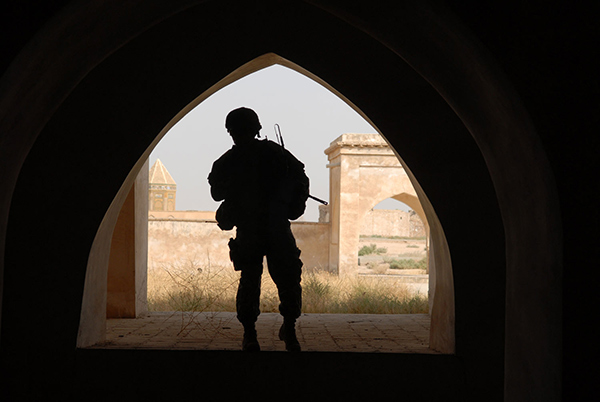
[.smalltext]Photograph by Dallas Edwards / Flickr.[.smalltext]
[.article__paragraph--cap][.small-caps]I didn’t join the military[.small-caps] for God or country; I doubt most soldiers ever do. Working fifty hours a week while trying to finish college was heavy, and by age twenty, I was already married, so I joined to provide for my wife and the family we looked forward to raising. I knew I was continuing a legacy of service for my country that traced back in my family to the Revolutionary War and continued through the Civil War, both world wars, and Vietnam. I thought I was under no patriotic illusions when I decided to enlist, but my upbringing had been steeped in far more patriotism and uncritical belief in American exceptionalism than I could have known. The things that had prepared me for basic training – school, church, politics, TV, talk radio – had already been molding me from an early age. They would eventually position me in a tower in Iraq, where, while my own months-old son slept in the safety of his crib at home, I would revel as tracer rounds stitched the night sky above the homes of Iraqi families.[.article__paragraph--cap]
I was raised Christian in the casual, cultural way that’s common for many Americans. Though my dad had been kicked out of his family’s Baptist church as a teenager and my mom was a nonpracticing Catholic, we still attended church on Easter. I spent summers in vacation Bible schools and was familiar with the stories of the faith. At school each morning, we recited “one nation under God” in the Pledge of Allegiance. It was in my junior year of high school, though, that I met Jesus in a way that was new and unmistakably real. A friend had just returned from a mission trip and shared the gospel with me, and I couldn’t resist the good news.
The formation I had received during my childhood deepened in the culture of the American evangelical church I joined. American exceptionalism was shaped into holy nationalism. A river of tradition flowing from Bible colleges to church leaders and even fiction guided my politics and opinions. Having a ready defense for the hope within (1 Pet. 3:15) was forged into a weapon to defend my culture and my nation’s interests.
I started to become aware of the events that were taking shape around me – political currents, global unrest, the increasing possibility of war, and unfinished business in the Middle East. During the first Gulf War, I heard preachers and talk radio hosts invoke Ecclesiastes – “a time for peace, a time for war” – to defend the war. I heard them quote Abraham Lincoln – the concern was “not whether God is on our side, but whether we are on God’s side” – and say that the war was on the side of God. Now, upon America’s return to Iraq, similar arguments were being made. The US attorney general spoke about freedom, God’s gift to us; quoting Deuteronomy, Isaiah, and the Declaration of Independence, he decreed “the way of God, and the way of the terrorists.” Five prominent evangelical leaders signed the 2002 “Land Letter,” defending the just cause of war, while other leaders across the country extolled the opportunity for proselytizing that would follow the war. The president felt “God’s words” coming to him, to “go get peace in the Middle East.”
By the time I left for my first deployment to the Middle East, I was a fully formed Christian, and a patriot. I represented freedom.
[.article__paragraph--cap][.small-caps]The goodbyes are difficult[.small-caps] for me. I remember kissing my wife and my son. What I remember most is the detachment: the male compartmentalization that kicks in when you need to move forward and can’t afford to feel what you’re leaving behind. I had already been formed for that too; feeling less had been part of the preparation.[.article__paragraph--cap]
Stepping off the aircraft and onto the ramp for the first time has also faded from memory, though what remains from three deployments to the Middle East is the smell of dry desert air and jet fuel. These hit me as I shuffled forward with the others, overwhelmed by the summer heat of the desert. The wind that smacked our faces felt as if it were blasted from a furnace. Sun … orange sand … tents … barbed wire.
I was confident; this much I remember clearly. I was here to help the Iraqi people. That was the story I carried, and I believed it completely. I was here to fight, not against fathers and sons of that land, but against insurgents and terrorists. The language was precise and moral. It told me who the enemy was, and who I was in relation to that enemy. I believed my basic training instructor, who had told us that “when a civilian population sees a military unit coming over a hill, they are happy to see our flag on the uniforms.”
My job there was as an air traffic controller, a profession built entirely on safety. Back home, certification in this profession would take months, with layers of training, evaluation, and multiple tests. The whole architecture of the work exists because the cost of getting it wrong is measured in human lives. That weight is supposed to be built into everything an air traffic controller does.
At Kirkuk, they fed me lunch, drove me to the tower, and certified me in a couple of hours. I still felt motion sickness from the combat landing when we had arrived, but I had to sleep and be ready to supervise the tower the following night.
I don’t remember the first time an explosion shook the ground. Soon I experienced rockets so regularly that they felt normal. A whistle incoming and then overhead as we drove home one night, followed by an explosion. One malfunctioned and landed yards from where I played cards, sitting in the dirt like an undelivered message before it finally detonated.
After a while, the incoming rockets were just part of the rhythm of the place. One night, feeling exhausted, I woke up to the alarms and covered myself with my flak vest before falling back asleep – I didn’t even bother to go to the shelter. Life went on, as if an explosion was no different from receiving a delivery or taking out the trash.
I didn’t recognize that normalization as a loss at the time.
I do now.
I had always taken a particular pride in my knowledge. I wasn’t just an airman following orders without understanding. I read Foreign Policy, studied the local cultures, and was the go-to guy on the politics of it all. My study of the region allowed me to discuss the dynamics with confidence. I educated people boldly on how the Kurds were our friends, how we had opened something for them, how they understood what American presence meant for their future.
What I didn’t know – what nothing so far had given me any category for – was that I was stationed amidst one of the oldest Christian communities on earth. The Assyrian Christians of Iraq had been here since the first century. They spoke a dialect of Aramaic, the language Jesus spoke. Their churches had stood in that city for longer than my country had existed. They were my brothers and sisters in the most literal theological sense.
That gap in my understanding wasn’t an accidental oversight. The map my culture had given me for the Middle East was drawn in the categories of geopolitics and end-times prophecy. In Revelation, the bowl of God’s anger is poured out by the sixth angel over the ancient land of Babylon, modern-day Iraq, “on the great river Euphrates, and its water was dried up to prepare the way for the kings from the East,” (Rev. 16:12), who would lead their armies along this river to Armageddon. Shiites, Sunnis, Kurds; friends, enemies, insurgents. The ancient body of Christ still living in the shadow of that tower had been entirely left out of the picture.
[.article__paragraph--cap][.small-caps]The night that holds[.small-caps] in my memory isn’t some action sequence; it could be one of many nights in the tower. Apache helicopters coming in to refuel received small-arms fire from the city. They reported it, and I followed my checklist. I notified a young woman at the command post, whose report required knowing what the aircraft intended. As tracer rounds lit up the sky, I proudly explained all – that our warriors were finally “taking the fight to the enemy.”[.article__paragraph--cap]
They were the enemy. That’s the only category I had for them. Writing this now grieves me, because they weren’t simply the enemy, or just fathers and sons. In the image of God, God had created them (Gen. 1:27). Like me, they were image-bearers.
Nothing changed in that moment. Soon after, I returned home to streetlights at night, an oddity after months of the protection of darkness. My son was nine months old. I had missed six months of his life. Friends’ lives, even my wife’s, had continued, while mine had paused.
I still believed that America was exceptional and that we held the moral high ground. It would take more than ten years, and two more deployments, before the political foundations I had known for so long began, finally, to crack. I started to see the altar of lies the idol sat upon. Not the easy idols we confess in Bible study – our phones, our sports, our comfort. Those confessions had never cost me anything. I’m talking about the idol that cost me everything to finally name. The one that sent me to Iraq: fear.
Fear had caused me to see the Iraqi and the Arab as dangerous. That same fear had trained me to distrust the poor and to ignore the immigrant as well. The cracks formed slowly. Still believing in my fluent grasp of politics, cultures, and religions, I stumbled when confronted with things that didn’t align with my prejudices. The lies were reassuring, though, and I returned often to trusted sources who “righted” my thinking back into comfort. But I had also learned to hold certain things as non-negotiable: character, integrity, consistency. Watching trusted people abandon those standards the moment it cost them something opened my eyes. I saw principles used as weapons, useful against opponents and holstered when it came to our own. That’s when I knew I hadn’t been following convictions. I had been following a team.
The hardest part of my journey was recognizing how I had embraced war. We all have regrets from our lives: things we said, did, or failed to do. My biggest one is how gravely misguided I had been about war. I had truly believed it was good, maybe even righteous, something more than a necessary evil. I had accepted euphemisms such as “collateral damage” regarding human life. Worse yet, I had tossed around crude, dehumanizing jokes that pass for toughness in certain circles – dark humor that treats real people as distant and formless instead of as image-bearers. I regret every word.
I was a warrior not only in the worldly sense but also, I thought, “clad in the full armor of God” (Eph. 6:11–17), defending my faith, culture, traditions, and politics as though Jesus had asked it of me. But he hadn’t. Fear had. Fear had trained me to see many in this world as enemies and hidden my brothers and sisters from me as they suffered.
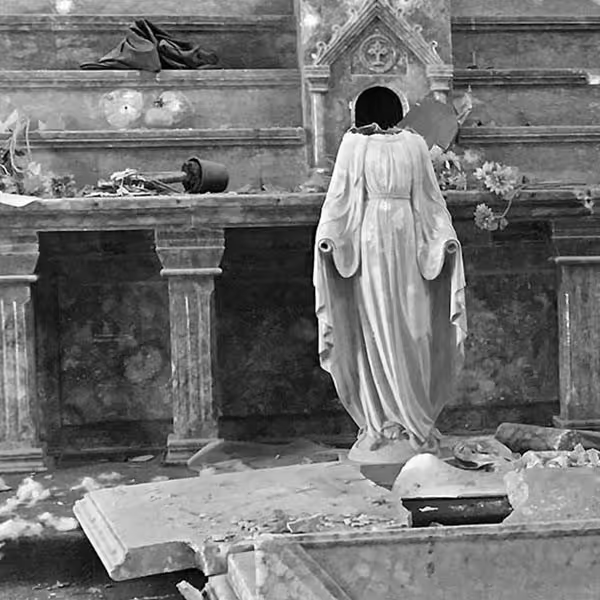
The damage done to one of the oldest Christian communities in the world is still hard to comprehend. In 2003, it is estimated there were 900 Christian families in Kirkuk. Today, approximately 175 remain. The country as a whole went from nearly 1.5 million Christians to around two or three hundred thousand. Scripture tells us, “By this all people will know that you are my disciples, if you have love for one another” (John 13:35). Even though I hadn’t even known they were there, I have to contend with the fact that I violated that sentiment.
I didn’t do so intentionally, but that doesn’t change the weight of it. I know I serve a gracious God, who provides me with a grace that covers every sin, yet like many veterans who never talk about it, I can identify with Paul where he says: “Christ Jesus came into the world to save sinners, among whom I am foremost” (1 Tim. 1:15).
There is a church in Kirkuk, the Tahmazgerd Church, which was the site of a tragically beautiful conversion story, one that was born of brutal persecution. I didn’t know it all those years ago, but I must have passed the Red Church many times. The Christians in Kirkuk were massacred in the fifth century: twelve thousand believers and the entire clergy, killed on that hill that I looked upon from the air traffic control tower. An executioner watched a young mother die with her children with such peace that he converted and asked to die in the same spot. Martyrs’ blood fertilized the soil where the church grew, and it continued to grow through centuries of persecution, until our war.
Today, I see a similar pattern emerging in Iran. There is an ancient church there too, one that can trace its beginnings to the birth of the church. At the first Pentecost, as recorded in Acts 2, Parthians, Medes, and Elamites of ancient Persia were among the earliest Christian converts when the Holy Spirit descended. This church has survived conquest, revolution, and persecution, and grown into a vibrant community of believers. It feels like Kirkuk all over again. Again, I hear voices using the same justifications I once used: “They hate us. They want to kill us. We are freeing the people.” I believed that story once.
My years in uniform were not only marked by harm. I experienced real good in Iraq. I saved a man’s life. I sat with a shell-shocked guardsman and spoke to him about Christ when he could barely speak at all. I learned what it meant to walk through the valley of the shadow of death and fear no evil. The military gave me brothers, purpose, and moments of courage that shaped me for the better.
There is a fine balance here that I am still trying to understand. Jesus commended the centurion’s faith and humility. John the Baptist told soldiers to act with integrity, not to abandon their posts. This suggests to me that the issue isn’t the uniform but the heart we bring to it and the way we see the people set before us.
What troubles me now is knowing that we are likely making Iran’s Christian minority pay the same costs that Iraqi Christians paid, and asking a new generation of soldiers to pay the same costs that veterans like me still carry. I have friends from my later deployments who are now in danger in Kuwait and Dubai. They are not distant figures on a map but men I know and love. War in the Middle East is not abstract to me; it is personal.
Deepening my grief is hearing well-meaning statements and prayers from people I know and love – a hope that this war will open a way to witness to the Iranian people. They are blind in the same way I was. They don’t see that Iranian believers are already doing this work, and doing it at a cost we will never know. This grief has troubled me so profoundly that it has disrupted even my worship. I do not trust God less, and my faith has not diminished. But for the first time, I find myself asking: Do I have enough faith to endure this?
War kept me from doing what Jesus asked of his church: love for one’s enemies. Did I hate my enemy in Iraq? If you had asked me then, I would have said no. But my actions and the belief structure I carried would have told a different story. If you ask me today, I still hear a voice that wonders whether I can trust a man before I love him. I have to quiet that voice, because I know it is the false god of fear trying to lead me away from the God I love. I am still unlearning fear. I am still learning to love my neighbors and my enemies. And by God’s mercy, I am learning to see the brothers and sisters I once could not see.