When Kierkegaard Got Cancelled
Mocked by Copenhagen’s most notorious scandal sheet, Kierkegaard endured months of deeply personal attacks and the silence of friends and allies.
April 27, 2026
Try 3 months of unlimited access. Start your FREE TRIAL today. Cancel anytime.
START FREE TRIAL NOWWhen Kierkegaard Got Cancelled
Mocked by Copenhagen’s most notorious scandal sheet, Kierkegaard endured months of deeply personal attacks and the silence of friends and allies.
[.article__paragraph--cap][.small-caps]The year was 1845.[.small-caps] At the time, the country of Denmark was experiencing a cultural renaissance of sorts. This “golden age” swelled with nationalistic fervor, artistic innovation, and intense political debate. Among its many rising cultural voices was Peder Ludvig Møller, a romantic poet and critic who often clashed with the rigid Hegelian orthodoxy seeping into the academy. He fancied himself a public figure in the mold of Lord Byron – sophisticated, worldly, and drawn to art and scandal.[.article__paragraph--cap]
Rising alongside him was Søren Kierkegaard.
The two men shared surface-level similarities. They were close in age and both studied at the University of Copenhagen. Each also saw himself as a rebel against the rote conventions of the day, yet their defiance took strikingly different forms. Møller’s public notoriety stood in sharp contrast to Kierkegaard’s introspective methods, defense of fidelity, and relentless pursuit of religious truth.
A confrontation between these two would ignite one of the most notorious clashes in Danish literary history.
[.article__subhead]Bad Press[.article__subhead]
The controversy began on December 22, 1845.
Around this time, Kierkegaard completed his Concluding Unscientific Postscript to Philosophical Fragments, which he regarded as the capstone of his work to date. With the tome finished, he intended to step back from public drama. He even toyed with the idea of pursuing the quiet life of a rural pastor. But the peaceful transition he envisioned never arrived.
The trouble began when Møller published an uncharitable review of one of Kierkegaard’s books in his well-regarded Gaea Aesthetic Yearbook.
Møller’s took aim at Kierkegaard’s philosophical novel Stages on Life’s Way, particularly the section featuring the character Johannes the Seducer. As the unsavory name suggests, this Don Juan figure offers a brazen defense of refined hedonism. Møller insinuated that many of his more vulgar antics were thinly veiled reflections of Kierkegaard himself, especially in light of the philosopher’s famously turbulent broken engagement to Regine Olsen.
Worse still, Møller seemed to miss the point of the book entirely. Taking Kierkegaard’s irony at face value, he ended up celebrating the libertine worldview of Johannes. In doing so, Møller did more than scorn the author – he mangled the work as an endorsement of the very message Kierkegaard sought to oppose.
Usually, a poor review could be ignored. But Kierkegaard knew what others did not. Møller – despite cultivating a façade of intellectual prestige – held undisclosed ties to The Corsair, Copenhagen’s most notorious satirical magazine and scandal sheet.
[.article__subhead]The Corsair[.article__subhead]
True to its name, The Corsair cultivated a reputation for mischief. The magazine thrived on the polarization of its day, taking equal pleasure in mocking the political extremism of radicals and of conservatives.
Under the editorship of Meïr Goldschmidt, the magazine’s fortunes soared by exploiting the public’s appetite for outrage. Articles frequently relied on exaggerated – and at times outright false – stories about Denmark’s most prominent figures. Accuracy and integrity were secondary to the relentless churn of opinions. The formula worked. For all its disrepute, The Corsair became a national sensation.
The situation was further complicated by a past friendship. As it happened, Kierkegaard and Goldschmidt, the magazine’s gifted young editor, were once on friendly terms. Goldschmidt even sought Kierkegaard’s counsel upon assuming control of the paper. Kierkegaard advised him to pursue “the comic” in its higher sense – a form of satire aimed at self-reflection and moral insight. Goldschmidt, however, took this advice as license for provocation and contrarianism for its own sake. As The Corsair’s tone grew more caustic, Kierkegaard became increasingly dismayed. He felt a mounting desire to separate Goldschmidt from Møller, to “snatch, if possible, a talented man from being an instrument of rabble-barbarism.”[.footnote-link]1[.footnote-link]
The stage was set for Kierkegaard’s next provocative move.
[.article__subhead]Suffering Alone[.article__subhead]
In public columns responding to the review, Kierkegaard cleared up the misunderstanding regarding his work’s intent. Along the way, he took a sly swipe at The Corsair’s disinterest in his private life – after all, he was evidently sophisticated enough to earn Møller’s attention: “Would that I might only get into The Corsair soon,” he wrote. “It is really hard for a poor author to be so singled out in Danish literature that he is the only one not abused there.”[.footnote-link]2[.footnote-link] By inviting the magazine’s attention in this manner, Kierkegaard wagered, the public might finally glimpse the unprincipled rot beneath the magazine’s indiscriminate attacks.
To guarantee a response, Kierkegaard went further.
Kierkegaard publicly identified Møller – the figure so esteemed in Copenhagen’s cultural and political circles – as the man anonymously pulling the strings behind The Corsair. Up until this point, Møller had tried to conceal his involvement to safeguard both his elite reputation and his career path. By exposing the business connection, Kierkegaard not only laid bare the truth but also dealt a decisive blow to Møller’s social standing and academic ambitions.
The gambit worked.
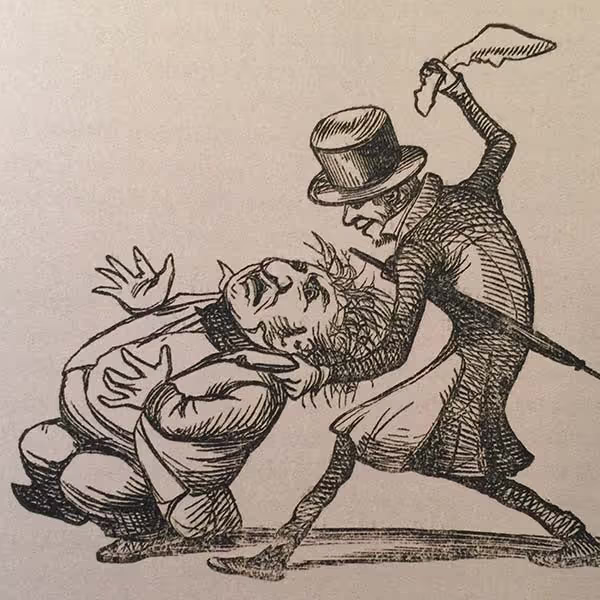
Beginning in early 1846, Meïr Goldschmidt led The Corsair to unleash a torrent of conspiratorial gossip and ridicule against Kierkegaard. Its pages gradually featured caricatured cartoons exaggerating Kierkegaard’s crooked spine, mockery of his eccentric outfits, and lurid tales spun around his former fiancée. Subscriptions soared as the public tuned in to watch the feud unfold.
The mockery spilled through the city’s cafés and street corners. Kierkegaard’s ritual walks and interactions with strangers were jeopardized as people would recognize his appearance in the streets and mock him openly. His book title Either/Or morphed into a catchphrase for being indecisive, and the name “Søren” itself became slang. Local university students staged a comedy whose chief buffoon bore the name “Søren Kirk.”
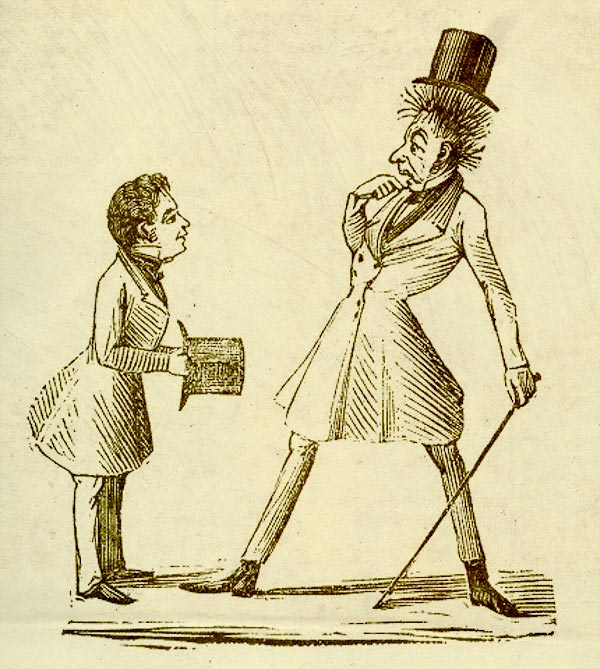
[.imgcaption]Kierkegaard and Goldschmidt in The Corsair. Illustration from Corsair no. 279, 1846. [.smalltext]Public domain.[.smalltext][.imgcaption]
The episode proved far more devastating than Kierkegaard had anticipated. He expected that his criticisms would provoke some controversy and perhaps irritate a few people, but he did not foresee the intensity or the personal nature of the backlash he would face. He was subjected to prolonged and deeply personal attacks that continued for months. The season of humiliation weighed heavily on his spirit. In his journals he would remember this entire experience simply as the “Corsair Affair.”
What pained him most, though, was not the ridicule but the silence of those he had counted as friends and allies. No one came to his side. Everyone, it seemed, was content to be a paying spectator to the drama, or feared getting too close and becoming targets themselves.
It is fitting but nonetheless tragic that the philosopher and champion of the “single individual” should himself have become a victim of the tyranny of the crowd.
[.article__subhead]The Phantom Public[.article__subhead]
The ordeal, predictably, only confirmed Kierkegaard’s view of the crowd’s blind infatuation with appearances and public opinion. Rather than withdraw, he renewed his critical authorship with new resolve. Writing in 1846 amid the Corsair Affair, he inaugurated his “second authorship” with Two Ages: A Literary Review.
Framed as a review of a novel by Thomasine Gyllembourg, Kierkegaard’s work soon broadened into a cultural diagnosis. Its central section, often excerpted as The Present Age, contrasts the passions of a revolutionary era with what he calls the “age of reflection.”
“A revolutionary age is an age of action; ours is the age of advertisement and publicity,” Kierkegaard writes. “Nothing ever happens, but there is immediate publicity everywhere.”[.footnote-link]3[.footnote-link] Where earlier generations had to risk everything on decisive choices (good or bad), the reflective age thrives only in appearance – reacting, commenting, and circulating impressions in an endless loop.
What Kierkegaard sees as missing in the modern age is passion – not mere intensity of feeling, but a single, unifying purpose that gathers and orders a person’s whole life. Without such passion, existence breaks apart into disconnected fragments, each governed by its own narrow concerns. The virtues no longer form a coherent character; they wander separately, untethered from any central commitment. In this condition, even the possibility of true, wholehearted virtue – or even genuine sin – fades away, replaced by a confusion of contradictions, postures, and incompatible “principles.”[.footnote-link]4[.footnote-link] Moral noise only increases, as each fragment insists on its own limited standard of right and wrong, with nothing higher to integrate them. As Kierkegaard remarks, “There is nothing for either the good or the bad to talk about, and yet for that very reason, people gossip all the more.”[.footnote-link]5[.footnote-link]
Out of this fragmentation arises something new – the public, a hollow substitute for genuine judgment. Where inward conviction falters, collective opinion steps in to bind the pieces together. But the bond it forges is thin and corrosive. Public opinion, Kierkegaard suggests, functions like an acidic pool: every act and thought which enters it is dissolved into a uniform solution. What emerges is a flat, standardized output where nuance is reduced to metrics and authority is measured by the size of the count. What remains is not genuine collective life, but a mass of unreal individuals “held together as a whole,” yet “never united in any actual situation.”[.footnote-link]6[.footnote-link]
For Kierkegaard, the despotism of “the public” represents not democracy’s realization but its grotesque fulfillment: a leveling power that smooths out real differences in the name of equality and replaces personal responsibility with the mere illusion of engagement. Committees, petitions, surveys – these are less tools of participation than props in a play where everyone can feel involved. “Now everyone can have an opinion,” Kierkegaard quips, “but they have to band together numerically in order to have one. Twenty-five signatures make the most frightful stupidity into an opinion.”[.footnote-link]7[.footnote-link]
What holds this abstraction together is envy, the “negative unifying principle” of modern life.[.footnote-link]8[.footnote-link] Envy does not look upward; it glances sideways, measuring its own worth by comparison, punishing excellence for the discomfort it causes. Yet even as it resents distinction, it cannot help but crave it. The result is a paradox of modern identity: in seeking to assert ourselves, we demand validation from a phantom audience. “That is the leveling process at its lowest” Kierkegaard warns, “for it always equates itself to the divisor by means of which everyone is reduced to a common denominator.”[.footnote-link]9[.footnote-link]
Long before our time, Kierkegaard intuited that expressive individualism and tribalism are not opposites but accomplices. Social media – something he could never have imagined yet seemed to anticipate – illustrates his nightmare rather starkly. What he described as “crowd action” now manifests as the churn of virtue signaling and algorithmic outrage, where nuanced convictions are diluted into prepackaged voting blocs, parties, and slogans.
The corrosion spreads inward. Kierkegaard would warn that the greatest danger of modern life is not excessive reading of the news or political activism, but the slow erosion of the self. The self comes to exist only as it is reflected back by others – dependent on being noticed, discussed, or displayed. In such an age, identity is constantly revised by the pressures of group opinion, until it dissolves like “sand and the sea” – a mass of interchangeable individuals who are regarded as significant only when gathered in large numbers.
Against this, Kierkegaard sets the true character born of “inwardness.” Here, a self is sufficiently formed and unified to hold its shape, as if “engraved,” rather than constantly redrawn by shifting opinion.[.footnote-link]10[.footnote-link] By contrast, he describes “ressentiment” as the “constituent principle of want of character, which from utter wretchedness tries to sneak itself a position, all the time safeguarding itself by conceding that it is less than nothing.”[.footnote-link]11[.footnote-link] ”One who seeks recognition from the crowd is compelled to become an abstraction, since the crowd is itself “everything and nothing” – everywhere present, yet far less real than “a single man, however unimportant.”[.footnote-link]12[.footnote-link]
By its very nature, the public is a phantom – an imagined collective whose approval can never truly be won because, in a real sense, it does not exist. It has no unity, no lasting identity, and no coherent will. It is, in Kierkegaard’s words, a “monstrous abstraction.” As such, its verdict is faceless, insatiable, and, in the end, as arbitrary and unforgiving as the rule of any tyrant. “No fictional pirate captain,” Kierkegaard reminds us, “has ever been as cruel as the demands of the age.”[.footnote-link]13[.footnote-link]
[.article__subhead]Called Out by Name[.article__subhead]
Kierkegaard, ever the paradoxical thinker, believed that the path forward was not to avoid self-conscious reflection but to go through it, to face it honestly. The true remedy was not to join the right faction or fine-tune the machinery of opinion, but to confront a deeper affliction. The true crisis was spiritual.
It is true, in fact, that we cannot have a self without being recognized. No one becomes a self in isolation. To exist as a self is always to stand in relation to something greater than ourselves – something real and distinct from us. Yet in an age dominated by abstraction, our avenues for genuine distinction and authority have been emptied of substance. Every meaningful institution is hollowed out while preserving the illusion of solid ground. The particular despair and unease we feel in a leveled world is not a new condition. It simply makes unavoidable the fact that we depend on recognition to understand who we are. This indeed is the self’s greatest need: to be personally known, to be addressed, to be called by name.
To recognize that hunger is already to know that something exists to satisfy it. What we seek cannot come from human approval alone. Even the best of friends, even those who love us deeply, can only know part of us and only from the outside. They may glimpse us truly, but never completely. It is God alone who fulfills the conditions of this ultimate knowing and responding. He knows us entirely – not partially or imperfectly but exhaustively. Indeed, he is nearer to us than we are to ourselves.
The highest form of individuality, then, is not to stand apart from others but the courage to “stand alone before God.” He calls each of us by name as the distinct person he made. And this calling is not reserved for the brilliant, the heroic, or the rebellious; it is “equally near every person.” No one is excluded, because the very reason we exist as selves is to live in relation to God. God takes the “single individual” far more seriously than we dare to imagine. Before Him, the crowd dissolves, and only the individual stands – fully known, fully exposed.
It is this encounter with personal responsibility that gives rise to the dread that precedes faith. It is not yet faith itself, but the threshold through which faith must be entered. In this moment, despair strips us bare. We are left with nothing to rely on – neither our relationships, nor our accomplishments, nor our moral comparisons with others – only the possibility of receiving God’s unearned recognition and love. It is here that the self truly begins, not in the sharpness of its self-awareness but in being loved: called forth, named, and sustained by God. This, ultimately, is God’s design for us: to give us our selves.
[.article__subhead]“Nothing at All”[.article__subhead]
The logic Kierkegaard outlined in The Present Age helps explain why he responded so fiercely to the trivialities of The Corsair.
For Kierkegaard, Møller’s review was merely the surface of the problem. The true adversary was the machinery of fashionable cynicism sweeping through modern culture. Beneath its cloak of anonymity and its pretense of commentary, the magazine’s writers had turned what we now know as rage-bait into a profitable art. It threatened to erode personal responsibility and to make identity a matter of tribal allegiance and trend chasing.
The danger, Kierkegaard believed, lay less in the content itself than in the complacency it fostered – a collective shrug that dismisses corrosion as harmless simply because it comes dressed as humor or as contrarianism.
“The misuse of the comic spreads so rapidly in our day,” he observed, “while everybody believes it is nothing at all – although they still read it and subscribe to it and talk about it as about no other paper.”[.footnote-link]14[.footnote-link] To those who might accuse him of overreacting, Kierkegaard invites us to consider that “perhaps the most dangerous temptations are those that come under the modest label of ‘nothing at all.’”[.footnote-link]15[.footnote-link]
His own willingness to play the fool was part of that conviction. In a culture eager to wave everything away as “nothing at all,” Kierkegaard sought to rescue individuality from the crowd.
And in the end, that is precisely what he did.
[.article__subhead]Victory Will Be Costly[.article__subhead]
On October 2, 1846 – the same year as the Corsair Affair – Meïr Goldschmidt resigned his editorship and sold his share of the magazine. Finances no doubt played a role, but a deeper unease seems to have driven his withdrawal. During the campaign, Goldschmidt appears to have flattered himself that Kierkegaard might take The Corsair’s mockery in stride, or even regard it as a form of mutual respect. Yet when Goldschmidt later met Kierkegaard in passing, the breach between them was palpable and, Goldschmidt realized, likely irreparable.
Goldschmidt found himself pondering anew Kierkegaard’s notion of a “higher right” – that ethical vision of comedy, fusing earnestness and jest. He may not have grasped it completely, but he at least recognized in Kierkegaard’s resolute conduct a profound moral integrity. Whatever Kierkegaard was pursuing felt more serious and spiritually anchored than the churn of scorn that had built Goldschmidt’s own reputation. In that recognition, Goldschmidt felt a gnawing sense of responsibility.
Not long after, Goldschmidt left political journalism behind for a career in fiction. In doing so, he soon became one of Denmark’s most distinguished novelists. Though The Corsair brand continued without him, its cultural influence declined considerably.
Looking back, Goldschmidt remembered his “victory” at The Corsair with unease. “There was something about [Kierkegaard’s] intense, wild glance,” he wrote, “that drew the curtain, as it were, away from the higher right that Kierkegaard had asserted earlier and that I had not been able, rather, was unwilling to see, although I did indeed suspect it. It accused and depressed me: The Corsair had won the battle, but I myself had acquired a false number one.”[.footnote-link]16[.footnote-link]
Kierkegaard, it seemed, had anticipated as much. “Goldschmidt’s victory was complete,” he wrote during the ordeal. “Everybody laughed – thousands and thousands. And yet his victory will be costly to him; he has me stuck in his throat.”[.footnote-link]17[.footnote-link] At least in this case, Kierkegaard achieved his goal: through his own humiliation, he redeemed at least one person from the crowd.
[.article__subhead]Patient No. 2067[.article__subhead]
The theme of suffering would follow Kierkegaard for the rest of his life.
On September 27, 1855, he once more became a figure of ridicule. That day saw the publication of a mocking pamphlet – Rhymed Epistle to Johannes the Seducer, Alias Dr. Søren Kierkegaard – written by a rural pastor who dabbled in poetry. The multipage poem targeted Kierkegaard’s recent irksome attacks on Denmark’s culture of “Christendom.”
The piece opened viciously, comparing Kierkegaard’s tongue to both a “slimy eel” and a “blade of steel.”[.footnote-link]18[.footnote-link] A cascade of taunts follow – sneers at his broken engagement, mockery of his philosophical puzzles, and contempt for the wealthy inheritance that had shielded him from material want. This pamphlet is just one example of Kierkegaard’s consistent ability to stir, unsettle, and confront the reading public.
Only days later, Kierkegaard’s life would near its end.
While walking through the streets of Copenhagen, he suddenly collapsed in pain and was carried to a hospital. There, the self-proclaimed voice of the “single individual” before God was, with grim irony, reduced to a bureaucratic designation: Patient No. 2067. For weeks he lingered in excruciating pain before dying on November 11, 1855, at the age of forty-two.
In his final days, before being admitted to the hospital, Kierkegaard sat at his desk to record what would become his last journal entry – “This Life’s Destiny, Understood from a Christian Point of View.”
“The destiny of this life,” he wrote, “is that it be brought to the extremity of life-weariness.” From that extremity, he wrote, a person “passes the examination of life and is matured for eternity.”[.footnote-link]19[.footnote-link] To rejoice in heaven, Kierkegaard said, is easy; the hard part is the schooling that prepares us for it. Yet even in such strain, the believer finds quiet, inward joy – joy not in his own achievement but in the mercy that makes endurance possible. “He will hear nothing of having done it himself,” Kierkegaard wrote. “He gratefully attributes all to God.”[.footnote-link]20[.footnote-link]