The Christian’s Fallback Position
The two great commandments of Jesus anchor the Christian life, and shed light on all kinds of situations.
June 3, 2026
Try 3 months of unlimited access. Start your FREE TRIAL today. Cancel anytime.
START FREE TRIAL NOWThe Christian’s Fallback Position
The two great commandments of Jesus anchor the Christian life, and shed light on all kinds of situations.
[.article__paragraph--cap][.small-caps]When a lawyer approached[.small-caps] Jesus with what he thought was a clever question, asking which commandment in the law was the greatest, he was not merely testing Jesus’ rabbinic knowledge. He was asking something that every thoughtful person eventually asks whether they realize it or not: when everything is on the line, when the pressure is on, and when I do not know what to do, what is the one thing I must get right?[.article__paragraph--cap]
Jesus’ answer in Matthew 22 is famous, perhaps too famous for us to feel its weight anymore. “You shall love the Lord your God with all your heart and with all your soul and with all your mind. This is the great and first commandment. And a second is like it: You shall love your neighbor as yourself. On these two commandments depend all the Law and the Prophets.”
Jesus is not merely ranking commandments as one might rank items on a list. He is giving us what I want to call a fallback position, a default posture for Christians when the map runs out. And it may be that recovering this sense of the two great commandments as our default is one of the most urgent tasks for the church in our moment.
Every Christian eventually discovers that the moral life is more complicated than a rulebook. Scripture is sufficient, yes, and it speaks to every area of life. But it does not address every area with the same specificity. The Bible tells me not to bear false witness, but it does not tell me whether to take the job in Dallas or stay in Pittsburgh. It tells me to honor my father and mother, but it does not tell me how to navigate a conversation with an aging parent whose memory is failing and dignity is slipping away. It tells me not to steal, but it does not tell me what to do when a colleague is being treated unjustly and speaking up might cost me my position, reputation, or livelihood.
This is where most of us live most of the time. Not in the territory of clear prohibition, but in the vast middle country of genuine ambiguity. And it is precisely here that we are most tempted to default to something other than the gospel. We default to self-protection. We default to what will make us look good, or at least not look foolish. We default to tribal loyalty, to what our political party, our social media feed, or our circle of friends tells us to feel. We default, in short, to idols. Some of these idols are obvious, the old familiar ones of money, sex, and power. But many of them are respectable, even admirable sounding. We default to “taking care of my family,” which sounds wonderful but can become a permission slip for greed. We default to “being authentic,” which sounds good but can include being cruel. We default to “standing up for what’s right,” which sounds right but can be tinged with contempt.
Jesus’ teaching in Matthew 22 is the antidote to all of this. He tells us that when you do not know what to do, there is a place to stand. There is a default that will never fail you. Love God. Love your neighbor. Everything else, he says, “depends” on these. The Greek word there, krematai, suggests a door hanging on its hinges. Without the hinges, the door is just a slab of wood.
Without these two commandments, all the other commandments become disconnected rules we can use to justify almost anything.
And this is really the heart of the matter. The commandments of scripture are not meant to be a set of discrete obligations that we weigh against one another. They are the shape and texture of what love looks like when it is lived out in the concrete circumstances of human life. When we forget this, we become the very people Jesus criticized, those who tithe their mint, dill, and cumin while neglecting the weightier matters of the law (Matt. 23:23). We can be scrupulously obedient in small ways while utterly missing what God actually wants from us.
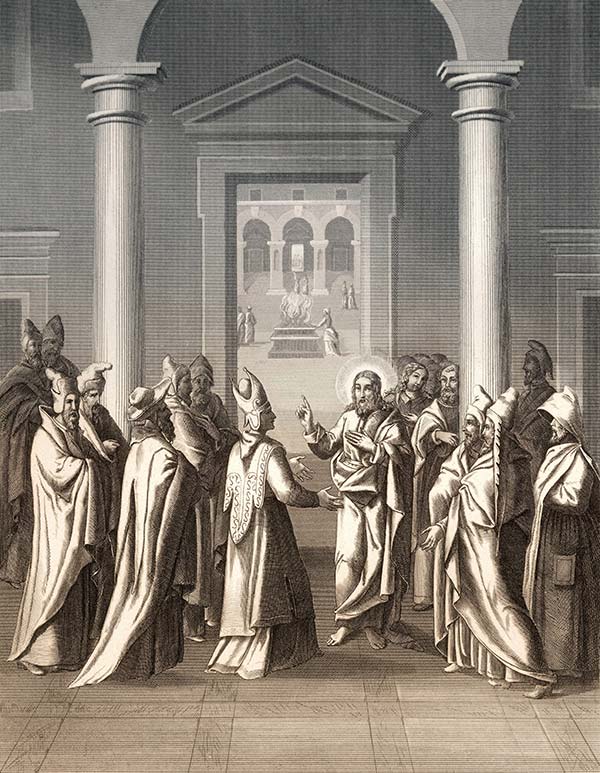
[.imgcaption]Rouargue brothers, The Great Commandment, New Testament, steel engraving 1853, digitally restored. [.smalltext]Image from Alamy Stock.[.smalltext][.imgcaption]
Here is a peculiar danger for the person who has been a Christian for a long time. The longer you walk with Christ and the more you know the Bible, the more material you have to rationalize whatever you wanted to do anyway.
I have watched this happen in countless lives and felt it in my own. A man wants to leave his wife, and suddenly he becomes fluent in the biblical passages about freedom in Christ and the dangers of legalism. He will tell you, with great sincerity, that God does not want him to be unhappy, that his marriage was never really a marriage, and that grace gives him permission to start over. A woman wants to cut off her brother, and she discovers a theology of boundaries she had never noticed before. She will cite verses about not casting pearls before swine and about shaking the dust off your feet. A congregation wants to exclude a certain kind of person, and they find the verses about holiness and separation that now seem especially pertinent. We become, in a word, sophisticated. We can build a biblical case for nearly anything if we are determined enough.
I want to be careful here, because I am not suggesting that all appeals to scripture in difficult situations are rationalizations. Of course, they are not. Sometimes freedom in Christ really is what a person needs to hear. Sometimes boundaries really are appropriate. Sometimes church discipline really is called for. The question is whether we are using the Bible to serve love or to justify our own decisions.
Jesus’ fallback position cuts through this. You may be able to convince yourself that some complex scriptural argument permits you to do what you want. It is much harder to convince yourself that what you want to do is actually an act of love toward God and your neighbor. The two great commandments are a kind of solvent. They dissolve our rationalizations. They strip away the sophistication and ask the simple, devastating question: Is this love?
The next time you find yourself building a case for a course of action, ask yourself whether you could stand before Jesus and say, “Lord, I am doing this because I love you with all my heart, and because I love this person as I love myself.” If that sentence sticks in your throat, pay attention to why. That hesitation is the voice of the Holy Spirit, and the two great commandments are the instrument through which he speaks.
I want to be clear about what I am and am not saying. When I call the two great commandments a fallback position, I do not mean they reduce Christianity to ethics. This is a common modern move. Liberal theology spent much of the twentieth century trying to reduce Christianity to the ethical teachings of Jesus, stripped of the atonement, the resurrection, and the trinitarian vision of God. The result was not a purer Christianity but a shadow of it, one that has been steadily disappearing ever since. You cannot sustain the radical ethics of Jesus without the reality of Jesus. “Love your enemies” is just a beautiful sentiment if detached from the cross, but because of the cross it is a commandment we can actually obey.
The two great commandments are not a substitute for the gospel. They are what the gospel produces in those who have truly received it. Notice the order Jesus gives. Love God first, with everything in you. You cannot love your neighbor rightly until you love God rightly, and you cannot love God rightly until you have been loved by God in Christ. The love of God for us in the death and resurrection of Jesus is the fuel. The two great commandments are what that fuel looks like when it is burning.
Think of it this way. If someone tells you to love your neighbor but gives you no resources to do so, the command is cruel. It simply adds another weight to the already crushing burden of being human in a broken world. But if someone tells you to love your neighbor because you have been loved beyond measure, forgiven infinitely, and have a Father in heaven who delights in you and a Savior who bore your shame, then the command is liberation. You are not being asked to draw love from your own empty tank. You are being asked to extend to others what has been poured into you in overwhelming abundance.
So when I call this a fallback position, I mean something specific. I mean that this is where the Christian returns when other guidance is unavailable, because this is the fundamental shape the gospel is creating in us. The gospel is not primarily making us theologically precise, though it should. It is not primarily making us morally upright, though it should. It is primarily making us loving, with a love that flows from having been loved. If our theology is not producing love, our theology is wrong somewhere, even if every individual doctrine we hold is technically correct.
This is why Paul says in 1 Corinthians 13 that he could have all knowledge and all faith and still be nothing without love. It is not that knowledge and faith are unimportant. Paul spent his life fighting for right knowledge and right faith. But knowledge and faith that do not produce love miss the whole point.
So, when facing a decision where scripture does not speak directly, ask two questions: Which option reflects greater love for God? Which option reflects greater love for my neighbor? When you find yourself building an elaborate case for a course of action, pause. Sophistication in moral reasoning is not wrong, but it is a warning sign. The test is not whether your argument is watertight, but whether your conclusion is something you could describe, without embarrassment, as love.
When you are in conflict with another Christian, return to the default together. So many church splits, ruined friendships, and broken families within the body of Christ happen because both parties are armed with Bible verses and neither asks whether they are loving. The two great commandments are not only a personal fallback, they are a communal one. They are where the church can return when the church has lost its way.
When the cultural moment pressures you to adopt a particular stance, return to the default. We live in an age of tremendous tribal pressure. The Christian in America, left or right, is constantly told what the faithful position is on the latest controversy, and the tribal position is always presented as the obvious and righteous one. If we let them, the two great commandments force us to ask a different question. Not “what does my tribe think?” but “what does love require?” You will often find that love requires things your tribe does not want to hear. Love requires tenderness toward the very people your tribe has identified as the enemy. Love requires telling the truth when your tribe would prefer silence. Love requires listening when your tribe would prefer to shout. The Christian who defaults to the two great commandments will never feel fully at home in any political or cultural tribe, and that is as it should be.
Lastly, when you are alone, when no one is watching, return to the default. This is the deepest test. What we do when no one is watching reveals most clearly what we love. A person who defaults to the two great commandments only in public, for the sake of appearance, has not actually made them the default. But a person who returns to these two loves in the quiet moments, in the decisions no one will ever know about, and in the thoughts they allow themselves to entertain is becoming the kind of person who will be faithful in little matters as well as larger ones.
Notice how Jesus phrases the first commandment: “Love the Lord your God with all your heart, with all your soul, and with all your mind.” Jesus is quoting Deuteronomy, but in doing so, he offers us a vision of human wholeness that cuts against both ancient and modern reductions.
In the ancient world, philosophical traditions elevated the mind above the heart, while religious traditions elevated ecstatic experience above rational thought. In our own time, we have inherited both tendencies and added our own. There is a strain of Christianity that is all about doctrinal precision and treats emotion with suspicion. There is another strain that is all about experience and feeling and treats doctrine with suspicion. Jesus will have neither.
Love God with all your heart, Jesus says. Your affections must be engaged. A Christianity that does not stir the heart, that does not produce longing, delight, sorrow, and joy, is not the Christianity of Jesus. But also, love God with all your mind. Your thinking must be engaged. A Christianity that does not produce serious thought, that is unwilling to wrestle with difficult questions and pursue truth wherever it leads, is not the Christianity of Jesus either. The fallback position includes the whole person. It is neither primarily intellectual nor primarily emotional. It calls us to be undivided in our devotion.
This matters enormously for how we apply the two great commandments as our default. When we ask, “Is this love?” we are not merely asking, “Does this feel loving?” Feelings are notoriously unreliable guides. What feels loving in the moment may be sentimentality or cowardice dressed up as kindness. But we are also not asking merely, “Is this theoretically justified as love?” Theory can be manipulated. What we are asking is something deeper and harder: does this action, in its fullness, represent what a whole person, with heart and mind and soul aligned, would do as an expression of love for God and neighbor?
These two commandments are not simple. They look simple. A child can memorize them. But loving God with all your heart, soul, and mind, and loving your neighbor as yourself, is the work of a lifetime. It is not a floor we can reach and then move on from. It is an ocean we can spend our whole lives exploring without ever reaching the bottom.
Think what it would mean to love God with all your heart. Not the parts you are willing to spare after attending to your other loves. All of it. This is something no human being has ever fully accomplished; it is something we are being shaped toward. Every time we choose God over an idol, we grow in this love. Every time we worship when we do not feel like it, pray when we are distracted, give when it costs us, or forgive when we would rather retaliate, we grow in this love. The commandment is infinite in scope, but it is not abstract. It shows up during specific moments every day.
Think what it would mean to love your neighbor as yourself. Not to love your neighbor while prioritizing your own comfort, nor to love the idea of your neighbor, but to love the specific human being in front of you, with all their irritating habits, unreasonable opinions, and frustrating choices, with the same attentiveness and care you naturally give yourself. This too is the work of a lifetime, and no one finishes it.
This is the beauty of Jesus’ answer. He gave the lawyer, and he gives us, a fallback that can never be exhausted. When you do not know what to do, return here. You will not find a formula. You will find a God who loves you, a neighbor who needs you, and a Savior who died to make both possible. You will find that the simplicity of the command contains the entire moral universe, and that the entire moral universe, in the end, is only the outworking of love.