Essay
Wendell Berry’s Wisdom for Living in Time
Each Sunday for decades, Wendell Berry has taken a walk around his Kentucky farm and often written a poem.
May 30, 2026
Try 3 months of unlimited access. Start your FREE TRIAL today. Cancel anytime.
START FREE TRIAL NOWWendell Berry’s Wisdom for Living in Time
Each Sunday for decades, Wendell Berry has taken a walk around his Kentucky farm and often written a poem.
[.article__paragraph--cap][.small-caps]The remarkable record[.small-caps] of a long, faithful, creative life, Wendell Berry’s collected Sabbath poems span over forty-four years, from 1979–2023. These poems are a record of Berry’s Sunday morning habit, walking his small hillside farm in Kentucky, and, if inspiration strikes, writing a poem about his thoughts. Berry explains that he is a “bad-weather churchgoer,” preferring, when the Sunday weather is nice, to be out walking in the woods, over hills, and along streams. On these Sabbath walks, he experiences a freedom from expectations – other people’s and also his own. “I go free from the tasks and intentions of my workdays,” writes Berry, “and so my mind becomes hospitable to unintended thoughts: to what I am very willing to call inspiration.” These “unintended inspirations” contribute to an expanded time-consciousness across his Sabbath poems, which now number over four hundred and fill two collected volumes, This Day (2013) and Another Day (2024). In these poems, Berry shows us how to access other layers of time beyond our restless, ordinary temporality in a way that speaks both to our modern exhaustion and our longings for transcendence.[.article__paragraph--cap]
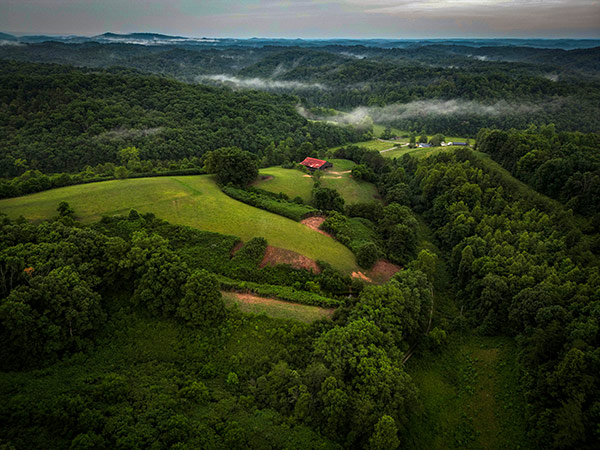
[.imgcaption][.smalltext]Photograph by Ben Sovine / Unsplash.[.smalltext][.imgcaption]
Because of the rhythmic nature of the Sabbath (the fact that it happens every seven days) and the longevity of Berry’s project (the fact that he began his Sabbath poems in middle age and has continued this project late into his eighties), it’s not surprising that time emerges as a major theme across this collection. The poems are organized chronologically, and capture decades of seasonal cycles – the transitions from winter to spring, the appearance of the year’s first wildflowers, the birth of lambs. Although some years have more poems than others, throughout the collection, multiple poems return to commemorate Easter, his wife Tanya’s birthday, their anniversary, and a growing awareness of his age, lending the collection a feeling of the cycle of years passing. Many poems explicitly meditate on the nature of time and eternity. “Eternity is not infinity. It is not a long time,” Berry writes in “Sabbath XIII, 2005”
[.blockquote]It does not begin at the end of time.
It does not run parallel to time.
In its entirety it always was.
In its entirety it will always be.
It is entirely present always.[.blockquote]
This eternity that is “entirely present always” is a theme that Berry visits time and again. “Everything worthy is fragile and under threat, is prey to time and invisible to power…. Worthy things, invested with affection, pass into ‘the now / which is eternal,’” he restates in a 2007 essay – and in a Sabbath poem from the same year, the ‘eternal present’ again echoes: “where we are, / as in the deepest sleep also / we are entirely present, / entirely trusting, eternal.”
Berry’s meditations on time are often self-reflexive, turning inward to the poet’s relation with time. In “Sabbath II, 2013,” he describes making poems as gathering fragments in an attempt to tell the story of eternity:
[.blockquote]He is a gatherer of fragments, a cobbler
of pieces. Piece by piece he tells
a story without end, for in the time
of this world no end can come.
It is the story of eternity’s shining,
much shadowed, much put off,
in time. And time, however long, falls short.[.blockquote]
The image of the poet as gatherer is reminiscent of Augustine’s beautiful meditations on time in Confessions. According to Augustine, God’s eternity gathers up all our time, our past, present, and future, our aging bodies, everything we have lost over time. Augustine contrasts God, who is perfectly unified, with humans, the “many, who live in a multiplicity of distractions by many things.” In the Confessions he writes, “You are my eternal Father, but I am scattered in times whose order I do not understand. The storms of incoherent events tear to pieces my thoughts, the inmost entrails of my soul, until that day when purified and molten by the fire of your love, I flow together to merge into you.”
Like Augustine, Berry experiences his story in a fragmentary, piecemeal sort of way and longs for eternity’s story. He senses its shining in a shadowy sort of way. As a writer of faith living in a secular age, Berry’s poems bridge the gap between our modern, secular experience of time and older views of time, such as Augustine’s, that are more imbued with the sacred.
[.article__paragraph--cap][.small-caps]In his book A Secular Age,[.small-caps] philosopher Charles Taylor explains that one aspect of living in a secular age is that we inhabit time in a very limited, impoverished way. An important part of the story of secularization is the shift in time-consciousness away from a premodern view of time as a multilayered, complex interplay between ordinary time and higher times, which include sacred time, eternity, and an ancient “time of origins.” Higher times in premodernity gave meaning and shape to ordinary time. According to Taylor, “they gathered, assembled, reordered, punctuated profane, ordinary time.” In particular, the Christian liturgical year created a feeling that Christ’s incarnation, crucifixion, and resurrection were very near on sacred days and could be re-experienced, not in the sense of being remembered as something from the past, but in the sense of being eternally present and accessible through the mystery of kairotic, sacred time. Taylor contrasts this view with our everyday experience, where the disciplines of our modern civilized order have reshaped our understanding of time, and time has come to be understood as a “precious resource” that cannot be wasted. The result, this “tight, ordered time environment,” has confined us, to the point that has come to seem like nature. This “time frame,” Taylor writes, “deserves, perhaps more than any other facet of modernity, [Max] Weber’s famous description of a stahlhartes Gehäuse (iron cage). It occludes all higher times, makes them even hard to conceive.”[.article__paragraph--cap]
It is, indeed, hard for me to even conceive of living in multiple layers of time, of higher times, which touch our ordinary times and gather them up in such a way that, as Charles Taylor might put it – Good Friday 2026 is, in many ways, closer to the original day of the Crucifixion than midsummer’s day 2025. Yet in the Sabbath poems, Wendell Berry is able to capture the iron cage of our modern time frame while gesturing toward a time-consciousness that includes higher times.
[.article__paragraph--cap][.small-caps]Our empty modern view[.small-caps] of time leads us to view it as a commodity, to try to cram as much as possible into our days, to measure our worth by what we can accomplish, and to ascribe to an unwise view of progress. An early Sabbath poem from 1979, in which time is compared to a relentless mill, captures these dilemmas well. To those who must “turn in time’s mill,” there is no rest:[.article__paragraph--cap]
[.blockquote]They wind the turns of the mill
In house and field and town;
As grist is ground to meal
The grinders are ground down.[.blockquote]
There is a healthy exhaustion from good work that lets us enjoy the rest of sleep and Sabbath, but here Berry is talking about work that feels unrelenting and purposeless. As Charles Taylor explains, we moderns cope with “empty, homogenous” time through discipline and routine. But “the disciplined routines of everyday life in civilization become highly problematic…. They can come to seem a prison, confining us to meaningless repetition, crushing and deadening whatever might be a source of meaning.” These confining routines are regularly alluded to in the Sabbath poems, particularly through the recurring motif of cars, which appear most obviously as images of the modern machine economy, though they are also emblematic of the way we have come to inhabit time. Our frenetic driving around allows us to squeeze more into our days. We can cover so much distance in our cars, filling more of our twenty-four hours with activity, and maximizing both space and time. In “Sabbath I, 1989,” Berry writes:
[.blockquote]In early morning we awaken from
The sound of engines running in the night,
And then we start the engines of the day.
We speed away into the fading light.
Nowhere is any sound but of our going
On roads strung everywhere with humming wire.
Nowhere is there an end except in smoke.
This is the world that we have set on fire.[.blockquote]
In a later poem, “Sabbath V, 1988,” he again describes the sound, “always in the distance,” of cars passing on the road – “that simplest form going only two ways, both ways away.” This description of a road is such a vivid image for how we often feel as if we are going and going yet not getting anywhere. Like the grist mill, it is an image of how meaninglessly busy our lives often feel. “But now,” Berry turns and declares, “I rest and am apart, a part of the form of the woods always arriving from all directions home.” The ever-present sound of passing cars – all going – is displaced by the “always arriving” of the “cell of wild sound, the hush of the trees, singers hidden among leaves.”
[.blockquote]a form whose history is old,
needful, unknown, and bright
as the history of the stars
that tremble in the sky at night
like leaves of a great tree.[.blockquote]
This is the same dispersing and gathering imagery that we saw earlier. The road, the cars, our ordinary experience of time, all have a scattering energy, while the Sabbath and the woods exert a gathering power that instead, “from all directions,” brings him home. Berry describes an attention in the woods that is at once focused on the present and part of something ancient, “a form whose history is old … as the history of the stars.”
In the Sabbath poems, Berry draws on older concepts of time to express both our exhausted discouragement as moderns trapped in empty, secular time – a time that “leaves us standing blind in our dust” – and our hope for more meaningful, expanded experiences of time. These are poems of slowing down and really seeing, of understanding that focusing on the present acts as a portal to eternity. The final stanza of “Sabbath IV, 2007” leads with a question: “Is it concentration of the mind, / our unresting counting / that leaves us standing / blind in our dust?” Berry’s answer is succinct, guiding the anxious mind, once again, to the present:
[.blockquote]In time we are present only
By forgetting time.[.blockquote]
In his 2015 essay, “On Being Asked for a Narrative for the Future,” Berry dismisses the question outright: “So far as I can see, the future has no narrative. The future does not exist until it has become the past.” He turns instead to the Sermon on the Mount, Matthew 6:34: “Take therefore no thought for the morrow: for the morrow shall take thought for the things of itself. Sufficient unto the day is the evil thereof.” For Berry, the Sabbath is restorative not only because it offers an opportunity to rest in nature from our daily work, but also because it invites us to deliberately practice the Sermon – to transcend our ordinary time-consciousness and touch the eternal.