Samba for Jesus
The rise of a Christian subgenre of samba in Brazil reignites old debates about cultural appropriation and whether any music can glorify God.
May 29, 2026
Try 3 months of unlimited access. Start your FREE TRIAL today. Cancel anytime.
START FREE TRIAL NOWSamba for Jesus
The rise of a Christian subgenre of samba in Brazil reignites old debates about cultural appropriation and whether any music can glorify God.
Rain poured down and a chorus of voices mingling with percussion echoed from one brightly lit front porch, breaking the evening quiet along a residential street in Rio de Janeiro’s northern zone. A dozen men sat on stools, strumming string instruments and beating drums of all shapes and sizes, singing their hearts out. At first glance, the scene would have appeared to be a classic roda de samba – a traditional Brazilian gathering where musicians sit in a circle to perform samba. But the large poster hanging behind the musicians, emblazoned with “Project Samba with Christ,” signaled a different kind of roda, as did the lyrics that rang out: all the songs praised God.
Samba is at the heart of Brazil’s identity. Every year, on December 2, Brazilians pay homage to this musical tradition during celebrations of the National Day of Samba. Many historians trace samba’s earliest forms to communities of formerly enslaved people in the northern state of Bahia, while samba as we recognize it today was shaped and popularized in the Afro-Brazilian neighborhoods of Rio in the 1920s. Characterized by syncopated rhythms, samba has a plethora of variants, including bossa nova, samba funk, and samba reggae. There is also samba enredo, composed for the famed Carnival parades and addresses immediate social and cultural themes; samba de gafieira, with faster, stronger rhythms to accompany ballroom dancing; and samba pagode, recognizable by its romantic lyrics and repetitive beat.
Since the early 2000s, a new subgenre has been gaining popularity: samba gospel. The usual suspects of samba can be found: instruments such as pandeiro, cavaquinho, surdo, reco-reco. The rhythms, too, are recognizably samba, but the lyrics are about God. Gospel music already draws a large audience, to the extent that in 2024, a law was signed establishing June 9 as the Brazilian National Day of Gospel Music. That same year, Spotify recorded a 46 percent increase in the number of listeners of gospel music in Brazil, and gospel music now accounts for approximately 20 percent of the Brazilian recorded music market, establishing favorable conditions for related subgenres, such as samba gospel, to gain traction.
Photograph by Apolline Guillerot-Malick. Used by permission.
Many Evangelicals regard samba with suspicion due to its roots in Brazil’s Afro-descendant communities, where many practice religions such as Candomblé or Umbanda, which blend African spiritual traditions with elements of Catholicism. While that suspicion is still predominant, a growing minority sees the musical genre as a gift from God that may be an effective tool for conversion. On the other end of the spectrum, some antiracist activists and defenders of Afro-Brazilian culture view samba gospel as cultural appropriation and another attempt to erase or transform their culture. “There is a perception that Brazilian samba loses out, especially in its lyrics, because of the content,” suggests Carly Machado, an anthropology professor at the Rural Federal University of Rio de Janeiro. “You’re no longer going to talk about beer, drinking, or women; you’re not going to use eroticism.”
The rise of samba gospel is intertwined with the growth of Evangelicalism in Brazil, particularly in Brazil’s low-income communities, where many inhabitants are black. According to Brazil’s national statistics agency, between 2010 and 2022 the number of Evangelicals increased by 5 percent, rising to 26.9 percent of the population. For many years, conversion required “separation from the world,” distancing oneself from one’s cultural heritage and secular musical genres, says Machado. But as Evangelicalism – and particularly Pentecostalism – has become increasingly widespread, a shift has occurred. New converts nowadays more frequently keep their connection with samba.
Rev. Adriano Sued converted to Evangelicalism twenty-three years ago. He had always loved samba and played cavaquinho, a small four-string guitar. When he first converted, he gave up samba and put the cavaquinho away. One day, he found the instrument on top of his wardrobe, covered in dust. He cleaned it up, tuned it, and started to praise God. “Tears began to fall, and I discovered that I could worship my God with the instrument he gave me to play,” he said, sitting on the front porch of the house where the Project Samba with Christ members had gather for worship and samba gospel songs. “Samba gospel is just another tool of the Lord. You attract people to the core of the message, which is life in Jesus Christ,” he added. “What sets me apart from the conventional samba musician? Only the message.”
Sued founded Project Samba with Christ nineteen years ago. Members gather once a week for a service and for another meeting out on the streets where, Sued says, they “announce Jesus Christ.”
Many of those present that hot, rainy evening had traveled from faraway neighborhoods to participate in the service. Behind the circle of musicians a row of white plastic lawn chairs – ubiquitous throughout Latin America and recently rendered famous on the cover of Bad Bunny’s Grammy-winning album Debí Tirar Más Fotos – were occupied by a few children and their mothers, while a fan whirred and dispersed mosquitoes. Golden, glittering letters formed the word “Jesus” above the door leading inside, next to a sign instructing: Você pode tudo, menos desistir. “You can do everything apart from give up.”
One man’s voice distinguished itself from the others. Flávio da Silva Gonçalves, known as Flavinho Silva, explained after the service that he had once been relatively famous in the world of secular samba. A member of the celebrated Fundo de Quintal group, he also recorded songs with hit artists Diogo Nogueira and Beth Carvalho. But in 2013, he was hospitalized for six months due to a cerebral lesion. He told God that if he was given another opportunity to live, he would do everything differently. At the hospital, Silva met his future wife, who took him to her local church. “From that moment on, I never again left the presence of Jesus Christ.” Silva believes his recovery was a miracle.
Silva, a man with a wide smile, smart black shirt, and navy-blue jeans, said his conversion forced him to make a choice. Secular samba is problematic for Evangelicals because of its lyrics, and, for some, because of the rhythms, which they believe invoke other deities or sinful passions. “These songs generally have an upbeat melody. During the refrain, people sing with all their hearts,” said Silva. “When you speak about these things, you attract them. We must be very careful.”
Before Silva’s conversion, he composed a song titled “Faith in God,” which has become one of samba gospel’s most popular tracks. The song goes:
For those who think that life doesn’t have hope – faith in God!
For those who extend a hand and help a child – faith in God!
For those who think that the world has ended;
For those who have never known love;
Have faith, go in faith –
Never lose faith in God.
The fact that he composed the song before his conversion is a sign of the power of God, Silva believes. Nowadays, he performs the tune in churches and other ecclesiastical environments. “I’m certain that I’m doing God’s will, because the gift he gave us is irrevocable.”
Many believers remain unconvinced that samba can be used for evangelizing and continue to associate Afro-Brazilian practices with malevolent spirits. This perception is intertwined with racist attitudes that persist in Brazil, where nonwhite citizens, often descendants of enslaved people, face higher rates of police violence, poverty, unemployment, and discrimination than white people. Authorities have historically demonized Afro-Brazilian belief systems, and that perception permeates Brazilian society. A 2023 report by researchers from the Observatory of Religious Freedoms in partnership with UNESCO showed that religious intolerance rose in Brazil between 2019 and 2021, and that most of those who committed the attacks had been Evangelicals.
Sued says that the criticism he faced for advocating samba gospel when he first started was extremely sharp. The disapproval has since diminished, but he also now pays less attention to it. “If God wants to convince them that samba saves, heals, and liberates like any other song of worship, great,” he says. “But if not, that person is going to heaven anyway.” Nowadays, he focuses his energy on those who are not Christian and spends less time on people who are already part of the church.
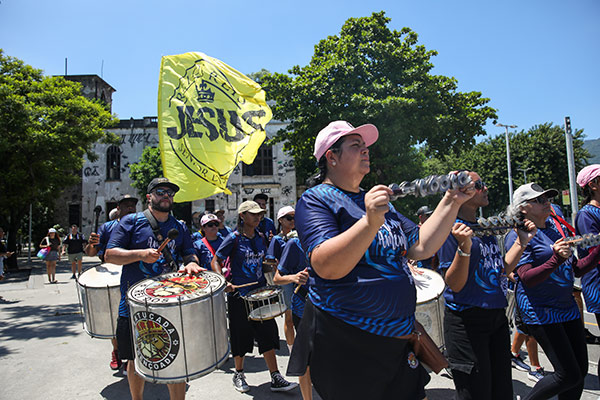
Rev. Francisco, a pastor at the Bola de Neve (Snowball) Church, also in Rio’s northern zone, takes a similar approach. In the middle of Carnival, he is with the church’s Batucada Abençoada (Blessed Beats) group – made up of percussionists, complete with surdos, caixas, tamborins, and pandeiros – who, in 2019, broke the Guinness World Record for the largest Brazilian drum ensemble. During this year’s Carnival, they planned more than fifteen events across Rio de Janeiro and São Paulo states, including one meeting that started at 10 a.m. on the fourth day of Carnival near the Maracanã soccer stadium. Under a scorching sun, with street parties already well underway, two dozen uniformly dressed members had convened; an expansive yellow flag proclaiming “King of Kings, Lord of Lords, JESUS” floated above them. Wearing sunglasses and sunhats, they made their way around the stadium, chanting, “When it’s for Jesus, it’s so much better!” as a group of volunteers accompanied them, handing out leaflets to curious passersby, promising, “It’s possible to be born again.”
“Those who don’t do anything want to criticize those who do something,” Ortiz says. Unlike those who perceive any contact with Carnival as dangerous and likely to lead to sin, he sees evangelizing during this time as essential. Festivities in Rio take over much of the city. Raucous street parties composed of stilt artists, wind instruments, and percussionists attract thousands of often intoxicated, scantily clad, glitter-covered revelers. At night, samba schools march down the central avenue of Rio’s Sambadrome, a huge arena designed by Oscar Niemeyer especially for parades. Evangelizing efforts during Carnival are primordial because it’s a time of “prostitution, drugs, and sexuality,” according to Ortiz. He says Bola de Neve is a church that stays to fight the war “against the devil and hell.”
While Ortiz sees traditional, secular samba as “very linked to mysticism and magic,” he has no issues with samba gospel. But, like positive attitudes toward samba gospel, the perception that Carnival is a good time of year to hit the streets and evangelize continues to be marginal. Martijn Oosterbaan, an anthropology professor at Utrecht University in the Netherlands, who has conducted fieldwork on the subject in Rio, notes that “suspicion is still the dominant frame.” Particularly in the case of Carnival, “a lot of friction still surfaces because it’s so related to a whole universe of Afro-Brazilian forces, energies, legacies, and so forth.”
Carnival is not the only massive celebration in Rio that generates tensions, and it can come from different directions. For the second year running, a stage set up on Copacabana Beach – one out of thirteen dotted across the city for New Year’s Eve – was dedicated to gospel music, including a performance by samba gospel artist Marcados Pagode Gospel. But no similar stage was set up for performers of Afro-Brazilian religions, illustrating, according to critics, the authorities’ persistent unequal treatment of religions. “When one religion receives infrastructure, visibility, and institutional funding, while others are pushed into invisibility, there is no equity,” says Ivanir dos Santos, a history professor at the Federal University of Rio de Janeiro and a Candomblé priest. Prosecutors have opened an investigation to determine if the decision to allow a stage exclusively for gospel music amounted to religious discrimination.
Popular festivities of Rio’s New Year’s Eve, where millions of people dressed in white bathe in the sea and offer gifts to the Goddess of the Sea, Yemanjá, are rooted in Afro-descendant practices. “This is the origin that many politicians, many figures ignore – that they simply close their eyes to,” says Léo Mattos de Xangô, a geography professor at the Federal University of Rio de Janeiro. As well as a professor, Mattos de Xangô is also a follower of Umbanda and a human rights activist. He says the problem with samba gospel, more widely, is that it portrays traditional, secular samba as the work of the devil. “I don’t think there is an attempt at a healthy blending of cultures; rather, there is a process of appropriation and a process of denying the origins and the roots of these rhythms,” he says. Evangelicals, Carly Machado adds, erase lyrical references to Afro-Brazilian deities known as orixás as well as certain rhythmic structures; both lyrics and sound are “cleaned up.”
Silvia Fagá is the founder of a forty-member strong Evangelical percussionist group in São Paulo called Bloco Idê. She identifies as conservative but laments Brazil’s political polarization and believes the gospel is above such divisions. Passionate about Brazilian culture, she believes churches in the country should embrace Brazil’s culture rather than look abroad for musical influence. Asked about the accusations of cultural appropriation, she strongly refutes them. “I’m as Brazilian as anyone from any other religion. It’s part of my culture, of who I am, of what I live,” she says. “I think all things come from God. All inspiration comes from him, all creativity comes from him, including our capacity to create diverse cultures.”
Back in Rio on that rainy weekday evening, Sued said that all samba should exclusively praise God – and not only that genre. “Rock, rap, all rhythms belong to the Lord. If humanity were with God, the world would be better off.”
That perspective has sparked fears of samba gospel taking over samba and diluting it. But both Machado and Oosterbaan agree that samba is too deeply rooted and too embedded in Brazilian culture to be truly at risk. “People sometimes believe that the church captured samba, but I think that samba invaded the church. Samba forced its way in,” says Machado. “Samba expanded – it took on more functions.”