Essay
Will There Be Books in Heaven?
And will AI-generated books go to hell?
August 21, 2026
Try 3 months of unlimited access. Start your FREE TRIAL today. Cancel anytime.
START FREE TRIAL NOWWill There Be Books in Heaven?
And will AI-generated books go to hell?
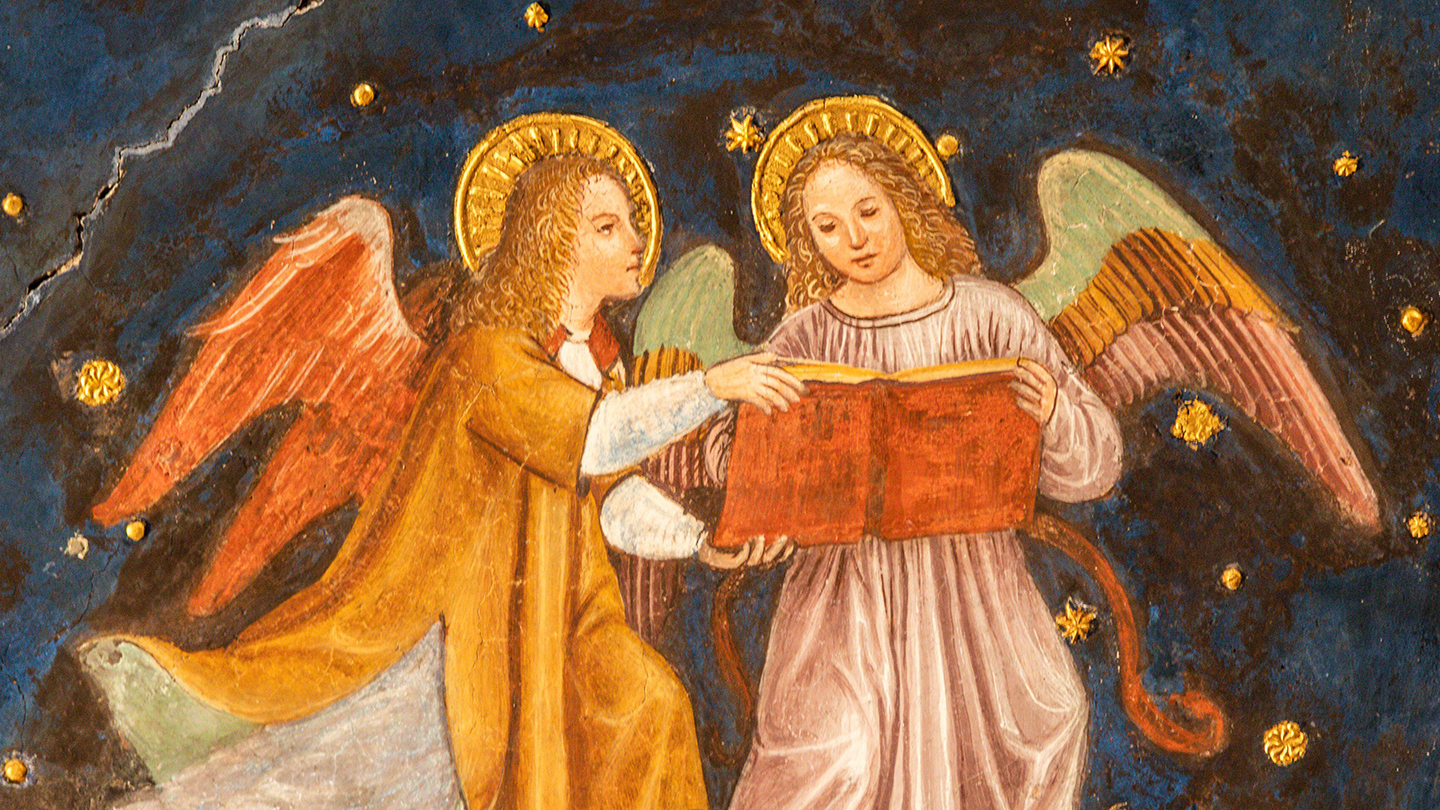
Fresco in San Maurizio al Monastero Maggiore. [.smalltext]Photograph by Perseomedusa / Alamy Stock.[.smalltext]
[.article__paragraph--cap][.small-caps]In one of those[.small-caps] meandering conversations of the post-service coffee hour, a member of our church looked forward to the leisure of heaven: there would be so many good books to read. Not so fast, said our pastor. There won’t be books in heaven. What would we need them for?[.article__paragraph--cap]
My wife and I were aghast: we too had been counting on eternity to finish the piles of books cluttering our home (always growing, despite our vague threats to eventually “go through” them). We also thought theology was on our side. God’s creation is good, and in “the new heavens and the new earth” that Christians await, “the creation itself will be set free from its bondage to corruption and obtain the freedom of the glory of the children of God.” What creative activity is more godlike than writing a good book? Surely the Lord – author of a notable best-seller himself – would keep a well-stocked library in the world to come.
Lately, though, I’ve been wondering.
As two people writing for a living in a hyper-literate society, we may, like Don Quixote, have “dried out [our] brains from too much reading of books.” Though the church has been teaching people to read for millennia, most Christians have lived and died in illiteracy. Perhaps the creative satisfaction that my wife and I find in books points to some deeper human longing that will be fulfilled and transformed at the end of the age – not as the pleasure of the leisured few, but in terms that both an unlettered Roman slave and an over-educated twenty-first-century nerd could both appreciate. Obsessing over the heavenly library might just be a failure of imagination, like someone in 1910 insisting that the afterlife would include phonographs. This, I think, was our pastor’s point.
And of course, the only real answer to this question is: God’s will be done. These do-all-good-dogs-go-to-heaven inquiries savor of presumption, and risk diverting us into irrelevancies. Why not just love God and your neighbor, read some books, and see what happens?
That would be sound advice. But the books-in-heaven hypothetical throws up a surprisingly fundamental question about this side of eternity: Are books really part of God’s good creation, simply because we have created them? No one seems to get worked up about whether we’ll have lawnmowers, or hair dryers, or escalators in the New Jerusalem. (Though admittedly a few Christians I know would be delighted to fire up a Kubota in glory.)
The difficulty seems to be that, unlike those things, books are not just tools for meeting our needs in the world, but a form of relationship: the written word gives us the means of accessing our own minds, the minds of our readers today, the minds of those unborn. As Thomas Hobbes put it, the creation of letters was a most “profitable Invention for continuing the memory of time past, and the conjunction of mankind, dispersed into so many, and distant regions of the Earth.” Books have changed us forever, in ways that have transformed the thought-world of both the literate and the illiterate.
The Bible, however, is conspicuously silent about the invention of writing. The Old Testament gives us origin stories for pain in childbirth, rainbows, the diversity of language, metalworking, musical instruments, agriculture, and animal husbandry. By contrast we find no one reading or writing until Exodus 17:14. After the Israelites successfully defended themselves from an Amalekite attack, “the Lord said to Moses, ‘Write this on a scroll as something to be remembered and make sure that Joshua hears it, because I will completely blot out the name of Amalek from under heaven.’” God apparently takes writing as he finds it on earth. Hey Moses, you might want to take this down for the next guy.
This is a striking (and probably polemical) reversal of the stories that surrounding cultures told about writing. The Greeks credited Hermes with first reducing sounds to letters; the ibis-headed deity Thoth created Egyptian hieroglyphics; and the scribe-god Nebo invented writing for the Babylonians and Assyrians. The authors of the Hebrew Bible knew these stories. The prophets even singled out Nebo for abuse: “Bel bows down, Nebo stoops low” (Isa. 46:1); “Woe to [the city of] Nebo, for it will be ruined” (Jer. 48:1). But they did not proclaim, in response, that Yahweh had devised the alphabet.
There has been, in certain times and places, an enormous temptation to fill this gap. The Apocryphal Book of Enoch has a fallen angel instructing mankind “in writing with ink and paper.” The medieval Kabbalists (who placed enormous emphasis on the mystical associations of letters) taught that the Angel Raziel gave Adam a book of secret writing when he was expelled from the Garden.
The weightier Rabbinic authorities agree, at a minimum, on the divine origin of the Hebrew alphabet. The Mishnah teaches that God made both letters and the art of writing on the sixth day of Creation. And according to the Talmud, He even had a hand in the font. A famous story has Moses ascending to heaven, only to find God meticulously attaching decorative serifs (tagin) to the tops of some letters in the Torah. When Moses asks why, God answers that many centuries hence, the great Rabbi Akiva ben Joseph would derive “mountains of law from every single stroke and crown.”
Rather problematically for that theory, tagin do not appear consistently in Hebrew manuscripts until hundreds of years after Christ. But there’s no denying God’s interest in typography. A few chapters after the battle with the Amalekites, Moses ascends Mount Sinai and returns with “the tablets of stone inscribed by the finger of God,” (Exod. 31:18), and the “tablets were the work of God; the writing was the writing of God, engraved on the tablets” (Exod. 32:15). While I doubt that Akiva or Hillel would have much sympathy for my aspirations of finishing Ulysses in the hereafter, it’s easy to see why the sages expected reading and writing to be central activities in the world to come.
And yet the great scholars of the Torah seem too ready to elide writing and speech. Speech is undoubtedly fundamental to the God of the Bible: “And God said, ‘Let there be light.’” It’s a fitting characteristic for a triune Godhead: not content with silent thought, the Trinity speaks to itself. “In the beginning was the Word, and the Word was with God, and the Word was God.” Speaking is the property of a person; conversation, an activity for persons. Writing, for all its relational qualities, is still artifice.
Socrates (a notable skeptic of writing, ironically immortalized in writing by Plato) knew this well:
You know, Phaedrus, that’s the strange thing about writing, which makes it truly analogous to painting. The painter’s products stand before us as though they were alive, but if you question them, they maintain a most majestic silence.
It is the same with written words; they seem to talk to you as though they were intelligent, but if you ask them anything about what they say, from a desire to be instructed, they go on telling you just the same thing forever.
And once a thing is put in writing, the composition, whatever it may be, drifts all over the place, getting into the hands not only of those who understand it, but equally of those who have no business with it; it doesn’t know how to address the right people, and not address the wrong.
And when it is ill-treated and unfairly abused it always needs its parent to come to its help, being quite unable to defend or help itself.
Writing, though deeply relational and capable of being redeemed to the highest purposes, is inherently sub-personal. Books turn out to be a tableau of relationship, not the real thing.
The dilemma is clear even in the revelation on Sinai. God first tells Moses the law, and then Moses writes it on a scroll for the people (presumably in whatever human alphabet he had been using back in Chapter 17). Then Moses goes back up the mountain, gets those stone tables “written with the finger of God,” and descends with them only to find the Israelites debauching themselves and worshipping the golden calf. He smashes the tablets in a fit of pique, requiring yet another trip up the hill. This time, God says, bring your own tablets. And in the end, all these documents turn out to be essentially preparatory: a moral, spiritual, and literal instruction booklet for building the Tabernacle, the tent where God intends to actually dwell with the roving Israelites.
The whole episode is a remarkable illustration of God humbling himself to participate in human life, descending to the level of passing notes with us, knowing all the while he will still have to come in person to clear things up. In that sense, writing resembles institutions like marriage and government; both a concession to our fallen nature, and a reflection of our godlike capacity to order and create. But the analogy is imperfect, since God expressly ordained marriage and society for our benefit: “It is not good that the man should be alone.” They are basic to our creaturely nature.
Writing, by contrast, is more like money: a medium, a token, a marker. Ingenious, but all too human. Like writing, money also appears in the Pentateuch without explanation, an emergent property of Near Eastern civilization: “Abram had become very wealthy in livestock and in silver and gold” (Genesis 13:2). Indeed, the origins of money and writing are closely linked: one of the oldest pieces of writing successfully deciphered is a Sumerian bill of sale for slaves. While writing’s connection to the divine faculty of speech is undeniable, history and scripture give the strong impression that it was also conceived by human beings, in sin.
So, to return to the question: If earthly marriage is merely a sign of greater things to come (“for in the resurrection they neither marry nor are given in marriage”) and no money will change hands in the New Jerusalem (“Come, buy wine and milk without money and without price!”) perhaps my pastor wasn’t so wrong to assume that books too will be outmoded. God was not ashamed to write a book for us. But when God was ready to fulfill that book, he didn’t send more tablets: he sent a person, the word, Jesus Christ. And Jesus (like Socrates) didn’t write a book. He spoke, walked, ate, and touched.
We may feel something like the pleasure of conversing with George Herbert by reading his poetry; just as we may recognize something of ourselves in the misfit characters sketched by Flannery O’Connor. But perhaps that satisfaction will be subsumed into true relationship, true connection, and true conversation, in the resurrection – perhaps with those authors themselves, perhaps with others who enjoyed their books, perhaps with God himself.
Subsumed, but not obliterated. Safe to say that the pleasures of a hearty breakfast will be subsumed at the resurrection, when the bodies of the elect “rise in glory.” And yet the risen Christ not only ate broiled fish but cooked it himself over a charcoal fire. God seems to take a special delight in taking our feeble productions and transforming them into images of his kingdom; there are few images has God made more his own than the book:
I saw the dead, great and small, standing before the throne, and books were opened. Another book was opened, which is the book of life. The dead were judged according to what they had done as recorded in the books. (Rev. 20:12)
Remember, too, that God didn’t get rid of his old books – not “one jot or one tittle” – when he came in person to explain them. Jesus was not a writer, but his friends turned out to be pretty good at it. So, accepting the caveats, I am prepared to die in Christian hope with my dog-eared copy of War and Peace on the nightstand.
Of course, that example raises some thorny questions about which books and authors we might encounter in glory. C. S. Lewis is one thing, E. L. James quite another. There seem to be two issues here. The first is one of genre. Novels, poetry, artful works of history and biography – to me, these are an elaboration of the kind of storytelling we do instinctively, embodying our most relational and human qualities. They come near to song and music, which figure in nearly every biblical account of the new heavens and the new earth.
Most writing, though, is utilitarian, from cuneiform tablets recording barley sales to the technical manuals for my washing machine. These things I would not miss. But what should we make of writing that is both narrative and functional: works of philosophy, scientific papers, encyclopedia articles, investigative journalism? On that day when nothing covered will remain hidden (Luke 12:2–3) we would seem to have little need for these essais. And yet they too are a kind of monument to our shared human vocation.
The second question is one of godliness. Some of the best books are rebel angels, deeply musical and relational but profoundly un-Christian in their outlook. But if there really are books in heaven, I see no reason why the catalog would be limited to authors of impeccable orthodoxy. No believer could say with Flaubert that “what is beautiful is moral, that is all there is to it.” And yet (in spite of the author’s decadent and atheistic worldview) the Christ-haunted emptiness of a Madame Bovary gives a kind of silhouette of the gospel, through a beautifully drawn negative example.
The great libraries of the world include a lot of trash: outdated prior editions, scraps of ephemera, meretricious pulp. These things are saved not because they are frequently (or ever) consulted but because they may, someday, tell a story of something better. Perhaps the same will be true of outmoded forms of functional writing, and flawed but beautiful pieces of literature, in heaven. It seems at least conceivable that we could find some use for these books as an archive of redemption history. Perhaps they’ll line the footnotes of new and better creations, written at the foot of the throne.
And yet, some books are in such open rebellion to God, so antithetical to all human goodness, that they seem on their face to have rejected the possibility of redemption. A book that perverts or deforms its readers corrupts the relational promise of the medium; it creates a form of toxic relationship. For example, some critics say that 120 Days of Sodom is among the most important novels ever written; its historical significance (to the development of psychiatry, for instance) cannot be doubted. But we may justly pray, I think, that the Marquis de Sade’s monstrous apology for rape and pederasty will be utterly blotted out in the new creation, submerged under the heaviest millstone in the glassy sea. I put my trust in the eternal librarian to separate the sheep from the goats.
Perhaps there is a lesson here for the technological leap we are all living through, whose only parallel may be the invention of letters. We hear again and again that, like all tools, artificial intelligence can be used for good or for ill. But at least in the case of generative AI, we are dealing with something relational – not just another tool, but a new framework interacting with other minds. And unlike the books of Socrates’ day, LLMs do not maintain a “majestic silence”; they can flatter, cajole, manipulate, seduce.
For all that, AI remains sub-personal. The Vatican cautions that “AI should not be seen as an artificial form of human intelligence but as a product of it.” The distinction, however, seems to ebb with each new model. As the invention of distilled spirits was to beer and wine, AI threatens to intoxicate us with a more potent synthetic derivative of writing: it makes it easier to accept a facsimile of relationship in lieu of the real thing. And so perhaps it will prove easier to abuse, harder to redeem, and less likely to earn its place in the new heavens and new earth. But that’s a question for another coffee hour.