Bible Reflection
We Look Away
We do not decide to be cruel. We simply decide, quietly and many times a day, not to look.
October 5, 2026
Try 3 months of unlimited access. Start your FREE TRIAL today. Cancel anytime.
START FREE TRIAL NOWWe Look Away
We do not decide to be cruel. We simply decide, quietly and many times a day, not to look.
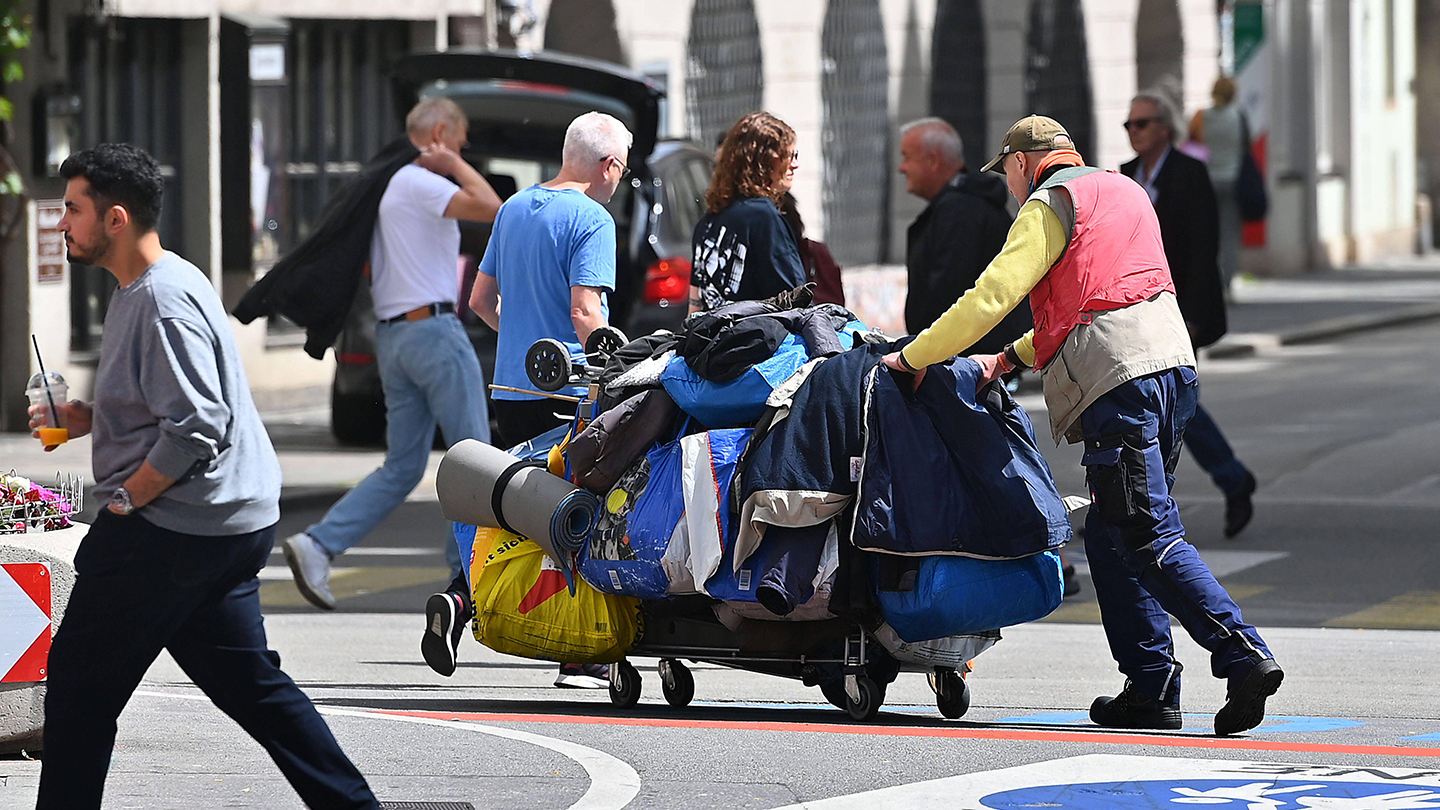
[.smalltext]Photograph by Frank Hoermann / Alamy Stock.[.smalltext]
[.article__paragraph--cap][.small-caps]You know the moment[.small-caps] because you have lived it too, and it takes a hundred forms. You are walking somewhere you need to get to, your mind already three blocks ahead of your feet, and there at the corner is a man you would rather not look at. He is holding a cardboard sign or a paper cup. One of his shoes has been mended with duct tape, and his face, when you let yourself catch it for half a second, is sunburned to the color of brick. And so you do the thing you are good at, the thing none of us would list on a résumé but all of us have nonetheless mastered. You find something absorbing in the middle distance. You are around the corner and gone before he has finished his sentence, and you tell yourself that you will do something, someday. Only not now. Not this man.[.article__paragraph--cap]
It is rarely so dramatic as that, of course. More often, it is the headline you scroll past because you already know it will ask too much of you, or the troubled neighbor you avoid encountering. The forms are endless, and the gesture is always the same. We do not decide to be cruel. We simply decide, quietly and many times a day, not to look.
The prophet Isaiah knew this gesture. He knew it from the inside, the way you only ever know the things you are ashamed of. He set it down some twenty-five hundred years ago, in words that have not aged a day. He was writing about a servant of God, a man of sorrows and acquainted with grief (Isa. 53). The remarkable thing is how small the sin he names turns out to be. He does not say we hated this man. He does not say we hunted him through the streets. He says something quieter, and worse. We turned our backs on him and looked the other way. There was nothing in him, Isaiah says, no beauty, no bearing, nothing to make you look twice. He was despised, and we esteemed him not, which is only the old way of saying we did not reckon him worth the price of a glance.
The scholars tell us this servant is one of a handful of mysterious figures who appear in the later chapters of Isaiah, someone in whom Israel saw its own suffering and could never decide whether to claim or disown. Here is a man so disfigured by his grief that to look at him directly is to be made complicit in it. So we hide our faces from his, the old translation says, as a man hides his face from something too bright or terrible to be regarded. Here it is not the sun but another human being in agony, holding up a mirror we would do almost anything to not see.
Because that is what the suffering of the innocent does: it indicts us, even when it doesn’t accuse us of causing it, simply by being there, by existing in the same world we are trying so hard to keep comfortable. To look at the suffering servant’s face is to be asked a question, and we have learned that the safest thing to do with certain questions is to keep walking until they are behind us. We learn this early and practice it all our lives, because the alternative is unbearable. The turned head is how we keep the world small enough to go on living in. It is an ordinary and unremarkable act of self-preservation from our exhaustion and fear.
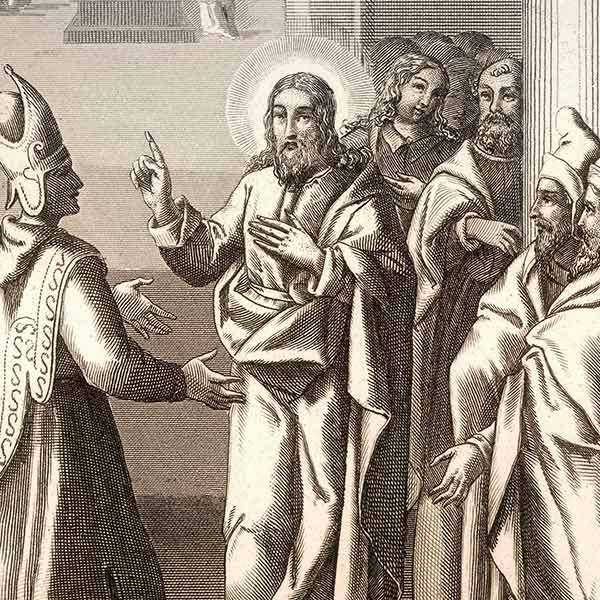
[.article__paragraph--cap][.small-caps]But there is[.small-caps] another scene, told by Matthew, in which all of this comes back around like a debt called in at last. It is nearly the final thing Jesus says before the betrayal and the cross, his last great word before words give out altogether. He tells it as a picture of the end of everything: the king come at last in his glory, with all the nations gathered before him in one vast, milling crowd, and he divides them as a shepherd at dusk divides the sheep from the goats (Matt. 25:31–33). Then he begins to speak, and it is not what anyone is braced to hear. He does not ask what they believed about him or whether they got the words right. He asks about food, a cup of water, a coat against the cold, and whether anyone has bothered to come by the jail. He says, “I was hungry and you gave me something to eat. I was thirsty and you gave me something to drink. I was a stranger and you took me in. I was naked and you clothed me, sick and you cared for me, in prison and you came to me” (Matt. 25:35–36).[.article__paragraph--cap]
And here is the strangest turn in the whole strange story, the one that should keep us up at night. Nobody recognizes it. Not one person in that enormous crowd knows what the king is talking about. The ones he is blessing are as baffled as the ones he is condemning. Lord, when? they all want to know, the saved and the damned in a single confused chorus. When did we ever see you hungry, when did we see you a stranger, when did we see you sick or behind bars, and do anything about it, one way or the other? They are certain they would have remembered a thing like that. You do not forget the day you fed the Son of God. Then the king says the only thing left to say: “As you did it to one of the least of these, you did it to me.”
Sit with the not-knowing. The ones welcomed into the kingdom are not welcomed for spotting Christ behind a dirty face and acting accordingly, like spiritual detectives who cracked the case. They had no idea. They simply fed the man because he was hungry and gave a coat because the night was cold, and they would have been astonished to learn that anything eternal hung on it. Their goodness was unselfconscious, almost absent-minded, the left hand not troubling to inform the right. And the ones turned away are not turned away for any spectacular cruelty. They did nothing. They are guilty of precisely what Isaiah confessed for the lot of us: they looked the other way, and they did it so reflexively that they cannot now recall a single instance, which is the most damning thing of all. We may be storing up heaven or losing it in the glance we will not even remember, on a corner we passed without slowing down.
This should frighten us, but if we stay with it a little longer, it begins, to our surprise, to comfort. For if the door to the kingdom turns out to be a cup of cold water given without a thought, then it is a door none of us is too clumsy or unschooled to find. You do not need to have recognized God in the beggar. You need only to have been kind to the beggar; the recognition, it seems, can wait until the end of the world, when the king will do it for you and tell you, to your everlasting astonishment, what you have been doing all along. Grace, here as everywhere, runs ahead of our understanding of it.
So set the two scenes side by side now. The servant in Isaiah, marred beyond anyone’s desire to look at him. The king in Matthew, hidden among the hungry, the imprisoned, and the stranger. They have the same face, and always have. The least of these is the disguise God has chosen – “Christ in distressing disguise,” as Mother Teresa often said – and he wears it in exactly the shape we are most practiced at not seeing. He does not hide in the splendor we are always scanning the horizon for. He hides in the person we cross the street to avoid. This is the deepest of his hidings, deeper even than the manger and the carpenter’s shop. Our habit of averting our eyes turns out to be the habit of turning from him.
Nowhere is this truer than on the day it all came to a head, when the prophecy of the servant ceased to be a poem. There, at the place of the skull, was a figure so beaten and bloodied that the crowd did what Isaiah said they would: they hid their faces, jeered, or drifted home to supper. There was no beauty in him that anyone should desire him. He was despised, and we esteemed him not. And the whole scandal of the faith is the claim that this disfigured and discarded one was and is the very God who made the eyes we turn away with. We looked the other way from Golgotha. We have been looking the other way ever since.
[.article__paragraph--cap][.small-caps]A word of warning[.small-caps] is in order here, though, because the idea is dangerous and has done its share of harm. To say that Christ hides in the poor is not to hand you a newer, more spiritual use for them. The man on the corner is not a costume God wears for your benefit, there so that you can feel the right things and go home improved. That is still the unseeing glance, this time dressed up in piety, looking at him just long enough to get something out of it and never truly seeing him at all. He is a person, with a name his mother gave him and a story you know nothing about, a childhood and a favorite color and a long chain of small mischances and large betrayals that brought him to this corner and not some other. If he is Christ to you, he is Christ as himself, not as your good deed, and the moment he becomes useful to you, a rung on your private ladder to God, Christ has slipped away again, around some corner of his own. The parable does not invite us to look through the poor to Jesus. It insists that there is no looking through. To love the least is to love the Lord, not because the least are a window to him, but because the least are where he has consented to be found.[.article__paragraph--cap]
I think of a face I walked past once, years ago, and have never fully gotten around the corner from. I do not remember what he wanted or what I told myself; I only remember a moment when I could have stopped and did not. I have carried that moment ever since. I suspect most of us are walking around with a small museum of such moments. The wonder of the gospel is not that it congratulates us for the few times we did stop, but that it demands our attention in the very places we are ashamed to have hurried past.
That is a hard word, and there is no getting around it. But it is not the last word. If he comes hidden in the least, then he is never far away. He does not appear only in a glory so blinding we could not miss it if we tried. He appears in the one we would just as soon miss. The whole of it may hang on something as small as turning one’s head. To stop and look back and meet the eyes we did not want to meet and to stay there a moment longer than is comfortable, long enough for the “type” to become a person, and the person to become, perhaps, the unbearable and beloved presence hiding in that ruined face the whole time. Because the eyes we are most desperate not to see may turn out, if we can bear it, to be the eyes of the one who has been looking for us all along, and who has never once, not for a single instant, looked the other way.