Report
The Last Christian Village in the West Bank
A Palestinian priest preaches peace, forgiveness, and justice to the few who remain despite the bulldozers.
June 26, 2026
Try 3 months of unlimited access. Start your FREE TRIAL today. Cancel anytime.
START FREE TRIAL NOWThe Last Christian Village in the West Bank
A Palestinian priest preaches peace, forgiveness, and justice to the few who remain despite the bulldozers.
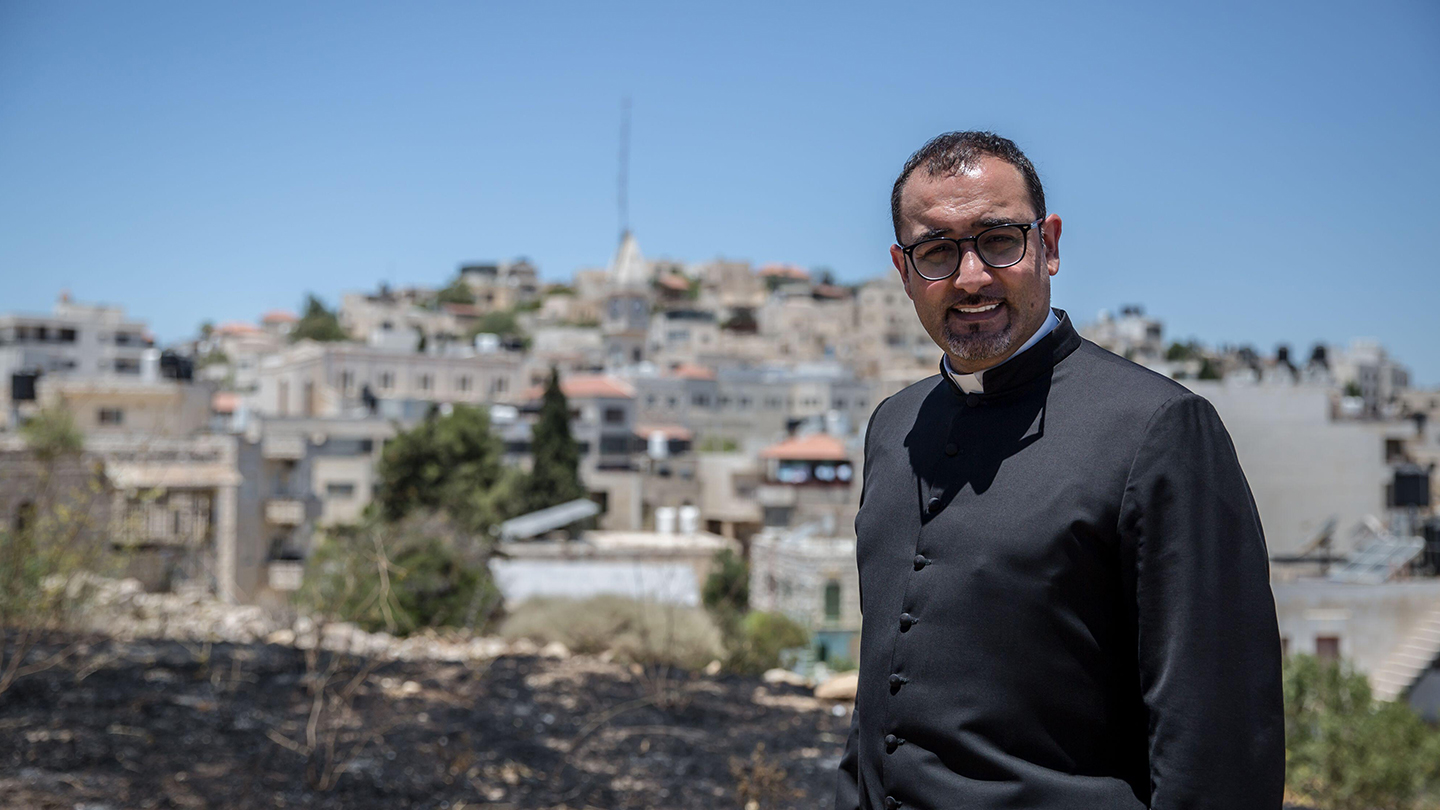
Father Bashar Fawadleh stands on charred ground in Taybeh, July 9, 2025. [.smalltext]Photo from Alamy Stock.[.smalltext]
[.article__paragraph--cap][.small-caps]This Palm Sunday,[.small-caps] Father Bashar Fawadleh faced a sobering sight. As the priest of Christ the Redeemer Catholic parish in a small West Bank village, he expected to be celebrating Palm Sunday Mass, with parishioners gathered in the square before the church, dressed as if for a wedding, waving palm fronds and dancing to shouts of “Hosanna!” But this year: silence. That very morning, Israeli police had stopped Cardinal Pierbattista Pizzaballa, the Latin Patriarch of Jerusalem, from entering the Church of the Holy Sepulchre for Palm Sunday Mass. The Christians in the village of Taybeh feared what it could mean for their safety.[.article__paragraph--cap]
As Fr. Fawadleh addressed his exhausted parishioners that morning, he reminded them that the Holy Land of today is not so different from the Holy Land of Jesus’ time: a land under occupation. To the village of olive farmers fatigued from war, Fr. Fawadleh emphasized that Jesus did not enter a city of saints but marked his arrival in the midst of humanity’s corruption. The priest listed the litany of threats they knew all too well, but in addition he highlighted another kind of danger that receives less coverage: the spiritual toll.
What is happening around us can change a person from within. War doesn’t just destroy homes. It doesn’t just kill people. War also destroys the human psyche, the human heart, human faith, love for one’s fellow human. And war can make a person hate, harden, lose hope, and feel that God is far away. … That is why, as the psalmist says, Christ did not come merely to change a political situation. He did not come long ago to change the reality of Roman occupation. He came to protect the human heart. Do you remember? In the Old Testament, “Make our hearts of flesh, O Lord, and do not make this heart a heart of stone.” Because the most dangerous thing, folks, is not that we lose external things. The most dangerous thing is that we lose ourselves from within.
As the priest of the last remaining Christian village in the West Bank, Fr. Fawadleh has become a well-known advocate for his flock. He has been quoted by Al Jazeera, the New York Times, and other international news outlets. He speaks about the dire situation Palestinian Christians suffer at the hands of fanatical Israeli settlers: their cars are set on fire, bulldozers destroy their farmland, intruders drive away their livestock, and access to their olive groves is denied. The strict economic constraints imposed by the Israeli government make finding work nearly impossible and are intended to drive many to emigration. Still, the ongoing Western interest in Taybeh serves to maintain a meticulous record of the daily abuses, offering Christian Palestinians more attention and sympathy than their Muslim neighbors are accorded.
Fr. Fawadleh was born in 1987 in Jerusalem, at the outbreak of the First Intifada. His name, Bashar, derives from the Arabic word “bashara,” which means “good news” – it has the same meaning as “gospel.” His parents gave him the baptismal name Gabriel, after the angel of the Annunciation.
He entered the priesthood at Holy Family Church in Ramallah at age twenty-seven in 2014, leaving the next year to serve at Our Lady of Fatima parish in Beit Sahour, a neighborhood near Bethlehem. There, he directed Christ the King Bookstore, where he would convene a local chapter of Young Catholic Students, a group that aims to provide spiritual guidance for young people across Palestine.
He soon discovered a special talent for ministering to youth. In May 2015, when Pope Francis canonized two nineteenth-century Palestinian nuns, Saint Marie Alphonsine and Saint Mariam of Jesus Crucified, Fr. Fawadleh led a delegation of about forty students to attend the ceremony at the Vatican. In 2017, he was appointed Youth Director for all Catholic churches of Israel and Palestine, contributing to YJHP (Youth of Jesus Homeland in Palestine), a youth ministry that hosts retreats and summer camps. He also led delegations to the World Youth Days in Panama and Portugal.
Fr. Fawadleh’s experience working with youth has taught him that children cannot form healthy identities without three ingredients he deems essential: the inner life, the home life, and the community life. “My identity starts from within me,” he said in an interview with the Catholic Near East Welfare Association. “If I know myself, then I can advance. If I don’t know myself or who I am as a human being, then I am unable to proceed with my life in any shape or form.”
When it comes to a sense of home, Palestinians have suffered from the loss of it. In 1948, the United Nations estimates, some 700,000 were expelled from their homes; many still have the keys to houses in which Israeli families now take up residence. From Fr. Fawadleh’s point of view, losing a sense of home, a place to feel secure in one’s belonging, is the main spiritual ailment affecting young Palestinians. “As long as there is a home,” he says, “there is an umbrella that can contain the individual within a group. But when the home is broken, we lose our identity. By then it’s too late. It can take a really long time to rebuild this.” Fr. Fawadleh seeks to recreate this sense of home in the church.
After his years ministering to youth, he received an appointment to what he considers his most important post yet: Christ the Redeemer in Taybeh, the last remaining Christian-majority village in the West Bank. It was once called Ephraim, the Gospel of John recounts how Jesus stayed there after raising Lazarus, using it as an opportunity to rest and pray before his entry into Jerusalem that first Palm Sunday. By the time Fr. Fawadleh arrived, its population had declined by about 15,000 inhabitants, as villagers escaped the intolerable conditions, with only about 1,200 remaining. But the 165-year-old parish had learned to persevere, building stubbornly resilient institutions like a school, a home for the elderly, and a radio station.
It is said that an artist spends his career asking the same question in a hundred different ways; parishioners who listen to Fr. Fawadleh’s Sunday sermons might pick up on a common theme: a constant grappling with peace, forgiveness, and justice.
Fr. Fawadleh often emphasizes a theology of peace, which brings him into line with the new pope. One year into his papacy, Pope Leo XIV has already invoked peace about four hundred times, with his first public words as pope being: “Peace be with you.” However, people hold many misconceptions about the word, and Fr. Fawadleh distinguishes between the false peace offered by this world and the true peace realized through Jesus, echoing Saint Augustine’s distinction between the City of Man and the City of God.
Worldly peace, he points out, is based on group loyalty, altruism, and deterrence. It really just amounts to law and order. As he explains, it is “a peace established merely because I seek a specific benefit from a particular party – whereby I forge peace with you, as a state, only as long as my interests are served.” This leads to a corrupted view of the world based on legalism and materialism. The true peace offered by Christ, says Fr. Fawadleh, is far more expansive – it is universal and unconditional – and cannot be achieved without justice.
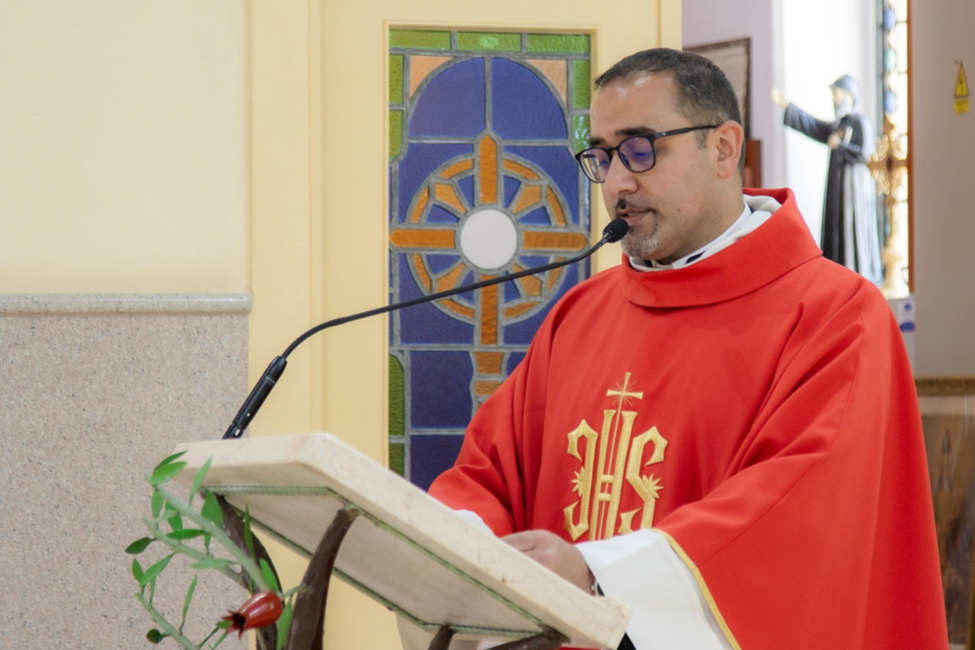
Fr. Fawadleh’s theory of peace begins at the level of the inner life. “The body of Christ alters my existence, guiding me toward ever more advanced stages of spiritual maturity and faith. … Through this sacred union, I begin to evolve.” Prayer is the doorway that welcomes us into a life of faith. Individuals enter and receive peace, and are ultimately inspired to contribute to social and political change. “Remaining here is an act of hope and peaceful resistance. We don’t ask for privilege, we ask for rights. The right to live in dignity, the right of our children to play without fear, the right to learn, the right to move, the right to travel, and the right to remain in our lands.”
On Good Friday, he took the pulpit and spoke about the most difficult prayer a person can offer: “Forgive them, Father, for they know not what they do.” Jesus’ forgiveness of his executioners serves as the model for Fr. Fawadleh’s parishioners toward the soldiers, settlers, and politicians who abuse them. The cross is the turning point in the story of humanity, breaking the cycle of retributive violence and restoring to humanity the possibility of redemption.
Forgiveness is the fragrance that sensitizes us to true peace. It means refusing to let one’s heart become a place of hatred. “If we don’t forgive, we’ll carry the wound inside us and in our hearts for the rest of our lives. It means someone hurts us once, and we hurt ourselves a thousand times.” However, here Fr. Fawadleh offers some clarification. Forgiveness does not mean that we must excuse injustice or forget the past. And peace must be the fruit of justice; the two are inseparable. We cannot consider ourselves peacemakers if we don’t seek to name injustices and hold people accountable. To borrow the words of another Palestinian pastor, Munther Isaac, in a 2025 lecture to Harvard Divinity School, we cannot be Christians who choose comfort over confrontation, who care more about avoiding controversy than achieving justice. “They pray for peace and release a statement – this is the moderate church.”
After speaking with Fr. Fawadleh and listening to hours of his preaching, I have identified another recurring theme: his rejection of the sin of apathy. Apathy creeps into the cracks of our souls to normalize an increasing barbarism. We hear of 72,000 dead in Gaza, or two million helped by relief agencies, and to us it is a statistic, dragging down the value of human life.
Fr. Fawadleh’s task looms above him: to push against the tides of dehumanization sweeping over the occupied territories of Gaza and the West Bank, and to re-sensitize people to the dignity of human life. But big changes start from small seeds. He cites a phenomenon that Palestinians often experience: checkpoints. While driving down the highway, they encounter Israeli soldiers blocking the road, leading to lengthy traffic jams. After waiting for hours, the Palestinians step from their cars and speak to each other, offering food and water. Once strangers, now they have developed what he calls mutual concern.
Fr. Fawadleh harbors an audacious hope for the future. “I see no signs of peace on the horizon; I perceive no vision of justice within this land. I discern no vision of human redemption, nor any indication that a ‘third day’ – a resurrection for humanity – is at hand. Yet, all these circumstances serve as signs that call upon the hope residing within us, a hope that compels us to remain ever surrendered to the will of our Lord.”
This last Palm Sunday, he took to the pulpit, looking out on the community, and said, “There is a cross, but the cross is not the end. There is death, but death is not stronger than God. And the message for us in Taybeh today is this: A procession may be canceled. Celebrations may be canceled. There may be war. There may be fear. But there is one thing that must never be canceled from our lives: hope.”