Essay
The Evangelist and the Crocodile
Legendary anti-apartheid preacher Michael Cassidy recalls the role Christianity played during apartheid, and in its demise.
July 31, 2026
Try 3 months of unlimited access. Start your FREE TRIAL today. Cancel anytime.
START FREE TRIAL NOWThe Evangelist and the Crocodile
Legendary anti-apartheid preacher Michael Cassidy recalls the role Christianity played during apartheid, and in its demise.
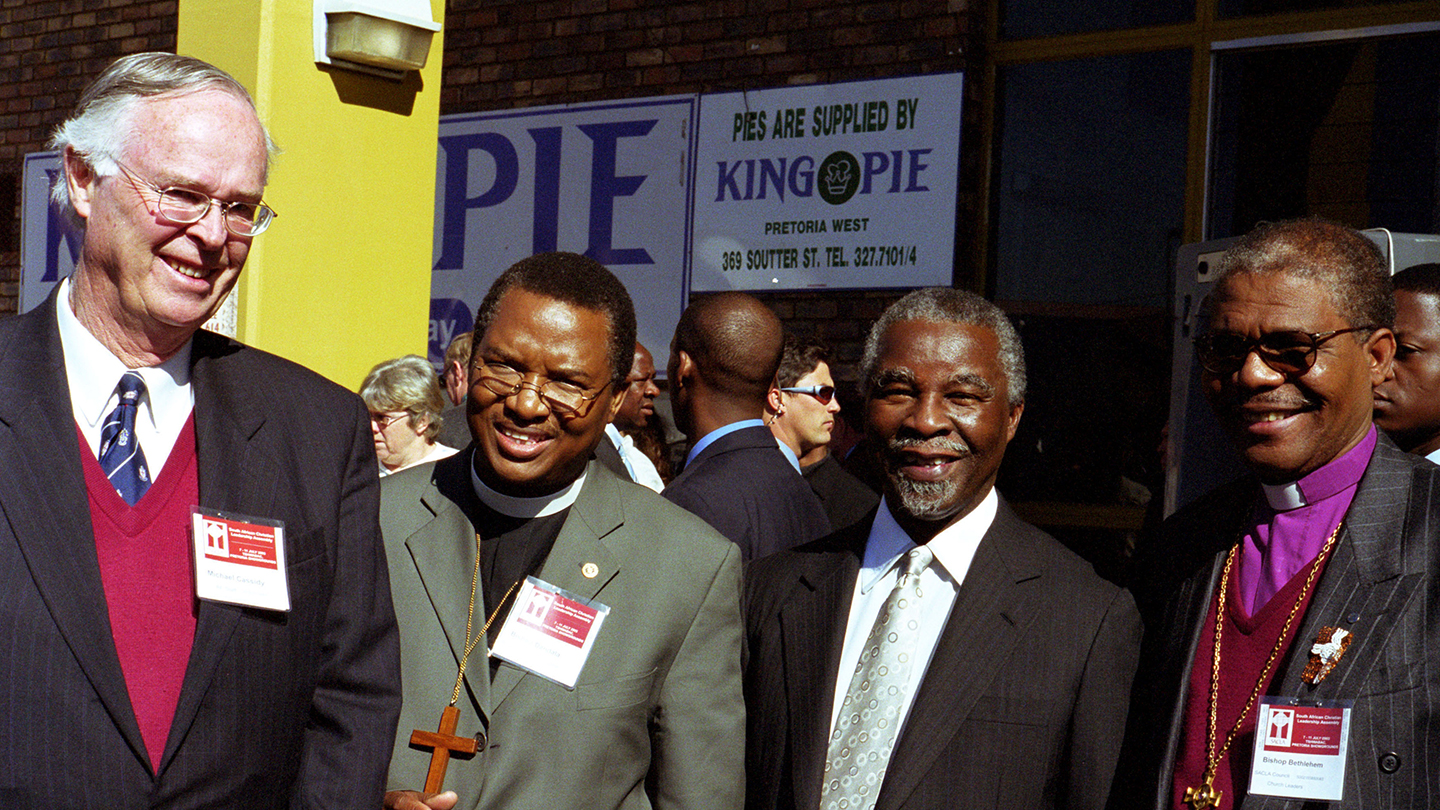
Left to right: Dr. Michael Cassidy, Bishop Mvume Dandala, President Thabo Mbeki, and Right Revd. Bethlehem Nopece. Pretoria South Africa, 2003. [.smalltext]Photograph by John Robinson / Alamy Stock.[.smalltext]
[.article__paragraph--cap][.small-caps]On April 17, 1994,[.small-caps] in Pietermaritzburg, South Africa, I woke up to our birthday tradition of breakfast in bed, excited to be turning four and looking forward to my birthday party at the park with our church. I was completely oblivious to the fact that an hour away, in the city of Durban, the biggest sports stadium in the city was packed with people of all races and denominations praying for a peaceful end to apartheid, and that South Africa’s first democratic elections would proceed without civil war in the next few days.[.article__paragraph--cap]
The lingering specter of the seven-days war, which ended a few weeks before my birth in 1990, gave rise to the fear and angst of our neighbors as the date of the elections drew closer. Despite the hope ignited by Mandela’s release form prison, key political figures were still being assassinated and violence between political parties continued to flare up. Now, with a major party refusing to join the elections, the democratic hopes of our country seemed close to derailment.
I, meanwhile, was excited to wear my new church clothes and dig into my birthday cake at the park.
When I recall this story to eighty-nine-year-old Michael Cassidy, founder of the evangelistic group African Enterprise and the organizer of that massive prayer meeting in 1994 (a “Jesus Peace Rally,” he called it), he chuckles. “But that’s delightful,” he says, with a twinkle in his eye. “What a birthday.”
One guiding principle throughout Cassidy’s sixty-five years of ministry is that change, even on such a grand scale, is fueled by imagination and hope: a hope born through what he calls “the chemistry of encounters.” When human beings, made in God’s image and imbued with God’s spirit, sit across from each other – talking and praying and eating with one another – they recognize each other’s humanity. Whether it is at prayer meetings, birthday parties, supper tables, or the private lounge of a former president, somehow, with prayer and presence, a new vision of what is possible for our relationships and future together can be ignited.
[.article__paragraph--cap][.small-caps]Michael Cassidy was born[.small-caps] in 1936 in Johannesburg, South Africa, and raised in Lesotho by nominally Christian parents. A politically active neighbor awakened his conscience to the injustice of apartheid by the time he was twelve, but it wasn’t until university at Cambridge in England that both his faith and his sense of what that faith meant for the world were kindled. A friend who had been converted through a Billy Graham crusade abruptly asked him if he had a personal relationship with Christ, and in the ensuing weeks, Cassidy came to realize this was “the most important question in the world.” A summer trip to the United States to visit relatives drew him into Billy Graham’s 1957 Madison Square Garden crusade, where he felt the Holy Spirit prompt him to evangelize the continent of Africa.[.article__paragraph--cap]
This was the beginning of his life of evangelism. Cassidy went on to found African Enterprise (AE) after completing his studies at Cambridge and Fuller Theological Seminary; today, AE has bases in ten African countries from Ghana to South Africa and has run evangelistic outreaches across the continent.
But upon his return to South Africa, Cassidy was confronted with the problem of apartheid. Thanks to apartheid laws – such as the Group Areas Act of 1950, which restricted where people of different races could live and work – Cassidy’s first mission hit a significant roadblock. AE had reserved the city of Ladysmith’s town hall for the mission, but at the last minute, they were told the town council had ruled that only white people would be allowed to sit there. Black people attending the service could sit in a different venue, and a small wire would be run across the road to a radio speaker so they could hear the message. The young Cassidy was unsure of what to do – they had already advertised for the event, so he couldn’t change venues the day before, could he? Was segregated seating as bad as it seemed, if people could still hear a gospel message?
It was, and he knew it. But he felt pressure to proceed anyways.
“I ended up saying we should just go ahead, and I sat with the black attendees across the street,” he shared during an interview with me in his home. “Can you imagine?” he recalls with a shudder, and I can still sense his regret, more than fifty years later. “I succumbed that first time. But that was the only time.”
Cassidy was adamant from then on: under no circumstances would AE allow this sort of segregation to occur during their missions. “I realized that our relationship with Christ and our relationship with our neighbors could not be separated,” he said with conviction. “Evangelism and social action are two sides of the same coin of the gospel. I couldn’t do one without the other.”
At that time, Christians were split in their responses to apartheid. On the one hand, the Dutch Reformed Church was a pillar of Afrikaner nationalism, abusing Christian theology to justify racist apartheid laws. Afrikaner Hendrik Frensch Verwoerd, Prime Minister of South Africa in 1958 and “architect of apartheid,” was confident that his plans for racial segregation and white supremacy in the country were God-ordained. Upon his election, he announced to South Africans on the radio that “in accordance with His will, it was decided who should assume the leadership of the government in this new period of the life of the people of South Africa.” Pro-Nazi and anti-Jewish, Verwoerd survived an assassination attempt in 1961, which only strengthened his belief that his plans to deny black South Africans education, prevent interracial marriages, and reserve land and jobs for white people were a divine calling placed upon his life. Verwoerd told his wife: “I heard the shots and then I realized that I could still think, and I knew that I had been spared to complete my life’s work.” Verwoerd was assassinated in 1966, but the government system he created lived on until its complete demise in 1994, continuing to draw official support from the Dutch Reformed Church for most of those years.
On the other hand, “mainline” denominations under the umbrella of the South African Council of Churches often had vocal anti-apartheid activists fervently pursuing political change, especially since political party leaders were banned from speaking publicly. Bishop Desmond Tutu from the Anglican church was one such activist. He went on to win the Nobel Peace Prize for his anti-apartheid activism, as well as chairing the Truth and Reconciliation Commission after apartheid ended.
Theologically conservative denominations that claimed the label “evangelical” often felt that opposing apartheid was too political and that the church should focus exclusively on personal salvation. Given his own background with the greater evangelical movement, these were the denominations with which Cassidy felt a close affinity. However, while recognized as an evangelical leader abroad (he went on to be an honorary chair of the Lausanne Movement), he was frequently sidelined in South Africa by white evangelical coalitions. “They used to say things like, ‘Ah, that Cassidy, we like him well enough, but he spoils things by bringing in politics. He shouldn’t mix politics with his evangelism,’” Cassidy told me.
But it was after a 1970 mission to Soweto, Johannesburg’s biggest black township – where Cassidy worked with local church leaders to run a year-long outreach – that he realized something needed to change. Cassidy could no longer abide the cries of the black church on account of the injustices of apartheid.
“At that time, the new secretary of the South African Council of Churches was a friend of mine. So I said, ‘I think we need to have a party. You invite the South African Council of Churches; I’ll invite my evangelical friends, like Billy Graham, and let’s see how many people we can get together.’” This “party” was the South African Congress on Missions and Evangelism of 1973, and although it seemed like an impossibility in apartheid South Africa, Cassidy and AE held firmly to the vision of a multiracial, multidenominational gathering. That pastors of different races were going to pray and worship together was already radical. But they were also going to sleep in the same hotel, eat at the same venue, and ride the same buses to and from the event. For the space of a few days, the attendees were going to have a taste of what the body of Christ could be like without apartheid laws governing their every move.
It took a great deal of prayer and fasting. At every level, they had to appeal their way up the chain of command to get permission to proceed. “We ended up on the phone with the minister of transport to get permission to allow the interracial bussing,” Cassidy explains. But in the end, it happened. In his autobiography, Cassidy shares the glee he experienced looking out of his hotel window and seeing two African delegates race across the lawn and jump into the “whites only” hotel swimming pool, and how he and his white roommate dashed down to join them.
“It formed a crack in the wall of apartheid,” Cassidy observed. “To live, eat, and worship together. Yes, the presentations from speakers and discussions were powerful. But it was the chemistry of encounter, it was seeing that the people you thought were your enemies are actually thoughtful Christians! That is what was so powerful about this event.”
The energy created at this meeting led to other interracial and interdenominational gatherings. At one gathering, Cassidy allowed a Dutch Reformed Church representative to give a talk. A group of black delegates protested giving the platform to someone from “the church of apartheid.” Cassidy held his ground. “After his talk, on the cross and the challenge of reconciliation and forgiveness, everyone was in tears,” he shared. “It was one of the most powerful messages shared, and it humanized the groups to each other.”
This led to another gathering in 1979: the South African Christian Leadership Assembly (SACLA), which consisted of about five and a half thousand Christian leaders from across South Africa. Against massive opposition from the government, as well as some church leaders from both the Dutch Reformed Church and more conservative evangelical groups who found it too political, the meeting went forward. Again, the gathering insisted on nonracial accommodation – this time, white delegates would stay in black homes, and black delegates in white homes. This was not without its difficulties. One Indian couple staying in an Afrikaner home was told they could use the outside toilet in the garden. They stood firm and said, “No, we are all brothers and sisters in Christ, and all SACLA delegates.” After that confrontation, the two couples went on to become dear friends.
Breakout groups mixed black teenagers from the townships with white Christian cabinet ministers, or poor black housewives with rich white businessmen from the suburbs. Such encounters, to Cassidy’s mind, inevitably led to dialogue and transformation. “When you’re sitting there, encountering people, you can’t help but be changed,” Cassidy asserted. In an environment where the government censored the press, Bishop Desmond Tutu was known to some white people only as an anti-apartheid activist. For them, hearing him speak on the lordship of Christ – not merely hearing about his work from a distance – was eye-opening enough to lead to a standing ovation. This was no political opponent; this was their brother in Christ.
Johan Heyns, a theologian and moderator of the General Synod of the Dutch Reformed Church, was also in attendance. Pastor to three apartheid presidents, Heyns went on to lead a commission to investigate if apartheid could be justified by the Bible. The result of Heyns’s commission was that apartheid was not justifiable from a biblical basis, and in 1986, the denomination split over this issue. In 1990, Heyns went so far as to declare apartheid a sin. He was tragically shot and killed in his own home in 1994, likely by racist extremists. Cassidy believed that someone like Heyns speaking out was more powerful than any political boycott in helping to shift the perspective of ordinary white South Africans as well as politicians. “It broke the back of apartheid,” he said.
Interestingly, Cassidy’s stories of large, climactic gatherings are often preceded by quieter, interpersonal moments of reconciliation. Before the five thousand plus delegates gathered at SACLA, Cassidy was convicted to spend his own savings to fly and talk in person with a leader in the Dutch Reformed Church who had been maligning him publicly. Cassidy walked into his office unannounced and confessed his bitterness toward him. As Cassidy shares in his book, even though this leader had alerted the apartheid security police to Cassidy and was pushing for him to be charged with high treason, after this encounter, “he found I wasn’t so off the wall as he thought. And I found he wasn’t so racist as I had imagined.” After praying with him, Cassidy walked out of the office with an invitation to speak at some Dutch Reformed mission stations.
While leaders on the theological right found Cassidy “too political,” his friends on the left didn’t think he was political or radical enough. For example, in 1985, during a gathering of Christian leaders that Cassidy had organized, a black caucus led by Desmond Tutu advocated for the churches to champion a week-long strike. They would demand Mandela’s release, the removal of the army from townships, and the unbanning of opposition parties. Everyone at the meeting agreed, but that night, Cassidy felt uneasy.
“I just wasn’t sure if this was the Christian way. I wasn’t sure if demanding was right. I thought of Christ and how scripture says, ‘He threatened not,’ and I wondered: Is this how Christians are really to do it? So we had a compromise. We decided to do a ‘pray-away’ on a workday, and Tutu and his delegates agreed to this.”
As the chair of their gathering, Cassidy had to prepare president P. W. Botha to receive a delegation of the church leaders who were coming to present their petition. P. W. Botha, nicknamed “The Great Crocodile,” was the South African prime minister and president from 1978 to 1989. Botha harshly repressed anti-apartheid activism and militarized the country, giving tacit approval for the secret police to detain and “eliminate” political opposition. In 1998, the Truth and Reconciliation commission found him guilty of approving and presiding over some of apartheid’s worst human rights violations.
Botha was dismissive of Cassidy and others of similar persuasion. “These church leaders,” he said, after hearing Cassidy’s introduction, “they are so small! Four hundred nothings!” Instead of engaging with Cassidy’s requests, Botha wanted to press him on his views of the recent Kairos Document, a statement put out by black church leaders. Influenced by liberation theology, the text analyzed the church’s role during apartheid and notably refused to condemn the use of violence against a violent, oppressive state. Although he had reservations about some of the theology, Cassidy refused to denounce the document. He could see this was not a time for theological nitpicking when the basic cry of the document was for biblical justice.
“Cassidy,” Botha said, “When you go on TV tonight announcing your ‘pray-away,’ I want you to denounce the Kairos Document. If you don’t, I’m going to fix you personally.” Cassidy understood that “fix you” was Botha’s euphemism for eliminating his opponents by whatever means necessary. He called his wife after that encounter, unsure if he would see her again. While nothing came of the threat, the psychological toll for Cassidy and his family was significant, and Cassidy felt deep bitterness toward the leader who had caused suffering for so many.
[.article__paragraph--cap][.small-caps]When I asked Cassidy[.small-caps] if there were ever times in which a Christian needed to draw a line in the sand and move on from other people, Cassidy returned to his encounter with P. W. Botha.[.article__paragraph--cap]
“You never give up on people,” he said. “As Christians, we are never let off the hook. We have to keep trying. There is no such thing as canceling someone.” Cassidy wrote Botha a letter, confessing his bitterness toward him for the pain he caused his family, which was never acknowledged. But years later, he felt the Holy Spirit prompting him again to let go of resentment and forgive, and had an opportunity to visit the then-aged Botha. Cassidy again confessed his bitterness and asked for forgiveness. While Botha was unable to say the words “I’m sorry,” Cassidy was satisfied with their meeting, which ended with the pair praying – Cassidy and the Great Crocodile, hand-in-hand.
Once Nelson Mandela was released, Cassidy and African Enterprise arranged more opportunities for people on opposite sides of the political conflict to meet by hosting weekend trips to Kolobe Game Lodge near Pretoria. “The goal of the meetings was simple,” recounted Cassidy: “get people to know one another and hear each other’s stories.” Cassidy believed these encounters that helped humanize previous enemies built a network of trust that was then leveraged by Washington Okumu, the negotiator who brokered a last-minute deal paving the way for a peaceful and democratic 1994 election. Okumu brokered this deal during AE’s massive Jesus Peace Rally prayer meeting. After the election, AE went on to promote peace-building efforts in other African countries, alongside their evangelistic mission. Addressing people’s material realities as well as their spiritual needs continues to be a hallmark of the ministry today.
Sometimes, people can’t imagine a different future. But when they encounter one another, God’s spirit can give them a picture of a new possibility.
A four-year-old praying earnestly for a pink purse and some party games with her church friends for her birthday, and a 25,000-seat stadium packed with people interceding for their nation’s future. On the surface, one couldn’t be more trite; the other, any more weighty. But when I look back at my four-year-old birthday party photos – black faces and white faces gathered at a park, eager to dive into a birthday cake – I think that such a gathering may have been just as needed for a nation learning how to live together after years of injustice and oppression.