Essay
The Disappearing Body
What have we lost with the decline in traditional burial practices? How can we give grief its ground and the body its place?
July 17, 2026
Try 3 months of unlimited access. Start your FREE TRIAL today. Cancel anytime.
START FREE TRIAL NOWThe Disappearing Body
What have we lost with the decline in traditional burial practices? How can we give grief its ground and the body its place?
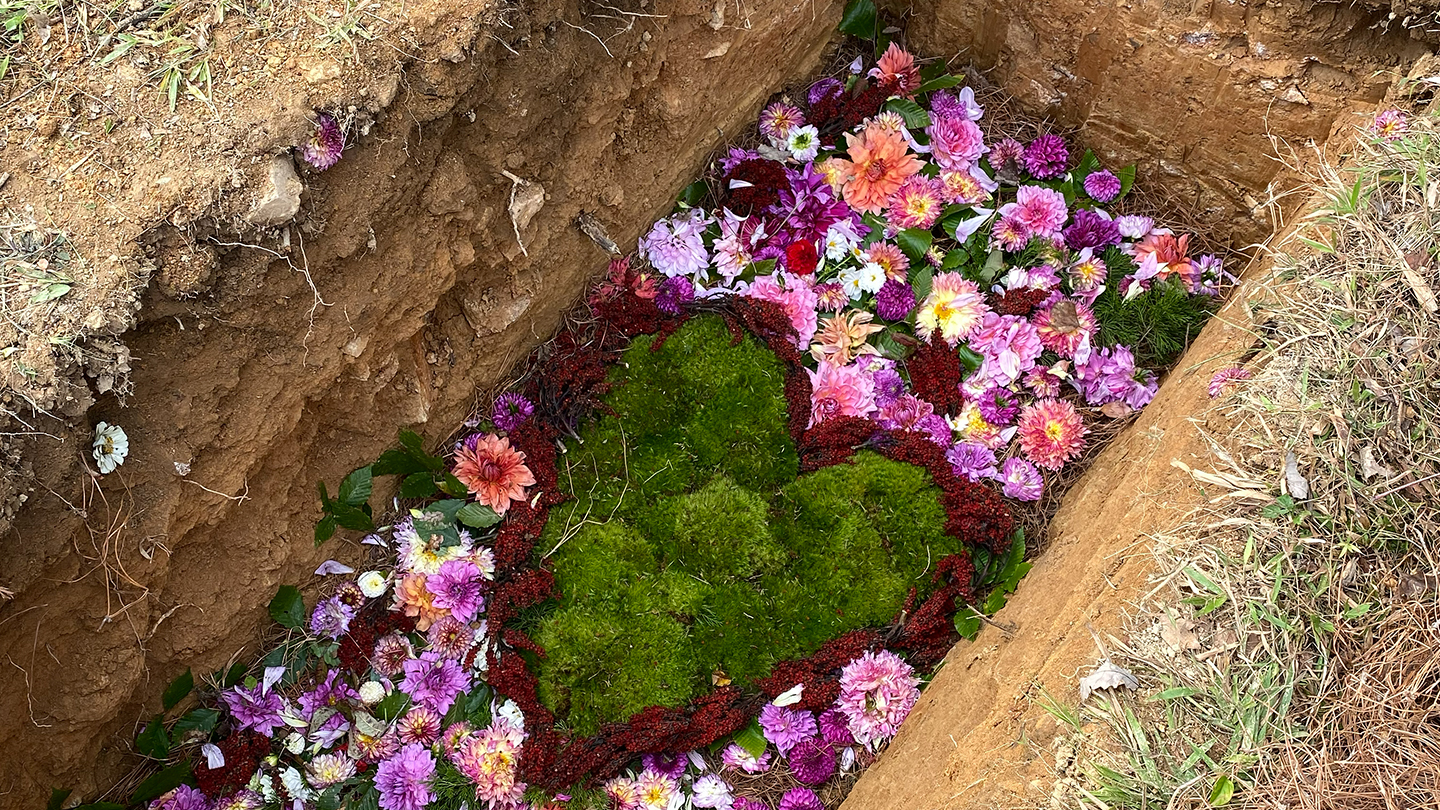
Photos courtesy of Larkspur Conservation.
[.article__paragraph--cap][.small-caps]The Paschal candle is lit,[.small-caps] the faint smell of bee’s wax radiating with the light. We gather around it, the crucifer and clergy. In the prayer books we hold, there is a rubric, instructions for how to carry out the liturgy, written in italics. “Never break a rubric!” was the command of my liturgy professor in seminary. It is easy to say such things from the front of a classroom, but I’ve found that the real, pastoral work of ministry sometimes demands a bending of the instructions.[.article__paragraph--cap]
From beside the candle the officiant reads: “Into your hands, O merciful Savior, we commend your servant Martin. Acknowledge, we humbly beseech you, a sheep of your own fold, a lamb of your own flock, a sinner of your own redeeming. Receive him into the arms of your mercy, into the blessed rest of everlasting peace, and into the glorious company of the saints in light.” It is one of the most moving parts of the funeral liturgy, a moment we call the “commendation.” Here we entrust the dead to the care of God. But this time, something felt missing. The rubric instructed, “The celebrant, facing the body, says…” But there was no body.
The body is missing. I’ve seen it fade to nothing but an empty space. And it is not happening in my church alone. I’ve talked with clergy across the country, who have found it missing as well. The body of the dead is absent from the funeral, absent from the work of return toward the earth.
Slowly, over the years, the body has been disappearing. Once every funeral needed pallbearers, not for show but to carry the hefty weight of the dead. We have few funerals requiring pallbearers these days. An urn can be carried easily enough by one person. The body has become lighter. Often, there is nothing at all to carry. Funerals now happen without the body, the physical trace of the person. The remains, usually cremated, are interred ahead of time in a concrete columbarium or set on a shelf for the family to scatter or divide among themselves at some later date. But what are we missing when we don’t pray with the body in our churches? How do we lose ground for grief when we don’t lay the body to rest in the earth?
[.article__paragraph--cap]I once had a conversation with my mother about her final wishes. Though cremation is an increasingly popular option for her late boomer generation, she said that she would prefer a full-body burial.[.article__paragraph--cap]
“Why?” I asked.
“Because the body matters,” she replied. For her, though she knew decay would come for her mortal flesh, letting it happen naturally, according to the metabolism of microbes, was a better path than burning it away with the efficiency of flames.
Her view reflects that of most Christians in history. With their roots in Judaism, where cremation was forbidden (as it still is for most sects of Judaism), Christians practiced full-body burials in tombs or graves. While the pagan cultures around them often practiced cremation, reflecting a liberation of the spirit from the body, the Christians lived as a contrast society that embraced the goodness of the material world and the creation of which it was a part. The body was no mere passing shell but was instead an integral part of the human person, a part that had a future with God through the resurrection.
The aversion to cremation in early Christendom was so great that Charlemagne outlawed it, making the practice punishable by death. While cremation remained a minority practice until the nineteenth century, practical matters, like mass deaths from wars or plagues, sometimes required it. Still, it was not until 1963 that the Roman Catholic Church allowed cremation among the faithful, and not until 1966 that priests were allowed to officiate at the funeral of a person who had been cremated.
Since then, cremation has rapidly gained popularity. Now, according to the National Funeral Directors Association, over 63 percent of the dead are cremated rather than buried. The rise in the popularity of cremation in American culture is understandable. Funeral costs have increased significantly, and what was once the task of families and communities has become professionalized, with a host of costly products and services. It was during the American Civil War that the practice of embalming was introduced to aid shipment of the war dead back home.
During the postbellum burst of industrialism, overcrowded cities led to a sanitation movement that pushed for cemeteries to be set outside of cities. These cemeteries included concrete liners and vaults for graves, falsely believed to keep contamination out of the soil. With each of these products came increasing expense. Now conventional funerals cost well over $7,000 on average, not including the cost of a cemetery plot. With cremation services available in many states for as little as $400, this option has seemed like a simple way to save loved ones the burden and expense of a conventional burial. I include flame cremation as an option in my own burial plan if my preferred options are not available. Yet, like my mother, I prefer another way – a more direct return of my body to the earth. I want my body in death to be as my body has been in life – tied to the particulars of a place.
The body needs a place. We live, always, through the particular connections of a community of life – the one here, where we are. From our gut biome, which reflects our region and its soils, to our foot fungi, which we share with those with whom we live, our bodies are connected to the household of life. And the way we show up in relationship with other people is through our flesh. Though there may be soulmates, such close companions only know one another through the medium of skin, the vibrations of air formed from lung and larynx, the thumping of an ear drum.
This necessity of the body is a basic truth of human personhood, but for Christians there is more. We are not Gnostics, who saw the body as a cage, or Manichaeans, who deemed the material world evil. The body is a part of the created world God called good, still loves, and seeks to redeem. Ours is a faith in which we hope for resurrection rather than a merely spiritual afterlife. The question becomes: What burial practices help us live into the fullness of the body? How do we celebrate the body in death, with all the connections it had in life? For my part, I’ve found resonance in the places of simple and direct return to wild places
[.article__paragraph--cap]Last summer, I sat at a picnic table, the pines humming with the wind. To our south was the snow-capped peak of Mt. Hood, to the north, Mt. Adams. Across from me was Russell, a former engineer with the calloused hands of a carpenter. He explained to me the beginnings of this place, Great River Natural Burial. When his brother Robert died in 2009, his body was cremated and his ashes distributed among the family. It had seemed a fitting memorial for a life lost too young. But over time, Russell felt like he was missing a place for his brother. As Russell explains on his website, “there was no specific place to memorialize him, no place where I might go to think about him and find another friend of his doing the same.”[.article__paragraph--cap]
As one who finds solace in wild places, Russell wished for a cemetery that offered the comforts of the wilderness and the sacredness of a graveyard. When he learned about natural burial, which emphasizes the return of a body or cremated remains directly to the earth, he found a form of honoring the dead that resonated with his sense of sacredness and place. With land that he and his wife Suzanne had owned for decades, Russell began the process of establishing a natural burial ground in preparation for his mother’s death. Now, after years of work, the burial ground is open to anyone in Oregon looking for a place to bury their loved ones directly in the earth.
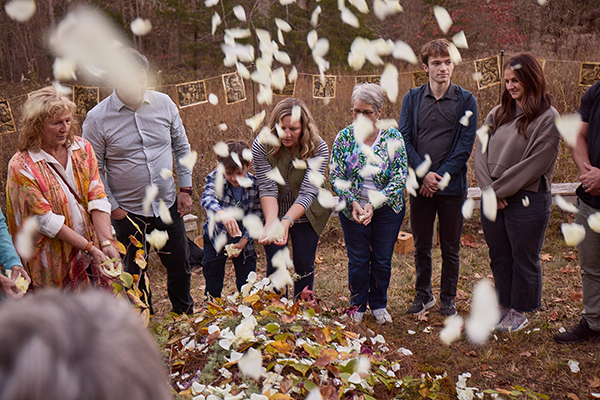
My introduction to this form of burial came while visiting family in Tennessee. One spring day I walked through trails of a forest and meadow set in a limestone hollow. Blue grosbeaks sang their melodies from the brushy edges of the field and great spangled fritillaries danced among the calliopsis flowers. Here and there, in the woods or fields, I found a mound of dirt, some fresh, most grown over. At the head of each mound was a simple native stone, flat against the ground. This was Larkspur Conservation’s cemetery at Taylor Hollow.
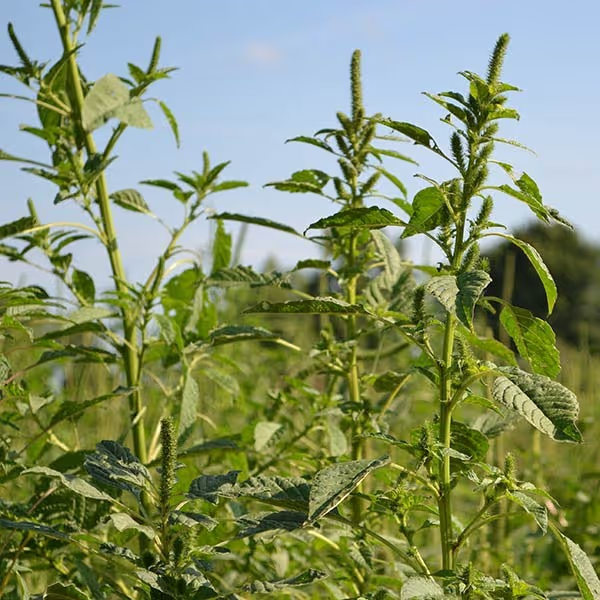
The feel of the place reminded me of a Nature Conservancy preserve, and in fact the cemetery borders land owned by the Nature Conservancy. Larkspur clears invasive, non-native plants and uses controlled burns to restore the ecosystem. And yet, amid all of this, there are burials. They are simple, involving no concrete vaults and often no coffin. All that goes into the ground must be biodegradable. There are ashes interred here, as well, which are mixed with compost to abet the alkaline toxicity of cremated remains. Though they accept cremains, when I asked John Christian Pfifer, Larkspur’s cofounder, if most people who choose full-body burial there would have opted for cremation elsewhere, he replied, “Oh, absolutely. This provides a more affordable option that enables people to have the kind of burial they want.” And along with that affordability, land is preserved for the continued life of the creation and its varied members.

Since beginning to explore contemporary burial options, I’ve talked to many people about their choices. It has become clear to me that though many people are opting for cremation, the choice is driven by the perceived cost and hassle of conventional burial, or even a sense that it is better for the environment (even though traditional flame cremation is highly energy intensive). Provided another choice that has more resonance with their wishes, they will choose it.
In traditional burial practices, the family and community are responsible for washing the body and preparing it for burial. They sit with it in vigil, staying with the body until the funeral. I’ve heard stories from older members of my church that the vestry, the lay governing body of my church, was responsible for sitting with the body of the dead until the funeral. Now, most people do not see the body of their loved one from the moment of death until the funeral. And increasingly, they do not encounter the body of the dead at all. With each move of disconnection, we are pulled into the abstractions in which what matters with matter, the life and goodness of creation found in our bodies, is lost.
To lower a body, shrouded in nothing but a linen cloth, into a hole dug in the earth – that is a practice that gives grief some ground. There, in that place, memory can be kept and returned to in all the particular reality that belongs to the embodied life of a creature. But when the body disappears, slowly losing its heft, its solid weight, until it is nothing but an empty space beside a candle? I worry that grief will have no solid place to stand, no connection to the lived and wild world of actual persons and bodies.
Pastoral response to the concrete life of real people and the complex decisions they have to make will always require that the rubrics be broken. In my church, we are sticklers on what we will or won’t allow for a wedding, but we are flexible for funerals. Yet the church has, among its tasks, the work of reminding us who we are. We are creatures, God-breathed earth, made real to others through our bodies. To uphold this truth, we would do well to draw on the traditions of our faith and seek ways to honor the body in death as well as in life. It is not a shell to be disposed of, but an integral part of our personhood to be returned to God. Enacting that return can take different shapes, but the growing natural burial movement that seeks to provide a simple burial in the earth is a promising opportunity for renewal. Combined with the cultivation of rich ecological landscapes, as it is in conservation burial, such a return can be a rich work of witness to the renewal of all creation that is our ultimate hope. Standing beside the Paschal candle, gathered in community, proclaiming our alleluias even at the grave, we give body to that hope. It would be a joy, in that hope, if the body were fully present so that we could commend it to God and carry the body together to the ground where grief can find its place.